Master Handbook: BNSS 2023 Criminal Trial Defence & Bail Architecture
 Authored by: Advocate Kishan Kumar (Advocate & Legal Consultant)
Quick Summary & Strategic Takeaways
- Notice of Appearance (Section 35 BNSS): Mandatory procedural safeguard for offences punishable up to 7 years. Arrest without recorded reasons and magistrate approval violates Article 21 under Arnesh Kumar & Satender Kumar Antil doctrines.
- Intermittent Police Remand (Section 187 BNSS): Police custody up to 15 days can now be granted in parts across the first 40 or 60 days of the total 60/90 days investigation period, requiring proactive remand defence objections.
- Bail Jurisprudence (Sections 480 & 482 BNSS): Pre-arrest Anticipatory Bail under Section 482 and Post-arrest Regular Bail under Section 480/483 protect personal liberty based on parity, lack of flight risk, and completion of custodial interrogation.
- Mandatory Electronic Seizures (Section 105 BNSS): Search and seizure memos (panchnama) must be recorded via audio-video electronic means. Omission provides vital trial cross-examination grounds.
- Discharge & Quashing Safeguards (Sections 250 & 528 BNSS): Magistrate Courts must discharge accused before charge-framing if allegations are groundless, while High Courts exercise inherent powers to quash abusive proceedings.
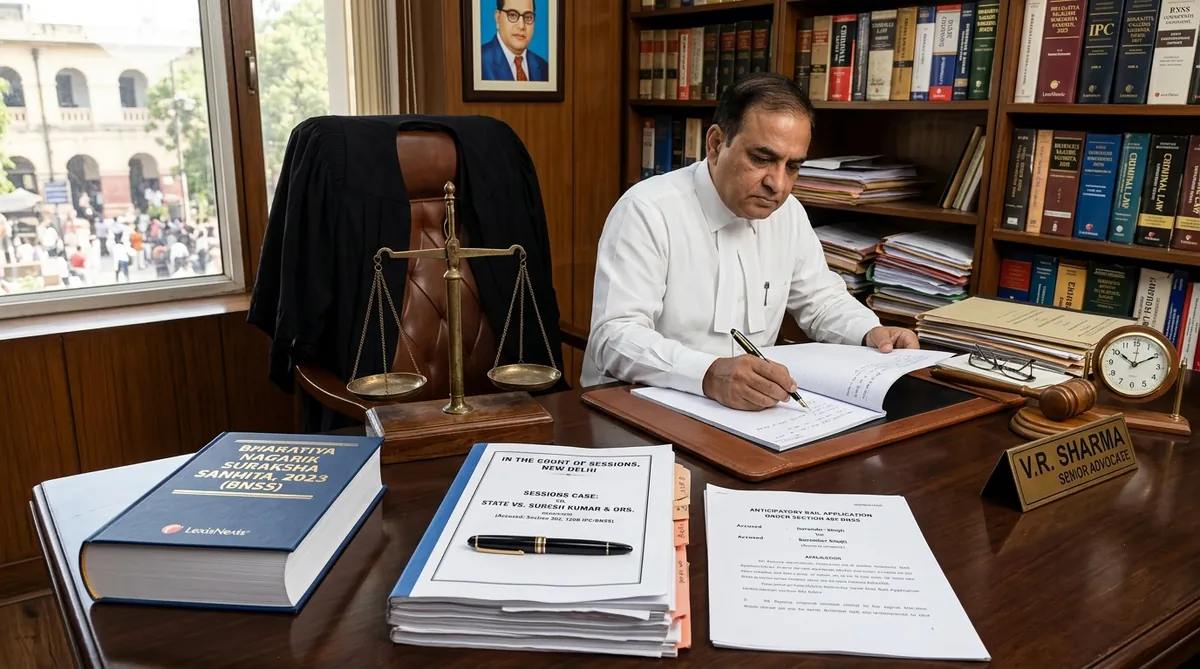
The Bharatiya Nagarik Suraksha Sanhita, 2023 (BNSS) has completely restructured Indian criminal procedure, replacing the Code of Criminal Procedure, 1973 (CrPC) with modern forensic mandates, revised remand timelines, structured bail categories, digitized trial summons, and strict inquiry deadlines. In modern criminal defence practice across Delhi NCR, Haryana, and the High Courts, defending an accused person requires an exhaustive operational mastery of statutory transformations, forensic safeguards under Section 105, arrest protections under Section 35, and authoritative Supreme Court constitutional benchmarks.
1. The Constitutional & Procedural Architecture of BNSS 2023
The enactment of the Bharatiya Nagarik Suraksha Sanhita, 2023 (BNSS) marks a historic turning point in Indian criminal jurisprudence, repealing and replacing the half-century-old Code of Criminal Procedure, 1973 (CrPC). Effective from July 1, 2024, BNSS fundamentally recalibrates the relationship between the investigative machinery of the State, the supervisory authority of the Magistracy, and the fundamental right to personal liberty guaranteed under Articles 20, 21, and 22 of the Constitution of India.
While the core procedural trajectory—spanning investigation, remand, bail, charge-framing, trial, and appeal—remains recognizably rooted in Anglo-Indian common law traditions, the BNSS incorporates structural innovations designed to integrate electronic forensics, expedite trial timelines, curb arbitrary arrests, and address systemic undertrial detention.
Criminal defence practitioners across the District Courts of Delhi NCR (including Faridabad, Gurugram, Gautam Buddha Nagar), High Courts, and the Supreme Court must navigate an intricate matrix of new statutory timelines, mandatory electronic recordings under Section 105, restructured police remand windows under Section 187, reformed bail thresholds under Sections 479 and 482, and expanded discharge provisions.
In this definitive master treatise, Advocate Kishan Kumar provides a comprehensive, section-by-section operational roadmap for defending individuals and corporate entities accused of cognizable penal offences under the Bharatiya Nyaya Sanhita, 2023 (BNS) and specialized economic and criminal enactments.
2. FIR Registration Dynamics: Zero FIR, Online E-FIR & Section 173(3) Preliminary Inquiry
Under Section 173 BNSS (the statutory successor to Section 154 CrPC), the registration of a First Information Report (FIR) has undergone significant legislative codification. For decades, the concept of a "Zero FIR"—an FIR registered by a police station irrespective of whether the territorial jurisdiction over the place of crime lay within its limits—existed purely as an administrative directive under executive circulars and judicial precedent (Lalita Kumari v. Govt. of U.P.). Section 173(1) BNSS now statutorily obligates every Station House Officer (SHO) across India to register a Zero FIR upon receiving information disclosing a cognizable offence.
The statutory transfer mandate is strict: once a Zero FIR is registered, the receiving police station must transfer the electronic and physical case docket to the jurisdictional police station within twenty-four (24) hours. This eliminates jurisdictional refusals that historically prejudiced victims of urgent offences.
Preliminary Inquiry under Section 173(3) BNSS: In a major statutory development, the BNSS formally authorizes police officers to conduct a preliminary inquiry prior to FIR registration for offences punishable with imprisonment for a term of three (3) years or more but less than seven (7) years. The inquiry must be conducted with the prior approval of an officer not below the rank of Deputy Superintendent of Police (DSP) or Assistant Commissioner of Police (ACP), and must be concluded within a strict statutory deadline of fourteen (14) days.
Defence Strategy during Preliminary Inquiry: The 14-day preliminary inquiry window provides an invaluable procedural opportunity for defence counsel. When a commercial client, family member, or professional faces a retaliatory or fabricated criminal complaint, defence advocates can submit a formal Written Representation accompanied by certified exculpatory evidence—such as bank transaction statements, registered sale deeds, WhatsApp exports complying with Section 63 BSA, or CCTV footage—to demonstrate that the dispute is purely civil, commercial, or matrimonial, thereby preventing FIR registration at the inception.
3. Section 35 BNSS: Statutory Arrest Protections & Notice of Appearance Protocol
The deprivation of personal liberty through police arrest is the most drastic exercise of State executive power. Section 35 BNSS (which consolidates and strengthens erstwhile Section 41 and Section 41A CrPC) establishes a rigorous statutory regime governing when a police officer may arrest without a warrant and when they are legally prohibited from doing so.
Under Section 35(3) BNSS, where the commission of an offence is punishable with imprisonment for a term which may be less than seven years or which may extend to seven years (whether with or without fine), the police officer SHALL issue a formal Notice of Appearance directing the suspect to appear before the investigating officer at a specified date and time.
The Statutory Immunity from Arrest: Section 35(4) and (5) BNSS provide that where the person to whom a notice is issued complies with the notice, appears before the police, and cooperates with the investigation, they CANNOT be arrested in respect of the offence mentioned in the notice, UNLESS the investigating officer records specific reasons in writing justifying that arrest is necessary (e.g. to prevent evidence tampering, intimidation of witnesses, or flight from justice) AND obtains prior judicial permission from the Magistrate.
Judicial Enforcement under Arnesh Kumar & Satender Kumar Antil: In the landmark judgments of Arnesh Kumar v. State of Bihar (2014) 8 SCC 273 and Satender Kumar Antil v. CBI (2022) 10 SCC 51, the Supreme Court ruled that compliance with Section 41A (now Section 35 BNSS) is a constitutional imperative under Article 21. Any police officer who arrests without complying with Section 35 is liable for departmental disciplinary proceedings and criminal contempt of court. Crucially, Magistrates who authorize routine judicial remand without independently verifying police compliance with Section 35 face judicial disciplinary inquiries.
4. Section 187 BNSS: Staggered Police Custody Remand Dynamics & Defence Opposition
One of the most consequential amendments introduced in the BNSS is the structural transformation of police custody remand under Section 187 (replacing Section 167 CrPC). Under the 1973 Code, police custody could only be sought and granted during the first 15 days immediately following the initial production of the accused before the Magistrate (as settled in CBI v. Anupam J. Kulkarni).
The Intermittent Remand Architecture: Section 187(3) BNSS fundamentally alters this principle by authorizing Judicial Magistrates to grant police custody of up to fifteen (15) days, in whole or in parts (staggered remand), at any time during the first forty (40) days (for offences carrying up to 10 years imprisonment) or during the first sixty (60) days (for offences carrying 10+ years, life imprisonment, or death) of the total 60-day or 90-day investigation window.
Tactical Defence Objections to Successive Remand: The possibility of intermittent police remand requires heightened vigilance from defence counsel. When police move an application for subsequent police custody after the accused has already been remanded to judicial custody, defence counsel must raise rigorous legal objections:
A. Inspection of Case Diary (Section 192 BNSS): Demand that the Magistrate examine the daily entries in the Case Diary to verify what specific investigation was conducted during the initial police custody and why the recovery could not be made earlier.
B. Bar Against Self-Incrimination (Article 20(3)): Argue that police custody cannot be granted merely for custodial interrogation to extract confessions or discover facts already within the knowledge of the investigating agency (Selvi v. State of Karnataka).
C. Absence of New Material: Demonstrate that no fresh incriminating facts or co-accused disclosures have arisen since the initial remand, rendering successive police custody an instrument of harassment.
5. Mandatory Electronic Recording of Search & Seizure under Section 105 BNSS
Section 105 of the BNSS introduces an unprecedented evidentiary safeguard: mandatory audio-video electronic recording during searches and seizures. Historically, police recovery memos (panchnamas) under Section 100 CrPC and Section 27 of the Evidence Act were notorious for being fabricated post-facto in police stations with stock recovery witnesses.
The Statutory Mandate: Under Section 105 BNSS, the entire process of conducting a search of any place or seizing any property, article, or document—including the preparation of the seizure list and the signatures of independent witnesses—MUST be captured via audio-video electronic recording, preferably using mobile phones or body-worn cameras. The investigating officer must transmit this electronic recording to the jurisdictional Magistrate without delay, and in any event within forty-eight (48) hours.
Trial Cross-Examination Impact: If the prosecution tenders physical weapons, currency, narcotics, or documents allegedly recovered from the accused without producing the contemporaneous Section 105 audio-video recording, defence counsel can mount a devastating cross-examination. The unexplained failure to record the search electronically violates mandatory statutory procedure, entitling the trial court to draw an adverse inference under Section 119 BSA and discard the recovery.
6. Anticipatory Bail Architecture under Section 482 BNSS: Strategic Pre-Arrest Protection
Anticipatory Bail under Section 482 BNSS (analogous to Section 438 CrPC) is an extraordinary equitable remedy designed to protect an innocent citizen from the ignominy, trauma, and reputational destruction of pre-trial arrest engineered by influential adversaries or overzealous police officers.
Jurisdictional Forum: An application under Section 482 BNSS can be moved before either the Court of Session or the High Court. Established practice in Haryana, Delhi NCR, and Punjab mandates approaching the Sessions Court first, unless exceptional circumstances (such as imminent threat of arrest or inter-state implications) justify directly invoking High Court jurisdiction.
Essential Parameters for Grant of Section 482 Bail: In the Constitution Bench landmarks of Gurbaksh Singh Sibbia v. State of Punjab (1980) 2 SCC 565 and Sushila Aggarwal v. State (NCT of Delhi) (2020) 5 SCC 1, the Supreme Court established that anticipatory bail should not be restricted by arbitrary time limits and should ordinarily continue till the conclusion of trial. The court evaluates: (1) The nature and gravity of the accusation; (2) The antecedents of the applicant, including previous non-bailable convictions; (3) The possibility of the applicant fleeing from justice; (4) The likelihood of the accusation being motivated by personal or commercial rivalry; and (5) The willingness of the applicant to join the investigation as and when summoned.
Structuring a Watertight Section 482 Petition: A successful anticipatory bail petition must include: (a) Clear narrative establishing the civil/commercial or matrimonial genesis of the dispute; (b) Direct refutation of specific role attributed to the applicant in the FIR; (c) Concrete proof of deep community roots (ownership of residential property, family ties, professional standing) eliminating flight risk; (d) Clean criminal antecedent certificate; and (e) An express undertaking under Section 482(2) BNSS to surrender passport and make oneself available for interrogation.
7. Regular Bail Jurisprudence under Sections 480 & 483 BNSS: Post-Arrest Liberty
When an accused has been arrested and remanded to custody, the remedy lies in filing a Regular Bail Application under Section 480 BNSS (before the Magistrate) or Section 483 BNSS (before the Sessions Court or High Court).
The Constitutional Philosophy of Bail: In the classic words of Justice V.R. Krishna Iyer in State of Rajasthan v. Balchand (1977) 4 SCC 308, reaffirmed in Sanjay Chandra v. CBI (2012) 1 SCC 40 and Manish Sisodia v. Directorate of Enforcement (2024), the fundamental rule of Indian criminal justice is "Bail is the Rule, Jail is the Exception". Pre-trial incarceration cannot be converted into pre-trial punishment.
Key Grounds for Securing Regular Bail:
A. Completion of Investigation: Once the police chargesheet has been filed under Section 193 BNSS, custodial interrogation is no longer required, and all primary evidence is in judicial custody.
B. Doctrine of Parity: If co-accused persons who played an identical or more severe role have been enlarged on bail by the High Court or Sessions Court, the applicant is constitutionally entitled to parity under Article 14 (Ramesh Bhavan Rathod v. Vishanbhai Hirabhai Makwana).
C. Prolonged Undertrial Incarceration & Speedy Trial Right: In cases involving voluminous witnesses where trial conclusion is not foreseeable in the near future, prolonged incarceration violates the fundamental right to a speedy trial under Article 21 (Union of India v. K.A. Najeeb).
D. Medical Emergency & Vulnerable Accused: Section 480(1) proviso explicitly provides special dispensation for persons under sixteen years of age, women, or persons who are sick or infirm.
8. Statutory Default Bail (Section 187(5)) & Landmark Undertrial Relief (Section 479 BNSS)
Default Bail as an Indefeasible Fundamental Right: Under Section 187(5) BNSS (erstwhile Section 167(2) CrPC), if the investigating agency fails to complete the investigation and file the police report (chargesheet) within sixty (60) days (for offences carrying up to 10 years imprisonment) or ninety (90) days (for offences carrying 10+ years, life imprisonment, or death), the accused acquires an indefeasible right to Default Bail.
The Right Accrues Automatically: In Bikramjit Singh v. State of Punjab (2020) 10 SCC 616 and M. Ravindran v. Directorate of Revenue Intelligence (2021) 2 SCC 485, the Supreme Court settled that the moment the 60/90 days period expires at 12:00 midnight without a chargesheet on record, the accused is entitled to release upon offering bail bonds. The subsequent filing of a chargesheet after the bail application is moved cannot defeat this fundamental right.
Revolutionary Undertrial Relief for First-Time Offenders (Section 479 BNSS): Section 479 BNSS introduces a groundbreaking reform. Where a first-time offender (a person who has never been previously convicted of any offence) has undergone detention for a period extending to one-third (1/3rd) of the maximum period of imprisonment specified for that offence, the court SHALL release them on personal bond. For repeat undertrials, the threshold remains one-half (1/2) the maximum term. Furthermore, Section 479(3) places a statutory duty upon the Jail Superintendent to directly apply to the court for the release of such eligible undertrials.
9. Pre-Charge Judicial Sifting & Discharge Strategy under Section 250 & 262 BNSS
The stage of framing charges is the primary judicial filter in criminal trials. It prevents innocent persons from undergoing the agony, expenditure, and humiliation of a multi-year trial based on groundless or malicious police chargesheets. Under Section 250 BNSS (for warrant cases instituted on police reports before Magistrates) and Section 262 BNSS (for trials before the Court of Session), the accused has a statutory right to seek Discharge.
The Judicial Standard of Scrutiny: In Union of India v. Prafulla Kumar Samal (1979) 3 SCC 4, Sajjan Kumar v. CBI (2010) 9 SCC 368, and Dipakbhai Jagdishchandra Patel v. State of Gujarat (2019) 16 SCC 547, the Supreme Court laid down the authoritative principles governing discharge: (1) The Judge has the undoubted power to sift and weigh the evidence for the limited purpose of finding out whether or not a prima facie case against the accused has been made out; (2) Where the materials placed before the court disclose grave suspicion against the accused which has not been properly explained, the court will frame charges; (3) But if the materials disclose mere suspicion, as distinguished from grave suspicion, the court MUST discharge the accused.
Strategic Grounds for Securing Discharge:
A. Failure to Establish Statutory Ingredients: Demonstrating that even if every allegation in the chargesheet is accepted as true, the essential ingredients of the penal offence (e.g. dishonest intention at inception for Section 318 BNS cheating, or entrustment of property for Section 316 BNS breach of trust) are missing.
B. Absence of Mandatory Prosecution Sanction: Where the accused is a public servant or government officer, failure to obtain prior sanction under Section 218 BNSS (Section 197 CrPC) renders the entire prosecution non-est.
C. Bar of Limitation: Demonstrating that cognizance was taken beyond the statutory period of limitation prescribed under Section 514 BNSS (Section 468 CrPC).
D. Exculpatory Documents of Sterling Quality: Under the doctrine in Nitya Dharmananda v. Gopal Sheelum Reddy (2018) 2 SCC 93, unimpeachable public records (such as court orders, registered deeds, or official government logs) withheld by the police can be relied upon by the defence at the stage of discharge.
10. The Trial Blueprint: Witness Cross-Examination Tactics & Section 351 BNSS Statement
When charges are framed, the prosecution bears the unyielding burden of proving guilt beyond reasonable doubt. The defence strategy must be meticulously executed across all trial phases:
Phase 1: Cross-Examination of Prosecution Witnesses (PWs): Under Section 140 of the Bharatiya Sakshya Adhiniyam, 2023 (BSA), cross-examination is the ultimate test of testimonial veracity. Essential cross-examination strategies include:
- Confrontation with Prior Inconsistent Statements: Under Section 148 BSA, confront eye-witnesses and complainants with material omissions and contradictions in their police statements recorded under Section 180 BNSS (Section 161 CrPC). Prove that critical allegations in court were never mentioned to the police during the initial investigation.
- Exposing Motive & Enmity: Establish underlying property disputes, commercial debts, or political rivalry that motivated the false complaint.
- Medical vs Ocular Conflict: Cross-examine the medical doctor (forensic expert) to demonstrate that the injuries described in the Medico-Legal Certificate (MLC) could not have been caused by the alleged weapon or manner described by the complainant.
Phase 2: Recording the Accused Statement under Section 351 BNSS (Section 313 CrPC): This is a crucial constitutional moment where the court puts all incriminating circumstances to the accused. The answers must be prepared with precision. The defence must give a coherent, complete narrative explaining false implication, reserve defence evidence, and avoid giving evasive single-word replies.
Phase 3: Leading Defence Evidence (DWs): Where the defence relies on an alibi (plea of alibi under Section 9 BSA), private defence (Sections 34–44 BNS), or specialized technical evidence, defence witnesses must be produced with certified documentary proof (such as flight boarding passes, hotel registers, or biometric logs).
11. High Court Quashing under Section 528 BNSS & Landmark Precedents
Section 528 BNSS preserves the plenary, inherent jurisdiction of the High Court to make such orders as may be necessary to prevent abuse of the process of any criminal court or otherwise to secure the ends of justice.
The Seven Bhajan Lal Quashing Benchmarks: In State of Haryana v. Bhajan Lal (1992) Supp (1) SCC 335, the Supreme Court formulated the classic categories where High Courts must quash FIRs:
1. Where allegations in the FIR, even if accepted at face value, do not prima facie constitute any offence;
2. Where allegations are so absurd and inherently improbable that no prudent person can reach a conclusion of sufficient ground for proceeding;
3. Where the criminal proceeding is manifestly attended with mala fides or maliciously instituted with an ulterior motive for wreaking vengeance;
4. Where there is an express statutory bar under the Code or special Act against institution of proceedings.
Quashing on Compromise (Gian Singh & Narinder Singh): Under Gian Singh v. State of Punjab (2012) 10 SCC 303 and Narinder Singh v. State of Punjab (2014) 6 SCC 466, High Courts possess the power to quash non-compoundable criminal proceedings arising out of commercial, civil, or matrimonial disputes where the parties have entered into a genuine, voluntary settlement and continuing the trial would be an oppressive exercise in futility.
12. Compounding of Offences (Section 359 BNSS), Victim Rights & Plea Bargaining
Compounding under Section 359 BNSS: Section 359 BNSS provides a detailed statutory table of offences compoundable by the victim/complainant without court permission, and offences compoundable with the leave of the trial court. Compounding operates as an immediate statutory acquittal of the accused under Section 359(8).
Plea Bargaining under Chapter XXI-A BNSS: For offences not punishable with death, life imprisonment, or imprisonment exceeding seven years, and not affecting the socio-economic conditions of the country or committed against women or children below fourteen years, the accused can invoke the formal Plea Bargaining process under Section 289 BNSS to negotiate a mutually satisfactory disposition, securing reduced sentences or probation without the uncertainty of trial.
Victim Compensation & Witness Protection: Section 396 BNSS strengthens the Victim Compensation Scheme, ensuring that trial courts recommend adequate compensation from state victim funds, while the Witness Protection Scheme, 2018 ensures that vulnerable trial witnesses receive security, identity protection, and safe transport to court.
13. Practical Courtroom Drafting Templates & Statutory Checklists
To assist trial practitioners and litigants, Advocate Kishan Kumar provides essential courtroom drafting checklists for key BNSS proceedings:
A. Essential Elements of a Section 482 BNSS Anticipatory Bail Petition: (1) Heading specifying Court of Session / High Court; (2) Description of FIR number, police station, and BNS sections; (3) Detailed paragraph setting out absence of any prior non-bailable convictions; (4) Demonstration of deep societal roots (Aadhaar, residential property ownership, dependents) eliminating flight risk; (5) Point-by-point rebuttal of allegations in the FIR; (6) Positive averment of willingness to join investigation under Section 35(3) BNSS; (7) Undertaking not to tamper with evidence or influence witnesses; (8) Specific prayer seeking interim protection and bail upon arrest.
B. Essential Elements of a Section 250 BNSS Discharge Application: (1) Specific grounds why the police report and documents under Section 193 BNSS fail to disclose grave suspicion; (2) Demonstration that essential statutory ingredients of the penal offence are completely missing; (3) Citation of binding Supreme Court precedents (Prafulla Kumar Samal and Sajjan Kumar); (4) Reliance upon unimpeachable public documents of sterling quality; (5) Prayer for discharge and release of bail sureties.
C. Essential Elements of an Application for Release of Property (Superdari under Section 503 BNSS): (1) Proof of absolute ownership (RC, invoice, insurance for seized vehicles); (2) Undertaking to produce the property whenever directed by the court; (3) Undertaking not to alter the color, engine number, or alienate the vehicle during trial; (4) Photographs of the property certified under Section 63 BSA.
Landmark Judicial Precedents
The Supreme Court laid down mandatory arrest safeguards for offences carrying up to 7 years imprisonment. Investigating officers must serve a Section 41A CrPC (now Section 35 BNSS) notice of appearance and record reasons before arrest. Violating police officers are subject to departmental action and contempt of court, and Magistrates authorizing mechanical remand face disciplinary scrutiny.
Established comprehensive categorization of offences (Categories A, B, C, D) for standardized bail adjudication. Ruled that for Category A offences (punishable up to 7 years), an accused who was not arrested during investigation and cooperated with Section 35 notices is entitled to bail upon filing of the chargesheet without issuing non-bailable warrants.
A 5-Judge Constitution Bench ruled that Anticipatory Bail under Section 438 CrPC (now Section 482 BNSS) should not be arbitrarily restricted to a predetermined time period and should ordinarily continue till the conclusion of the trial, unless exceptional circumstances warrant a time-limited grant.
The foundational Constitution Bench ruling establishing that personal liberty under Article 21 is of paramount importance and the statutory power to grant anticipatory bail must be exercised with broad judicial discretion without importing artificial fetters not created by Parliament.
Reaffirmed the classic doctrine of Justice V.R. Krishna Iyer: "Bail is the rule and jail is the exception". Pre-trial detention cannot be punitive, and liberty cannot be denied solely based on the alleged gravity of financial charges when the investigation is substantially complete.
The Supreme Court ruled that prolonged incarceration without trial due to voluminous documents and hundreds of witnesses violates the fundamental right to a speedy trial under Article 21, overriding stringent statutory bail bars.
Laid down foundational principles on judicial discharge: the Judge has the unquestionable power to sift and weigh the evidence for the limited purpose of determining whether a prima facie case has been made out. Mere suspicion is insufficient; grave suspicion is required to frame charges.
Formulated the seven definitive categories where High Courts must exercise inherent powers under Section 482 CrPC (now Section 528 BNSS) to quash frivolous, malicious, or legally untenable FIRs and trial proceedings.
Authoritative ruling establishing that High Courts can quash non-compoundable criminal proceedings involving private matrimonial, commercial, or civil disputes when the parties have reached an amicable out-of-court settlement.
Settled that the right to Default Bail under Section 167(2) CrPC (now Section 187(5) BNSS) is an indefeasible fundamental right under Article 21 that accrues the moment the 60/90-day investigation deadline expires without a chargesheet on record.
Established the parameters for the Doctrine of Parity in bail matters: an accused is entitled to claim parity with a co-accused who has been enlarged on bail if their roles, evidence, and criminal antecedents are substantially identical.
A 3-Judge Bench held that compulsory administration of narco-analysis, polygraph tests, or brain electrical activation profiles violates the protection against self-incrimination under Article 20(3) of the Constitution.
BNSS 2023 vs CrPC 1973 Criminal Defence Statutory Transformation Matrix
| Procedural Stage / Power | Former CrPC 1973 Provision | BNSS 2023 Provision | Criminal Defence Strategy & Operational Impact |
|---|---|---|---|
| Zero FIR & Territorial Jurisdiction | Informal police circulars | Section 173(1) BNSS | Mandatory registration across India; compulsory transfer to jurisdictional station within 24 hours. |
| Preliminary Inquiry | Judicial guidelines (Lalita Kumari) | Section 173(3) BNSS | 14-day statutory inquiry for 3–7 year offences; crucial window to submit exculpatory defence representations. |
| Notice of Appearance | Section 41A CrPC | Section 35(3) BNSS | Statutory immunity from arrest upon compliance; prior Magistrate approval mandatory for arrest. |
| Police Remand Staggering | Section 167(2) (First 15 days only) | Section 187(3) BNSS (Intermittent 40/60 days) | Police custody can be split in parts; requires rigorous case diary opposition on lack of new facts. |
| Mandatory Video Seizure | Ad-hoc / Discretionary | Section 105 BNSS (Mandatory) | Audio-video recording of search & panchnama mandatory; omission invalidates illegal police recoveries. |
| First-Time Offender Relief | Section 436A (Half sentence) | Section 479 BNSS (One-third sentence) | Statutory release on personal bond for undertrials serving 1/3rd of maximum prescribed sentence. |
| Discharge in Warrant Trials | Section 239 CrPC | Section 250 BNSS | Judicial duty to discharge before charges if allegations are groundless or based on mere suspicion. |
| Anticipatory Bail | Section 438 CrPC | Section 482 BNSS | Pre-arrest protection before Sessions & High Court; continues till conclusion of trial. |
| Regular Bail Powers | Sections 437 & 439 CrPC | Sections 480 & 483 BNSS | Post-arrest liberty based on parity, completion of chargesheet, medical grounds, and delay in trial. |
| Default Statutory Bail | Section 167(2) CrPC | Section 187(5) BNSS | Indefeasible right to bail upon expiry of 60/90 days investigation window without chargesheet. |
| Inherent High Court Quashing | Section 482 CrPC | Section 528 BNSS | Plenary power to quash malicious FIRs under Bhajan Lal or compromise settlements under Gian Singh. |
Criminal Investigation & Trial Statutory Limitation Matrix (Section 514 BNSS)
| Category of Penal Offence | Punishment Threshold | Limitation for Taking Cognizance | Key Defence Remedy |
|---|---|---|---|
| Fine Only Offences | Monetary Fine only | Six (6) Months | Bar of Cognizance under Section 514(2)(a) BNSS; immediate discharge. |
| Minor Offences | Imprisonment up to One (1) Year | One (1) Year | Bar of Cognizance under Section 514(2)(b) BNSS; challenge police report. |
| Medium Offences | Imprisonment from 1 to 3 Years | Three (3) Years | Bar of Cognizance under Section 514(2)(c) BNSS. |
| Serious Offences | Imprisonment exceeding 3 Years | No Statutory Limitation | Challenge on grounds of unconstitutional trial delay under Article 21 (Antil). |
Bail Application Category & Strategic Checklist Matrix
| Bail Classification | Statutory Section | Jurisdictional Forum | Critical Documentary Enclosures |
|---|---|---|---|
| Anticipatory Bail (Pre-Arrest) | Section 482 BNSS | Sessions Court / High Court | Clean antecedent affidavit, residence proof, Aadhaar, Section 35 notice compliance proof. |
| Interim Bail (Emergency) | Sections 480/482 Proviso | Magistrate / Sessions / High Court | Hospital admission records, medical board certificates, marriage invitations, examination slips. |
| Regular Bail (Post-Arrest) | Sections 480 & 483 BNSS | Magistrate / Sessions / High Court | Certified copy of Chargesheet (Sec 193), custody certificate, co-accused parity orders. |
| Default Bail (Statutory) | Section 187(5) BNSS | Judicial Magistrate / Special Court | Calculation chart of 60/90 days from remand, Court order sheets, ready bail bonds. |
Actionable Next Steps & Critical Legal Strategy
If you are navigating an active legal dilemma regarding this subject matter, execute these immediate procedural steps:
- Preserve Primary Documentary Proof: Assemble certified copies of title deeds, notices, bank statements, and electronic records with Section 63 BSA compliance.
- Adhere to Statutory Limitation Windows: File urgent applications before jurisdictional civil courts or tribunals before rights are extinguished.
- Engage Specialized Trial Counsel: Secure customized litigation strategies from experienced High Court and Sessions Court advocates.
Statutory Authorities & Legal References
- Governing statutory codes under Bharatiya Nyaya Sanhita (BNS 2023), Bharatiya Nagarik Suraksha Sanhita (BNSS 2023), Bharatiya Sakshya Adhiniyam (BSA 2023), or Code of Civil Procedure (CPC 1908).
- Relevant state rules, court fee schedules, and registration notifications issued by the Government of Haryana and Delhi NCR authorities.
- Binding judicial precedents of the Supreme Court of India and the High Court of Punjab & Haryana.
- Official e-Courts portal and National Judicial Data Grid (NJDG) procedural guidelines.
Frequently Asked Questions
Key statutory answers and procedural guidance curated by Senior Advocates in Faridabad & Delhi NCR.
What immediate legal steps should be taken when named in a non-bailable FIR under BNSS?
Immediately obtain a certified copy of the FIR. If the offence is punishable with imprisonment up to 7 years, prepare documentation to strictly comply with the Section 35 BNSS Notice of Appearance. If the offence carries grave non-bailable charges (7+ years or life imprisonment), immediately move an Urgent Anticipatory Bail Application under Section 482 BNSS before the Sessions Court before arrest is effected. Use our interactive BNS/BNSS Offence Finderto check bailable status and maximum penalties.
Can police arrest without issuing a Section 35 BNSS Notice?
No. For all offences carrying up to 7 years imprisonment, issuance of a Section 35 Notice is a mandatory statutory precondition under Arnesh Kumar and Satender Kumar Antil. Arrest without notice is strictly prohibited unless the investigating officer records written reasons that arrest is necessary to prevent flight risk or evidence tampering, AND obtains prior judicial approval from the Magistrate.
How does the staggered police custody remand under Section 187 BNSS work in practice?
Under Section 187(3) BNSS, Magistrates can grant up to 15 days of police custody in whole or in parts across the first 40 days (for offences carrying up to 10 years) or 60 days (for grave offences) of the investigation period. Defence counsel must aggressively oppose successive remand applications by demanding production of the Case Diary (Section 192 BNSS) and demonstrating that the police had ample opportunity during initial custody and no new discovery is warranted.
What happens if the police fail to record search and seizure on video under Section 105 BNSS?
Section 105 BNSS makes audio-video electronic recording of searches, seizures, and panchnamas mandatory. If police fail to record the seizure electronically or fail to submit the video to the Magistrate within 48 hours, defence counsel can challenge the recovery during trial cross-examination, leading to the exclusion of fabricated physical recoveries under Section 119 BSA.
What is the legal difference between Discharge under Section 250 BNSS and an Acquittal?
Discharge under Section 250 BNSS occurs before charges are framed because the judicial magistrate finds the allegations groundless or based on mere suspicion, terminating proceedings without a trial. Acquittal occurs after a full trial on merits when the prosecution fails to establish guilt beyond reasonable doubt.
Can a non-compoundable criminal case be settled out of court under BNSS?
Yes. While the trial Magistrate cannot compound non-compoundable offences under Section 359 BNSS, the High Court possesses the inherent power under Section 528 BNSS (Gian Singh v. State of Punjab) to quash non-compoundable FIRs and criminal trials if the dispute is personal, commercial, or matrimonial and the parties have executed a formal settlement deed.
How is Default Statutory Bail calculated under Section 187(5) BNSS?
The 60-day or 90-day period begins on the day the accused is first remanded to custody by the Magistrate (excluding the date of police arrest). If the police fail to file the completed police report under Section 193 BNSS by the 60th/90th day at 12:00 midnight, the accused acquires an automatic right to default bail (Bikramjit Singh). Use our Limitation Calculatorto verify exact deadlines.
What are the revolutionary undertrial rights for first-time offenders under Section 479 BNSS?
Section 479 BNSS mandates that where a first-time offender (someone with no prior convictions) has undergone detention for a period extending to one-third (1/3rd) of the maximum imprisonment prescribed for the offence, the court SHALL release them on personal bond. The Jail Superintendent is statutorily obligated to move this application directly.
What should an accused do if a Non-Bailable Warrant (NBW) is issued by a Magistrate?
Immediately instruct counsel to inspect the court order sheet to verify whether summons and bailable warrants were properly served. Move an urgent Application for Cancellation of Non-Bailable Warrant under Section 72 BNSS (Section 70(2) CrPC) along with an undertaking to appear on every trial date and furnish surety bonds (Inder Mohan Goswami v. State of Uttaranchal).
How does Plea Bargaining work under Chapter XXI-A BNSS?
An accused facing charges carrying up to 7 years imprisonment (not involving offences against women or children below 14) can file a voluntary application for Plea Bargaining before the trial court under Section 289 BNSS. The court supervises a mutually satisfactory disposition, awarding reduced sentences, fines, or probation under the Probation of Offenders Act without full trial.