
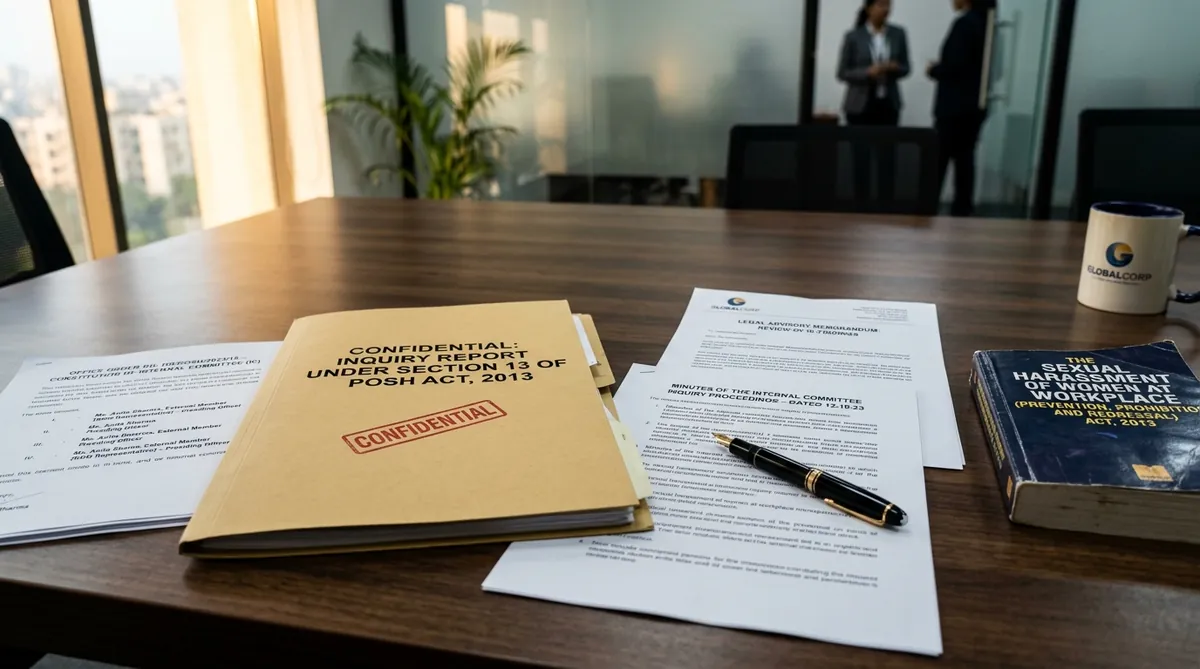
The Sexual Harassment of Women at Workplace (Prevention, Prohibition and Redressal) Act, 2013 (POSH Act) is a progressive, gender-affirmative enactment crafted to dismantle patriarchal toxicity and guarantee safe working environments for women under Articles 14, 19, and 21 of the Constitution.
However, the immense socio-legal power wielded by the POSH framework also creates the potential for weaponization. Disgruntled employees, individuals facing performance improvement plans (PIPs), or corporate rivals occasionally file fabricated or vindictive sexual harassment complaints to settle professional grudges or thwart disciplinary oversight. When an employee endures months of traumatic scrutiny only to be fully exonerated by the Internal Committee (IC), what statutory protections and legal remedies exist to repair their shattered reputation, recover career trajectory, and hold malicious actors accountable? This treatise examines Section 14 of the POSH Act, tortious remedies for defamation, and corporate rehabilitation protocols for exonerated personnel.
Section 14 of the POSH Act 2013 penalizes false or malicious sexual harassment complaints and forged evidence, recommending service rule disciplinary action against malicious complainants. However, mere failure to substantiate an allegation does not constitute malice. Exonerated employees may additionally pursue civil defamation suits and criminal remedies for fabricated workplace proceedings.
1. The Statutory Architecture of Section 14: Penalizing Malice
Recognizing that false allegations could undermine the credibility of genuine victims, Parliament embedded a specific deterrent mechanism under Section 14 of the POSH Act:
"Where the Internal Committee arrives at a conclusion that the allegation against the respondent is malicious or the aggrieved woman or any other person making the complaint has made the complaint knowing it to be false, or the aggrieved woman or any witness has produced any forged or misleading document, it may recommend to the employer to take action against the woman or the person who made the complaint... in accordance with the provisions of the service rules."
The Crucial Statutory Provisos
To ensure Section 14 is not weaponized to intimidate genuine victims whose complaints cannot be proved due to lack of witnesses, the statute incorporates two rigorous safeguards:
- Inability to Substantiate Is Not Malice: Proviso 1 explicitly mandates that mere inability to substantiate a complaint or provide adequate proof shall not attract action under this section. There is a vast legal gulf between a complaint that fails for want of corroborative evidence and a complaint demonstrated to be knowingly false and fabricated.
- Mandatory Due Process Before Penalizing Complainant: Proviso 2 requires that malicious intent on the part of the complainant can only be established after a formal inquiry held in accordance with the prescribed procedure, ensuring the complainant is heard before being penalized.
2. Judicial Interpretation: The Anita Suresh Ruling and High Evidentiary Bar
The application of Section 14 and judicial sanctions against frivolous complaints received authoritative treatment from the Delhi High Court in Anita Suresh v. Union of India & Ors. (2019) SCC OnLine Del 9037:
The Constitution Bench established the landmark principles governing the abolition and absorption of contract labour under the Contract Labour (Regulation and Abolition) Act, 1970. The Court held that mere issuance of a notification prohibiting contract labour under Section 10 does not lead to automatic absorption; however, where the contract arrangement is found to be a sham or camouflage to deny statutory benefits, the industrial adjudicator is fully empowered to direct regular employment.
The petitioner had filed a sexual harassment complaint against an employee, which was dismissed by the IC as entirely unsubstantiated. Upon reviewing the record, the High Court observed that the petitioner had filed a vague, uncorroborated complaint without providing any date, time, or specific context, solely to settle administrative grievances.
"The High Court held: 'The POSH Act is meant to provide protection to women at workplaces, but it cannot be permitted to be used as a tool to harass, blackmail, or victimize colleagues.' Finding the petition entirely vexatious, the Delhi High Court imposed exemplary costs of Rs. 50,000 on the complainant."
However, courts consistently reiterate that the burden of proving malice under Section 14 rests squarely on the respondent, who must demonstrate deliberate falsehood, fabrication of electronic records, or a demonstrable conspiracy to harm.
3. Post-Exoneration Legal Remedies Available to Exonerated Employees
When an employee secures a clean exoneration accompanied by an explicit finding of malice by the IC, multiple legal remedies become operative:
1. Disciplinary Action Under Internal Service Rules
Following an IC recommendation under Section 14, the employer must initiate formal disciplinary proceedings against the malicious complainant under corporate service rules or certified standing orders, which may culminate in written reprimand, demotion, suspension, or termination of employment.
2. Civil Suit for Defamation and Tortious Damages
An exonerated employee has the right to institute a civil suit before a competent Civil Court claiming unliquidated damages for defamation and injury to reputation under the Law of Torts. While complaints made before an IC enjoy qualified privilege, that privilege is completely destroyed upon proof of actual malice (mala fides).
3. Criminal Prosecution for False Charges and Defamation
The exonerated employee may initiate criminal proceedings:
- Criminal Defamation: Under Section 499 and 500 IPC (now Section 356 of Bharatiya Nyaya Sanhita, 2023);
- Fabricating False Evidence: Under Section 193 and 195 IPC for fabricating misleading documents before a quasi-judicial body;
- False Charge with Intent to Injure: Under Section 211 IPC (now Section 248 BNS) where a false formal police complaint was registered.
4. Corporate Rehabilitation: Repairing Reputation and Career Trajectory
Even after complete exoneration, the "stigma of suspicion" can severely cripple an executive's professional standing, client relationships, and peer interactions. Progressive corporate governance demands a structured rehabilitation framework:
- Formal Exoneration Letter: Management must issue an unambiguous written exoneration certificate confirming that all allegations were investigated and found baseless, clearing the employee's internal personnel record.
- Neutralization of Appraisal Biases: Ensure performance ratings, increments, and pending promotions frozen during the pendency of the inquiry under Section 12 are retrospectively restored with full back-pay adjustments.
- Confidentiality Enforcement (Section 16): Strictly enforce Section 16 POSH prohibitions against internal gossip or publishing details of the inquiry, penalizing colleagues who perpetuate harassment against the exonerated individual.
- Optional Team Realignment: Where working in close proximity with former witnesses causes friction, facilitate lateral team transfers without any diminution in role, stature, or compensation.
5. Comparative Jurisprudence: Malice Remedies Across Common Law Jurisdictions
Understanding how foreign jurisdictions balance protection for complainants with remedies against fabricated allegations provides useful guidance for Indian courts:
International Harassment Framework Comparison
| Jurisdiction | Statutory Redressal Mechanism | Remedies for Fabricated Complaints |
|---|---|---|
| India (POSH Act 2013) | Internal Committee (IC) with Civil Court discovery powers | Section 14 service rule sanctions; tortious civil defamation damages; Section 499 IPC / 356 BNS. |
| United States (Title VII) | Equal Employment Opportunity Commission (EEOC) & Federal Courts | Severe anti-retaliation protections; common law tort of malicious prosecution and defamation where actual malice is proven. |
| United Kingdom (Equality Act 2010) | Employment Tribunals adjudicating harassment claims | Section 27(3) denies victimisation protection if allegations are made in bad faith; employer disciplinary dismissal of bad-faith accusers. |
6. Defense Strategy: Preserving Evidence against Fabricated Charges
Employees confronting false or retaliatory POSH allegations must adopt a rigorous evidentiary defense:
- Forensic Electronic Archiving: Immediately archive all official and informal electronic communications (Slack, WhatsApp, emails, calendars, building access logs) with the complainant to demonstrate professional context and absence of harassment.
- Establish Contemporaneous Retaliation Motive: Document any negative performance reviews, audit queries, or disciplinary actions initiated by the respondent against the complainant immediately preceding the POSH complaint.
- Insist on Certificate under Section 65B: Challenge all digital screenshots produced by the complainant, demanding statutory certification under Section 65B of the Indian Evidence Act (now Section 63 BSA 2023) to eliminate manipulated chat logs.
- Document Section 14 Grounds During Hearings: Specifically request the IC to examine the deliberate falsity of the statements and incorporate Section 14 findings in the final inquiry report.