
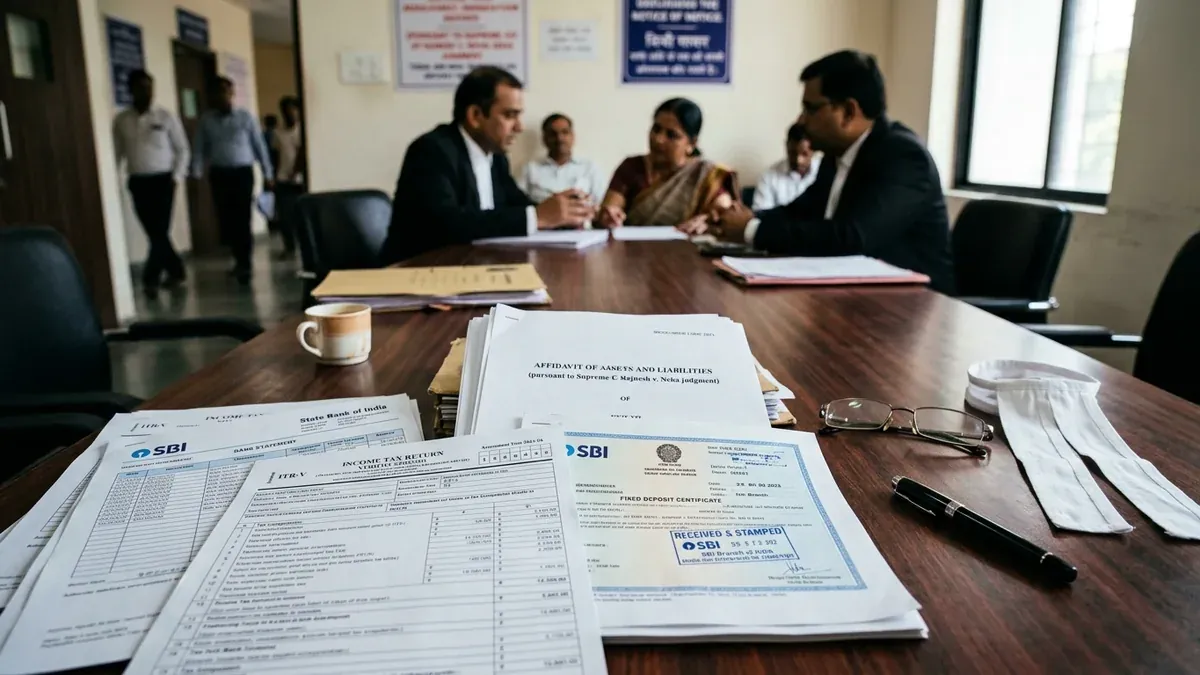
Maintenance and permanent alimony disputes represent the most bitterly contested financial battlefield in Indian matrimonial litigation. Spouses routinely engage in elaborate games of financial hide-and-seek: wives demanding exorbitant maintenance citing astronomical lifestyles, while husbands conceal corporate shareholdings, suppress tax returns, and claim meager salaries to artificially minimize maintenance liabilities.
To end this chaotic evidentiary vacuum, the Supreme Court of India delivered a monumental judgment in Rajnesh v. Neha (2021 2 SCC 324), supplemented by Aditi alias Mita v. Jitesh Sharma (2023). The Supreme Court framed a comprehensive, mandatory Affidavit of Assets and Liabilities that both spouses must file under oath, standardizing the judicial formula for interim and final maintenance across all statutes.
In Rajnesh v. Neha, the Supreme Court mandated that both spouses must file detailed Affidavits of Assets and Liabilities to determine maintenance. Courts generally award 20% to 30% of the husband's net disposable income, considering standard of living, dependent parents, reasonable living expenses, and earning capacity of both parties.
1. The Mandatory Affidavit of Assets and Liabilities
Under Rajnesh v. Neha, every maintenance application filed under Section 144 BNSS (Section 125 CrPC), Section 24 HMA, or the Domestic Violence Act must be accompanied by a sworn affidavit disclosing exhaustive financial details across three enclosures:
- Personal and Lifestyle Details: Educational qualifications, employment history, residential status, and details of dependent family members.
- Income and Financial Assets: Income Tax Returns (ITR) for the last 3 years, salary slips with Form 16, audited balance sheets of private limited companies, bank statements of all active accounts for the last 3 years, and details of mutual funds, fixed deposits, demat holdings, and digital crypto assets.
- Real Estate and Liabilities: Immovable residential/commercial properties owned individually or jointly, motor vehicles, home loans, credit card debts, and monthly household expenses.
Filing a false or suppressed affidavit triggers immediate perjury prosecution under Section 215 BNSS / Section 340 CrPC.
2. The Mathematical Apportionment Formula
While no statutory percentage is fixed, the Supreme Court in Kalyan Dey Chowdhury v. Rita Dey Chowdhury Nee Nandy (2017 14 SCC 200) established the standard judicial apportionment formula:
"25% of the husband's net salary is considered a just and reasonable award for maintenance to the wife. Net disposable income is computed after deducting statutory taxes, mandatory GPF/EPF contributions, and reasonable medical expenses of elderly dependent parents."
If minor children reside with the mother, courts generally award 30% to 40% of the husband's net income to ensure the child continues to enjoy the same educational and social standard of living as if the family had remained together.
3. Adjustments for Overlapping Maintenance Orders
Before Rajnesh v. Neha, wives frequently obtained separate, conflicting maintenance awards across Section 125 CrPC, Section 24 HMA, and Section 20 DV Act. The Supreme Court ruled:
- A claimant must disclose all previous maintenance orders in every subsequent application.
- The subsequent court must adjust or set off the amount awarded in previous proceedings, ensuring the husband is not subjected to cumulative, double payments.
- Maintenance must be awarded from the date of filing of the application, not from the date of the judicial order.
Landmark Judicial Precedents & Statutory Authorities
Courts and appellate tribunals across Delhi NCR (Faridabad, Saket, Tis Hazari, Gurugram, High Courts) strictly apply these authoritative Supreme Court benchmarks:
The Supreme Court mandated comprehensive procedural guidelines across all maintenance proceedings in India (Section 125 CrPC / Section 144 BNSS, DV Act, HMA Section 24), requiring both spouses to file comprehensive Affidavits of Assets and Liabilities. The Bench established that maintenance must be awarded from the date of application to prevent procedural delays from prejudicing dependent spouses and minor children.