
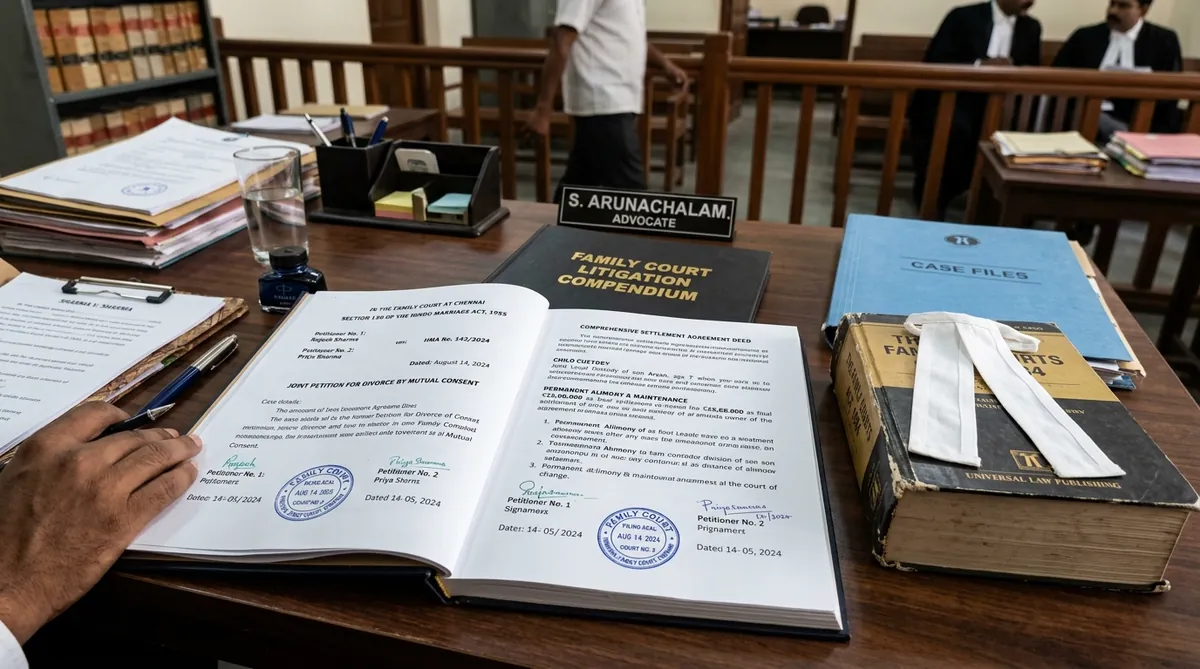
Under the Hindu Marriage Act, 1955 and other personal family laws in India, divorce is founded largely on the "fault theory"—requiring one spouse to prove specific grounds such as cruelty, adultery, or desertion—or the "mutual consent theory" under Section 13B. Notably, Irretrievable Breakdown of Marriage (IBM) has never been enacted by Parliament as a statutory ground for divorce. Consequently, thousands of couples remain trapped in dead marriages for decades where one spouse arbitrarily withholds consent out of spite.
To bridge this severe legislative void and do "complete justice," the Supreme Court of India exercises its extraordinary constitutional powers under Article 142 of the Constitution of India. In a historic 5-judge Constitution Bench ruling in Shilpa Sailesh v. Varun Sreenivasan (2023 SCC OnLine SC 544), the apex court reaffirmed that it can dissolve a dead marriage on the ground of irretrievable breakdown, bypassing statutory waiting periods and contested trial delays.
Under Article 142 of the Constitution, the Supreme Court possesses plenary power to dissolve a marriage on the ground of irretrievable breakdown. Following the Constitution Bench ruling in Shilpa Sailesh, the apex court can grant immediate divorce without relegating exhausted parties to protracted Family Court trials or statutory delays.
1. Constitutional Scope of Article 142 in Matrimonial Law
Article 142(1) of the Constitution empowers the Supreme Court to pass any decree or order necessary for doing "complete justice" in any cause or matter pending before it. In Shilpa Sailesh, the Constitution Bench held:
"The Supreme Court can grant a decree of divorce by mutual consent without following the procedural requirement of Section 13-B of the Hindu Marriage Act... and can also dissolve a marriage by granting a decree of divorce on the ground of irretrievable breakdown of marriage, even if one party opposes the divorce."
This power is exclusive to the Supreme Court; High Courts and Family Courts do not possess inherent jurisdiction to dissolve marriages on the ground of irretrievable breakdown.
2. Crucial Factors Evaluated by Supreme Court in IBM Petitions
The Supreme Court does not grant divorce under Article 142 mechanically. The Constitution Bench formulated rigorous factors that must be evaluated:
The Supreme Court reaffirmed the three mandatory golden tests for grant of interlocutory injunctions under Order XXXIX Rules 1 and 2 of the Code of Civil Procedure: (i) strong prima facie case, (ii) balance of convenience tilted in applicant's favor, and (iii) imminent threat of irreparable injury not compensable in monetary damages. The Court held that temporary relief cannot be granted mechanically without judicial application of mind.
- Duration of Separation: The period of time the parties had cohabited after marriage compared with the duration of physical separation (typically, separation exceeding 5 to 10 years).
- Nature and Extent of Litigation: The number of criminal complaints (Section 498A/85 BNS, Domestic Violence Act), civil suits, and maintenance disputes filed between the spouses.
- Attempts at Reconciliation: Whether multiple mediation proceedings before mediators, elders, or court-annexed centers have failed conclusively.
- Emotional and Physical Estrangement: Proof that the emotional bond is dead, cohabitation is unviable, and continuing the legal tie amounts to mental cruelty.
- Economic Security for Wife & Children: Guaranteeing fair and equitable permanent alimony, housing provision, and child maintenance.
3. Complete Closure of All Pending Inter-Spousal Criminal FIRs
One of the greatest benefits of invoking Article 142 before the Supreme Court is comprehensive closure. In exercise of its plenary powers, the Supreme Court simultaneously quashes all collateral cases pending across different states—including Section 85 BNS / 498A IPC FIRs, Section 12 DV Act proceedings, Section 144 BNSS / 125 CrPC maintenance petitions, and restitution suits—bringing total, irreversible finality to the litigation.