
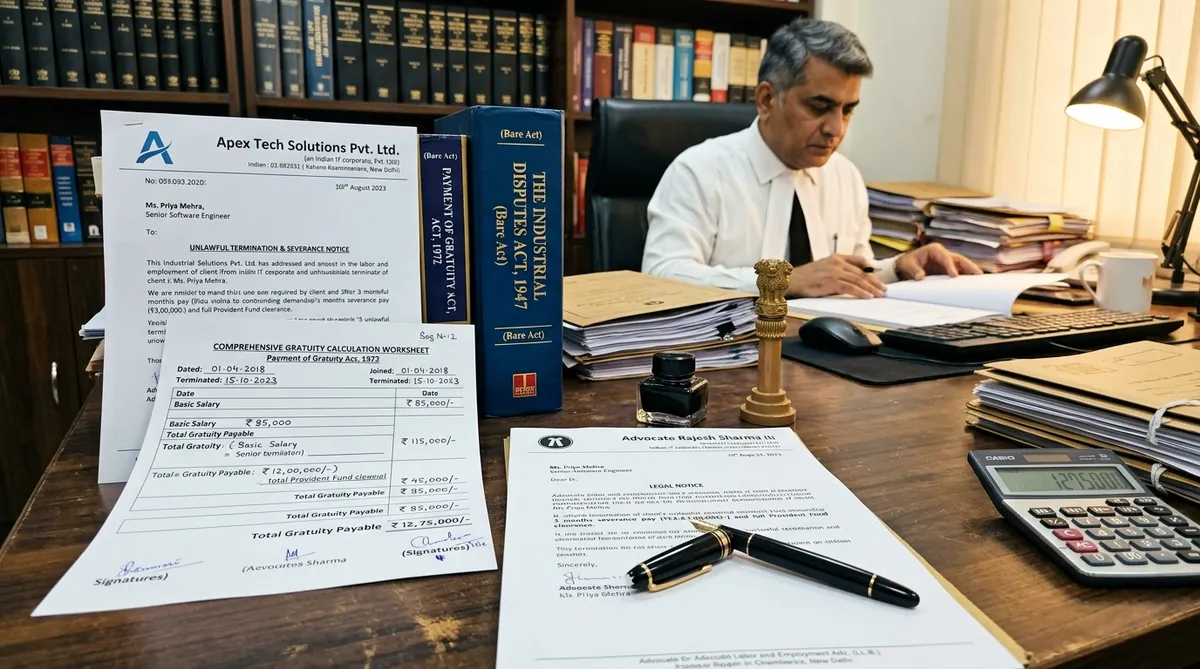
Under Indian industrial jurisprudence, the power of an employer to terminate the services of an employee is severely circumscribed by social welfare legislation. The notion of "at-will employment"—where an employer can dismiss an employee without cause simply by issuing a contractual notice pay—has no place in Indian labour law as applied to any employee falling within the definition of a "workman".
The core statutory bulwark protecting workmen against arbitrary termination is Section 25F of the Industrial Disputes Act, 1947 (IDA). Section 25F lays down three mandatory statutory conditions precedent that must be strictly, simultaneously, and flawlessly fulfilled prior to or at the exact moment of termination. A failure to comply with even the most minute procedural requirement renders the termination void ab initio in the eyes of the law, entitling the workman to reinstatement with full back wages under the Supreme Court's landmark doctrine in Deepali Gundu Surwase (2013). This treatise provides an exhaustive analysis of Section 25F, the expansive definition of retrenchment under Section 2(oo), continuous service calculations, and Labour Court litigation strategies.
Section 25F of the Industrial Disputes Act 1947 establishes mandatory conditions precedent for retrenching any workman with one year continuous service: one month written notice or wages in lieu, fifteen days average pay per completed year of service, and notice to government authorities. Non-compliance renders the termination void ab initio.
1. The Expansive Meaning of "Retrenchment": Section 2(oo) and Sundara Money
To determine whether Section 25F applies, one must first analyze the definition of "retrenchment" under Section 2(oo) of the Industrial Disputes Act:
"'Retrenchment' means the termination by the employer of the service of a workman for any reason whatsoever, otherwise than as a punishment inflicted by way of disciplinary action, but does not include: (a) voluntary retirement; (b) retirement on reaching superannuation; (bb) termination resulting from non-renewal of employment contract upon expiry; or (c) termination on the ground of continued ill-health."
The Monumental *State Bank of India v. N. Sundara Money* Precedent
In the historic verdict State Bank of India v. N. Sundara Money (1976) 1 SCC 822, a Constitution Bench headed by Justice V.R. Krishna Iyer laid down the definitive interpretation of the phrase "for any reason whatsoever":
- Termination for Any Reason: Retrenchment is not confined to cases of surplus labour or economic downsizing. Any termination of a workman's service—whether by discharge, termination of temporary engagement, automatic cessation under appointment terms, or failure to pass a probation test—amounts to retrenchment unless covered by the four express statutory exceptions.
- Words of Absolute Generality: Justice Krishna Iyer observed: "A termination takes place where a term expires either by active discharge or by passive flow of time. Whatever the reason, every termination is retrenchment."
2. The Three Mandatory Conditions Precedent Under Section 25F
Section 25F governs the retrenchment of any workman employed in any industry who has been in continuous service for not less than one year. The section establishes three inviolable conditions precedent:
The Constitution Bench established the landmark principles governing the abolition and absorption of contract labour under the Contract Labour (Regulation and Abolition) Act, 1970. The Court held that mere issuance of a notification prohibiting contract labour under Section 10 does not lead to automatic absorption; however, where the contract arrangement is found to be a sham or camouflage to deny statutory benefits, the industrial adjudicator is fully empowered to direct regular employment.
Condition 1: One Month's Written Notice or Wages in Lieu (Section 25F(a))
The workman must be given one month's notice in writing indicating the precise reasons for retrenchment, and the period of notice must have expired, or the workman must have been paid in lieu of such notice, wages for the period of the notice.
Condition 2: Retrenchment Compensation (Section 25F(b))
The workman must be paid, at the time of retrenchment, compensation which shall be equivalent to fifteen (15) days' average pay for every completed year of continuous service or any part thereof in excess of six months.
Condition 3: Notice to the Appropriate Government (Section 25F(c))
Notice in the prescribed format must be served on the appropriate government or such authority as may be specified by the government by notification in the Official Gazette.
Simultaneous Tender Rule: The "Cash and Carry" Principle
In National Iron and Steel Co. v. State of West Bengal (1967) 2 SCR 391, the Supreme Court held that the payment of retrenchment compensation and notice pay is a condition precedent, not a condition subsequent. The compensation must be tendered simultaneously with the retrenchment letter. A retrenchment letter stating that compensation "can be collected from the cash counter tomorrow" is fatally defective, rendering the termination void ab initio.
3. The 240 Days Rule: Calculating "Continuous Service" under Section 25B
To qualify for Section 25F protection, the workman must establish "continuous service for not less than one year" under Section 25B of the IDA:
- The 240-Day Rule: Under Section 25B(2)(a)(ii), where a workman is not in uninterrupted service for a full calendar year, they are deemed to have completed one year of continuous service if, during a period of twelve calendar months preceding the date of termination, they have actually worked for not less than two hundred and forty (240) days.
- Inclusions in 240 Days: The calculation of 240 days includes: days of lay-off under agreement or law; paid holidays and weekly off-days; days of earned leave with wages; and in the case of a female worker, maternity leave not exceeding twelve weeks.
- Burden of Proof: In Range Forest Officer v. S.T. Hadimani (2002) 3 SCC 25, the Supreme Court held that the initial burden of proving that the workman worked for 240 days rests on the workman, which can be discharged by calling for muster rolls, wage registers, and gate passes maintained by the employer.
4. Legal Remedies: The Deepali Gundu Surwase Reinstatement Doctrine
When a Labour Court or Industrial Tribunal holds that retrenchment violated Section 25F, what is the default legal remedy?
The Landmark Ruling: Deepali Gundu Surwase (2013)
In Deepali Gundu Surwase v. Kranti Junior Adhyapak Mahavidyalaya (2013) 10 SCC 324, the Supreme Court delivered a comprehensive restatement of the law on reinstatement and back wages:
"The Supreme Court declared: 'In cases of wrongful termination of service, reinstatement with continuity of service and back wages is the normal rule. The concept of discretion was introduced to alleviate hardship, but discretion must be exercised judicially... Once wrongful termination is established, the burden shifts to the employer to prove that the employee was gainfully employed during the interregnum to deny back wages.'"
The Shift toward Lump-Sum Compensation in Recent Decisions
While *Deepali Gundu* represents the foundational principle, the Supreme Court in subsequent decisions—including Hari Nandan Prasad v. FCI (2014) and BSNL v. Bhurumal (2014)—has recognized that where a daily-wage or temporary workman has been out of service for over a decade or the establishment has permanently closed, courts may award substantial lump-sum monetary compensation (ranging from Rs. 3,00,000 to Rs. 10,00,000) in lieu of reinstatement.
5. Correlative Protections: Section 25G (Seniority) and Section 25H (Re-Employment)
Compliance with Section 25F is not evaluated in isolation. An employer must also strictly observe two interrelated statutory mandates:
- Section 25G (Last Come, First Go): Where any workman in an industrial establishment is to be retrenched, the employer must ordinarily retrench the workman who was the last person to be employed in that category. If the employer departs from this rule of seniority, they must record valid reasons in writing. Retrenching a senior workman while retaining a junior peer vitiates the entire exercise as an unfair labour practice.
- Section 25H (Right of Re-Employment): Where an employer retrenches workmen and subsequently proposes to take into employment any persons, they must give first preference to the retrenched workmen who offer themselves for re-employment, before recruiting outsiders.