
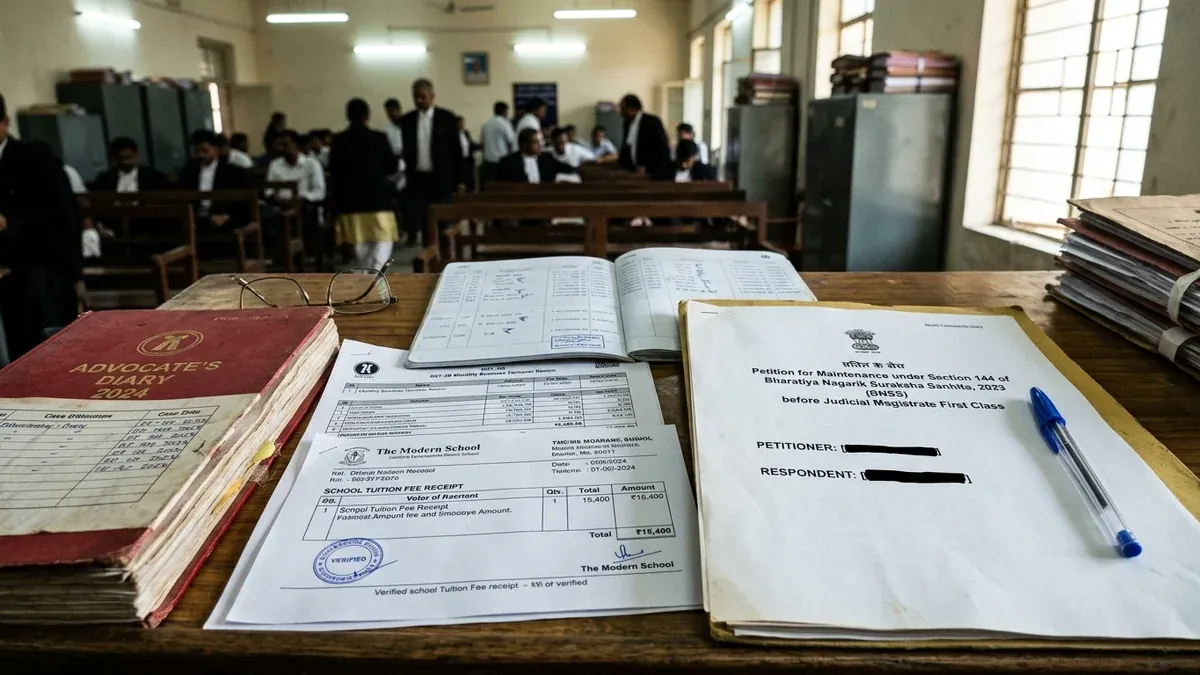
When maintenance or alimony applications are argued before Family Courts and High Courts, a recurring controversy centers on which financial deductions qualify to reduce a husband's taxable gross salary. Estranged wives often argue that only statutory income tax should be subtracted, while husbands face crippling liabilities from residential home loan EMIs, elderly parents' medical insurance, and mandatory provident funds.
The Supreme Court of India has firmly established that maintenance cannot be punitive, nor should it drive the paying spouse into bankruptcy. Under landmark rulings like Rajnesh v. Neha (2020) and Kalyan Dey Chowdhury v. Rita Dey Chowdhury Nee Nandy (2017), courts must evaluate the genuine net disposable income left in the husband's hands.
In determining maintenance under Section 144 BNSS or Section 24 HMA, Indian courts compute alimony on net disposable income rather than gross salary. Mandatory statutory deductions such as income tax, provident fund, and pre-existing home loan EMIs for matrimonial residences are routinely deducted to prevent financial ruin of the paying spouse.
1. Gross Salary vs. Net Disposable Income: The 25% Benchmark
In Kalyan Dey Chowdhury, the Supreme Court ruled that 25% of the husband's net salary is generally a just and reasonable benchmark for maintenance for the wife:
- Permissible Deductions: Compulsory deductions enforced by statute—such as Income Tax, Professional Tax, and statutory Provident Fund (GPF/EPF)—are strictly deducted from gross CTC.
- Impermissible Deductions: Voluntary non-essential savings, voluntary recurring deposits (RD), or post-dispute personal loan EMIs taken to artificially depress take-home pay are disallowed by courts.
2. Judicial Treatment of Home Loan EMIs
The treatment of home loan EMIs depends heavily on who occupies the property:
The Supreme Court mandated comprehensive procedural guidelines across all maintenance proceedings in India (Section 125 CrPC / Section 144 BNSS, DV Act, HMA Section 24), requiring both spouses to file comprehensive Affidavits of Assets and Liabilities. The Bench established that maintenance must be awarded from the date of application to prevent procedural delays from prejudicing dependent spouses and minor children.
"Where the wife and child continue to reside in the matrimonial flat while the husband pays the monthly home loan EMI and maintenance of the society, courts treat the EMI as direct financial support towards housing, deducting it before computing additional cash maintenance."
— Delhi High Court in Bhushan Kumar Meen v. Mansi Meen
Even if the husband resides in the mortgaged property alone, if the loan was contracted during the subsistence of the marriage prior to matrimonial litigation, courts recognize that default would trigger SARFAESI auction, thereby allowing partial or full consideration of the EMI obligation.
3. Accounting for Dependent Parents and Medical Costs
Under Section 144 BNSS, a son has an equal statutory obligation to maintain his aged and ailing parents:
- Medical Bills & Insurance: Documented medical expenditure, dialysis costs, and health insurance premiums for dependent parents are deducted.
- Sibling Non-Contribution: If other siblings do not contribute, the husband must demonstrate that the burden of parental care falls solely upon his shoulders.