
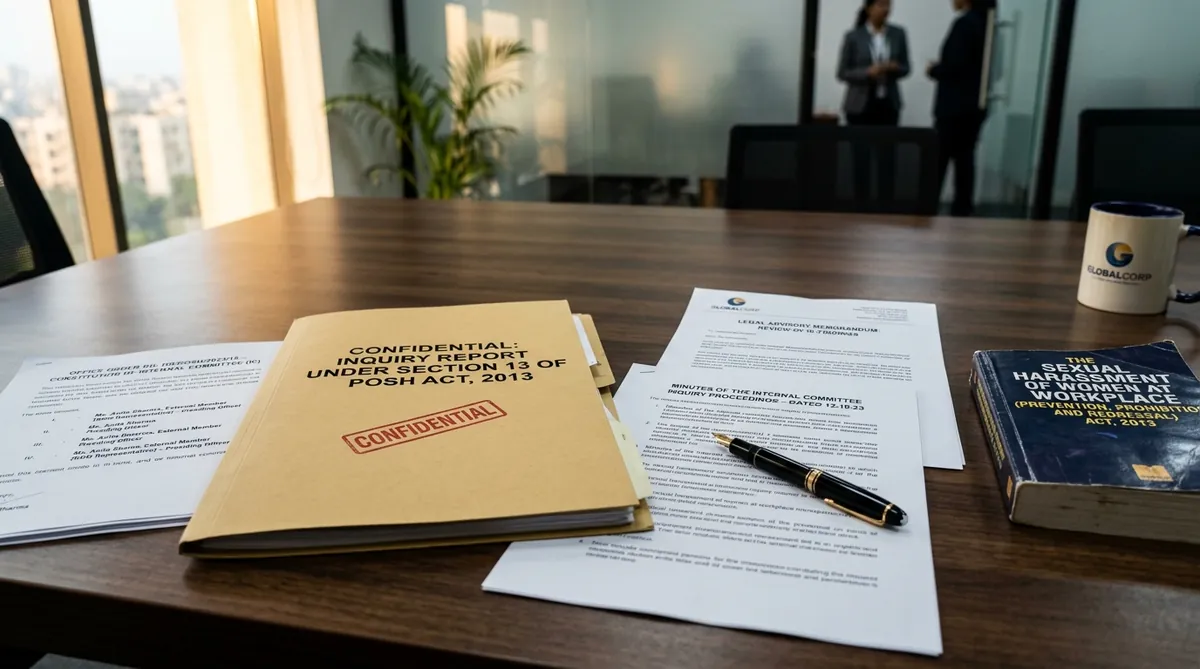
The enactment of the Sexual Harassment of Women at Workplace (Prevention, Prohibition and Redressal) Act, 2013 (POSH Act) established a specialized quasi-judicial mechanism—the Internal Committee (IC)—empowered to investigate allegations of sexual harassment with the powers of a civil court under the Code of Civil Procedure, 1908.
However, corporate IC proceedings frequently suffer from severe procedural vulnerabilities: committees operating as management puppets, denial of cross-examination rights, lack of truly independent external members, refusal to share witness testimonies, and blatant disregard for the principles of natural justice (audi alteram partem). When an Internal Committee inquiry is corrupted by procedural invalidity, affected employees (both respondents facing wrongful termination and complainants facing whitewashed reports) frequently bypass standard service appeals to invoke the extraordinary writ jurisdiction of the High Court under Article 226 of the Constitution of India. This treatise examines the constitutional boundaries, procedural hurdles, and judicial standards governing writ challenges against flawed POSH inquiries.
High Courts exercise writ jurisdiction under Article 226 against flawed POSH Internal Committee inquiries where proceedings violate principles of natural justice, demonstrate blatant committee bias, lack independent external membership, or deny essential cross-examination rights. Following the Supreme Court Aureliano Fernandes ruling, courts actively quash procedurally defective sexual harassment enquiry reports.
1. Maintainability of Article 226 Writs Against Internal Committees
The threshold question in any writ petition challenging an IC inquiry is maintainability, particularly where the employer is a private corporate entity rather than the "State" under Article 12 of the Constitution:
Public Duty and Quasi-Judicial Tribunal Doctrine
While a writ of mandamus under Article 226 does not ordinarily lie against purely private employers in contractual disputes, the legal status of a POSH Internal Committee is fundamentally distinct:
- Statutory Tribunal Function: Under Section 11(3) of the POSH Act, the Internal Committee is vested with the powers of a Civil Court trying a suit under the CPC in respect of summoning witnesses, enforcing attendance, examining persons on oath, and requiring the discovery and production of documents.
- Exercise of Public and Statutory Duty: In landmark rulings across the Delhi, Bombay, and Madras High Courts (e.g., Ruchika Singh Chhabra v. Air France and Dr. Sneha Parikh v. Union of India), courts have affirmed that an Internal Committee, even within a private corporate multinational, performs a statutory function under central legislation. Its inquiry report carries binding statutory consequences affecting personal liberty, livelihood, and reputation under Article 21.
- Writ of Certiorari: Consequently, a writ of certiorari lies to quash an IC report or ongoing inquiry proceedings where there is an absence or excess of jurisdiction, manifest violation of natural justice, or apparent error of law on the face of the record.
2. Fatal Procedural Defects that Warrant Judicial Quashing
High Courts across India have identified specific, recurring procedural violations that vitiate POSH inquiry proceedings and warrant quashing under Article 226:
The Constitution Bench established the landmark principles governing the abolition and absorption of contract labour under the Contract Labour (Regulation and Abolition) Act, 1970. The Court held that mere issuance of a notification prohibiting contract labour under Section 10 does not lead to automatic absorption; however, where the contract arrangement is found to be a sham or camouflage to deny statutory benefits, the industrial adjudicator is fully empowered to direct regular employment.
1. Defective Committee Constitution and the External Member (Section 4)
Under Section 4(2)(c) of the POSH Act, the Internal Committee must include one member from amongst non-governmental organizations or associations committed to the cause of women or a person familiar with the issues relating to sexual harassment.
"In Ruchika Singh Chhabra v. Air France (2018), the Delhi High Court held that the presence of a truly independent external member is a mandatory statutory safeguard designed to prevent institutional bias and employer dominance. Appointing an external member who has commercial, consultancy, or employment ties with the employer invalidates the committee ab initio."
2. Denial of Natural Justice: Complaint Copies and Cross-Examination (Rule 7)
Under Rule 7 of the POSH Rules, 2013, the IC must send a copy of the complaint to the respondent within seven (7) working days of receiving it. Inquiries where:
- The respondent is denied the full written complaint and supporting documents;
- Witness testimonies are recorded behind closed doors without supplying transcripts to the respondent;
- The respondent is denied the right to cross-examine the complainant or key witnesses (whether directly or via written questionnaires approved by the IC);
- The committee relies on undisclosed electronic evidence or ex-parte communications;
violate the fundamental maxim audi alteram partem, rendering the inquiry report a nullity in the eyes of the law.
3. The Supreme Court's Landmark Aureliano Fernandes Directives (2023)
In a monumental verdict delivered on May 12, 2023, the Supreme Court in Aureliano Fernandes v. State of Goa & Ors. (2023) SCC OnLine SC 621 laid bare systemic failures in the implementation of the POSH Act nationwide:
The appellant, a university professor, had been terminated following an inquiry conducted in breach of natural justice where hearings were rushed within days despite his genuine medical incapacitation. Setting aside the dismissal, the Supreme Court held:
- Due Process Cannot Be Sacrificed: The grave nature of sexual harassment allegations does not permit the Internal Committee to cut procedural corners, bypass statutory timelines, or truncate the respondent's right to mount an effective defense.
- Serious Repercussions of Disciplinary Action: An adverse finding by an IC shatters the career, reputation, and livelihood of an individual permanently. Therefore, procedural fairness must be observed with scrupulous fidelity.
- Pan-India Directives: The Supreme Court issued mandatory directives to all Union ministries, State departments, statutory bodies, professional councils, and private institutions to conduct a time-bound verification of IC constitutions, update website disclosures, and mandate regular sensitization workshops.
4. Exhaustion of Alternative Remedies: Section 18 Appeal vs. Article 226
Under Section 18 of the POSH Act, any person aggrieved by the recommendations of the IC or non-implementation thereof may prefer an appeal to the appellate authority notified under service rules, or in their absence, to the Court or Tribunal under the Industrial Disputes Act or Industrial Employment (Standing Orders) Act within ninety (90) days.
When can a litigant bypass Section 18 and directly approach the High Court under Article 226?
Whirlpool Corporation Exceptions to Alternative Remedy Bar:
Under the celebrated doctrine of Whirlpool Corporation v. Registrar of Trade Marks (1998) 8 SCC 1, the existence of an alternative statutory remedy does not bar writ jurisdiction where:
1. The writ petition seeks enforcement of a Fundamental Right under Part III;
2. There is a complete lack of jurisdiction in the Internal Committee (e.g., defective composition or time-barred complaints beyond Section 9 limits);
3. The proceedings have been conducted in patent violation of principles of natural justice;
4. The vires of an Act or rule is challenged.
5. Evidentiary Standards in POSH Inquiries: Preponderance vs Probabilities
A recurring ground in writ litigation concerns the misapplication of evidentiary standards by Internal Committees:
- Civil Standard Governs: Unlike a criminal trial under Section 354A IPC / Section 75 BNS which requires proof beyond reasonable doubt, a POSH inquiry is a domestic quasi-judicial proceeding governed strictly by the preponderance of probabilities.
- No License for Conjecture: In Union of India v. Sardar Bahadur (1972) 4 SCC 618, the Supreme Court ruled that while strict rules of the Evidence Act do not apply to domestic inquiries, findings cannot rest on mere conjecture, suspicion, or hearsay. There must be tangible, relevant evidence on record from which a reasonable mind could draw the inference of sexual harassment.
- Quashing Perverse Findings: If an IC returns an adverse finding that is completely unsupported by evidence on record or ignores critical exculpatory electronic proof (such as CCTV footage or timestamped emails), the High Court will issue a writ of certiorari quashing the finding as perverse.
6. Strategic Blueprint for Drafting and Filing a POSH Writ Petition
Counsel mounting a writ challenge against an IC inquiry must assemble an unassailable evidentiary record:
- Preserve Procedural Objections in Writing: Litigants must never wait until the final report to protest procedural violations. Every refusal of documents, denial of cross-examination, or biased conduct must be recorded in contemporaneous, dated emails addressed to the Presiding Officer.
- Challenge Interim Recommendations (Section 12): If the IC recommends transfer, suspension, or salary restraint without prima facie grounds, move an immediate interlocutory writ seeking stay of interim measures.
- Expose Institutional Bias: Establish hierarchical dependency between IC members and the complainant or senior management through corporate organizational charts.
- Prayer Matrix: Seek a writ of certiorari quashing the inquiry report, a writ of prohibition restraining disciplinary implementation, and, where appropriate, a mandamus directing fresh inquiry before an independent reconstituted committee.