
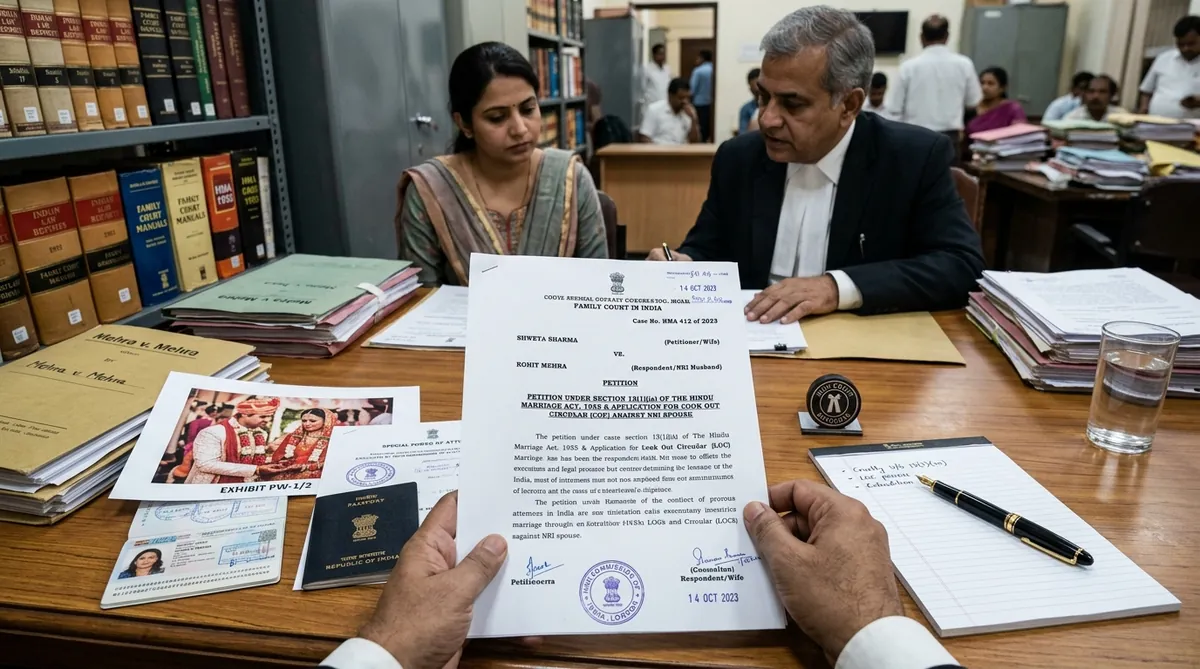
With millions of Indian citizens residing across the United States, Canada, the United Kingdom, UAE, and Singapore, cross-border marital dissolution is increasingly litigated. A prevalent tactic among non-resident spouses is to initiate divorce proceedings in a foreign country (often leveraging no-fault divorce laws or domicile rules) while the other spouse resides in India.
However, obtaining a divorce certificate from a foreign court does not automatically dissolve a Hindu, Muslim, or Special Marriage Act union in the eyes of Indian law. Unless the foreign decree satisfies the stringent statutory filters of Section 13 of the Code of Civil Procedure, 1908 (CPC), it is considered a nullity in India, rendering any subsequent remarriage by the foreign spouse bigamous under Section 82 BNS.
Under Section 13 CPC, foreign divorce decrees are invalid in India if passed by a court lacking competent matrimonial jurisdiction, decided without hearing both parties on the merits, or granted on grounds unrecognized under Indian personal laws. The Supreme Court's Y. Narasimha Rao ruling protects spouses from unilateral ex-parte foreign divorces.
1. The Six Statutory Bars under Section 13 CPC
Under Section 13 CPC, a foreign judgment is conclusive as to any matter directly adjudicated upon, except in six specific circumstances:
- Clause (a) - Not Competent Court: Where it has not been pronounced by a court of competent jurisdiction.
- Clause (b) - Not on Merits: Where it has not been given on the merits of the case (e.g., summary or default ex-parte judgments).
- Clause (c) - Refusal to Recognize Indian Law: Where it appears on the face of proceedings to be founded on an incorrect view of international law or a refusal to recognize the law of India in cases in which such law is applicable.
- Clause (d) - Violation of Natural Justice: Where the proceedings in which the judgment was obtained are opposed to natural justice (lack of proper summons or hearing).
- Clause (e) - Obtained by Fraud: Where it has been obtained by fraud or perjury.
- Clause (f) - Breach of Indian Law: Where it sustains a claim founded on a breach of any law in force in India.
2. The Landmark Y. Narasimha Rao Doctrine
In the historic decision Y. Narasimha Rao v. Y. Venkata Lakshmi (1991) 3 SCC 451, the Supreme Court laid down definitive rules for foreign matrimonial decrees:
The Supreme Court formulated authoritative parameters governing mental cruelty under Section 13(1)(ia) of the Hindu Marriage Act, holding that sustained reprehensible conduct, prolonged separation, baseless character assassination, and total destruction of the matrimonial bond constitute actionable cruelty. The Bench held that where a marriage is irretrievably broken down, forcing estranged spouses to remain legally bound constitutes protracted mental cruelty.
"The jurisdiction assumed by the foreign court as well as the grounds on which the relief is granted must be in accordance with the matrimonial law under which the parties are married. An ex-parte decree obtained on 'irretrievable breakdown' or 1-year residency in a US state is non-binding if the marriage was solemnized under the Hindu Marriage Act without mutual submission."
Only when the non-initiating spouse actively submits to the foreign court's jurisdiction, contests the matter on the merits, or agrees by mutual consent, will Indian courts recognize the dissolution.
3. Legal Remedies in Indian Courts
If a foreign ex-parte decree has been secured by a spouse:
- Declaratory Suit under Section 34 Specific Relief Act: File a civil suit in the District/Family Court seeking a declaration that the foreign divorce decree is null, void, and non-binding in India.
- Maintenance Petition under Section 144 BNSS / Section 125 CrPC: The foreign decree cannot bar an Indian magistrate from awarding interim maintenance.
- Anti-Bigamy Injunction: Restrain the NRI spouse from entering into a second marriage during the subsistence of the lawful Indian marriage.