
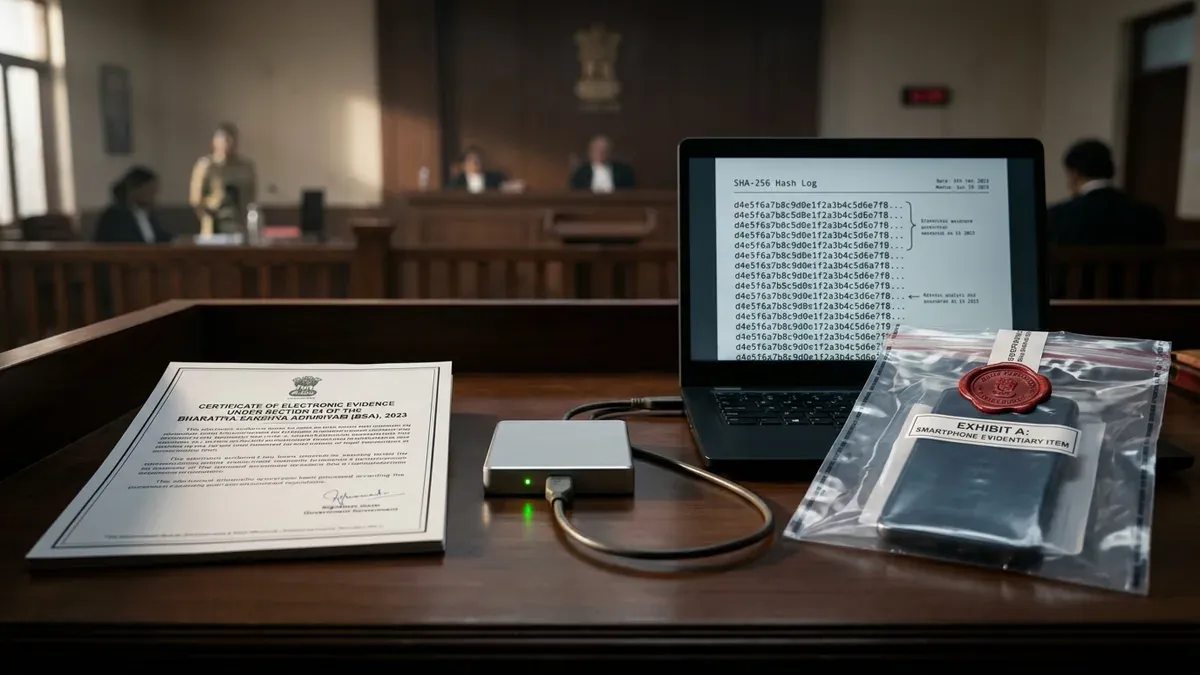
In modern litigation, electronic evidence—ranging from WhatsApp chats, SMS threads, emails, and call detail records (CDRs) to CCTV hard drives, cloud backups, and server system logs—forms the decisive evidentiary core of civil and criminal trials. Under the Bharatiya Sakshya Adhiniyam, 2023 (BSA), the admissibility of electronic records is governed by Section 63 (which replaces Section 65B of the Indian Evidence Act, 1872).
The legal regime governing electronic certificates has been strictly interpreted by a three-judge bench of the Supreme Court of India in Arjun Panditrao Khotkar v. Kailash Kushanrao Gorantyal (2020 7 SCC 1). Tendering electronic printouts or flash drives without a compliant statutory certificate renders the evidence inadmissible, leading to collapsed trials or excluded evidence.
Under Section 63 BSA 2023, secondary electronic records such as WhatsApp messages, emails, and CCTV recordings require a mandatory certificate to be admissible. Following the Supreme Court's ruling in Arjun Panditrao, producing this certificate is a condition precedent, verifying hash value integrity and lawful custody of computer systems.
1. Primary vs. Secondary Electronic Evidence under BSA
Section 63 BSA establishes a clear evidentiary boundary between original digital media and secondary reproductions:
- Primary Electronic Evidence: The original computer output, hard drive, original smartphone, or digital camera on which the record was first stored. If the original physical device is produced in court, no Section 63 certificate is required.
- Secondary Electronic Evidence: Any printout, USB drive, CD-ROM, external hard drive, or cloud export containing copies of digital records. For secondary electronic records, a Section 63 Certificate is mandatory.
2. Mandatory Contents of the Section 63 Certificate
Under Section 63(4) BSA, the certificate must be signed by a person occupying a responsible official position in relation to the operation of the relevant device or management of the relevant activities. It must expressly certify:
- Device Identification: Identifying the electronic record and describing the manner in which it was produced (e.g. mobile phone IMEI, printer model, server IP).
- Regular Lawful Operation: Affirming that the computer was used regularly to store or process information during the relevant period by a person having lawful control.
- Operating Integrity & Accuracy: Confirming that the computer was operating properly during the period, or if out of order for any time, that it did not affect the accuracy of the electronic record.
- Hash Value Verification: Modern forensic best practices require recording the cryptographic Hash Value (SHA-256 or MD5) of the digital artifact to prove non-tampering.
3. The Supreme Court Benchmark: Arjun Panditrao Khotkar (2020)
In Arjun Panditrao Khotkar, the Supreme Court delivered three foundational holdings:
The Supreme Court reaffirmed the three mandatory golden tests for grant of interlocutory injunctions under Order XXXIX Rules 1 and 2 of the Code of Civil Procedure: (i) strong prima facie case, (ii) balance of convenience tilted in applicant's favor, and (iii) imminent threat of irreparable injury not compensable in monetary damages. The Court held that temporary relief cannot be granted mechanically without judicial application of mind.
"The certificate required under Section 65B(4) (now Section 63 BSA) is a condition precedent to the admissibility of secondary electronic evidence. Oral evidence in place of the certificate cannot suffice."
However, the Court also established that if an individual party does not possess or control the computer system (e.g. telecom company CDRs or bank CCTV), the court has power under Section 94 BNSS / Section 91 CrPC to summon the certified records directly from the custodian.