
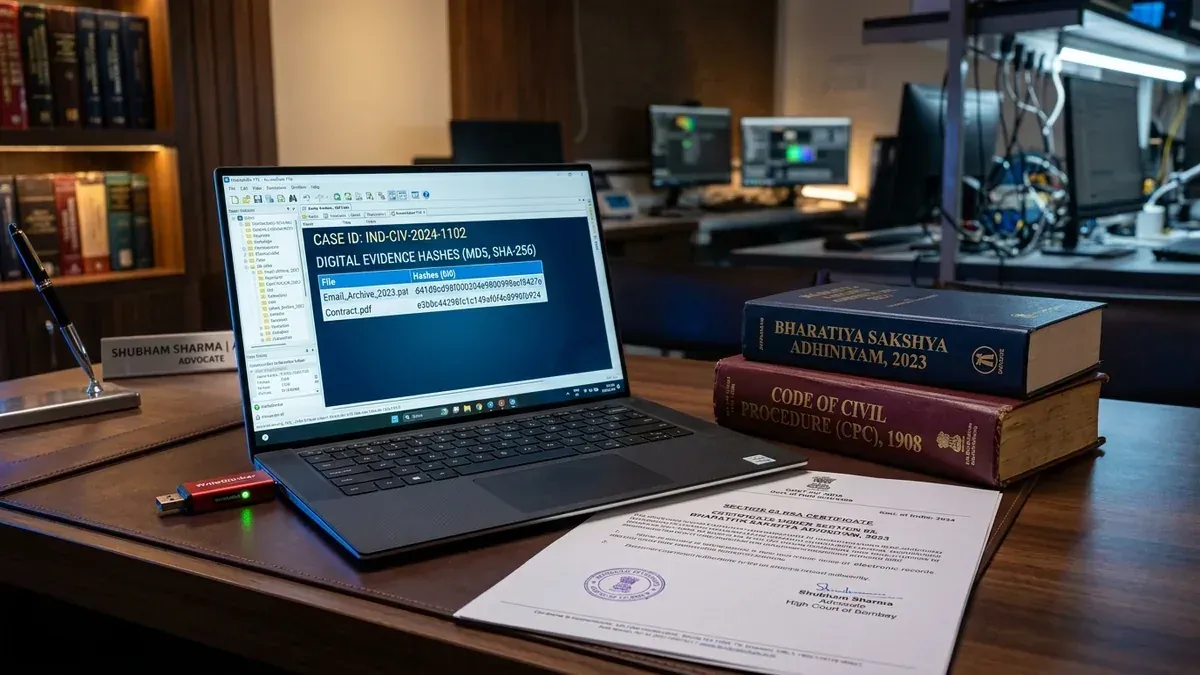
For over a century, civil litigation in India was infamous for procedural dilatoriness, opportunistic document suppression, and the pervasive culture of "trial by ambush." Litigants routinely instituted bare civil suits on skeleton pleadings, intentionally withholding critical records, ledger accounts, and correspondence, only to spring surprise documents upon their adversaries during the cross-examination of witnesses years or decades later. This practice transformed commercial adjudication into an endless war of attrition, severely eroding India's enforcement of contracts ranking and undermining investor confidence.
To fundamentally revolutionize commercial dispute resolution, Parliament enacted the Commercial Courts Act, 2015. By virtue of Section 16 read with the Schedule to the Act, the procedural architecture of the Code of Civil Procedure, 1908 (CPC) was radically overhauled for commercial disputes. Among these transformative amendments, none is more rigorous than the complete substitution of Order XI CPC (Disclosure, Discovery and Inspection of Documents in Commercial Disputes). The amended Order XI replaces the lax disclosure norms of ordinary civil suits with an unforgiving regime of front-loaded document disclosure, stringent affidavits on oath, and tight statutory deadlines.
Under this modern commercial regime, a plaintiff must disclose and file every document in their power, possession, control, or custody at the time of presenting the plaint. If a party fails to file a document at the threshold, Order XI Rule 1(5) CPC imposes an absolute bar: the party cannot introduce additional documents at any subsequent stage without obtaining the express leave of the Commercial Court upon demonstrating strict "reasonable cause." As affirmed by the Supreme Court in Sudhir Kumar @ S. Baliyan v. Vinay Kumar G.B. (2021), the Commercial Court will not condone casual negligence or tactical delays. This treatise provides an exhaustive analysis of the amended Order XI CPC, interrogatories, inspection protocols, electronic discovery, and trial strategies.
Under Order XI CPC as amended by the Commercial Courts Act 2015, parties must disclose all relevant documents in their power, possession, control, or custody at the plaint or written statement stage. Filing additional documents later requires establishing reasonable cause under Order XI Rule 1(5), barring trials by ambush.
1. The Front-Loaded Disclosure Mandate under Order XI Rule 1 CPC
The amended Order XI Rule 1 fundamentally alters how commercial pleadings are prepared. Unlike ordinary suits where documents can be filed until the framing of issues under Order XIII Rule 1, a commercial plaintiff must lay bare their entire evidentiary arsenal on day one:
Order XI Rule 1(1), Code of Civil Procedure, 1908 (Commercial Courts Act):
"Plaintiff shall file a list of all documents and photocopies of all documents, in its power, possession, control or custody, pertaining to the suit, along with the plaint, including:
(a) documents referred to and relied on by the plaintiff in the plaint;
(b) documents relating to any matter in question in the suit, in the power, possession, control or custody of the plaintiff, whether assisting or adversely affecting the plaintiff's case;
(c) nothing in this Rule shall apply to documents produced by plaintiffs and relevant only—(i) for the cross-examination of the defendant's witnesses, or (ii) in answer to any case set up by the defendant."
The Revolutionary Clause (b): Disclosing Adverse Documents
Clause (b) of Order XI Rule 1(1) represents an unprecedented shift in Indian adversarial procedure. A commercial plaintiff is statutorily mandated to disclose and produce not merely favorable documents, but every document that adversely affects their own case or assists the defendant. Deliberate suppression of inconvenient emails, audit memos, or defect notices constitutes perjury and perjury under the Statement of Truth.
The Declaration on Oath (Statement of Truth)
Under Order XI Rule 1(3), the plaint must be accompanied by an exhaustive Statement of Truth on affidavit, wherein the plaintiff must verify:
- That all documents in the plaintiff's power, possession, control, or custody have been disclosed and copies filed with the plaint.
- That the plaintiff does not have any other documents in its power, possession, control, or custody.
- Specifying in detail whether any documents are in the possession of the defendant, a third party, or are currently unavailable, detailing the steps taken to procure them.
Under Order XI Rule 1(4), in case of urgent interim applications under Order XXXIX CPC, if the plaintiff seeks leave to rely on additional documents, they must file an application demonstrating why those documents could not be filed with the plaint, and must file them within thirty days of the suit being registered.
2. The "Reasonable Cause" Bar: Order XI Rule 1(5) and the Sudhir Kumar Doctrine
The core enforcement mechanism that prevents parties from dragging commercial trials through piecemeal document filings is codified in Order XI Rule 1(5) CPC:
Order XI Rule 1(5), Code of Civil Procedure, 1908:
"The plaintiff shall not be allowed to rely on documents, which were in the plaintiff's power, possession, control or custody and not disclosed along with the plaint or within the extended period provided, save and except by leave of court and such leave shall be granted only upon the plaintiff establishing reasonable cause for non-disclosure along with the plaint."
The Supreme Court Landmark in Sudhir Kumar @ S. Baliyan (2021)
In Sudhir Kumar @ S. Baliyan v. Vinay Kumar G.B. (2021) 13 SCC 559, the Supreme Court delivered an authoritative interpretation of Order XI Rule 1(5):
- Strict Interpretation of "Reasonable Cause": The Apex Court held that "reasonable cause" cannot be equated with the casual or liberal standards applied under Section 5 of the Limitation Act. The party seeking leave must provide a cogent, credible, and verifiable explanation establishing why the document—despite due diligence—could not be discovered or produced earlier.
- Inadvertence and Change of Counsel Not Grounds: Pleadings alleging that documents were "inadvertently missed," "misplaced in records," or that the "previous advocate failed to attach them" do not satisfy the statutory threshold of reasonable cause.
- Balancing Commercial Efficiency vs. Substantive Justice: The Supreme Court emphasized that if the requirement of establishing reasonable cause is relaxed, the very legislative object of the Commercial Courts Act—namely, the expeditious disposal of commercial disputes—would be completely defeated.
Delhi High Court Jurisprudence: The Nitin Gupta Standards
The Commercial Division of the Delhi High Court in Nitin Gupta v. Texmaco Infrastructure & Holdings Ltd. (2019) SCC OnLine Del 8367 and Hassad Food Company Q.S.C. v. Bank of India (2019) ruled that:
Judicial Test for Additional Documents (Nitin Gupta v. Texmaco):
1. Were the documents in the physical or constructive possession of the party when the plaint/written statement was filed?
2. Did the party make a specific declaration in its Statement of Truth explaining the existence and location of those documents?
3. Has there been an unforeseen intervening event or discovery of fresh records that could not have been uncovered despite reasonable diligence?
If the answers show lack of diligence, leave to file additional documents must be summarily rejected with exemplary costs.
3. Discovery by Interrogatories (Rule 2) & Notice to Produce (Rule 3 & 5)
Order XI provides a structured mechanism to extract admissions and compel production of records from adversaries before trial commences:
Discovery by Interrogatories (Order XI Rule 2)
Under Order XI Rule 2, in any commercial suit, the plaintiff or defendant may deliver interrogatories in writing for the examination of the opposite parties with leave of the court. Interrogatories serve to narrow the factual controversy, extract vital admissions, and pin down the adversary on specific transaction details.
- Permissible Scope: Interrogatories must relate directly to matters in question in the suit. Fishing or cross-examining questions aimed at impeaching witness credibility are disallowed.
- Affidavit in Answer: Interrogatories must be answered by affidavit within ten days of service or within such other time as the court allows.
- Striking Out Answers for Default: Under Order XI Rule 21 CPC, if a party fails to comply with an order to answer interrogatories, their suit may be dismissed for want of prosecution, or their defence struck out, placing them in the same position as if they had not defended.
Inspection and Notice to Produce Documents (Order XI Rules 3, 4 & 5)
The inspection timetable under amended Order XI is governed by strict statutory deadlines:
| Procedural Step | Statutory Time Window | Statutory Mandate |
|---|---|---|
| Notice to Produce for Inspection | Within 30 days of service of written statement / replication | Party serves notice requiring adversary to produce documents referred to in pleadings for physical inspection. |
| Notice Fixing Inspection Date | Within 4 days of receiving notice to produce | The receiving party must state a time within 3 days when documents may be inspected at their advocate's office. |
| Completion of Inspection | Within 30 days from date of notice | All physical inspection must be completed, and certified photocopies supplied upon payment of costs. |
4. Electronic Records & Metadata Disclosure under Order XI Rule 6
Modern commercial disputes revolve almost exclusively around digital communications: emails, ERP database logs, WhatsApp chats, CAD drawings, electronic purchase orders, and PDF invoices. Order XI Rule 6 establishes specialized standards for electronic evidence disclosure:
Order XI Rule 6, Code of Civil Procedure, 1908 (Electronic Records):
"In case of electronic records, each party shall state: (a) list of electronic records, along with file names, hash values, size, and source metadata; (b) software details required to view or verify the record; (c) mode of extraction and verification certificate."
Compliance with Section 63 Bharatiya Sakshya Adhiniyam, 2023 (Section 65B IEA)
Under Order XI Rule 6(3), any electronic record filed in a commercial suit must be accompanied by a mandatory certificate under Section 63 of the Bharatiya Sakshya Adhiniyam, 2023 (BSA) (corresponding to Section 65B of the Indian Evidence Act, 1872).
In Arjun Panditrao Khotkar v. Kailash Kushanrao Gorantyal (2020) 7 SCC 1, the Supreme Court affirmed that producing a valid electronic evidence certificate is a condition precedent to the admissibility of electronic records. If the certificate is not filed alongside the electronic printout at the plaint stage, the Commercial Court can reject the document during admission/denial.
Metadata and Audit Trail Preservation
Under Order XI Rule 6(4), where an adversary disputes the authenticity or date of an email or electronic transaction, the court may direct the party possessing the server or computer system to disclose complete electronic metadata—including internet message headers, server routing logs, IP addresses, and creation timestamps. Altering or wiping electronic metadata during pending discovery constitutes spoliation of evidence, inviting severe adverse inferences under Section 119 BSA.
5. Litigator's Playbook: Mastering Order XI Strategy in Commercial Courts
To dominate commercial litigation under the amended CPC, counsel must implement a structured, disciplined document management protocol:
Best-Practice Protocol for Order XI Compliance:
• Pre-Institution Document Audit: Never draft a commercial plaint based on verbal instructions. Conduct a comprehensive forensic document audit of all client servers, email archives, and WhatsApp threads before finalizing pleadings.
• Drafting the Statement of Truth: Scrutinize every line of the Statement of Truth. Ensure that every document cited in the narrative is physically annexed to the plaint bundle with corresponding pagination.
• Preserving Additional Document Pathways: If certain crucial third-party records (e.g., bank statements, customs shipping bills) cannot be procured immediately, specifically name them in the plaint narrative and the Statement of Truth, detailing the RTI applications, bank requests, or subpoena efforts undertaken. This creates the foundational "reasonable cause" required under Rule 1(5).
• Weaponizing Interrogatories Early: Serve interrogatories under Order XI Rule 2 immediately after the written statement is filed to force the defendant to admit signatures, receipt of invoices, and delivery of goods before the Case Management Hearing under Order XV-A CPC.
Landmark Judicial Precedents & Statutory Authorities
Courts and appellate tribunals across Delhi NCR (Faridabad, Saket, Tis Hazari, Gurugram, High Courts) strictly apply these authoritative Supreme Court benchmarks:
The Supreme Court reaffirmed the three mandatory golden tests for grant of interlocutory injunctions under Order XXXIX Rules 1 and 2 of the Code of Civil Procedure: (i) strong prima facie case, (ii) balance of convenience tilted in applicant's favor, and (iii) imminent threat of irreparable injury not compensable in monetary damages. The Court held that temporary relief cannot be granted mechanically without judicial application of mind.