
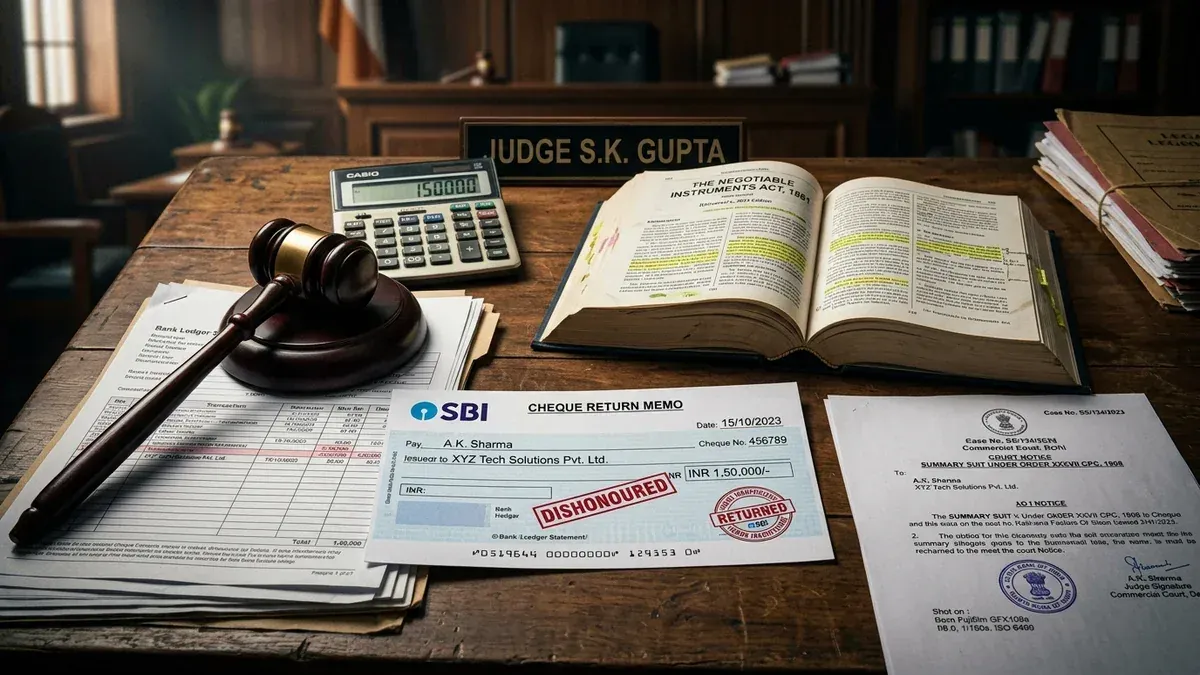
In India's commercial economy, sole proprietorships represent the single largest business structure, powering millions of retail shops, wholesale distributors, transport operators, and professional service enterprises. In daily trade, commercial cheques are routinely drawn on current bank accounts maintained under firm trade names such as "M/s ABC Enterprises" or "M/s Royal Trading Co."
However, when a trade cheque bounces, payees and commercial litigators frequently commit a fatal legal error: they treat a sole proprietorship firm as if it were a private limited company or a registered partnership firm. Complainants invoke Section 141 of the Negotiable Instruments Act, 1881 (NI Act) and indiscriminately array the proprietorship firm, the proprietor, their family members, shop managers, accountants, and authorized signatories as co-accused, alleging that they were all "in charge of and responsible to the firm for the conduct of its business."
This legal approach is fundamentally flawed under Indian corporate and commercial law. In a monumental series of judgments led by Raghu Lakshminarayanan v. Fine Tubes (2007) 5 SCC 103 and Shankar Finance and Investments v. State of A.P. (2008) 8 SCC 536, the Supreme Court of India declared that a sole proprietorship is not a juristic person, legal entity, or company. It is merely a commercial trade name adopted by a single human individual. Consequently, Section 141 of the NI Act has ZERO application to sole proprietorships. Only the individual human proprietor can be held criminally liable under Section 138. Understanding this distinction provides an absolute, unshakeable defense to quash criminal proceedings against non-proprietor managers, family members, and employees.
A sole proprietorship has no separate legal entity from its proprietor. Under the Supreme Court's Raghu Lakshminarayanan ruling, Section 141 of the Negotiable Instruments Act does not apply to proprietorship firms. Only the individual proprietor can be prosecuted under Section 138; managers and employees cannot be held vicariously liable.
1. Legal Nature of Sole Proprietorship: The Non-Juristic Entity Doctrine
The core principle governing sole proprietorships was crystallized by the Supreme Court in Raghu Lakshminarayanan v. Fine Tubes (2007) 5 SCC 103:
Supreme Court Doctrine in Raghu Lakshminarayanan (Paras 8-11):
"A sole proprietary concern is not a company, nor a partnership firm, nor a corporate entity... It is nothing but a name and style under which an individual trades. It has no legal existence separate from the individual who owns it. The concept of vicarious liability under Section 141 of the Negotiable Instruments Act applies strictly to companies, firms, and associations of individuals. Section 141 does NOT apply to a sole proprietary concern."
From this doctrine, four foundational legal consequences flow:
- Identity of Firm and Individual: In the eyes of the law, "M/s ABC Enterprises" and "Mr. John Doe (Proprietor)" are one and the exact same legal person. The firm name is merely an assumed trade jacket worn by the individual human.
- Inapplicability of Corporate Alter-Ego Rules: Unlike a private limited company incorporated under the Companies Act, 2013—which possesses perpetual succession, a common seal, and an independent juristic personality—a proprietorship cannot own property in its own name or sue and be sued independently of its proprietor.
- No Board of Directors or Partners: A proprietorship cannot have "directors", "managing partners", or "sleeping partners". Any person working in the firm other than the proprietor is legally an employee or agent.
2. Inapplicability of Section 141: Immunity for Managers, Family & Employees
Under Section 141(1) of the NI Act, vicarious liability is restricted strictly to a "company", which the Explanation defines as "any body corporate and includes a firm or other association of individuals." The word "firm" in the Explanation means a partnership firm registered under the Indian Partnership Act, 1932 or a Limited Liability Partnership (LLP). It does NOT include a sole proprietorship.
| Entity Category | Does Section 141 Apply? | Who Can Be Prosecuted under Section 138? |
|---|---|---|
| Sole Proprietorship | NO (Absolute Bar) | Exclusively the Sole Proprietor. Managers, accountants, spouses, and authorized signatory agents cannot be prosecuted under Section 141. |
| Partnership Firm | YES | The firm itself PLUS every partner who was actively in charge of and responsible for the business. |
| Private / Public Limited Company | YES | The company itself PLUS Managing Director and executive officers responsible for the transaction. |
Consequently, when a complainant arrays the proprietor's spouse or general manager under Section 141, the summoning order against them is void ab initio and liable to be quashed at the threshold.
3. The Title of the Plaint: Proper Naming Conventions under Shankar Finance
A recurring technical pitfall in proprietorship cheque bounce litigation is how the complaint must be titled. In Shankar Finance and Investments v. State of A.P. (2008) 8 SCC 536, the Supreme Court clarified the legal naming conventions:
- Option A (Ideal Format): "Mr. A, Proprietor of M/s XYZ Enterprises". Here, the individual human is named as the primary accused, describing their trading style. This is unassailable.
- Option B (Permissible Format): "M/s XYZ Enterprises, represented by its Sole Proprietor Mr. A". The Supreme Court held that while a proprietorship is not a juristic person, styling the accused in this manner is legally permissible because the human proprietor is identified as the person representing the firm.
- Option C (Fatal Defect - Sole Trade Name): "M/s XYZ Enterprises" (without naming any natural human proprietor). Filing a criminal complaint against a mere trade name without identifying the individual owner is a fatal jurisdictional defect. A trade name cannot be summoned, cannot take oath, cannot execute a bail bond, and cannot be committed to prison under Section 138!
4. The Authorized Signatory Dilemma: Can a Mandate Holder Be Jailed?
In many commercial enterprises, the proprietor grants a Power of Attorney (PoA) or bank mandate to an employee or family member to sign cheques on the proprietorship account. If such a cheque bounces, can the authorized signatory be prosecuted under Section 138?
The legal resolution established across Indian High Courts reveals a nuanced distinction:
- The Rule in Aparna A. Shah v. Sheth Developers (2013) 8 SCC 71: The Supreme Court held that under Section 138, prosecution is strictly confined to the "drawer of the cheque" on an account maintained by them. An authorized signatory who signs merely as an agent on behalf of the proprietor is not the account holder.
- Signatory Cannot Be Held Vicariously Liable: Because Section 141 does NOT apply to sole proprietorships, an authorized signatory cannot be roped in through vicarious liability. In multiple rulings (such as the Delhi and Gujarat High Courts), proceedings against non-proprietor authorized signatories have been quashed where they had no proprietary ownership in the business.
- Exclusive Liability of the Account Holder: The statutory offence under Section 138 is anchored strictly to the person who maintains the bank account. Thus, the sole proprietor whose name stands on the bank account ledger remains exclusively liable.
5. Quashing Strategy under Section 528 BNSS (Section 482 CrPC)
When non-proprietor employees, family members, or managers are improperly arrayed in a Section 138 complaint, defense counsel should execute a rapid quashing petition:
Quashing Roadmap for Improperly Impleaded Parties:
- Produce Bank Account Ledger / GST Registration: Obtain certified copies of the bank account opening form and GST registration certificate proving that the enterprise is a sole proprietorship owned exclusively by one individual.
- File Petition under Section 528 BNSS (Section 482 CrPC): Move the High Court for quashing the summoning order against the employee, spouse, or manager, citing the binding authority of Raghu Lakshminarayanan v. Fine Tubes (2007) 5 SCC 103.
- Establish Inapplicability of Section 141: Plead that because the accused business is a sole proprietorship, invocation of Section 141 vicarious liability is an abuse of judicial process.
- Secure Immediate Stay of Trial Process: Pray for an immediate ad-interim stay of the trial court's summons, relieving the innocent non-proprietor from personal appearances and bail bond requirements.
6. Substantive Defenses Available to the Individual Proprietor
While employees can easily secure quashing under Raghu Lakshminarayanan, the individual sole proprietor must defend the case on merits before the trial Magistrate:
- Rebutting the Statutory Presumption under Section 139: The proprietor must rebut the statutory presumption of debt liability by establishing a preponderance of probabilities under the landmark Three-Judge Bench doctrine in Rangappa v. Sri Mohan (2010) 11 SCC 441 and Basalingappa v. Mudibasappa (2019) 5 SCC 418.
- Cheque Issued for Unenforceable / Security Purpose: Demonstrate through purchase orders and communications that the cheque was issued as an advance security deposit for goods that were never delivered, or for an illegal / time-barred transaction.
- Absence of Statutory Demand Notice: Prove through post office tracking registers that the statutory 15-day demand notice under Section 138 proviso (b) was never served on the proprietor's correct residential or business address.
By asserting the non-juristic nature of proprietorships, enforcing the total inapplicability of Section 141, and deploying the Raghu Lakshminarayanan doctrine, defense litigators can successfully quash illegal prosecutions against employees and mount a formidable defense for the sole proprietor.
7. Death of the Proprietor: Abatement of Criminal Proceedings and Civil Estate Recovery
A fundamental principle distinguishing sole proprietorships from incorporated companies is that the proprietorship possesses no perpetual succession. When the sole proprietor of a trading concern passes away, the business entity immediately ceases to exist in law. This structural reality has monumental ramifications for ongoing and prospective cheque bounce proceedings under Section 138 of the Negotiable Instruments Act.
Criminal jurisprudence in India operates on the strict maxim actio personalis moritur cum persona (a personal right of action dies with the person). In Smt. Girija v. K. Vinay (2003) Cri LJ 1625 and consistent decisions of High Courts across the country, it has been authoritatively settled that criminal liability under Section 138 is strictly personal to the drawer of the cheque. The criminal court does not try property; it tries an individual natural person whose penal culpability cannot be inherited.
If a sole proprietor dies during the pendency of a Section 138 trial, the legal consequences and defensive strategies unfold as follows:
- Immediate Abatement of Criminal Complaint under Section 435 BNSS (Section 394 CrPC): Upon production of the original or certified death certificate of the accused proprietor, the Magistrate has no jurisdiction to continue proceedings and must pass a formal order abating the complaint. The criminal proceeding terminates permanently.
- Strict Prohibition on Impleading Legal Heirs in Criminal Trial: Complainants frequently file applications under Section 302 CrPC (Section 340 BNSS) seeking to substitute the widow, children, or parents of the deceased proprietor as accused persons. Courts have repeatedly held that such substitution is illegal and unconstitutional. Legal heirs cannot be jailed or fined for cheques drawn and signed by the deceased relative.
- Payee's Exclusive Remedy: Civil Suit against the Inherited Estate: The payee's only lawful recourse is to institute a summary suit under Order XXXVII CPC or an ordinary civil recovery suit against the legal representatives under Section 52 of the Code of Civil Procedure, 1908. Under Section 52 CPC, legal heirs are liable only to the extent of the value of the deceased proprietor's estate that has actually come into their hands and has not been duly administered.
- Protection Against Harassment by Recovery Agents: Surviving family members who face coercion, threatening calls, or illegal visits from bank recovery agents or commercial payees can file police complaints for criminal intimidation under Section 351 BNS (Section 506 IPC) and approach the High Court for police protection.
| Legal Characteristic | Sole Proprietorship Concern | Partnership Firm (Indian Partnership Act) | Private Limited Company (Companies Act) |
|---|---|---|---|
| Juristic Personality | None; mirror image of individual human | Limited juristic entity under Section 141 | Complete separate legal corporate entity |
| Vicarious Liability (Sec 141) | Does NOT apply; employees fully immune | Applies to all active managing partners | Applies to MD, signatories, executive directors |
| Effect of Death of Accused | Criminal case abates completely and permanently | Case continues against surviving managing partners | Company remains liable; case proceeds against active directors |
| Authorized Signatory Liability | Immune unless account holder (Aparna Shah) | Liable if partner or person in control | Liable under Section 141(2) as agent |
Landmark Judicial Precedents & Statutory Authorities
Courts and appellate tribunals across Delhi NCR (Faridabad, Saket, Tis Hazari, Gurugram, High Courts) strictly apply these authoritative Supreme Court benchmarks:
The Supreme Court affirmed that the statutory presumption under Section 139 of the Negotiable Instruments Act includes the existence of a legally enforceable debt or liability once the execution of the cheque is admitted. However, the Bench settled that the accused is not required to establish their defense beyond reasonable doubt; raising a probable defense through cross-examination or relying on the complainant's own admissions on a preponderance of probabilities is sufficient to rebut the presumption.