
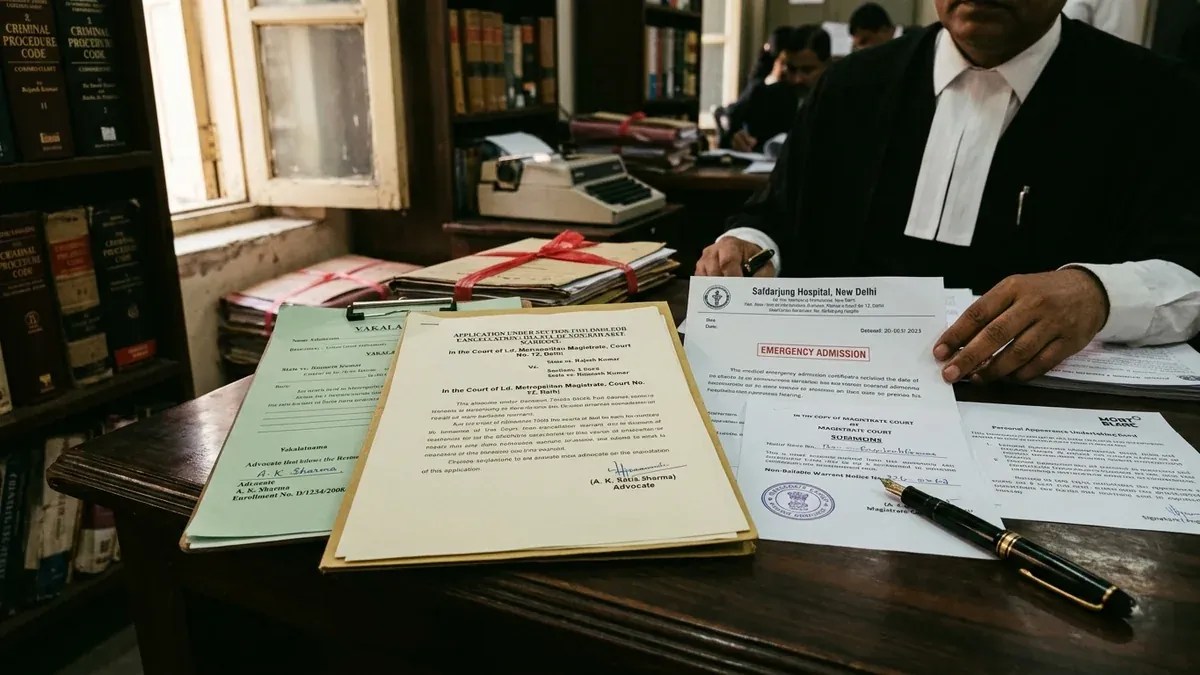
Receiving information that a criminal court has issued a Non-Bailable Warrant (NBW) against you is one of the most alarming situations a citizen can encounter. Whether resulting from missed hearing dates due to medical emergencies, non-service of summons by police, or inadvertent address discrepancies, an active NBW exposes an individual to imminent arrest and police lockup.
However, an NBW is not an irreversible decree. Under Section 73(2) of the Bharatiya Nagarik Suraksha Sanhita, 2023 (BNSS) (formerly Section 70(2) of the Code of Criminal Procedure, 1973), the court that issued the warrant possesses complete statutory authority to cancel or recall it. Guided by the Supreme Court’s landmark guidelines in Inder Mohan Goswami v. State of Uttaranchal (2007), trial courts are mandated to prioritize personal liberty over mechanical incarceration.
Under Section 73 BNSS, a warrant of arrest remains in force until cancelled by the issuing court or executed. The Supreme Court in Inder Mohan Goswami ruled that Non-Bailable Warrants should never be issued mechanically, and courts must liberally cancel NBWs when the accused voluntarily appears and furnishes undertaking.
1. Statutory Architecture of Section 73 BNSS
Section 73 BNSS governs the form and duration of arrest warrants:
"(1) Every warrant of arrest issued by a Court under this Sanhita shall be in writing, signed by the presiding officer of such Court and shall bear the seal of the Court.
(2) Every such warrant shall remain in force until it is cancelled by the Court which issued it, or until it is executed."
2. The Inder Mohan Goswami Supreme Court Guidelines
In Inder Mohan Goswami v. State of Uttaranchal (2007 12 SCC 1), the Supreme Court laid down exhaustive instructions restraining magistrates from issuing NBWs casually:
The Constitution Bench settled that anticipatory bail under Section 438 CrPC (Section 482 BNSS) should not routinely be limited to a fixed time frame, reaffirming that personal liberty under Article 21 cannot be curtailed on vague apprehensions. In Satender Kumar Antil, the Supreme Court mandated that investigating agencies and magistrates strictly adhere to procedural compliance under Section 41A (Section 35 BNSS), establishing that arrests must be justified by exceptional necessity rather than mechanical executive exercise.
"Non-bailable warrant involves curtailment of liberty. Arrest and imprisonment means deprivation of the most precious right of an individual. Therefore, the courts have to be extremely careful before issuing non-bailable warrants. The court should properly balance personal liberty and the interest of the State... As far as possible, if the court is of the opinion that a summons will suffice in getting the appearance of the accused in the court, the summons or the bailable warrants should be preferred."
NBWs should be issued only when: (1) it is reasonable to believe that the person will not attend court voluntarily, (2) police have been unable to serve summons, or (3) the person has gone underground to evade trial.
3. Step-by-Step Procedure to Cancel an NBW
To cancel an NBW safely without being remanded to jail, the following procedure should be adopted:
- File Recall Application under Section 73(2) BNSS: Prepared by counsel detailing the bona fide reason for non-appearance (e.g. medical illness with hospital records, travel, bereavement).
- Furnish Personal Undertaking: Affirming continuous future appearance on every scheduled trial date.
- Physical Appearance Before Court: Accompanying counsel to the courtroom early in the morning session, surrendering to the court's jurisdiction while praying for cancellation.