
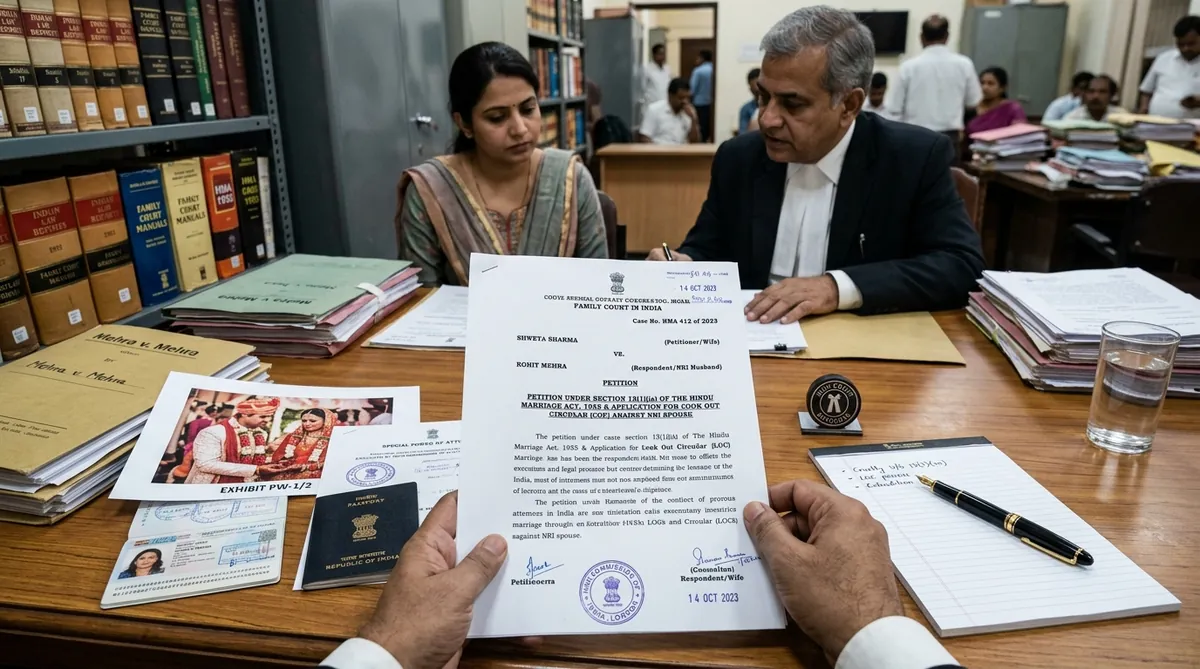
In transnational matrimonial breakdowns, "forum shopping" is a frequent strategic ploy. A financially dominant spouse living abroad often files for divorce in foreign family courts (e.g., Texas, California, London, or Dubai) where no-fault divorce laws, restrictive alimony rules, or sheer geographical distance severely disadvantage the spouse residing in India.
To prevent grave injustice, Indian courts exercise in personam jurisdiction to grant Anti-Suit Injunctions. Although an Indian court does not direct or instruct the foreign sovereign court, it acts directly upon the litigant spouse under its personal jurisdiction, prohibiting them from prosecuting or maintaining the oppressive foreign proceedings under pain of contempt of court.
An anti-suit injunction is an equitable remedy granted by Indian courts restraining a spouse from instituting or continuing vexatious divorce proceedings in a foreign court. Courts grant anti-suit injunctions when the foreign forum is oppressive, Indian courts are the natural forum, and foreign litigation circumvents statutory Indian matrimonial protections.
1. The Three-Pillar Test for Anti-Suit Injunctions
In Modi Entertainment Network v. W.S.G. Cricket Pte. Ltd. (2003) and reaffirmed in matrimonial contexts in Dinesh Singh Thakur v. Sonal Thakur (2018), the Supreme Court established three cardinal principles:
- Personal Jurisdiction: The defendant spouse against whom the injunction is sought must be amenable to the personal jurisdiction of the Indian court.
- Injustice & Oppression: If the injunction is declined, the refusal would result in grave injustice and irreparable hardship to the applicant spouse.
- Natural & Appropriate Forum: India must be the natural, convenient, and appropriate forum (forum conveniens) for resolving the matrimonial dispute, taking into account solemnization of marriage, matrimonial home, and child residence.
2. Common Grounds for Restraining Foreign Divorce
Indian Family Courts and High Courts grant anti-suit injunctions upon proof of:
"Where a marriage is solemnized in India under the Hindu Marriage Act, 1955, and the parties lived as husband and wife in India, a spouse cannot rush to a foreign court immediately after desertion to take advantage of liberal foreign divorce laws, leaving the resident spouse without travel means or legal representation."
- Vexatious and Oppressive Action: The foreign litigation is designed solely to coerce a settlement or escape domestic cruelty and maintenance complaints.
- Lack of Visa or Means: The resident spouse is legally unable to travel to the foreign country due to expired visa or financial incapacitation.
- Forum Non-Conveniens Abroad: The foreign court lacks substantive connection with the root causes of the matrimonial breakdown.
3. Consequences of Breaching an Anti-Suit Injunction
If the injuncted spouse defies the Indian court order and continues foreign proceedings:
- Contempt of Court: Contempt proceedings under the Contempt of Courts Act, 1971 lead to fine or civil imprisonment upon entering India.
- Per Se Nullity in India: Any decree obtained from the foreign court in violation of an Indian injunction is treated as obtained by fraud, rendering it completely void under Section 13(e) CPC.
- Attachment of Indian Properties: The Family Court can order attachment of the defaulting spouse's bank accounts and properties under Order 39 Rule 2A CPC.
Landmark Judicial Precedents & Statutory Authorities
Courts and appellate tribunals across Delhi NCR (Faridabad, Saket, Tis Hazari, Gurugram, High Courts) strictly apply these authoritative Supreme Court benchmarks:
The Supreme Court reaffirmed the three mandatory golden tests for grant of interlocutory injunctions under Order XXXIX Rules 1 and 2 of the Code of Civil Procedure: (i) strong prima facie case, (ii) balance of convenience tilted in applicant's favor, and (iii) imminent threat of irreparable injury not compensable in monetary damages. The Court held that temporary relief cannot be granted mechanically without judicial application of mind.