Voice Recording & Phone Call Audio Admissibility: Forensic Voice Spectrography in Indian Courts under BSA 2023
 Authored by: Advocate Kishan Kumar (Advocate & Legal Consultant)
Quick Summary & Strategic Key Takeaways
- Foundational Admissibility Rules (R.M. Malkani): Audio recordings and wiretap conversations are legally admissible as res gestae evidence if the speaker's voice is identified, continuous recording integrity is proven without cuts, and relevance is demonstrated.
- Mandatory Section 63 BSA Certificate: Digital audio files extracted onto flash drives, optical discs, or hard drives are inadmissible unless accompanied by a certified Part A / Part B statutory certificate under Section 63 of the Bharatiya Sakshya Adhiniyam, 2023.
- Forensic Voice Exemplars Compulsion (Ritesh Sinha 2019): Judicial Magistrates possess inherent power to order an accused or witness to provide voice exemplars for CFSL spectrographic analysis; this does not violate Article 20(3) self-incrimination protections.
- Family Courts Act Relaxation (Section 14): Matrimonial litigants can place telephonic clips before Family Courts to substantiate cruelty or marital infidelity, subject to forensic authenticity scrutiny.
1. Evidentiary Status of Audio Clips under Bharatiya Sakshya Adhiniyam, 2023
In contemporary Indian litigation, audio recordings—ranging from recorded telephonic conversations, WhatsApp voice notes, and sting operation dictaphone recordings to CCTV audio feeds—constitute critical electronic evidence. Under the Bharatiya Sakshya Adhiniyam, 2023 (BSA), which replaced the Indian Evidence Act, 1872, electronic records are elevated to equal footing with traditional documentary evidence.
Section 61 of the BSA establishes that the contents of electronic records may be proved in accordance with Section 63. Audio data stored in semiconductor flash memory, hard disk drives, cloud servers, or magnetic tapes constitutes an "electronic record" under Section 2(1)(t) of the Information Technology Act, 2000. When an audio recording is tendered in court, it serves two distinct evidentiary purposes: as substantive evidence of an admission or confession under Sections 15 to 23 of the BSA, or as contemporaneous res gestae evidence forming part of the same transaction under Section 4 of the BSA.
2. The Three-Prong Judicial Admissibility Test (Malkani to Arjun Khotkar)
The admissibility of audio evidence is governed by landmark jurisprudence developed by the Supreme Court across five decades:
R.M. Malkani v. State of Maharashtra (1973) 1 SCC 471
In this foundational ruling, the Supreme Court laid down that a contemporaneous tape recording of a relevant conversation is a relevant fact and is admissible under Section 7 (now Section 4 BSA) of the Evidence Act. The Court formulated the celebrated three-condition test:
- Identification of Voice: The voice of the speaker must be clearly identified with certainty by the maker, by persons familiar with the voice, or through forensic voice analysis.
- Accuracy and Completeness: The whole of the conversation must be recorded, and the court must be satisfied that the recording has not been tampered with, edited, spliced, or erased in any part.
- Contemporaneous Relevance: The conversation must be relevant to the issues in dispute and must have been recorded contemporaneously with the events in question.
Ziyauddin Burhanuddin Bukhari v. Brijmohan Ramdass Mehra (1976) 2 SCC 17
The Supreme Court held that tape records of speeches and conversations are "documents" within the meaning of Section 3 of the Evidence Act. The Court emphasized that before admitting tape-recorded evidence, the trial court must satisfy itself that the record has been kept in safe custody with an unbroken chain of custody, ruling out the possibility of third-party interference.
Arjun Panditrao Khotkar v. Kailash Kushanrao Gorantyal (2020) 7 SCC 1
A three-judge bench settled that secondary electronic evidence (such as audio burned to a CD or copied to a USB drive) is strictly inadmissible unless accompanied by a statutory certificate under Section 65B (now Section 63 BSA). The production of this certificate is a condition precedent to the admissibility of any secondary electronic audio recording.
3. Forensic Voiceprint Identification & CFSL Spectrographic Methodology
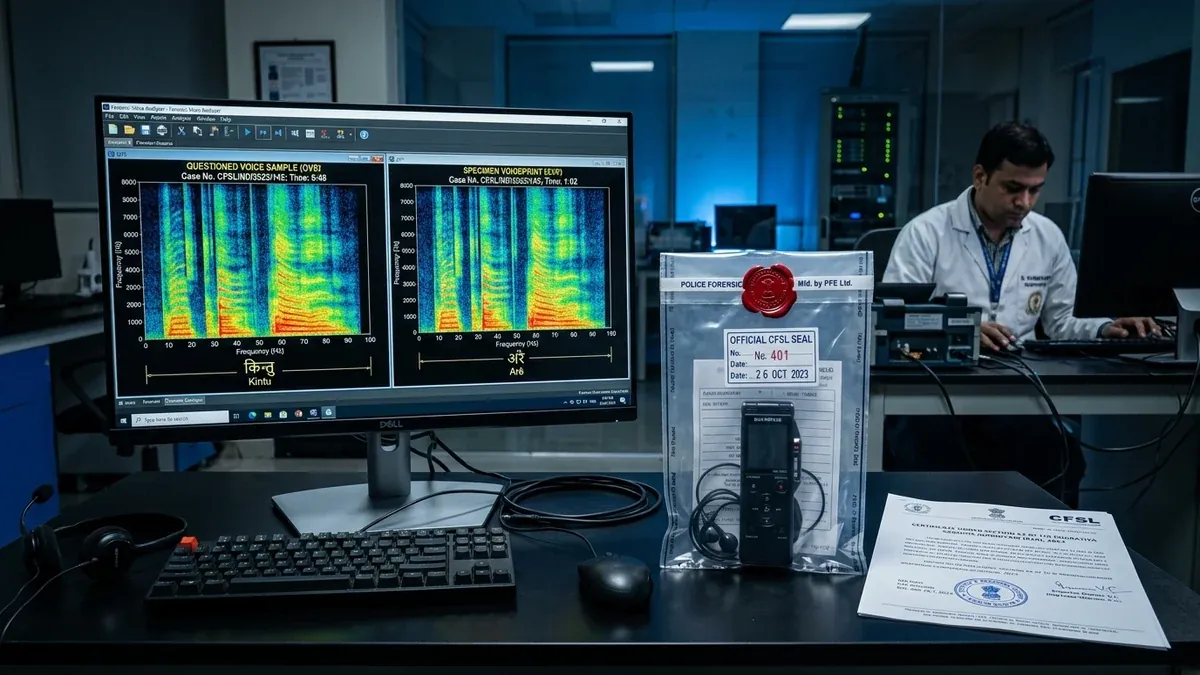
When an accused or opposite party denies that the recorded voice is theirs, the court refers the questioned audio to the Central Forensic Science Laboratory (CFSL) or a State Forensic Science Laboratory (FSL) for forensic voice identification. Voiceprint identification is based on the biological and neurological uniqueness of human speech production.
The human voice tract consists of vocal cords, larynx, pharynx, oral cavity, nasal cavity, tongue, teeth, and lips. The combination of these anatomical structures creates unique resonance frequencies known as formants. The CFSL forensic protocol entails:
| Forensic Analysis Stage | Scientific Methodology | Judicial Significance |
|---|---|---|
| 1. Auditory Analysis | Acoustic-phonetic evaluation by certified linguists examining accent, pitch, dialect, speech rate, and respiratory pauses. | Initial screening to eliminate obvious voice mismatches or unnatural digital artifacts. |
| 2. Spectrographic Analysis | Generation of sound spectrograms displaying frequency (Hz) on the vertical axis, time on the horizontal axis, and energy intensity. | Precise matching of formant frequencies (F1, F2, F3) and vowel-consonant transition patterns. |
| 3. Authenticity & Tamper Verification | Electric Network Frequency (ENF) analysis and waveform continuity inspection to identify splices, background hum disruptions, or AI syntheses. | Detects whether audio was digitally edited, concatenated, or generated using deepfake voice cloning models. |
| 4. Exemplar Comparison | Statistical comparison against controlled voice exemplars recorded before the Magistrate under standard reading texts. | Establishes scientific probability of speaker identity under Section 39 BSA (Expert Opinion). |
4. Judicial Power to Compel Voice Samples: Ritesh Sinha Doctrine
For decades, an unresolved constitutional question persisted: Could a magistrate compel an unwilling accused to provide a voice sample, or did it violate the fundamental right against self-incrimination under Article 20(3) of the Constitution?
Ritesh Sinha v. State of Uttar Pradesh (2019) 8 SCC 1
A three-judge bench of the Supreme Court invoked its plenary constitutional powers under Article 142 to bridge the legislative gap. The Court held:
Supreme Court Ruling in Ritesh Sinha (2019):
"Until explicit statutory provisions are enacted by Parliament, a Judicial Magistrate must be conceded the power to order a person to give a sample of his voice for the purpose of investigation of a crime... Such an order does not infringe the fundamental right against self-incrimination guaranteed under Article 20(3) of the Constitution, as physical or vocal measurements do not constitute 'testimonial compulsion'."
This principle has now received statutory codification under Section 349 of the Bharatiya Nagarik Suraksha Sanhita, 2023 (BNSS), empowering Magistrates to order any person to furnish voice samples, signatures, or handwriting specimens for investigation.
5. Wiretaps & Secret Recordings in Matrimonial Litigation (Section 14 Family Courts Act)
In matrimonial and family disputes, spouses frequently seek to introduce secretly recorded phone calls to establish mental cruelty under Section 13(1)(ia) of the Hindu Marriage Act, 1955, or adultery. Litigants often object, citing the right to privacy affirmed in K.S. Puttaswamy v. Union of India (2017).
However, Family Courts operate under a specialized statutory regime. Section 14 of the Family Courts Act, 1984 explicitly provides:
Section 14, Family Courts Act, 1984:
"A Family Court may receive as evidence any report, statement, document, information or matter that may, in its opinion, assist it to deal effectually with a dispute, whether or not the same would be otherwise relevant or admissible under the Indian Evidence Act, 1872."
In Deepti Kapur v. Ranbijay Singh (2021), the Delhi High Court reconciled the right to privacy with Section 14, holding that a secretly recorded conversation between husband and wife is admissible before the Family Court to determine matrimonial cruelty. The Court ruled that constitutional privacy violations do not operate as an automatic statutory bar to evidentiary admissibility in civil proceedings, though the court exercises discretion regarding its weight and credibility.
6. Preserving Hash Values, Metadata & Chain of Custody
To withstand intense courtroom cross-examination, counsel must advise clients to follow strict digital forensics standards (ISO/IEC 27037) from the moment of recording:
- Never Edit or Rename Original File: Keep the source recording untouched on the original capturing device (smartphone, voice recorder). Creating an edited or cropped version immediately destroys digital authenticity.
- Generate Cryptographic Hash Value: Immediately calculate the SHA-256 and MD5 hash values of the original audio file. Document the exact date, time, and command-line output.
- Bit-Stream Forensics Mirroring: Create an exact bit-stream physical image of the storage media onto write-blocked external storage before extracting copies for court filing.
- Preserve Unbroken Chain of Custody: Maintain a physical log detailing who handled the source media, storage temperature/safekeeping, and transfer timestamps to the forensic expert or filing advocate.
7. Strategic Cross-Examination Blueprint for Discrediting Fabricated Audio
When defending against an audio clip produced by the prosecution or opposite party, cross-examination must systematically attack three vulnerabilities:
| Cross-Examination Target | Trial Counsel Strategy & Line of Questioning | Judicial Objective |
|---|---|---|
| 1. Non-Production of Source Device | Confront the witness: "Where is the original smartphone used to record this conversation? Why was the primary device not seized or deposited under panchnama?" | Exclude secondary evidence under Section 63(3) BSA and create doubt regarding device tampering. |
| 2. Defective Section 63 BSA Certificate | Interrogate the certifying officer on technical credentials: "Do you possess administrative control over the recording server? Can you state the exact cryptographic hash algorithm used?" | Invalidate certificate under Arjun Khotkar precedent, rendering the audio legally inadmissible. |
| 3. Background Noise & ENF Continuity | Highlight acoustic anomalies: "Is it not true that the ambient traffic hum abruptly stops at minute 02:14 and restarts at 02:22?" | Establish evidence of splicing, editing, or artificial insertion of incriminating words. |
| 4. AI Voice Synthesis / Deepfake Possibility | Cross-examine CFSL expert: "Did your laboratory employ AI generative voice detection models to eliminate neural network voice cloning?" | Introduce reasonable doubt in criminal trials regarding deepfake audio synthesis. |
8. Specimen Draft: Section 63 BSA Certificate for Audio Evidence
Below is a standardized statutory certificate format for tendering audio recordings under Section 63(4) of the Bharatiya Sakshya Adhiniyam, 2023:
CERTIFICATE UNDER SECTION 63(4) OF THE BHARATIYA SAKSHYA ADHINIYAM, 2023
FOR ADMISSIBILITY OF ELECTRONIC AUDIO RECORDING
I, [Name of Certifying Person], aged [X] years, residing at [Address], do hereby solemnly affirm and state as follows:
1. I am the lawful owner / person in lawful command and control of the electronic device, namely: [Device Make, Model, IMEI / Serial Number], running operating system [OS Version].
2. On [Date] at approximately [Time] hours, I recorded / received the telephonic conversation / audio recording between [Speaker 1] and [Speaker 2], having a total duration of [Minutes:Seconds], stored under original filename [Original_Audio.m4a / .wav].
3. Integrity & Operational Regularity (Section 63(2)): During the period in which the recording was produced, the said electronic device was operating properly, and there were no operational defects or system malfunctions affecting the production, contents, or reproduction of the electronic record.
4. Cryptographic Hash Value Authentication: The original audio file was transferred onto a brand-new, write-once Compact Disc / USB Flash Drive [Serial No: XXXXXX] without any editing, compression, or modification. The cryptographic hash values are:
- SHA-256 Hash: [Insert 64-character SHA-256 Hash]
- MD5 Hash: [Insert 32-character MD5 Hash]
5. The contents of the accompanying Compact Disc / USB drive are an exact, true, and unadulterated reproduction of the original electronic recording stored in my source device.
DEPONENT
Name: [Full Name] | Designation / Relation: [Details] | Date: [DD/MM/YYYY]
9. Forensic Parameters vs Evidentiary Weight Comparative Matrix
| Evidence Scenario | Statutory Compliance | Forensic Weight | Admissibility & Evidentiary Value |
|---|---|---|---|
| Primary Device Produced (Source phone in court with unbroken seal) | Section 62 BSA (Primary Electronic Evidence) | Maximum (100% conclusive) | Substantive evidence; no Section 63 certificate required (per Arjun Khotkar). |
| Secondary Media + Valid Sec 63 Certificate + CFSL Voice Match | Section 63 BSA & Section 39 BSA | High (Corroborative to Substantive) | Admissible; capable of supporting criminal conviction or civil decree. |
| Secondary Media WITHOUT Sec 63 Certificate | Non-compliant with Section 63 BSA | Zero (Statutorily Inadmissible) | Absolute bar on admissibility; trial court cannot look into contents. |
| Audio Clip with Broken Timestamps / No Source Device | Section 63 BSA attempted | Extremely Weak (Suspect) | Vulnerable to rejection during trial due to reasonable doubt of splicing. |
Frequently Asked Questions on Audio Recording Admissibility & Forensic Voiceprints
Comprehensive legal and forensic guide to voice clip admissibility, BSA 2023 Section 63 certification, and cross-examination tactics.
Are secretly recorded phone calls and audio clips admissible in Indian courts?
Yes. The Supreme Court in R.M. Malkani v. State of Maharashtra held that tape-recorded or digital audio conversations are admissible as relevant contemporaneous res gestae evidence, provided three mandatory legal conditions are met: (1) The voice of the speaker is identified by someone familiar with it or through forensic voice spectrography; (2) The accuracy and continuous integrity of the recording is proven without any cuts, tampering, or erasure; and (3) The recording is contemporaneous and strictly relevant to the matter in issue. The fact that the recording was made without the other party's knowledge does not per se render it inadmissible, though courts evaluate its evidentiary weight with extreme caution.
Is a Section 63 BSA 2023 certificate mandatory for submitting audio clips in court?
Yes. Under Section 63 of the Bharatiya Sakshya Adhiniyam, 2023 (formerly Section 65B of the Indian Evidence Act, 1872) and the three-judge bench ruling in Arjun Panditrao Khotkar (2020), any electronic record—including audio files stored on pen drives, CDs, memory cards, or phone storage—must be accompanied by a mandatory statutory certificate in Part A and Part B format under the Schedule to BSA 2023 at the time of filing or leading evidence. Without this certificate, secondary electronic evidence of audio clips is completely inadmissible.
How does Forensic Voiceprint Identification work in the CFSL / FSL?
Forensic Speech and Audio Analysis at Central/State Forensic Science Laboratories involves two scientific processes: Auditory Acoustic Analysis and Spectrographic Examination. Forensic scientists compare the questioned audio clip against standard voice exemplars of the speaker recorded under controlled conditions (under Section 349 BNSS / old Section 311A CrPC). They analyze acoustic parameters such as Fundamental Frequency (F0), formant frequencies (F1, F2, F3), vocal tract resonance, jitter, shimmer, and unique dialectal articulation patterns.
Can audio recordings of a spouse be used in matrimonial disputes without violating privacy?
In matrimonial proceedings before Family Courts (under Section 14 of the Family Courts Act, 1984), strict rules of evidence are relaxed. The Punjab & Haryana High Court and Delhi High Court have held that a spouse can place recorded telephone conversations on record to prove cruelty, adultery, or harassment, as technical rules of evidence yield to the court's truth-finding objective. However, the opposing spouse can challenge the recording's integrity and request forensic verification.
What is the Hash Value and why is it critical for digital audio evidence?
A cryptographic Hash Value (such as SHA-256 or MD5) serves as a unique digital fingerprint of an audio file. Generated using mathematical algorithms, the hash value remains identical as long as the file is untouched. If even a single byte or microsecond of audio is spliced, edited, or deleted, the hash value changes completely. Documenting the original hash value at the moment of recording establishes chain of custody and rules out tampering.
Can an accused refuse to give voice samples citing Article 20(3) against self-incrimination?
No. In Ritesh Sinha v. State of Uttar Pradesh (2019) 8 SCC 1, a three-judge bench of the Supreme Court held that compelling an accused to give voice samples for forensic examination does not violate the fundamental right against self-incrimination under Article 20(3) of the Constitution. The Court empowered Judicial Magistrates to direct any person or accused to provide voice samples during criminal investigations.
What is the consequence if the original recording device (phone/dictaphone) is destroyed?
If the primary recording device is destroyed, lost, or unavailable, secondary copies (e.g., pen drives, CD-ROMs) can only be admitted if the party proves the chain of custody and satisfies Section 63 BSA conditions, demonstrating why the primary device cannot be produced. If the opponent establishes plausible allegations of editing or fabrication, the absence of the primary device severely undermines the evidential weight.
What cross-examination tactics are used to dismantle unauthenticated audio recordings?
Key trial tactics include: (1) Demanding the source device and SIM card under Section 94 BNSS; (2) Establishing gaps, background ambient noise changes, or non-continuous timestamps; (3) Challenging the competence of the person executing the Section 63 BSA certificate; (4) Proving that modern Generative AI / Deepfake voice cloning tools could simulate the speaker's vocal characteristics; and (5) Moving an application under Section 329 BNSS seeking independent CFSL re-examination.