
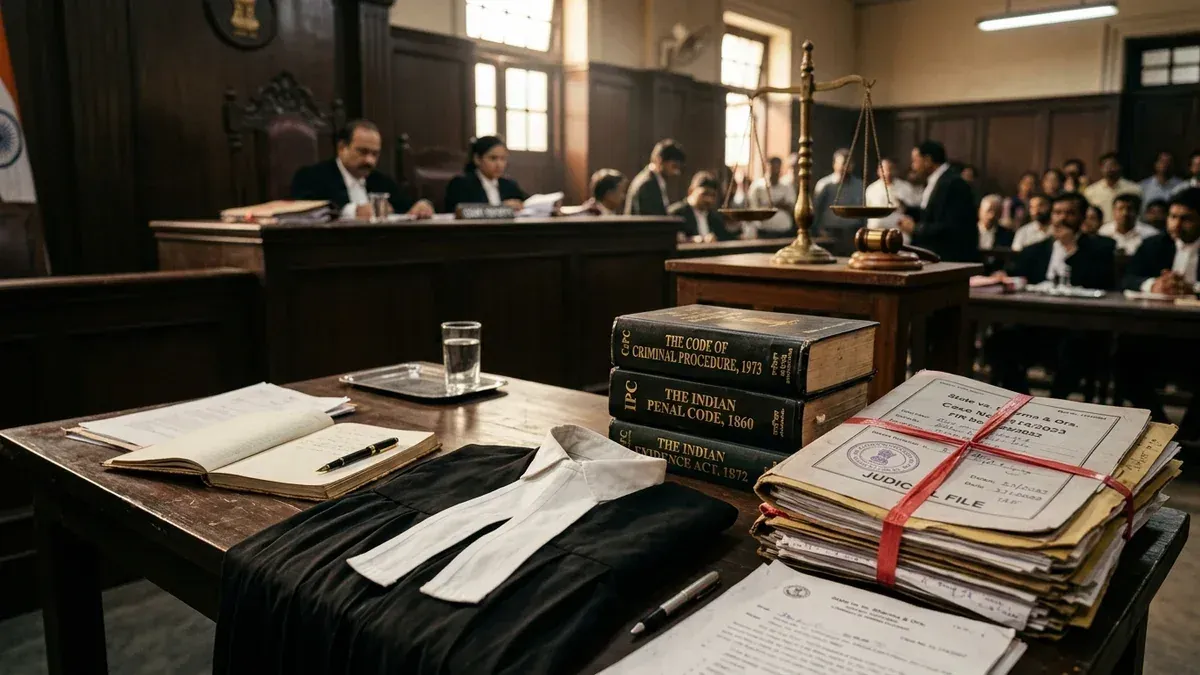
In Indian criminal jurisprudence, personal liberty under Article 21 of the Constitution is zealously protected against prolonged, languishing pre-trial detention. Section 167(2) of the Code of Criminal Procedure, 1973 (now incorporated and expanded under Section 187 of the Bharatiya Nagarik Suraksha Sanhita, 2023 [BNSS]) establishes an indefeasible statutory right: if the police or investigating agency fails to conclude investigation and file a complete Final Report within 60 or 90 days, the accused is entitled to Statutory Default Bail as a matter of right.
To circumvent this statutory guarantee, investigating agencies frequently resort to a deceptive strategy: on the 59th or 89th day, they submit a preliminary, piecemeal, or incomplete charge-sheet lacking forensic reports, sanctions, or material witness statements, accompanied by a routine request for "further investigation." The legal battle over whether such truncated reports extinguish default bail reached its zenith in the Supreme Court's landmark judgment in Central Bureau of Investigation v. Kapil Wadhawan & Anr. (2024) 3 SCC 734.
The right to default bail under the proviso to Section 167(2) CrPC / Section 187(3) BNSS is an indefeasible fundamental right linked directly to Article 21. Once the statutory period (60 or 90 days) expires without a competent charge-sheet on record, the right to bail crystallizes the instant the accused applies and offers to furnish bail bonds.
1. Statutory Timelines: Section 167(2) CrPC vs. Section 187 BNSS, 2023
Trial advocates must compute limitation deadlines with mathematical precision:
| Offence Category | Statutory Window | Key Offences (BNS / IPC) |
|---|---|---|
| 90 Days | Offences punishable with death, imprisonment for life, or imprisonment for a term of not less than 10 years. | Section 103 BNS (Murder / 302 IPC), Section 111 BNS (Organized Crime), Section 70 BNS (Gang Rape / 376D IPC), Section 310 BNS (Dacoity / 395 IPC). |
| 60 Days | All other cognizable offences punishable with imprisonment up to 10 years. | Section 318 BNS (Cheating / 420 IPC), Section 316 BNS (Breach of Trust / 406 IPC), Section 115 BNS (Grievous Hurt / 326 IPC). |
Calculation Rule: The date on which the accused was first remanded to custody by the Magistrate is excluded, and the date on which the charge-sheet is tendered in court is included (Chaganti Satyanarayana (1986)).
2. The Incomplete Charge-Sheet Controversy: Kapil Wadhawan (2024)
In CBI v. Kapil Wadhawan, a two-judge bench of the Supreme Court resolved conflicting interpretations regarding what constitutes a valid police report for Section 167(2) purposes:
- Sufficiency to Take Cognizance: If the police report filed under Section 173(2) contains sufficient factual allegations and prima facie evidence against the accused for the Magistrate to take cognizance of the offence, the charge-sheet cannot be branded as "incomplete" merely because further investigation is pending under Section 173(8) CrPC.
- The Line Between Incomplete and Supplementary: However, if the report is an empty shell—devoid of core witness statements or basic material establishing the ingredients of the crime, filed solely as a sham subterfuge to defeat the 90-day clock—the accused remains entitled to statutory default bail.
- Absence of Sanction / FSL: The Supreme Court clarified that the absence of government sanction or pending chemical examiner reports does not automatically vitiate an otherwise complete charge-sheet if the core investigation against the custody prisoner is complete.
3. Step-by-Step Courtroom Protocol: How to Secure Default Bail
To prevent the prosecution from defeating your client's accrued right, follow this tactical trial protocol:
- Track the Midnight Clock: Calculate the exact 60th or 90th day from initial remand. If day 90 expires on Sunday, the accused's right accrues on Monday morning the moment court opens.
- File the Default Bail Application Immediately: File the application under Section 187(3) BNSS / Section 167(2) CrPC at 10:00 AM before the Ahlmad or Magistrate. The application must explicitly state: "The applicant is ready and willing to furnish sound and solvent surety bonds."
- The "Filing Before Disposal" Trap: Under M. Ravindran v. Directorate of Revenue Intelligence (2021) 2 SCC 485, once the accused files the default bail application, the subsequent filing of a charge-sheet later that afternoon cannot extinguish the accrued right. The Magistrate must decide the bail application first.
Ready Court Draft: Application for Statutory Default Bail
IN THE COURT OF THE LEARNED CHIEF JUDICIAL MAGISTRATE / METROPOLITAN MAGISTRATE, DELHI / GURUGRAM

CRIMINAL CASE NO. ________ OF 2026

IN THE MATTER OF:
State (Govt. of NCT of Delhi / Haryana)      ...PROSECUTION
                             VERSUS
[Accused Name], S/o [Father Name]
Presently confined in Central Jail, Tihar    ...APPLICANT / ACCUSED

FIR NO.: [FIR Number]
POLICE STATION: [Police Station]
UNDER SECTIONS: [Sections of BNS / IPC]

APPLICATION UNDER SECTION 187(3) OF THE BHARATIYA NAGARIK SURAKSHA SANHITA, 2023
(SECTION 167(2) OF THE CODE OF CRIMINAL PROCEDURE, 1973) FOR GRANT OF STATUTORY DEFAULT BAIL

MOST RESPECTFULLY SHOWETH:

1. That the Applicant was arrested in connection with the aforesaid FIR on [Date] and was first remanded to judicial custody by this Hon'ble Court on [Date of First Remand].
2. That the statutory period of 60 / 90 days prescribed under Section 187(3) BNSS expired on [Date of Expiry].
3. That the investigating agency has failed to submit a complete and lawful charge-sheet under Section 193 BNSS (Section 173 CrPC) within the mandated statutory period.
4. That by operation of law, an indefeasible right to statutory default bail has accrued in favor of the Applicant in terms of the binding Constitution Bench principles in Sanjay Dutt (1994) and M. Ravindran (2021).
5. That the Applicant is a permanent resident of [Address], has clean antecedents, and is ready and willing to furnish sound and solvent local surety bonds to the satisfaction of this Hon'ble Court.

PRAYER:
It is therefore respectfully prayed that this Hon'ble Court may be pleased to release the Applicant on Statutory Default Bail under Section 187(3) BNSS / Section 167(2) CrPC, upon such terms and conditions as deemed fit and proper.

APPLICANT / ACCUSED
THROUGH COUNSEL
Official Landmark Case Brief
Read our certified courtroom brief: CBI v. Kapil Wadhawan (2024) Case Analysis & Ratio. Our criminal trial team secures regular bail, anticipatory bail, and default bail for clients across Delhi NCR and Haryana courts.

Advocate Kishan Kumar
Criminal, Civil & Debt Recovery Advocate • Bar Council of Delhi