Specific Performance of Sale Agreement: Section 16(c) Readiness & Willingness in Property Litigation
 Authored by: Advocate Kishan Kumar (Advocate & Legal Consultant)
Quick Summary & Strategic Key Takeaways
- Specific Performance is Now Mandatory: The Specific Relief (Amendment) Act, 2018 fundamentally transformed property litigation in India. Section 10 now commands that specific performance shall be enforced by civil courts, removing the historic discretion of judges to refuse execution and award only nominal compensation.
- The Inflexible Mandate of Section 16(c): Under Section 16(c) of the Specific Relief Act, 1963, a buyer cannot secure a decree of specific performance unless they affirmatively aver and prove that they were continuously "ready and willing" to perform their contractual obligations from the date of the agreement up to the date of the decree.
- Readiness vs. Willingness Explained: As established in Acharya Swami Ganesh Dassji v. Sita Ram Thapar, "readiness" refers to the financial capacity and solvency to pay the balance sale consideration, while "willingness" refers to the mental desire and overt conduct showing enthusiasm to complete the purchase.
- Evidentiary Burden (U.N. Krishnamurthy Precedent): In U.N. Krishnamurthy v. A.M. Krishnamurthy (2022 SC), the Supreme Court held that mere verbal averments of financial capacity are fatal. The plaintiff must produce contemporaneous bank statements, fixed deposit certificates, or loan sanction letters.
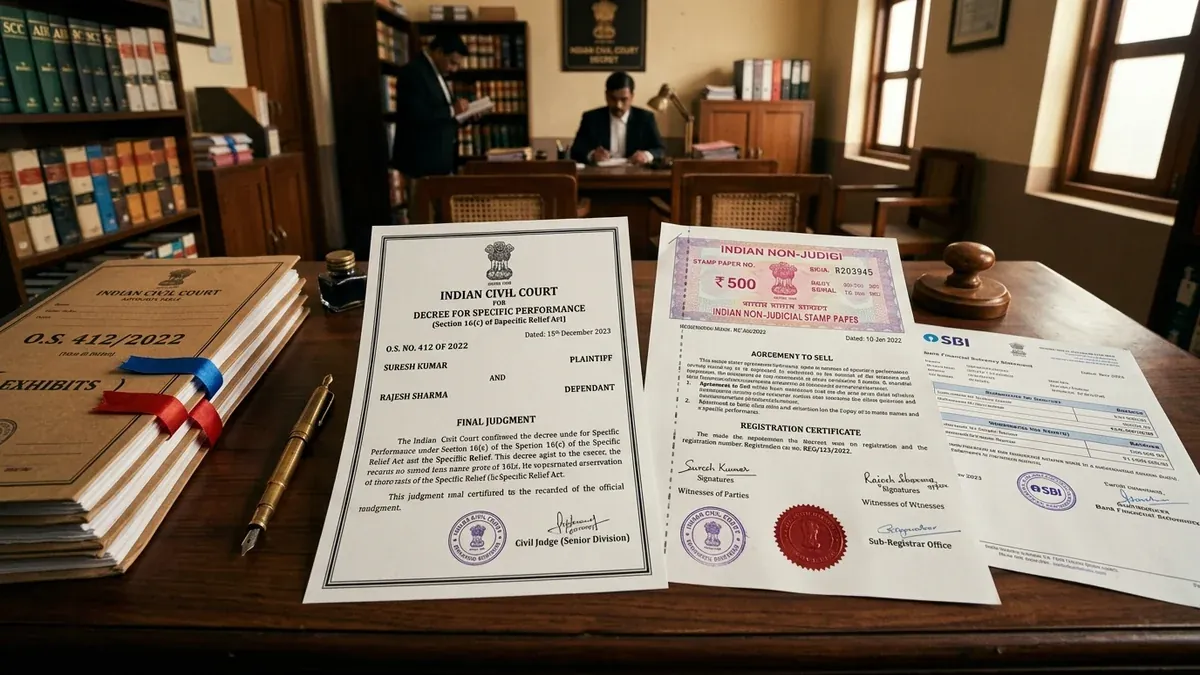
1. The 2018 Paradigm Shift: From Discretionary to Mandatory Relief (Section 10)
For decades, agreements to sell immovable property across India were plagued by judicial uncertainty. If real estate prices skyrocketed after signing an Agreement to Sell (Bayana Agreement), unscrupulous vendors routinely reneged on contracts, sold to higher third-party bidders, and offered to return only the initial deposit. Civil courts frequently refused specific performance on equitable grounds, leaving bona fide buyers with inadequate monetary compensation.
This entire legal landscape was overhauled by the Specific Relief (Amendment) Act, 2018 (Act No. 18 of 2018), which took effect on October 1, 2018. The amendment altered the fundamental philosophy of Indian contract enforcement:
| Statutory Dimension | Pre-2018 Legal Regime | Post-2018 Amended Regime |
|---|---|---|
| Judicial Discretion (Section 10) | Section 10 provided that specific performance may, in the discretion of the court, be granted if monetary compensation was inadequate. | Section 10 mandates that specific performance shall be enforced by the court. Judicial discretion to deny performance is extinguished. |
| General Rule vs. Exception | Monetary damages were the default general rule; specific performance was an exceptional equitable remedy. | Specific performance of real estate contracts is the statutory default rule; damages are strictly secondary. |
| Substituted Performance (Section 20) | No statutory mechanism existed for getting performance completed through a third party at the defaulting party's expense. | Section 20 introduces a complete statutory regime for "Substituted Performance" through third parties after 30 days notice. |
| Special Courts & Timelines (Section 20B & 20C) | Suits languished for 10 to 15 years without statutory fast-track disposal mandates. | State governments must designate Special Civil Courts to dispose of infrastructure and contract suits within 12 months. |
Supreme Court Jurisprudence on the 2018 Amendment
In Sughar Singh v. Hari Singh (2021 SCC OnLine SC 975), the Supreme Court held that even in suits filed prior to the 2018 amendment, courts must bear in mind the statutory legislative intent that favors performance over monetary damages. Furthermore, in Katta Sujatha Reddy v. Siddamsetty Infra Projects Pvt. Ltd. (2022), the Supreme Court clarified the prospective application of procedural and substantive amendments under the 2018 statute, firmly establishing that for modern property transactions, specific performance is a mandatory statutory entitlement.
2. Deconstructing Section 16(c): The Dual Prongs of Readiness & Willingness
Despite the mandatory nature of Section 10, the plaintiff’s path to a decree is strictly conditional upon overcoming the personal bar codified in Section 16(c) of the Specific Relief Act, 1963. The provision mandates that specific performance cannot be enforced in favor of a person:
"who fails to prove that he has performed or has always been ready and willing to perform the essential terms of the contract which are to be performed by him, other than terms the performance of which has been prevented or waived by the defendant."
The Supreme Court of India has meticulously analyzed the bifurcated concepts of "Readiness" and "Willingness" across a long line of authoritative precedents:
A. The Doctrinal Distinction: Acharya Swami Ganesh Dassji
In Acharya Swami Ganesh Dassji v. Sita Ram Thapar (1996 4 SCC 526), the Supreme Court laid down the classic formula:
- Readiness refers to the financial capacity, backing, and solvency of the purchaser to pay the balance consideration money and discharge necessary stamp duty and registration expenses.
- Willingness refers to the mental disposition, conduct, and enthusiasm of the purchaser to perform the agreement, manifested through overt acts such as calling upon the vendor, tendering draft conveyances, and issuing timely legal notices.
B. Substance Over Pleading Form: Syed Dhasthageer
In Syed Dhasthageer v. T.R. Gopalakrishna Chetty (2001 2 SCC 513), the Supreme Court ruled that the law does not require any rigid mechanical mantra or talismanic incantation in the plaint. While Section 16(c) requires a specific averment, the court must look at the overall substance of the pleadings and contemporaneous conduct of the parties rather than mere syntactic formula.
C. Strict Proof of Financial Capacity: U.N. Krishnamurthy
In the seminal decision of U.N. Krishnamurthy v. A.M. Krishnamurthy (2022 SC), the Supreme Court firmly reiterated that readiness cannot be presumed. A plaintiff who fails to place on record credible documentary evidence demonstrating their ability to arrange the balance consideration on the relevant date must be non-suited. Oral statements or assertions that relatives or business associates promised to lend money do not satisfy the rigorous evidentiary standard of Section 16(c).
3. Evidentiary Standards: Bank Statements, Sub-Registrar Attendance & Notices
Winning a specific performance suit requires an unassailable evidentiary paper trail. Trial courts in India demand contemporaneous documentary proof spanning the entire contractual timeline:
| Stage of Contract | Essential Evidentiary Document Required | Strategic Legal Purpose |
|---|---|---|
| Execution of Agreement | Registered Agreement to Sell / Duly Stamped Bayana Receipt; banking trail of earnest money paid (cheque / RTGS). | Proves valid, enforceable contract; eliminates vendor's defense of forged signature or cash non-receipt. |
| Approaching Target Date | Formal written communication tendering Draft Sale Deed for approval; requesting title deeds verification. | Establishes continuous "willingness" and places vendor under an active contractual obligation to respond. |
| Target Date of Execution | Certified affidavit and entry token slip from Sub-Registrar; bank pay orders for balance consideration. | Incontrovertible proof of physical presence and financial "readiness" on the exact target execution date. |
| Immediate Post-Default | Legal Notice dispatched via Speed Post / Registered AD on same day or within 48 hours of vendor's non-appearance. | Records vendor's breach contemporaneous to default, eliminating allegations of buyer's waiver or delay. |
| Trial & Deposition | Bank passbooks, IT returns, FD certificates, or bank loan sanction letters for entire suit duration. | Discharges statutory burden under Section 16(c) demonstrating uninterrupted solvency until final decree. |
The Sub-Registrar Attendance Strategy
The single most decisive piece of evidence in specific performance trials is the Sub-Registrar Attendance Affidavit. On the target execution date, the buyer must:
- Prepare Demand Drafts or Bank Pay Orders representing the balance consideration in favor of the vendor.
- Purchase requisite e-stamp papers or carry draft conveyance deeds.
- Physically present themselves before the jurisdictional Sub-Registrar’s office at 10:00 AM.
- Submit an application/affidavit to the Sub-Registrar stating readiness to execute the sale deed and requesting their presence be recorded.
- Obtain a stamped receipt, entry token, or certified copy of the Sub-Registrar’s attendance diary, and photograph the vendor's absence.
4. Limitation Periods under Article 54: The Two Limitation Limbs
The period of limitation for instituting a suit for specific performance is governed strictly by Article 54 of the Schedule to the Limitation Act, 1963. The prescribed period is three (3) years. However, the exact date from which the 3-year period begins to run depends on the language of the agreement:
Article 54, Limb 1: Where a Date is Fixed for Performance
If the Agreement to Sell explicitly specifies a calendar date or determinable milestone for performance (e.g., "The sale deed shall be registered on or before 30th November 2024"), limitation begins to run strictly from that specified date. The buyer cannot extend limitation by unilaterally issuing legal notices years later.
Article 54, Limb 2: Where No Date is Fixed for Performance
If the contract does not fix a specific calendar date (e.g., "The sale deed shall be executed after the vendor obtains municipal mutation and clearance of bank mortgage"), limitation begins to run only when the plaintiff has formal notice that performance is refused. This refusal typically manifests when the vendor issues a repudiation letter, forfeits the bayana, or formally rejects a legal notice.
5. Securing the Asset: Section 52 Lis Pendens & Order 39 Interim Injunctions
During the pendency of a specific performance suit, the greatest peril faced by the plaintiff is the vendor selling or mortgaging the subject property to a third-party purchaser. Indian property law provides a two-layer defense shield:
A. Doctrine of Lis Pendens (Section 52 Transfer of Property Act, 1882)
Section 52 codifies the common law maxim ut lite pendente nihil innovetur (during litigation, nothing new should be introduced). Any transfer, sale, gift, or mortgage of the property made during the active pendency of a contentious specific performance suit is legally subservient to the final decree of the court. The third-party purchaser cannot claim the status of a "bona fide purchaser for value without notice" to defeat the plaintiff’s decree.
B. Temporary Injunction under Order 39 Rules 1 & 2 CPC
Relying exclusively on Section 52 is dangerous because third-party creation introduces complicated execution hurdles and impleadment applications under Order 1 Rule 10 CPC. Therefore, immediately upon filing the plaint, the buyer must file an application under Order 39 Rules 1 & 2 read with Section 151 CPC seeking an ad-interim temporary injunction restraining the vendor from alienating, transferring, selling, mortgaging, or creating any encumbrance or parting with possession of the suit property until the final disposal of the suit.
6. Specimen Legal Notice Demanding Execution of Registered Sale Deed
Below is a specimen legal notice drafted by an advocate representing a ready and willing purchaser against a defaulting vendor:
LEGAL NOTICE VIA REGISTERED SPEED POST / COURIER / EMAIL
Date: [Insert Date]
To:
[Vendor Full Name],
[Vendor Father's / Husband's Name],
[Full Residential Address],
[City, District, State, PIN]
Subject: Formal Legal Notice demanding execution and registration of Sale Deed in respect of [Property Description / Flat / Plot No.] in terms of Agreement to Sell dated [Insert Agreement Date] under Section 10 & 16(c) of the Specific Relief Act, 1963.
Sir / Madam,
Under instructions from and on behalf of my client, [Client Full Name], residing at [Client Address], I hereby serve you with this formal Legal Notice:
- That you, the Addressee, entered into a valid and binding Agreement to Sell dated [Insert Date] with my client for the sale and transfer of absolute ownership rights in respect of immovable property being [Complete Property Description], for a total agreed sale consideration of Rs. [Insert Total Amount].
- That my client paid an earnest money sum of Rs. [Insert Bayana Amount] vide Cheque / RTGS UTR No. [Insert UTR/Cheque No.] dated [Insert Date], drawn on [Bank Name], which was duly acknowledged and encashed by you.
- That under Clause [Insert Clause No.] of the Agreement, the balance sale consideration of Rs. [Insert Balance Amount] was agreed to be paid at the time of execution and registration of the Sale Deed on or before [Target Date].
- That my client has throughout been, and continues to be, fully ready and willing to perform all obligations under the said agreement. My client has arranged the complete balance consideration vide Bank Pay Order Nos. [Insert Pay Order Details] and purchased requisite e-stamp papers.
- That on [Target Date], my client physically attended the office of the Sub-Registrar, [City/Zone], from 10:00 AM to 4:00 PM along with the balance consideration, draft sale deed, and witnesses, and recorded their physical presence vide Attendance Application / Token No. [Insert Token No.]. However, you willfully failed to turn up, committing a deliberate breach of the contract.
I THEREFORE CALL UPON YOU to notify my client within seven (7) days of receipt of this notice of a convenient date (not exceeding fifteen days from this notice) to appear before the Sub-Registrar, [City], receive the balance consideration of Rs. [Insert Balance Amount], and execute and register the Conveyance / Sale Deed in favor of my client, failing which my client shall institute a Suit for Specific Performance under Section 10 of the Specific Relief Act, 1963, accompanied by an application for an injunction under Order 39 Rules 1 & 2 CPC, holding you liable for all costs and consequences.
Yours faithfully,
[Advocate Name]
Advocate, High Court / District Bar
7. Frequently Asked Questions (FAQs)
Frequently Asked Questions
Strategic legal guidance on Specific Performance, Section 16(c) Readiness and Willingness, and property sale agreements
What is the critical legal difference between 'readiness' and 'willingness' under Section 16(c)?
In the landmark judgment of Acharya Swami Ganesh Dassji v. Sita Ram Thapar (1996 4 SCC 526), the Supreme Court established that 'readiness' refers to the plaintiff's financial capacity and solvency to pay the balance sale consideration, whereas 'willingness' refers to the mental attitude, conduct, and eagerness of the buyer to fulfill the contractual terms. A buyer may be emotionally willing but financially unready, or financially wealthy (ready) but dragging their feet (unwilling). Both elements must co-exist continuously.
Did the 2018 Amendment make specific performance mandatory rather than discretionary?
Yes. The Specific Relief (Amendment) Act, 2018 amended Section 10 of the parent Act by replacing the words 'may, in the discretion of the court' with 'shall be enforced by the court'. As confirmed by the Supreme Court in Sughar Singh v. Hari Singh (2021), specific performance of a contract is no longer an exceptional or discretionary equitable remedy in India; it is now a mandatory statutory right, provided the plaintiff satisfies Section 16(c) and no statutory bars under Section 11(2), 14, or 16 apply.
How must a buyer prove financial capacity in a specific performance trial?
As ruled in U.N. Krishnamurthy v. A.M. Krishnamurthy (2022 SC), mere verbal statements by the buyer claiming they had access to funds are insufficient. The plaintiff must produce contemporaneous documentary evidence—such as bank account statements showing liquid balances, fixed deposit certificates, formal bank home loan sanction letters, or registered sale deeds of other properties showing funds realized during the contractual window. The plaintiff is not required to deposit the physical cash in court at the time of filing unless specifically ordered by the court.
What is the limitation period for filing a specific performance suit in India?
Under Article 54 of the Schedule to the Limitation Act, 1963, the limitation period is strictly three (3) years. The limitation clock begins ticking from: (1) The date fixed in the contract for performance; or (2) If no specific date is fixed, from the date the plaintiff has formal notice that the defendant has refused performance (such as upon receipt of a reply notice or cancellation letter from the vendor).
How does the doctrine of Lis Pendens under Section 52 of TPA protect the buyer?
Section 52 of the Transfer of Property Act, 1882 establishes that during the active pendency of any contentious civil suit regarding immovable property, the property cannot be transferred or alienated by any party so as to affect the rights of the other party. Any third-party purchaser who buys the property during the pendency of the specific performance suit is completely bound by the final court decree, regardless of whether they were aware of the litigation.
Can a seller forfeit the entire earnest money (Bayana) if the sale deed is not registered in time?
No. Under the Supreme Court landmark in Kailash Nath Associates v. DDA (2015 4 SCC 136), forfeiture of earnest money is governed by Section 74 of the Indian Contract Act, 1872. A vendor cannot forfeit the entire earnest money arbitrarily. Forfeiture is permissible only where the vendor has suffered actual financial damage or where the earnest money represents a genuine pre-estimate of damages, which the courts have consistently capped at reasonable thresholds (typically 10%).
Why is recording physical attendance before the Sub-Registrar crucial for the buyer?
On the contractual date fixed for execution of the sale deed, the buyer should physically attend the Sub-Registrar's office with balance consideration (demand drafts/bank pay orders), draft sale deed, and stamp duty. The buyer must mark their attendance by submitting an application/affidavit before the Sub-Registrar, obtaining a stamped entry receipt or token. This creates incontrovertible, unimpeachable documentary proof of readiness and willingness under Section 16(c).
Can a specific performance decree be enforced if the vendor refuses to sign the sale deed?
Yes. Under Order XXI Rule 34 of the Code of Civil Procedure, 1908 (CPC), if the judgment-debtor vendor refuses or neglects to execute the conveyance deed despite a court decree, the court itself appoints a Court Commissioner or the Court Officer to execute and register the sale deed on behalf of the vendor, and delivers physical possession through court bailiffs and police assistance.