Section 146 NI Act Bank Return Memo Presumption: Evidentiary Standards & Defense Rebuttal Blueprint

Strategic Executive Summary
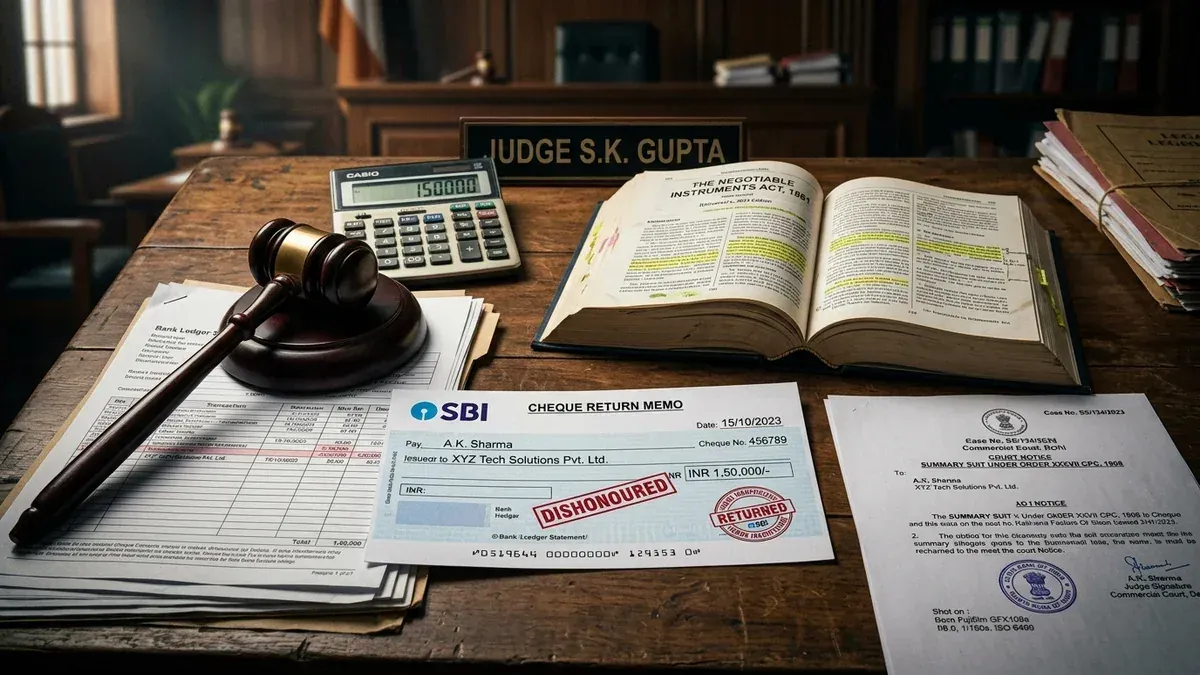
The Evidentiary Engine of Section 138: Under Section 146 of the Negotiable Instruments Act, 1881, Parliament inserted a special rule of evidence: when the complainant produces a bank return memo or slip bearing an official mark denoting dishonour, the trial court shall presume the fact of dishonour.
However, Section 146 does not create an irrebuttable presumption. In modern electronic banking governed by the Cheque Truncation System (CTS) and Section 63 of the Bharatiya Sakshya Adhiniyam, 2023 [BSA], computer-generated printouts lacking certified digital signatures or standard bank markings are vulnerable to challenge. When the accused produces certified ledger statements showing adequate balance, demonstrates an external account freeze by law enforcement, or proves bank technical error, the Section 146 presumption collapses completely.
Table of Contents
- 1. Section 146 Statutory Scheme: The Evidentiary Presumption
- 2. What Constitutes an "Official Mark"? Rubber Stamps vs. Digital Printouts
- 3. CTS Truncation & Section 63 BSA 2023 Electronic Certificates
- 4. Decoding Bank Reason Codes: Presumption Scope by Reason
- 5. Rebuttal Playbook: 4 Proven Methods to Overcome Section 146 Presumption
- 6. Cross-Examining the Bank Witness (CW-2 / DW) to Disprove Dishonour
- 7. Frequently Asked Questions (FAQs)
1. Section 146 Statutory Scheme: The Evidentiary Presumption
In ordinary criminal trials, the prosecution must summon the bank official to step into the witness box and prove the ledger entries under the Bankers' Books Evidence Act, 1891. To prevent banking officers from spending endless hours in courts, Parliament enacted Section 146:
"The Court shall, in respect of every proceeding under this Chapter, on production of bank's slip or memo having thereon the official mark denoting that the cheque has been dishonoured, presume the fact of dishonour of such cheque, unless and until such fact is disproved."— Section 146, Negotiable Instruments Act, 1881
The operative words are "shall presume" (mandatory presumption of fact) and "unless and until such fact is disproved" (rebuttable burden on the drawer).
2. What Constitutes an "Official Mark"? Rubber Stamps vs. Digital Printouts
For the presumption under Section 146 to trigger, the document must possess an "official mark". High Courts across India have established strict standards:
- Physical Instruments: A clear rubber seal or stamp of the drawee or presenting bank, indicating the branch name, date of presentation, and signature/initials of the clearing officer.
- Plain Computer Printouts: A simple uncertified printout taken from internet banking or an unsigned piece of paper without any bank seal does not qualify as an official mark. Under established Supreme Court and Delhi High Court precedents (such as K.N. Beena v. Muniyappan (2001) 8 SCC 458 and M.M.T.C. Ltd. v. Medchl Chemicals (2002) 1 SCC 234), unauthenticated slips lacking genuine official bank marks cannot trigger the statutory presumption under Section 146 without formal examination of the bank officer.
3. CTS Truncation & Section 63 BSA 2023 Electronic Certificates
Under the Cheque Truncation System (CTS-2010), physical cheques are not routed between banks; instead, an electronic image of the cheque and electronic metadata are transmitted. The return memo is generated digitally by the clearing house.
Under Section 63 of the Bharatiya Sakshya Adhiniyam, 2023 (BSA) (formerly Section 65B of the Indian Evidence Act, 1872):
Mandatory Electronic Certificate for Digital Return Memos
Where the return memo is an electronic printout generated from a Core Banking System (CBS), the complainant must furnish a certificate under Section 63(4) BSA 2023 signed by the authorized bank manager identifying the electronic record and describing the manner in which it was produced. Failure to produce this certificate renders the digital memo inadmissible under the Supreme Court judgment in Arjun Panditrao Khotkar v. Kailash Kushanrao Gorantyal (2020 SC).
4. Decoding Bank Reason Codes: Presumption Scope by Reason
Section 146 presumes only that the cheque was dishonoured for the reason stated. The table below delineates the legal effect of common return reasons:
| Bank Reason Code / Memo Text | Section 138 Applicability | Governing Supreme Court Ratio |
|---|---|---|
| Funds Insufficient / Exceeds Arrangement | DIRECTLY COVERED | Explicitly covered in Section 138 statutory text. |
| Account Closed Prior to Presentation | COVERED (Deemed Insufficiency) | Covered under NEPC Micon Ltd. v. Magma Leasing (1999 SC). |
| Payment Stopped by Drawer | COVERED (Unless Justified) | Covered under Modi Cements v. Kuchil Kumar Nandi (1998 SC). |
| Refer to Drawer | COVERED (Banking Synonym) | Held to be synonymous with lack of funds in Lily Hire Purchase (2001). |
| Account Frozen by Cyber Cell / Police Order | NOT COVERED (Valid Defense) | Involuntary freeze negates statutory mens rea (Delhi & P&H High Courts). |
| Signature Differs / Mismatch | COVERED (Laxmi Dyechem Ratio) | Covered under Laxmi Dyechem v. State of Gujarat (2012 SC). |
5. Rebuttal Playbook: 4 Proven Methods to Overcome Section 146 Presumption
To disprove the fact of dishonour or establish lack of criminal culpability, defense counsel should execute four strategic moves:
- Produce Certified Bank Statement under Section 2A Bankers' Books Evidence Act: Demonstrate that on the exact date and clearing cycle the cheque was presented, the drawer maintained a credit balance exceeding the cheque amount.
- Prove Bank Operational Glitch: Where dishonour occurred due to connectivity failure between the NPCI clearing grid and the bank's CBS, obtain an official letter from the branch manager admitting technical error.
- Establish Section 102 CrPC / Section 106 BNSS Freeze: Place on record the formal police debit-freeze order under Section 102 CrPC showing that the account was frozen by an external authority without fault of the drawer.
- Challenge Lack of Bank Endorsement: If the memo is an unverified photocopy without an original bank seal or Section 63 BSA certificate, object to its exhibition at the stage of complainant's testimony.
6. Cross-Examining the Bank Witness (CW-2 / DW) to Disprove Dishonour
When the bank manager is summoned to court, defense counsel should put the following targeted questions:
A. It does not bear any physical signature; it is a system printout.
Q. Did you issue a certificate under Section 63 of the Bharatiya Sakshya Adhiniyam / Section 65B Evidence Act for this printout?
A. No certificate is attached.
Q. Is it correct that on [Date of Presentation], the drawer's account had an active overdraft limit of Rs. 20 Lakhs against fixed deposit?
A. Yes, an OD limit was in place.
Q. Therefore, the cheque was returned due to internal clearing hold and not due to insufficiency of funds?
A. That is correct.
7. Frequently Asked Questions (FAQs)
Is production of the original bank return memo mandatory in court?
Yes. The complainant must produce the original bank memo or a certified copy under the Bankers' Books Evidence Act. A simple photocopy cannot be marked as an exhibit unless secondary evidence is formally permitted by the court.
What if the bank memo does not mention the date of return?
If the return memo lacks a date, the 30-day limitation period for issuing statutory demand notice under Section 138(b) cannot be computed. The complaint becomes vulnerable to dismissal for failure to prove timely notice dispatch.
Does Section 146 apply to dishonoured Demand Drafts?
Demand Drafts are orders drawn by one bank branch upon another and are not cheques drawn by a customer. A Demand Draft cannot be stopped for lack of funds, and dishonour occurs only in rare cases of fraud or court stay orders.