RWA vs. Flat Owners: Maintenance Charge Disputes, Amenity Cut-Offs & Society Registration Rules in NCR
 Authored by: Advocate Kishan Kumar (Advocate & Legal Consultant)
Quick Summary & Strategic Key Takeaways
- Absolute Prohibition on Essential Utility Disconnection: An RWA or private facility management agency possesses zero statutory authority to disconnect electricity, piped water, cooking gas, or elevator access. Supreme Court and High Court precedents affirm that access to essential services is an inalienable component of the right to life under Article 21 of the Constitution of India.
- Dual Statutory Regime in Haryana: Residential group housing in Haryana is governed concurrently by the Haryana Apartment Ownership Act, 1983 (HAOA) regarding undivided ownership shares in common property, and the Haryana Registration and Regulation of Societies Act, 2012 (HRRS Act) governing association administration, audits, and elections.
- Undivided Common Area Rights (Section 6 HAOA): Common areas and facilities—including staircases, lifts, parks, driveways, basements, and community halls—remain in common ownership and cannot be partitioned, segregated, or arbitrarily restricted against any lawful resident.
- Statutory Remedies for Aggrieved Owners: Aggrieved flat owners can institute proceedings before the District Registrar of Societies under Section 40 HRRS Act, file a deficiency in service complaint under the Consumer Protection Act 2019, or obtain immediate interim protective injunctions under Order 39 Rules 1 & 2 CPC.
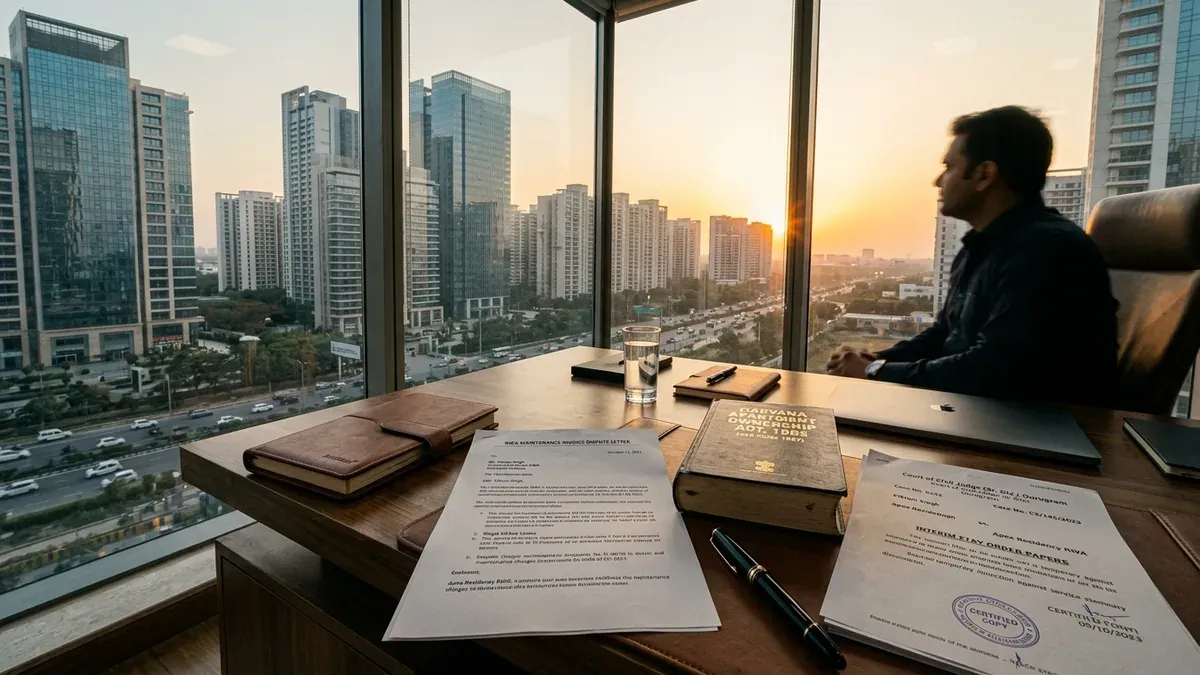
1. Statutory Architecture: HAOA 1983 & HRRS Act 2012
In modern group housing developments across Gurgaon, Faridabad, Sonipat, and the National Capital Region (NCR), conflicts between Resident Welfare Associations (RWAs) or maintenance agencies and individual apartment owners are among the most contentious property disputes. Flat owners frequently face arbitrary fee escalations, opaque balance sheets, and draconian threats of utility cut-offs. Navigating these conflicts requires an exact understanding of the statutory framework governing apartment ownership and resident societies in Haryana.
The governance of group housing societies in Haryana is anchored primarily in two distinct statutes that operate harmoniously:
A. Haryana Apartment Ownership Act, 1983 (HAOA)
The HAOA establishes the foundational property rights of apartment owners within a multi-storey condominium. The pivotal statutory protections include:
- Section 3(f) — Common Areas and Facilities: Broadly defines common property to encompass the entire land parcel, structural foundations, main columns, roofs, lobbies, stairways, fire escapes, entrances, basements, yards, gardens, parking zones, central installations for power, light, gas, cold and hot water, heating, refrigeration, air conditioning, reservoirs, water tanks, pumps, motors, fans, compressors, ducts, and all apparatus designated for common utility.
- Section 6 — Undivided Interest in Common Areas: Statutorily mandates that each apartment owner is entitled to an undivided percentage interest in the common areas and facilities as stipulated in the registered Deed of Declaration. Crucially, Section 6(2) provides that this undivided interest cannot be altered without the unanimous consent of all apartment owners, and Section 6(3) mandates that the common areas shall remain undivided and no apartment owner or other person may bring any action for partition or division thereof.
- Section 14 — Common Profits and Expenses: Establishes that common profits of the property shall be distributed among, and common expenses shall be charged to, the apartment owners according to the percentage of their undivided interest in the common areas and facilities.
- Section 15 — Strict Compliance with Covenants: Obligates every apartment owner and tenant to comply strictly with the by-laws, administrative rules, and covenants set forth in the Deed of Declaration. However, failure to comply empowers the association to sue for damages or injunctive relief, but explicitly does not authorize extrajudicial disconnection of utilities.
B. Haryana Registration and Regulation of Societies Act, 2012 (HRRS Act)
While the HAOA governs underlying real property rights, the HRRS Act governs the organizational, managerial, and democratic mechanics of the registered association of apartment owners (AOA/RWA). The essential regulatory provisions encompass:
- Section 39 — Right to Inspect Accounts: Confers a statutory entitlement on every member of the society to inspect the register of members, books of accounts, minutes of general body and governing body meetings, and audited annual reports during normal business hours.
- Section 40 — Adjudication of Internal Disputes: Empowers the District Registrar of Societies to entertain petitions regarding election disputes, financial embezzlement, mismanagement, or ultra vires actions of the governing body.
- Section 72 — Settlement of Society Conflicts: Provides an administrative appellate hierarchy from the District Registrar to the State Registrar General and subsequently to the State Government.
Cross-State Jurisprudential Parallels in NCR: In Delhi, condominium governance is governed by the Delhi Apartment Ownership Act, 1986, whereas in Uttar Pradesh (Noida, Greater Noida, and Ghaziabad), societies operate under the robust UP Apartment (Promotion of Construction, Ownership & Maintenance) Act, 2010. Across all three jurisdictions, the core statutory doctrine remains uniform: individual ownership of the apartment interior is legally inseparable from the perpetual, undivided co-ownership of all common amenities and infrastructure.
2. Illegality of Disconnecting Essential Amenities & Lift Access
The most pervasive and high-handed tactic adopted by errant RWAs or builder-appointed maintenance agencies is the unilateral suspension of prepaid electricity meters, throttling of water supply lines, or disabling RFID cards for lift and vehicular boom barrier access. Indian courts have categorically declared such punitive measures unlawful, tortious, and actionable under both constitutional and civil law.
| Legal Forum / Court | Landmark Case Citation | Core Judicial Principle Established |
|---|---|---|
| Supreme Court of India | Subhash Chandra & Anr. v. State of U.P. | Access to water, sanitation, and electricity forms an integral part of the fundamental Right to Life and Shelter under Article 21. No entity can sever essential life utilities extrajudicially. |
| Delhi High Court | Ravi Verma v. RWA, Vasant Kunj | Elevator access cannot be withheld or segregated based on maintenance defaults or socio-economic discrimination against domestic workers or delivery agents. |
| NCDRC (Apex Consumer) | Rameshwar Prasad v. Ansal Housing | Disconnection of water or electricity lines by a maintenance service provider constitutes gross 'Deficiency of Service' and 'Unfair Trade Practice', attracting severe punitive damages. |
| Punjab & Haryana High Court | Brig. (Retd.) Kuldip Singh v. State of Haryana | A registered RWA does not enjoy sovereign coercive recovery powers. Unpaid maintenance charges constitute an ordinary civil debt recoverable exclusively through formal civil process. |
When an RWA or maintenance contractor intentionally cuts off electricity, water, or lift facilities, the victimized flat owner has access to immediate legal remedies:
- Ex-Parte Interim Injunction under Order 39 Rules 1 & 2 CPC: A civil suit for permanent injunction can be filed accompanied by an urgent interim application. Civil courts routinely issue immediate ex-parte directions ordering local police authorities to enforce immediate restoration of essential utilities within 24 hours.
- Criminal Prosecution under Bharatiya Nyaya Sanhita, 2023 (BNS): If security guards or office bearers physically obstruct an owner, their family members, domestic help, or delivery personnel from entering the premises or using the common elevators, a criminal complaint lies under Section 126 BNS (Wrongful Restraint) and Section 351 BNS (Criminal Intimidation), corresponding to old Sections 341 and 506 IPC.
- District Consumer Disputes Redressal Commission: Section 2(11) of the Consumer Protection Act, 2019 classifies maintenance agencies (whether builder-promoted or society-run) as service providers. Unlawful disconnection entitles the consumer to claim immediate restoration, compensatory damages for mental agony, and litigation costs.
3. Apportioning Maintenance Charges: Flat-Rate vs. Per-Square-Foot
One of the fiercest battlegrounds within group housing societies revolves around how monthly common maintenance charges should be levied. Large unit owners argue that fixed flat-rate charging forces 4BHK owners to subsidize 1BHK/2BHK units unfairly, while smaller unit owners argue that per-square-foot charging forces them to overpay for services consumed equally by all residents (e.g., security guards, swimming pools, clubhouse access).
| Expense Category | Statutory Alignment | Recommended Allocation Methodology | Statutory Justification |
|---|---|---|---|
| Structural Repairs & Painting | Section 6 & 14 HAOA | Per Square Foot (Undivided Share) | Capital repairs preserve the entire asset in proportion to undivided ownership interest. |
| Sinking & Replacement Fund | Section 24 HRRS Act | Per Square Foot (Undivided Share) | Long-term capital reserve must legally mirror property asset valuation and undivided rights. |
| Security Personnel & Guards | General Body Resolution | Equal Flat Rate (Per Unit) | Every apartment enjoys an identical level of perimeter security and gate protection. |
| Accounting, Audit & Legal Fees | Administrative Overhead | Equal Flat Rate (Per Unit) | Administrative maintenance costs are uniform per registered door unit. |
| Common Water & Electricity | Consumption / Hybrid | Square Foot or Metered Hybrid | Correlates to collective usage footprint of larger households vs smaller apartments. |
The Legality of the Hybrid Billing Model
Recognizing the inequities of a purely flat-rate or purely square-foot billing model, modern condominiums adopt a Hybrid Maintenance Model. Under this structure, operational expenses that do not vary by flat size (security, landscaping, management salaries) are distributed on an equal per-apartment basis, whereas capital sinking funds, building insurance, and heavy structural repairs are distributed according to the percentage of undivided interest stipulated in the registered Deed of Declaration. This hybrid model has received consistent judicial validation provided it is passed by a two-thirds majority in a duly convened Annual General Meeting (AGM) and recorded in the registered by-laws.
Goods and Services Tax (GST) Compliance Parameters
The Central Board of Indirect Taxes and Customs (CBIC) maintains stringent guidelines regarding GST levy on residential maintenance:
- Exemption Ceiling: Maintenance contributions up to Rs. 7,500 per month per member are entirely exempt from GST under Notification No. 12/2017-Central Tax (Rate).
- Exceeding the Threshold: If the monthly maintenance charge exceeds Rs. 7,500 per member, GST at 18% is chargeable on the entire amount, not merely on the incremental surplus, provided the RWA’s aggregate annual turnover exceeds Rs. 20 Lakhs.
- Multiple Properties: If an individual owns multiple apartments in the same society, the Rs. 7,500 monthly threshold applies separately to each apartment.
4. Right to Financial Audits, Invoices & Sinking Fund Oversight
Financial opacity is the root cause of the vast majority of RWA disputes. Management committees frequently collect large sums for sinking funds, capital equipment replacement, and festival levies without presenting vendor quotations, audited ledgers, or competitive procurement bids.
Mandatory Statutory Disclosures under the HRRS Act, 2012
Under Section 39 of the HRRS Act, the governing body of a society is statutorily compelled to:
- Maintain complete and regular accounts of all receipts, disbursements, assets, and liabilities.
- Submit annual accounts for statutory audit by an independent Chartered Accountant holding a valid Certificate of Practice.
- Present the audited financial statement, together with the auditor’s report, before the General Body at the mandatory Annual General Meeting (AGM) within six months of the close of the financial year.
- Submit a certified copy of the audited accounts, signed by the President and Secretary, to the District Registrar within thirty days of the AGM.
The Sinking Fund Safeguards
The Sinking Fund is a statutory reserve created to fund future major structural replacements—such as lift overhauls, diesel generator replacement, external waterproofing, and electrical transformer upgrades. The law strictly prohibits RWAs from diverting Sinking Fund reserves into operational day-to-day expenditures. Under Section 24 of the HRRS Act, reserve funds must be invested exclusively in authorized securities, scheduled commercial bank fixed deposits, or post office saving certificates. Any diversion of Sinking Funds for operational shortfalls constitutes criminal breach of trust under Section 316 BNS (old Section 405/409 IPC).
5. Multi-Tiered Dispute Resolution: District Registrar, Consumer Forum & Civil Court
When an RWA committee acts unlawfully, flat owners must select the appropriate legal forum based on the exact nature of their grievance:
| Nature of Dispute | Appropriate Legal Forum | Governing Statutory Provision | Nature of Relief Available |
|---|---|---|---|
| Election Rigging / By-Law Violations / Financial Fraud | District Registrar of Societies (HRRS) | Section 39 & 40 HRRS Act, 2012 | Order an independent audit, quash illegal elections, appoint an Administrator to run the society. |
| Utility Disconnection / Barrier Blocking / Harassment | Civil Court (Senior Civil Judge) | Order 39 Rules 1 & 2 CPC | Immediate ex-parte ad-interim injunction restraining disconnection; mandatory order for restoration. |
| Deficiency in Maintenance Services / Builder Agencies | District Consumer Commission | Section 35 Consumer Protection Act, 2019 | Compensation for defective maintenance, refund of overcharged fees, punitive damages. |
| Physical Assault / Wrongful Restraint by Bouncers | Jurisdictional Police Station / Magistrate | Sections 126 & 351 BNS (old 341 & 506 IPC) | FIR registration, criminal arrest of delinquent office bearers and private security staff. |
Flat owners should avoid unstructured verbal altercations and instead build a meticulous documentary record. Every statutory demand must be submitted in writing via registered post or speed post, establishing a clear paper trail for downstream judicial review.
6. Specimen Legal Notice to RWA Against Amenity Disconnection
Below is a specimen legal notice drafted by an advocate representing an aggrieved apartment owner against an RWA or maintenance agency threatening utility disconnection or demanding unauthorized fines:
LEGAL NOTICE VIA REGISTERED SPEED POST / EMAIL
Date: [Insert Date]
To:
The President / General Secretary,
[Name of Resident Welfare Association / Condominium Association],
[Address of Society Office / Club House],
[City, District, State, PIN]
Subject: Formal Legal Notice demanding immediate cessation of threats to disconnect essential utilities (Electricity/Water/Elevator Access) to Apartment No. [Insert Flat Number] and demand for statutory financial disclosure under the Haryana Apartment Ownership Act, 1983 and HRRS Act, 2012.
Sir / Madam,
Under instructions from and on behalf of my client, [Client Full Name], sole and absolute owner of Apartment No. [Insert Flat Number], [Name of Society], situated at [Full Address], I hereby serve you with this formal Legal Notice:
- That my client is the lawful owner and occupant of the aforementioned apartment by virtue of a registered Conveyance / Sale Deed dated [Insert Date], registered as Document No. [Insert Reg Number] with the Sub-Registrar, [City].
- That my client holds an undivided, non-partitionable interest in all common areas and facilities under Section 6 of the Haryana Apartment Ownership Act, 1983, which statutorily guarantees unfettered access to elevators, staircases, lobbies, entry gates, and common utilities.
- That on [Insert Date], your office illegally and high-handedly issued a demand letter / notice threatening to disconnect my client's prepaid electricity meter / water supply / lift RFID tag on account of disputed maintenance claims amounting to Rs. [Insert Amount].
- Take notice that under settled Supreme Court law in Subhash Chandra v. State of U.P., essential services such as drinking water, electricity, and lift access constitute fundamental rights under Article 21 of the Constitution of India. An RWA does not possess any coercive authority to disconnect life-sustaining amenities. Unpaid maintenance, even if legally due, is merely a civil debt recoverable strictly through civil process.
- Furthermore, your association has consistently failed to comply with Section 39 of the Haryana Registration and Regulation of Societies Act, 2012 by refusing to permit my client to inspect audited balance sheets, vendor contracts, and sinking fund registers.
I THEREFORE CALL UPON YOU to immediately and unconditionally withdraw your illegal threat to disconnect my client's utilities, cease any harassment of my client and their domestic staff, and provide certified copies of the society's audited financial accounts for the past three financial years within seven (7) days of receipt of this notice, failing which my client shall initiate appropriate civil proceedings for an interim injunction under Order 39 Rules 1 & 2 CPC, file a statutory complaint before the District Registrar under Section 40 HRRS Act, and lodge criminal proceedings for wrongful restraint under Section 126 BNS at your sole cost and consequence.
Yours faithfully,
[Advocate Name]
Advocate, High Court / District Bar Association
7. Frequently Asked Questions (FAQs)
Frequently Asked Questions
Detailed legal answers on RWA maintenance disputes, utility cut-offs, and society registration rules
Can an RWA disconnect electricity, water, or lift services if a resident defaults on maintenance?
No. Under settled jurisprudence from the Supreme Court of India and various High Courts, essential amenities such as potable water supply, electricity, and lift access constitute non-derogable components of the right to shelter and dignified life under Article 21 of the Constitution of India. In Subhash Chandra v. State of U.P. and multiple NCDRC precedents, courts have held that an RWA or maintenance agency has zero statutory authority to curtail essential supplies as a coercive recovery mechanism. Maintenance arrears must be recovered through civil suits or statutory remedies before the District Registrar, never through high-handed disconnection.
How should maintenance charges be legally calculated: flat-rate or per square foot?
The calculation methodology depends on the statutory declaration and society by-laws registered under the Haryana Apartment Ownership Act, 1983 or Haryana Registration and Regulation of Societies Act, 2012 (HRRS Act). While charges tied to common area repairs, structural insurance, and sinking funds must strictly correlate to the undivided interest percentage (super built-up area), common operational costs such as guard security, accounting software, and administrative salaries may be apportioned equally per apartment if approved by a valid general body resolution.
What is the GST threshold for RWA maintenance charges in India?
Under Ministry of Finance CBIC Circulars and Notification No. 12/2017-Central Tax (Rate), RWA maintenance contributions up to Rs. 7,500 per month per member are exempt from GST. If the monthly contribution exceeds Rs. 7,500 per member, the entire amount is taxable at 18% GST, provided the RWA's total annual turnover exceeds Rs. 20 Lakhs. Commercial units or multiple apartments owned by a single individual are assessed separately based on individual unit accounts.
Can an RWA restrict domestic help, delivery personnel, or visitors from using elevators?
No. Section 6 of the Haryana Apartment Ownership Act, 1983 establishes that all common areas and facilities—including lobbies, corridors, and lifts—are held in undivided common ownership by all apartment owners. Restricting service staff, couriers, or domestic aides from passenger elevators constitutes unlawful segregation, violates fundamental human dignity, and has been repeatedly struck down by consumer commissions and civil courts as an ultra vires and discriminatory practice.
Where can a flat owner file a complaint against an arbitrary or corrupt RWA committee?
An aggrieved owner has three distinct legal remedies: (1) File a statutory petition under Section 40 of the HRRS Act, 2012 before the District Registrar of Societies for financial mismanagement, illegal elections, or by-law violations; (2) File a consumer complaint under Section 35 of the Consumer Protection Act, 2019 before the District Consumer Commission for deficiency in facility management services; or (3) File a civil suit under Order 39 Rules 1 & 2 CPC seeking an interim injunction against wrongful restraint or amenity disconnection.
Does an apartment owner have the right to inspect the RWA's financial accounts and invoices?
Yes. Under Section 39 of the Haryana Registration and Regulation of Societies Act, 2012, every registered society is statutorily mandated to maintain accurate books of account and make them available for inspection by any member during designated hours. Furthermore, under Section 14 of the Haryana Apartment Ownership Act, 1983, apartment owners are entitled to inspect audited annual balance sheets, sinking fund investments, and vendor contracts upon reasonable written requisition.
Can an RWA impose arbitrary fines for pet walking, balcony alterations, or late payments?
An RWA cannot arbitrarily levy penal fines unless such specific powers are explicitly codified in duly registered society by-laws approved by the General Body and compliant with parent statutes. The Animal Welfare Board of India (AWBI) guidelines specifically prohibit RWAs from banning companion animals or levying pet maintenance surcharges. Unregistered penal fines are legally unenforceable and can be challenged as ultra vires before the District Registrar.
Can a tenant be elected as an RWA office bearer or vote in society elections?
Generally, voting and contesting rights in an RWA are vested strictly in the title holder (the recorded apartment owner) as defined under the registered Deed of Declaration and Section 3 of the Haryana Apartment Ownership Act, 1983. A tenant may participate or vote only if the owner executes a formal registered power of attorney or specific written proxy authorized under the society's registered bye-laws and the HRRS Act, 2012.