Restraining Child Removal Overseas: Airport LOC, Injunctions & Parental Abduction Safeguards in Family Courts
 Authored by: Advocate Kishan Kumar (Advocate & Legal Consultant)
Quick Summary & Strategic Key Takeaways
- Non-Signatory Status to Hague Convention: India is not a signatory to the 1980 Hague Child Abduction Convention. Foreign court custody decrees are not mechanically executed in India; Indian courts adjudicate independently on the basis of the child's welfare.
- The Paramount Welfare Doctrine: Under binding Supreme Court jurisprudence in Nithya Anand Raghavan (2017) and Prateek Gupta (2018), the comity of international courts must yield to the paramount welfare, safety, and psychological best interests of the minor child.
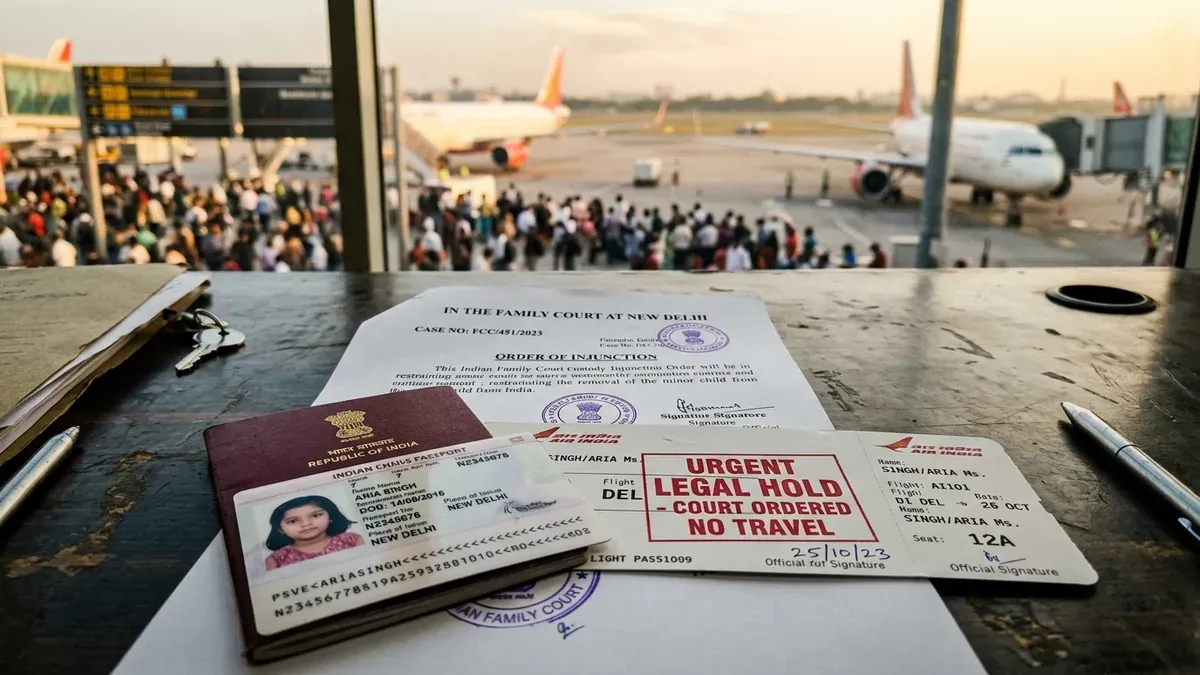
- Emergency Airport Interception (LOC Protocol): When parental abduction is imminent, moving an emergency application for an interim travel injunction under GWA Section 12 coupled with a Look Out Circular (LOC) via the Bureau of Immigration can halt departure at international departure gates.
- High Court Article 226 Habeas Corpus: A Writ of Habeas Corpus before the High Court is the primary constitutional remedy to compel the immediate production of a concealed or abducted minor child and determine custodial safety.
1. The Legal Landscape: India's Non-Hague Convention Position
With the exponential growth of the global Indian diaspora (NRIs and OCIs residing in the United States, United Kingdom, Canada, Australia, and the UAE), cross-border matrimonial breakdowns have generated a surge in international parental child abductions. In typical scenarios, one spouse secretly relocates with the minor child to India during a vacation or marital dispute, defying custody orders or travel bans issued by foreign courts in the child's country of habitual residence.
The foundational legal reality governing cross-border custody disputes in India is that India has consciously chosen NOT to sign or ratify the 1980 Hague Convention on the Civil Aspects of International Child Abduction. Under the Hague Convention, signatory nations are treaty-bound to execute the summary return of an abducted child to their country of habitual residence without adjudicating custody merits. In India, foreign custody decrees cannot be mechanically executed under Section 44A of the Code of Civil Procedure, 1908. Indian Family Courts and Constitutional High Courts retain absolute plenary jurisdiction to independently evaluate the custodial rights and living arrangements of the child.
2. The Paramount Welfare Doctrine vs. Comity of Foreign Courts
When a foreign left-behind parent approaches Indian courts demanding the immediate summary repatriation of the child citing foreign court orders, Indian jurisprudence applies the Paramount Welfare of the Child Doctrine.
The Supreme Court of India in a series of authoritative constitutional rulings has firmly established that the principle of comity of courts (respect for foreign judicial decrees) is subservient to the best interests and welfare of the child:
A 3-Judge Bench of the Supreme Court held that the High Court in a habeas corpus petition is not bound to order the summary return of the child merely because a foreign court has passed a custody decree. The Court must conduct an independent assessment of whether returning the child would expose them to physical or psychological harm, or place them in an intolerable situation. The welfare of the child is the sole paramount consideration.
The Supreme Court reiterated that an order of repatriation cannot be granted on a mechanical application of the doctrine of comity of courts. The court must assess the child's adaptation, schooling, family support system, and emotional bond in India before considering any foreign return.
The Apex Court balanced the welfare principle by emphasizing that where a child was born abroad, is a foreign citizen, and has spent their entire formative developmental years in the foreign country, returning the child to their habitual residence under robust protective mirror orders is consistent with their long-term welfare.
3. Emergency Travel Injunctions under Guardians and Wards Act 1890
When a parent in India suspects that the other spouse is planning to secretly remove the minor child overseas to prevent custody access, immediate preventive civil relief must be initiated before the Family Court:
- Petition under Section 7 & 9 of the Guardians and Wards Act, 1890 (GWA): File a substantive petition for permanent custody before the Family Court having territorial jurisdiction where the minor child ordinarily resides.
- Interim Travel Injunction under Section 12 GWA & Order 39 Rules 1 & 2 CPC: Move an urgent application for an ex-parte interim restraining order prohibiting the respondent parent from taking the minor child outside the territorial jurisdiction of the court or outside India without prior written permission of the court.
- Direction to Deposit Passports: Pray for an immediate direction ordering the respondent parent to deposit the minor child's original passport and visa documents with the custody of the Family Court Registrar.
4. Airport Look Out Circulars (LOC) & Bureau of Immigration Protocols
A court injunction on paper cannot physically stop a parent boarding an international flight at 2:00 AM unless international border control authorities are officially alerted. To achieve physical interception, counsel must execute the Look Out Circular (LOC) Protocol:
- Securing Court Direction for LOC: In the interim injunction order, specifically request the Family Court or High Court to direct the Bureau of Immigration (Ministry of Home Affairs) and local police authorities to open an immediate Look Out Circular (LOC) against the minor child and the fleeing parent.
- Service on Airport Immigration Authorities: Serve the certified court order along with full biographical details, passport numbers, and recent photographs of the child directly upon:
- The Foreigners Regional Registration Officer (FRRO) at major international transit hubs (Indira Gandhi International Airport Delhi, Mumbai, Bengaluru, Chennai);
- The Ministry of Home Affairs (Immigration Division);
- The local Senior Superintendent of Police (SSP) / DCP Crime.
- Real-Time Border Interception: Once logged into the Bureau of Immigration national computerized database, any attempt to scan the minor's passport at airport immigration counters triggers an automatic system red-flag, resulting in immediate detention and transfer to local airport police.
5. Passport Impoundment under Section 10(3) Passports Act 1967
The Passports Act, 1967 provides an independent statutory mechanism to immobilize cross-border flight:
- Section 10(3)(h) — Pending Criminal Proceedings: Where criminal proceedings (e.g., Section 85/86 BNS for cruelty, or Section 137 BNS for kidnapping from lawful guardianship) are pending against the parent, the Regional Passport Officer (RPO) is empowered to impound or revoke their passport.
- Section 10(3)(b) — Suppression of Material Facts: If a parent obtained a minor's passport without the written consent of the other parent by forging Annexure 'D' or suppressing pending family court litigation, file a formal complaint before the RPO under Section 10(3)(b) for fraudulent procurement, resulting in immediate administrative cancellation of the passport.
6. High Court Article 226 Habeas Corpus Writs for Abducted Children
Where a child has already been secretly removed or concealed in an unknown location within India, filing a Writ of Habeas Corpus under Article 226 of the Constitution of India before the jurisdictional High Court is the most rapid legal vehicle:
- The High Court issues notice to the state police and the respondent parent, directing the physical production of the minor child before the High Court bench on a fast-track date (typically within 48 to 72 hours).
- The High Court conducts an in-camera interaction with the child and parents in chamber to evaluate the child's immediate safety and psychological state.
- The High Court passes interim orders determining temporary custody, directing passport surrender, and transferring substantive custody determination to the jurisdictional Family Court.
7. Mirror Orders & Cross-Border International Custody Undertakings
In cases where an Indian court or foreign court permits temporary overseas travel for vacations or schooling, cross-border compliance is enforced through Mirror Orders:
- Bilateral Jurisdiction Synchronization: The traveling parent is required to obtain an identical order from the foreign court of destination acknowledging that the Indian Family Court remains the primary court of custody jurisdiction.
- Financial Security Undertakings: The traveling parent is ordered to deposit substantial financial security (e.g., fixed deposits or property title deeds worth Rs. 50 Lakhs to Rs. 1 Crore) with the court, which is forfeited if the child is not returned by the specified date.
8. Comparative Matrix: Emergency Legal Remedies against Child Removal
| Remedy Type | Governing Legal Forum | Speed of Execution | Primary Strategic Purpose |
|---|---|---|---|
| Family Court Interim Injunction | Family Court (Section 12 GWA / O39 CPC) | 24 to 48 hours | Restrain physical departure & order passport deposit |
| Look Out Circular (LOC) | Bureau of Immigration (via Court Order / Police) | Real-time upon portal entry | Physical border/airport interception at immigration gates |
| High Court Habeas Corpus Writ | High Court (Article 226 of Constitution) | 48 to 72 hours | Compel physical production of concealed/detained child |
| Passport Impoundment Notice | Regional Passport Office (Section 10 Passports Act) | 7 to 15 days | Administrative revocation of travel documents |
9. Actionable Emergency Checklist: The First 24 Hours of Parental Abduction
Parental Abduction Emergency Response Protocol
- Secure Minor's Identity & Travel Documents: Safely preserve the minor's original birth certificate, school ID, OCI card, and certified copies of passports in a secure personal vault.
- File Urgent Family Court Injunction: Move an emergency ex-parte application under GWA Section 12 seeking an immediate restraining order on international travel.
- Serve Emergency Intimation on FRRO & Bureau of Immigration: Dispatch urgent emails and physical letters enclosing court orders and passport numbers to airport immigration desks.
- Lodge Police Complaint for Kidnapping: File a formal complaint under Section 137 BNS (kidnapping from lawful guardianship) to initiate official police tracking.
- Move High Court Habeas Corpus if Child Concealed: If the child's whereabouts are unknown, petition the High Court under Article 226 for immediate police search and production.
Frequently Asked Questions on Restraining Child Removal & Parental Abduction
Key statutory answers and emergency custody guidance curated by International Child Custody Advocates in Delhi NCR.
Is India a signatory to the Hague Convention on the Civil Aspects of International Child Abduction?
No. India is NOT a signatory to the 1980 Hague Convention on Child Abduction. Consequently, Indian courts are NOT statutorily bound to automatically order the summary return of a child brought to India by a parent in violation of a foreign court custody order. Instead, Indian constitutional courts adjudicate custody disputes based on the domestic legal doctrine that the 'Welfare of the Child' is the paramount consideration, which overrides foreign court orders and comity of courts.
How do Indian courts resolve conflicts between foreign custody orders and Indian jurisdiction?
In landmark judgments including Nithya Anand Raghavan v. State of NCT of Delhi (2017) 8 SCC 454, Prateek Gupta v. Shilpi Gupta (2018) 2 SCC 309, and Lahari Sakhamuri v. Sobhan Kodali (2019) 7 SCC 311, the Supreme Court established that comity of courts must yield to the paramount welfare of the minor child. An Indian court will conduct an independent domestic inquiry into the child's psychological welfare, educational stability, emotional comfort, and security before deciding whether to order the child's return to the foreign jurisdiction.
How can a parent immediately prevent the other parent from taking a minor child abroad from India?
An aggrieved parent must execute a fast-track 3-tier emergency protocol: (1) File an urgent application for an ex-parte interim injunction under Order 39 Rules 1 & 2 CPC read with Section 12 of the Guardians and Wards Act, 1890 before the Family Court; (2) Move an emergency application for the issuance of a Look Out Circular (LOC) through the Bureau of Immigration and local police to alert all international airports; and (3) Apply to the Regional Passport Office (RPO) under Section 10(3)(h) of the Passports Act, 1967 to impound the child's passport.
Can a parent file a Habeas Corpus petition before the High Court to recover an abducted child?
Yes. Under Article 226 of the Constitution of India, a parent can file a Writ of Habeas Corpus before the High Court alleging that the minor child has been illegally removed, concealed, or detained by the other parent. While a parent's custody is not strictly 'unlawful detention' in criminal terms, the Supreme Court has ruled that a writ of habeas corpus is maintainable to examine whether the child's continued retention by one parent is detrimental to their paramount welfare and safety.
What is a 'Mirror Order' in international cross-border custody disputes?
A Mirror Order is an identical or reciprocal legal order obtained from an Indian Family Court reflecting the exact custody, visitation, and travel conditions granted by a foreign court (or vice-versa). In cases where an Indian court permits a parent to take a child abroad temporarily, the court frequently demands that the traveling parent first obtain a mirror order from the foreign court submitting to Indian jurisdiction, ensuring that the child will be returned to India without jurisdictional conflicts.
Can the Regional Passport Office issue a child's passport without both parents' consent?
Under standard Indian passport rules, the consent of both biological parents (signed Annexure 'D') is mandatory to issue a minor's passport. If one parent refuses consent or a custody dispute is pending, the applying parent must submit Annexure 'C' (declaring reasons for absence of consent) accompanied by a specific Family Court order granting permission to obtain a passport and travel abroad. If a passport was obtained fraudulently without notice, the other parent can apply for immediate revocation under Section 10(3)(b) of the Passports Act.
What factors do Indian courts evaluate when deciding whether a child should be returned overseas?
The court evaluates: (1) The age and developmental needs of the child; (2) The duration of the child's residence in India and degree of integration into Indian schooling and social environment; (3) The citizenship and immigration status of the child; (4) Psychological evaluations assessing parental alienation; (5) Any history of domestic violence or substance abuse in the foreign country; and (6) The financial and caregiving capacity of both parents.