Legal Rights and Procedure for Recovery of Streedhan from In-Laws: BNS 316 & DV Act Remedies
 Authored by: Advocate Kishan Kumar (Advocate & Legal Consultant)
Quick Summary & Strategic Takeaways
- Absolute Ownership under Section 14 HSA: Under Section 14 of the Hindu Succession Act, any property possessed by a Hindu female is held by her as full owner, not as a limited estate.
- Criminal Breach of Trust (Section 316 BNS): Refusal by the husband or in-laws to return Stridhan constitutes criminal breach of trust under the landmark Pratibha Rani v. Suraj Kumar doctrine.
- Domestic Violence Act Section 19(8) Orders: Magistrate Court can pass urgent return-of-property orders directing police to recover Stridhan articles and restore possession to the woman.
- Evidentiary Proof & Inventory Lists: Preserving wedding photograph proof, jeweller purchase receipts, video recordings, and signed Stridhan handover inventories.
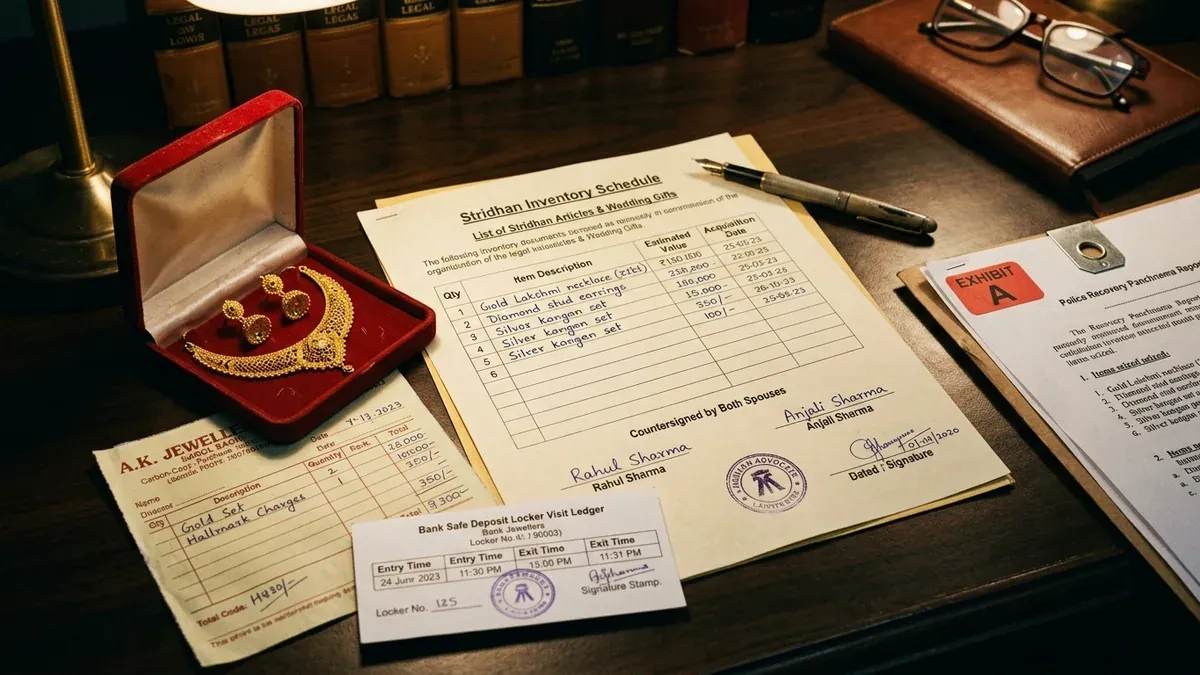
Upon the breakdown of a marriage, one of the most fiercely contested issues is the return and recovery of the woman Stridhan—including gold jewellery, silver ornaments, bridal gifts, cash, fixed deposits, and household electronics given to her before, during, or after marriage. In Indian law, Stridhan is the absolute, unchallengeable property of the woman. If the husband or in-laws refuse to return Stridhan upon demand, they commit the criminal offence of Criminal Breach of Trust under Section 316 BNS.
1. What Constitutes Stridhan under Indian Law?
Stridhan includes all gifts and property given to a woman at the time of marriage (Yautuka) and gifts received before or after marriage from her parents, husband, or in-laws (Ayautuka).
Under Section 14(1) of the Hindu Succession Act, 1956, all property acquired by a Hindu woman by gift, will, inheritance, purchase, or at a partition is her absolute property, and she possesses unfettered rights to sell, gift, or manage it as she deems fit.
2. The Landmark Pratibha Rani Doctrine & Section 316 BNS
In the landmark ruling of Pratibha Rani v. Suraj Kumar (1985), the Supreme Court established that when a woman entrusts her Stridhan to her husband or in-laws for safe custody, they hold it as trustees and not as owners.
If the husband or in-laws refuse to return Stridhan upon demand or misappropriate it for their own use, they commit Criminal Breach of Trust punishable under Section 316 of the Bharatiya Nyaya Sanhita, 2023 (carrying up to 5 years imprisonment).
3. Statutory Remedies for Recovering Stridhan Articles
1. Section 19(8) Domestic Violence Act: The Magistrate can direct the respondent to return to the possession of the aggrieved person her Stridhan or any other property or valuable security.
2. Section 94 BNSS Search Warrant: The Magistrate can issue a search warrant directing police to enter the matrimonial home, conduct a search, and seize Stridhan articles.
3. Civil Suit for Recovery of Movable Property: A civil suit can be filed under Order VII CPC along with an application for appointment of an Advocate Local Commissioner under Order 26 Rule 9 CPC to prepare an inventory of gold articles.
Landmark Judicial Precedents
The Supreme Court ruled that Stridhan is the absolute property of the woman, and the husband and in-laws hold it purely in trust. Refusal to return Stridhan constitutes Criminal Breach of Trust.
Reaffirmed that entrustment of Stridhan to the husband or parents-in-law does not extinguish the woman title, and criminal proceedings under 406 IPC (now 316 BNS) are maintainable upon refusal to return.
Held that retention of Stridhan by the husband is a continuing offence under the Domestic Violence Act, and the limitation period does not bar the wife from recovering her property.
Stridhan vs Matrimonial Property Framework
| Property Category | Ownership Status | Husband / In-laws Rights | Legal Remedy on Dispute |
|---|---|---|---|
| Gold & Diamond Jewellery | 100% Absolute Property of Woman | Zero right; safe custody trustee only | Sec 316 BNS / Sec 19(8) PWDVA |
| Cash & Fixed Deposits in Wife Name | 100% Absolute Property of Woman | Zero right to withdraw or encash | Freezing orders / Civil Recovery |
| Jointly Purchased House / Asset | Proportionate Joint Ownership | Co-owner share according to contribution | Partition Suit / Section 12 PWDVA |
| Gifts Given Exclusively to Husband | Property of Husband | Husband ownership | Excluded from Stridhan recovery |
Practical Steps to Recover Stridhan from In-Laws under BNS & DV Act
A married woman seeking recovery of her Stridhan has robust civil and criminal remedies:
1. Section 12 & 19(8) Application under PWDVA: Apply before the Magistrate for a direct search and recovery warrant directing the Protection Officer to seize and return all Stridhan articles.
2. Criminal Complaint under Section 316 BNS (Criminal Breach of Trust): Demand return of Stridhan via legal notice; refusal by husband or in-laws constitutes criminal breach of trust punishable with up to 5 years imprisonment.
3. Comprehensive Stridhan Inventory & Evidence: Maintain wedding gift lists, jewellery purchase invoices, photographs, and bank locker records to prove exclusive ownership under Pratibha Rani.
Reiterated that Stridhan is the absolute property of the woman and dishonest misappropriation by the husband constitutes criminal breach of trust under Section 406 IPC (Section 316 BNS).
Courtroom Evidence Checklist for Proving Stridhan Ownership
To secure an unassailable recovery order for Stridhan before the Magistrate or Family Court, the wife must tender comprehensive documentation:
1. Wedding Gift List & Photographs: Certified photographs under Section 63 BSA showing the bride wearing the jewellery during marriage ceremonies.
2. Purchase Invoices & Hallmark Certificates: Original jewellery receipts or bank locker inventory records establishing weight and karat purity.
3. Refusal Proof: Legal demand notice sent via speed post and WhatsApp demanding return of specific articles within 15 days, proving dishonest retention under Section 316 BNS.
Actionable Next Steps & Critical Legal Strategy
If you are navigating an active legal dilemma regarding this subject matter, execute these immediate procedural steps:
- Preserve Primary Documentary Proof: Assemble certified copies of title deeds, notices, bank statements, and electronic records with Section 63 BSA compliance.
- Adhere to Statutory Limitation Windows: File urgent applications before jurisdictional civil courts or tribunals before rights are extinguished.
- Engage Specialized Trial Counsel: Secure customized litigation strategies from experienced High Court and Sessions Court advocates.
Statutory Authorities & Legal References
- Governing statutory codes under Bharatiya Nyaya Sanhita (BNS 2023), Bharatiya Nagarik Suraksha Sanhita (BNSS 2023), Bharatiya Sakshya Adhiniyam (BSA 2023), or Code of Civil Procedure (CPC 1908).
- Relevant state rules, court fee schedules, and registration notifications issued by the Government of Haryana and Delhi NCR authorities.
- Binding judicial precedents of the Supreme Court of India and the High Court of Punjab & Haryana.
- Official e-Courts portal and National Judicial Data Grid (NJDG) procedural guidelines.
Frequently Asked Questions
Key statutory answers and procedural guidance curated by Senior Advocates in Faridabad & Delhi NCR.
What constitutes Stridhan under Indian law?
Under Section 14 of the Hindu Succession Act, 1956 and Pratibha Rani v. Suraj Kumar, Stridhan includes all gifts of gold, diamond jewellery, silver articles, cash, clothes, and vehicles given to the woman before, at, or after marriage by her parents, in-laws, husband, or relatives.
Can in-laws claim ownership of Stridhan gold jewellery?
No. In-laws hold Stridhan merely as custodians or trustees. They have zero legal right, title, or interest in the jewellery.
What is the criminal penalty for refusing to return Stridhan?
Refusal to return Stridhan upon demand constitutes Criminal Breach of Trust under Section 316 of the Bharatiya Nyaya Sanhita, 2023 (Section 406 IPC), punishable with imprisonment up to 5 years and fine.
How quickly can a court issue a search warrant for Stridhan recovery?
Under Section 12 and 19(8) of the PWDVA, 2005, the Magistrate can issue an immediate direction to the Protection Officer or police to inspect the matrimonial premises and recover all Stridhan articles within 14 days.
Is an inventory list signed at marriage necessary to recover Stridhan?
While a signed inventory list is best practice under Dowry Prohibition Rules, recovery can also be proven through jewellery invoices, wedding photographs, and witness testimonies.
What should a woman do if in-laws lock Stridhan in a bank locker?
File an urgent application under Section 19(8) of the Domestic Violence Act or Section 94 BNSS seeking court directions to freeze the locker and appoint a Local Commissioner to open the locker and inventory the jewellery.
Are jewellery purchase bills mandatory to claim Stridhan?
While original purchase bills are strong documentary proof, they are not mandatory. Clear wedding photographs, videography, marriage gift lists, and family affidavits can establish entrustment.
Can Stridhan be claimed during a mutual consent divorce?
Yes. In a Mutual Consent Divorce under Section 13B HMA, complete return and full settlement of Stridhan must be recorded in the formal Settlement Agreement before the First Motion is completed.