High Court Quashing of Non-Compoundable FIRs on Settlement: Section 528 BNSS Guidelines
 Authored by: Advocate Kishan Kumar (Advocate & Legal Consultant)
Quick Summary & Strategic Key Takeaways
- Plenary Inherent Jurisdiction (Section 528 BNSS): The High Court exercises inherent powers under Section 528 BNSS (old Section 482 CrPC) to quash non-compoundable criminal cases where parties have reached an amicable compromise.
- The Gian Singh Landmark Doctrine (2012): In commercial disputes, matrimonial conflicts, and private civil wrongs, criminal proceedings can be terminated upon settlement to prevent futile trials and promote societal harmony.
- Absolute Bar on Heinous Offenses: Offenses against society involving murder, rape, POCSO, dacoity, and public corruption cannot be quashed on settlement under any circumstances.
- Mandatory Verification Protocol: High Courts mandate personal appearance or video-conferencing of the complainant and victim to record voluntary consent and confirm receipt of agreed settlement amounts.
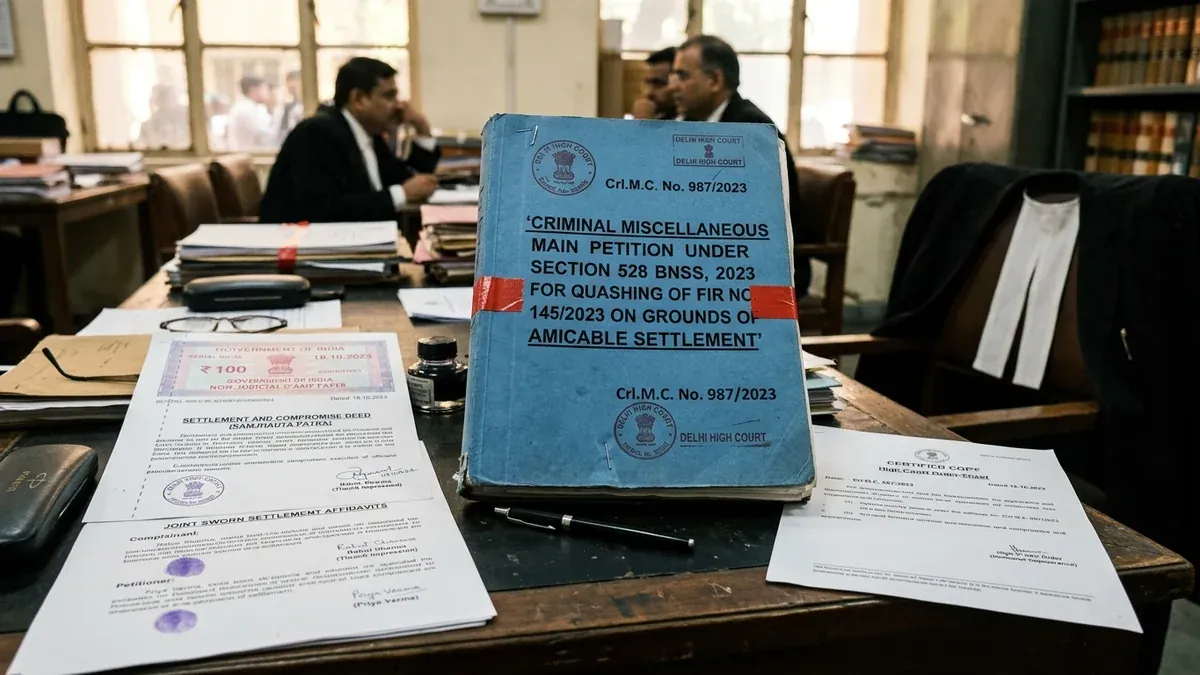
When private adversaries, warring matrimonial spouses, or commercial trading partners achieve an amicable out-of-court settlement, the overarching public interest lies in restoring social harmony and terminating bitter litigation. However, under Indian criminal law, the vast majority of serious offences—such as matrimonial cruelty under Section 85 BNS (old 498A IPC), cheating under Section 318 BNS (old 420 IPC), and voluntarily causing hurt by dangerous weapons under Section 118 BNS—are statutorily classified as non-compoundable. A trial magistrate possesses zero statutory authority to drop such proceedings merely because the parties have compromised. To permanently extinguish non-compoundable criminal proceedings and FIRs, the parties must invoke the inherent jurisdiction of the High Court under Section 528 of the Bharatiya Nagarik Suraksha Sanhita, 2023 (BNSS) (corresponding to Section 482 of the old Code of Criminal Procedure, 1973).
1. Doctrinal Interplay: Section 528 BNSS vs Section 359 BNSS Compounding
Understanding the quashing of criminal proceedings on compromise requires a firm grasp over the statutory distinction between Compounding by Trial Courts and Quashing by the High Court:
| Parameter | Compounding under Section 359 BNSS (Old 320 CrPC) | Quashing under Section 528 BNSS (Old 482 CrPC) |
|---|---|---|
| Judicial Forum | Trial Magistrate or Sessions Court where trial is pending. | Exclusively the High Court (Punjab & Haryana High Court, Delhi High Court, etc.). |
| Jurisdictional Scope | Strictly limited to the offences tabulated in Section 359 BNSS; Section 359(9) bars compounding any other offence. | Plenary inherent jurisdiction to quash non-compoundable offences to secure the ends of justice. |
| Nature of Power | Statutory ministerial recording of composition. | Constitutional inherent power governed by judicial conscience and public policy. |
| Resulting Decree | Section 359(8) BNSS: Composition has the statutory effect of an Acquittal. | High Court order quashing the FIR, charge-sheet, and all consequential proceedings. |
The constitutional validity of this distinction was authoritatively settled by a three-judge bench of the Supreme Court in Gian Singh v. State of Punjab (2012) 10 SCC 303:
"The power of the High Court in quashing a criminal proceeding or FIR or complaint in exercise of its inherent jurisdiction is distinct and different from the power given to a criminal court for compounding the offences under Section 320 of the Code. Inherent power has no limits and its exercise depends on the facts of each case, the paramount consideration being to prevent abuse of the process of any court or to secure the ends of justice."
2. Permissible vs Strictly Forbidden Categories of Quashing
While the inherent power under Section 528 BNSS is wide, it is not unbridled. The Supreme Court in Parbatbhai Aahir v. State of Gujarat (2017) 9 SCC 641 established clear guidelines distinguishing between disputes that can be quashed and heinous crimes that can never be compromised:
Categorization of Offences under Supreme Court Guidelines:
- Permissible Categories for Compromise Quashing:
- Matrimonial & Family Disputes: Offences arising out of dowry harassment, cruelty (Section 85 BNS / 498A IPC), domestic violence, and matrimonial estrangement where parties have reconciled or dissolved marriage (B.S. Joshi v. State of Haryana 2003 SC).
- Commercial, Mercantile & Financial Wrongs: Cheating (Section 318 BNS), criminal breach of trust (Section 316 BNS), partnership fights, and dishonour of cheques where financial restitution is complete.
- Private & Civil Wrongs: Boundary disputes between neighbors, simple affray, property trespass, and private personal altercations without widespread public ramifications.
- Strictly Forbidden Categories (Never Quashed on Compromise):
- Heinous Crimes Against Society: Murder (Section 103 BNS), Rape (Section 64 BNS), Gang Rape, Dacoity, Robbery, Kidnapping for Ransom.
- Offences Against Children: All crimes under the Protection of Children from Sexual Offences Act (POCSO Act).
- Special Statues: Offences under the NDPS Act (commercial narcotics quantity), Prevention of Corruption Act (PC Act), and Arms Act.
- Abetment of Suicide: In Daxaben v. State of Gujarat (2022) 13 SCC 329, the Supreme Court held that abetment of suicide (Section 108 BNS / 306 IPC) is a crime against society and can never be quashed on private financial compromise.
3. Quashing Attempt to Murder (Section 109 BNS): The Narinder Singh Ratio
A frequent challenge arises when an altercation is registered under Section 109 BNS (old Section 307 IPC - Attempt to Murder). Can such an FIR be quashed if the parties settle?
The Supreme Court answered this question authoritatively in Narinder Singh v. State of Punjab (2014) 6 SCC 466 and reaffirmed in State of M.P. v. Laxmi Narayan (2019) 5 SCC 688:
- Merely Invoking Section 109 BNS is Not an Absolute Bar: The High Court is not bound solely by the police section mentioned in the FIR. The High Court has the duty to examine the case diary and medical reports.
- Nature of Injuries & Weapon Used: If the medical report reveals simple contusions or blunt abrasions without bone fractures or weapon penetration to vital organs, the High Court may conclude that the intention to cause death was absent and quash the proceedings.
- Stage of Trial: If the compromise is presented at the threshold stage before charges are framed or early in trial, quashing is favoured. However, if the trial is concluded and prosecution witnesses have supported the charge, compromise quashing will be refused.
4. Drafting an Irrevocable Deed of Settlement & No-Objection Affidavits
The linchpin of a Section 528 BNSS quashing petition is a watertight, irrevocable Deed of Settlement (Compromise Agreement) accompanied by supporting sworn affidavits of the complainant and victim:
Record the exact demand draft numbers, RTGS references, and clearing dates. Specify that the sum constitutes full, final, and absolute settlement of all claims including Streedhan, permanent alimony, maintenance, and damages.
The complainant must unequivocally declare that they have settled all disputes amicably without any coercion, duress, or undue influence, and have no objection whatsoever to the quashing of the FIR and all consequential proceedings.
Both parties must undertake to withdraw all pending cross-cases, civil suits, complaints under Section 12 DV Act, maintenance claims under Section 144 BNSS, and police complaints.
5. Mandatory High Court Magisterial Verification Protocol
To eliminate bogus settlements and forged signatures, High Courts have established a mandatory Verification Protocol:
- Notice & Referral Order: Upon the first listing of the Section 528 BNSS petition, the High Court issues notice to the State and refers the parties to appear before the trial Magistrate or Registrar on a designated date.
- Recording of Sworn Statements: The Magistrate examines the complainant, victims, and accused in person, verifies their original photo identity cards (Aadhaar/Passport), and records their statements on oath confirming that the settlement was executed voluntarily.
- Submission of Verification Report: The Magistrate transmits a formal report to the High Court stating that the compromise is genuine and voluntary.
- Final Hearing & Quashing Decree: Upon perusing the Magistrate's report and hearing the State Public Prosecutor, the High Court passes the final order quashing the FIR and discharging all accused persons.
6. Remedies When Complainant Reneges After Accepting Settlement Consideration
A frequent fraudulent abuse occurs when a complainant accepts substantial financial sums (e.g. 50% or 100% of alimony/settlement money) and then maliciously refuses to appear before the High Court or opposes quashing.
The Supreme Court has decisively eliminated this practice in Mohd. Shamim v. Nahid Begum (2005) 3 SCC 402 and Ruchi Agarwal v. Mukesh Kumar (2005) 3 SCC 299. The Court held that:
"A party who has received benefits under a solemn agreement of compromise cannot be permitted to resile from the settlement. Permitting the complainant to pursue the criminal complaint after retaining settlement funds would amount to an abuse of the judicial process, and the High Court must quash the proceedings despite the complainant's objection."
7. Verification for NRIs & Distant Residents under Section 530 BNSS
Under the new architecture of Section 530 BNSS, all inquiries, trials, and legal proceedings may be conducted through audio-video electronic means. When an NRI complainant or accused resides abroad (USA, UK, Canada, UAE), they are no longer required to travel to India solely for recording compromise statements. The High Court directs verification via video conferencing through the Indian Embassy or Consulate, with identity verified by consular officers.
8. Step-by-Step Quashing Litigation Protocol before High Court
Executing a flawless quashing petition under Section 528 BNSS:
Draft the bilateral Deed of Settlement and sworn affidavits of no-objection attested by a Notary Public or Oath Commissioner.
File the quashing petition before the High Court of Punjab & Haryana or Delhi High Court, annexing certified copies of the FIR, charge-sheet, Settlement Deed, and no-objection affidavits.
Appear before the assigned trial Magistrate on the referral date with original Aadhaar cards and photographs to record sworn verification statements.
Obtain the certified copy of the High Court's final quashing judgment and serve it upon the trial court and the concerned police station to officially close the case record.
Practical Compromise Quashing Checklist for Litigants
- Ensure Non-Heinous Classification: Verify that the charges do not involve murder, rape, POCSO, or commercial NDPS offences.
- Draft Comprehensive Compromise Deed: Include full financial payment schedules and mutual waivers of civil and criminal claims.
- Procure Sworn No-Objection Affidavits: Obtain attested affidavits with passport-sized photographs from all complainants and injured victims.
- Ensure In-Person or VC Verification: Prepare all parties to appear before the trial Magistrate with valid government photo identity cards.
- Serve Certified Quashing Copy on Police Station: Deliver the final High Court quashing order to the SHO and trial court to extinguish bail bonds.
Statutory Authorities & Legal References
- Bharatiya Nagarik Suraksha Sanhita, 2023: Section 359 (Compounding of offences), Section 528 (Inherent powers of High Court), and Section 530 (Trial and proceedings in electronic mode).
- Bharatiya Nyaya Sanhita, 2023: Section 85 (Cruelty by husband or relatives), Section 318 (Cheating), Section 118 (Voluntarily causing grievous hurt by dangerous weapons), and Section 109 (Attempt to murder).
- Supreme Court Landmark Jurisprudence: Gian Singh v. State of Punjab (2012), B.S. Joshi v. State of Haryana (2003), Narinder Singh v. State of Punjab (2014), Parbatbhai Aahir v. State of Gujarat (2017), Daxaben v. State of Gujarat (2022), and Mohd. Shamim v. Nahid Begum (2005).
Frequently Asked Questions
Authoritative guidance on quashing non-compoundable FIRs on compromise before the High Court.
Why can the High Court quash non-compoundable FIRs while the Trial Magistrate cannot?
Under Section 359(9) of the Bharatiya Nagarik Suraksha Sanhita, 2023 (BNSS) (old Section 320(9) CrPC), the Trial Magistrate is strictly bound by the statutory table of compoundable offences and possesses zero power to compound any offence not listed therein. Doing so would violate the statutory bar. In contrast, the High Court exercises plenary inherent powers under Section 528 BNSS (old Section 482 CrPC). As authoritatively settled in Gian Singh v. State of Punjab (2012) 10 SCC 303, the High Court's power to quash is distinct and independent from the power of compounding, designed to prevent abuse of the process of law and secure the ends of justice.
Can an FIR under Section 109 BNS (Attempt to Murder / old 307 IPC) be quashed on compromise?
Yes, but subject to stringent judicial scrutiny established by the Supreme Court in Narinder Singh v. State of Punjab (2014) 6 SCC 466 and State of M.P. v. Laxmi Narayan (2019) 5 SCC 688. The High Court must examine: (1) The nature of injuries sustained (whether simple or life-threatening); (2) The weapon used and whether vital body parts were targeted; (3) The stage of the proceedings (pre-charge or after prosecution evidence); and (4) Whether the dispute was fundamentally private, matrimonial, or commercial rather than an organized gang attack or public crime.
What happens if the complainant reneges or backs out of the compromise after receiving money?
If a complainant executes a formal Deed of Settlement, accepts monetary consideration (demand draft / RTGS), and subsequently reneges in court, the Supreme Court in Mohd. Shamim v. Nahid Begum (2005) 3 SCC 402 and Ruchi Agarwal v. Mukesh Kumar (2005) 3 SCC 299 held that a party cannot blow hot and cold or retain settlement funds while continuing criminal prosecution. In such cases, the High Court exercises Section 528 BNSS powers to quash the criminal proceedings despite the complainant's belated objections.
Can criminal proceedings be quashed partially against certain accused persons while continuing against others?
Yes. As held by the Supreme Court in Lovely Salhotra v. State (NCT of Delhi) (2018) 12 SCC 391, partial quashing is legally permissible. In matrimonial or corporate disputes where settlement has been reached with specific relatives (e.g. aged in-laws or independent non-executive directors) or where accusations against them are completely groundless, the High Court can quash proceedings qua those specific individuals while the trial continues against the primary accused.
What is the mandatory High Court statement verification protocol in compromise quashing?
When a petition under Section 528 BNSS is filed along with a Settlement Deed, the High Court issues a referral order directing the parties to appear before the trial Magistrate or Registrar on a designated date. The Magistrate records the sworn statements of the complainant and accused, verifies their original identity proofs (Aadhaar/Passport), ensures the settlement is voluntary and free from coercion, and transmits a formal Verification Report to the High Court, which then acts upon the report to pass a quashing decree.
Can parties residing abroad or in distant states verify their statements via Video Conferencing?
Yes. Under Section 530 of BNSS 2023 read with the High Court Rules for Video Conferencing, parties who are NRIs, hospitalized, or residing in distant states can appear before the verifying Magistrate through video conferencing from Indian Embassies/Consulates or local district courts, accompanied by attested affidavits of no-objection.
Can an FIR under Section 85 BNS (Cruelty / 498A) be quashed on compromise without obtaining a divorce?
Yes. In the seminal precedent of B.S. Joshi v. State of Haryana (2003) 4 SCC 675, the Supreme Court held that the purpose of Section 482 CrPC (now Section 528 BNSS) is to encourage marital harmony and amicable resolutions. The High Court can quash matrimonial cruelty proceedings where the spouses have reconciled and decided to live together peacefully, as well as where they have agreed to part ways through mutual consent divorce.
Which categories of criminal offences can NEVER be quashed on the basis of compromise?
Under the Supreme Court's ruling in Parbatbhai Aahir v. State of Gujarat (2017) 9 SCC 641 and Daxaben v. State of Gujarat (2022) 13 SCC 329, heinous crimes against society can never be quashed on compromise. These include murder (Sec 103 BNS), rape (Sec 64 BNS), dacoity, offences under the POCSO Act, NDPS Act (commercial quantity), Prevention of Corruption Act, and abetment of suicide (Sec 108 BNS).