Passport Impoundment & Court Permission to Travel Abroad in Pending Criminal Cases under Passports Act
 Authored by: Advocate Kishan Kumar (Advocate & Legal Consultant)
Quick Summary & Strategic Key Takeaways
- Constitutional Right to Travel (Maneka Gandhi): The right to hold a passport and travel abroad is a fundamental liberty protected under Article 21 of the Constitution, which cannot be curtailed arbitrarily without natural justice.
- Police Lack Impounding Authority (Suresh Nanda): The Supreme Court established that police and probe agencies (CBI, ED) can only temporarily seize a passport under Section 102 CrPC (now Section 107 BNSS); exclusive power to impound lies solely with the Passport Authority under Section 10(3) Passports Act.
- Trial Court Travel Permission (MEA Notification G.S.R. 570(E)): Accused persons facing pending criminal trials can travel abroad by securing a 'No Objection' order from the trial court; mere pendency of an FIR without chargesheet is no statutory bar.
- High Court LOC Quashing (Article 226): Arbitrary Look Out Circulars opened by banks or investigating agencies in private loan or matrimonial disputes can be suspended or quashed through High Court writ petitions.
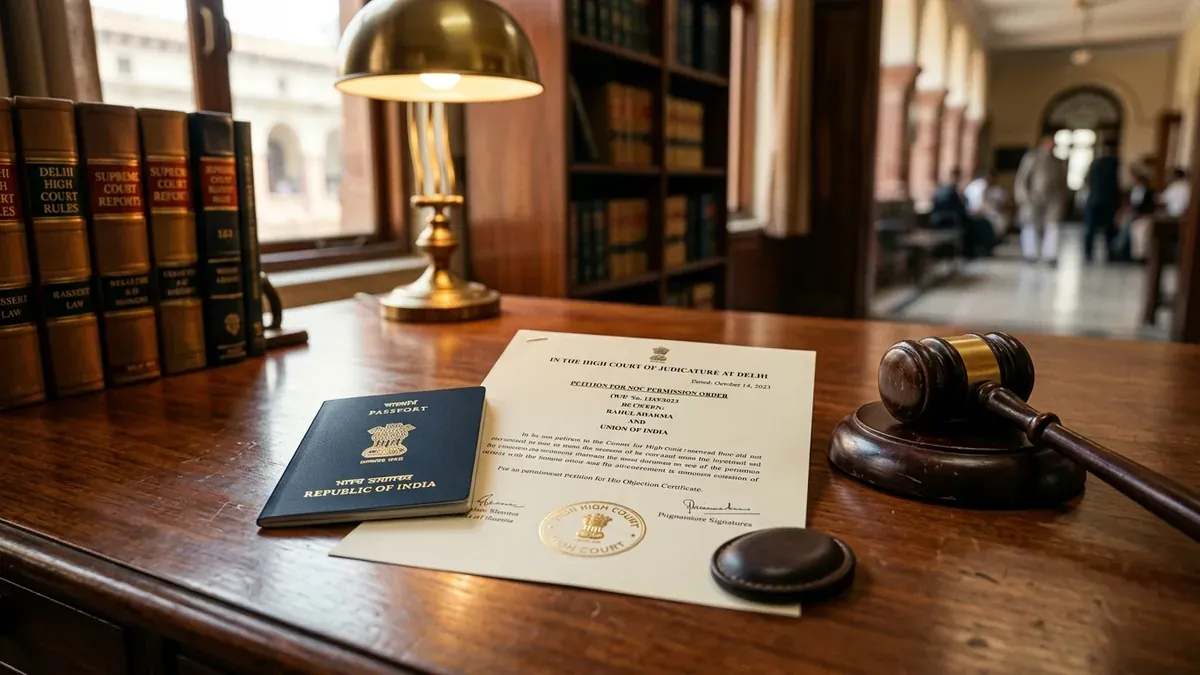
1. Constitutional Jurisprudence: The Article 21 Right to Travel Abroad
The freedom of an Indian citizen to travel across international borders, pursue livelihood abroad, or seek overseas medical care is not a mere statutory privilege; it is an organic component of fundamental liberty guaranteed under Article 21 of the Constitution of India.
Satwant Singh Sawhney v. D. Ramarathnam, APO, New Delhi (1967) 3 SCR 525
In this early landmark ruling, a Constitution Bench held that the right to travel abroad is an integral aspect of "personal liberty" within the meaning of Article 21. The Court ruled that no person can be deprived of their right to travel abroad except in accordance with a procedure established by law enacted by Parliament, leading directly to the enactment of the Passports Act, 1967.
Maneka Gandhi v. Union of India (1978) 1 SCC 248
A seven-judge bench of the Supreme Court held that any procedure established by law to impound a passport must satisfy the triple test of Articles 14, 19, and 21—it must be right, just, and fair, and not arbitrary, fanciful, or oppressive. The Court established that an order impounding a citizen's passport without affording a post-decisional or pre-decisional hearing violates the core tenets of natural justice.
2. Seizure by Police vs Impoundment by Passport Authority (The Suresh Nanda Rule)
A frequent abuse of administrative power in criminal investigations occurs when investigating agencies (such as local police, Crime Branch, CBI, or Enforcement Directorate) seize an accused person's passport and retain it indefinitely in the case malkhana.
Suresh Nanda v. Central Bureau of Investigation (2008) 3 SCC 674
The Supreme Court examined whether the police possess statutory authority to impound a passport under Section 102 of the Code of Criminal Procedure (now Section 107 of the Bharatiya Nagarik Suraksha Sanhita, 2023). A two-judge bench laid down the categorical difference between 'seizure' and 'impounding':
Supreme Court in Suresh Nanda (2008):
"While the police may have the power to seize a passport under Section 102 of the CrPC, it does not have the power to impound the same. Impounding of a passport can only be done by the Passport Authority under Section 10(3) of the Passports Act, 1967... The Passports Act is a special act, whereas the CrPC is a general act. Hence, the provisions of the Passports Act will prevail over Section 102 of the CrPC. The police cannot retain the passport indefinitely; if the police believe that the passport should be impounded, they must immediately forward it to the Passport Authority."
Consequently, any police officer who unlawfully retains an accused's passport is guilty of an illegal act, and the accused can move an application under Section 497 BNSS (old Section 451/457 CrPC) before the Magistrate for immediate release of the travel document.
3. Navigating Section 6(2)(f) & MEA Notification G.S.R. 570(E)
Under Section 6(2)(f) of the Passports Act, 1967, the passport authority shall refuse to issue or renew a passport if proceedings in respect of an offense alleged to have been committed by the applicant are pending before a criminal court in India.
To prevent this provision from operating as an automatic life ban on overseas employment or travel for citizens facing protracted criminal litigation, the Ministry of External Affairs (MEA) issued Notification G.S.R. 570(E) dated August 25, 1993:
MEA Notification G.S.R. 570(E):
Citizens against whom criminal proceedings are pending before a court in India are exempt from the refusal clause of Section 6(2)(f), provided:
1. The applicant produces an order from the court concerned permitting them to depart from India or obtain a passport;
2. If the court order specifies a period of validity, the passport shall be issued for that period;
3. If no period is specified in the court order, the passport shall be issued for a period of one year.
4. Judicial Threshold: Pending FIR vs Cognizance by Criminal Court
A crucial legal battleground is whether the mere registration of an FIR without a chargesheet attracts Section 6(2)(f). Passport officers frequently issue show-cause notices denying passports merely because a police verification report (PVR) states "Adverse: FIR pending".
High Courts across India have repeatedly clarified that criminal proceedings are NOT pending before a court during the police investigation stage:
- Bombay High Court in Narendra K. Ambwani v. Union of India (2014): Proceedings in respect of an offense are pending before a criminal court only after a chargesheet is filed and the Magistrate takes cognizance under Section 190 CrPC (now Section 210 BNSS). During the FIR investigation stage, Section 6(2)(f) does not apply, and the passport authority cannot refuse passport issuance.
- Delhi High Court in Ashok Khanna v. Central Bureau of Investigation (2019): An adverse police report citing a preliminary investigation cannot deprive a citizen of passport renewal under Section 6(2)(f).
5. Look Out Circulars (LOCs): Immigration Bans & High Court Writ Quashing
A Look Out Circular (LOC) is an internal coercive tool utilized by immigration authorities at airport international terminals to intercept, detain, or prevent an individual from boarding foreign flights. LOCs are frequently opened at the request of public sector banks for loan defaults, or in private matrimonial disputes under Section 85 BNS (old 498A IPC).
Sumer Singh Salkan v. Asst. Director, DG of Security, Delhi HC (2010)
The Delhi High Court formulated binding guidelines governing the opening of LOCs:
- An LOC can be opened only when the accused is deliberately evading arrest, failing to appear in court despite non-bailable warrants (NBWs), or where there is a reasonable apprehension that the accused will flee the country.
- An LOC cannot be issued mechanically in matrimonial disputes or commercial debt recovery matters.
- If an LOC is opened arbitrarily, the aggrieved person can file a Writ Petition under Article 226 of the Constitution before the High Court. High Courts routinely quash such LOCs or grant interim permission to travel upon deposit of security.
6. Step-by-Step Trial Court Application Roadmap for Foreign Travel Permission
An accused seeking court permission to travel abroad must follow this rigorous litigation roadmap:
- Step 1: Collect Documentary Evidence of Travel: Secure employment contract, conference invitation, medical referral, return air tickets, and foreign accommodation confirmations.
- Step 2: Draft Formal Application under BNSS: Prepare an application before the Trial Magistrate detailing exact travel dates, foreign address, contact email/phone, and undertaking to return.
- Step 3: Offer Surety & Security Deposit: Propose a fixed deposit receipt (FDR) or local property surety to guarantee return to India.
- Step 4: Appoint Special Advocate under Section 355 BNSS: Authorize a trial advocate to represent the accused under Section 355 BNSS (old Section 317 CrPC) so the ongoing trial is not delayed.
- Step 5: Present Certified Court Order to RPO: Submit the certified court permission order to the Regional Passport Office (RPO) along with Form G.S.R. 570(E) for immediate passport issuance/renewal.
7. Specimen Draft: Application for Permission to Travel Abroad before Magistrate
Below is a standardized application format for obtaining trial court permission to travel abroad:
IN THE COURT OF CHIEF JUDICIAL MAGISTRATE / SPECIAL JUDGE
AT [CITY, E.G., GURUGRAM / NEW DELHI]
CRIMINAL CASE NO. _______ OF 202X
IN THE MATTER OF:
State / CBI ... PROSECUTION
VERSUS
[Accused Full Name, Address] ... APPLICANT / ACCUSED
APPLICATION UNDER SECTION 480 / 483 BNSS READ WITH MEA NOTIFICATION G.S.R. 570(E) FOR PERMISSION TO TRAVEL ABROAD TO [COUNTRY] FROM [START DATE] TO [END DATE] AND FOR DIRECTIONS TO RPO FOR PASSPORT RENEWAL
MOST RESPECTFULLY SHOWETH:
1. The Applicant is an accused in the above-captioned criminal case and is currently on regular bail granted by this Hon'ble Court. The Applicant has strictly adhered to all bail conditions and has never misused liberty.
2. Bona Fide Purpose of Overseas Travel: The Applicant is employed as [Designation] with [Company Name] and is required to travel to [City, Country] to attend mandatory corporate conferences / executive meetings from [DD/MM/YYYY] to [DD/MM/YYYY] (travel itinerary attached as Annexure A).
3. Protection of Right to Livelihood: Depriving the Applicant of foreign travel will result in wrongful termination of employment, causing irreparable loss to his livelihood guaranteed under Article 21 of the Constitution as held in Maneka Gandhi v. UOI.
4. Undertaking & Security: The Applicant undertakes to return to India on or before [Date], will furnish a Fixed Deposit Receipt of ₹[5,00,000] as security, and has authorized his advocate Mr. [Name] under Section 355 BNSS to appear on his behalf on all trial dates so that proceedings are not delayed.
PRAYER: It is respectfully prayed that this Hon'ble Court may be pleased to grant permission to the Applicant to travel abroad to [Country] for the period [Dates], and direct the Regional Passport Office to renew the Applicant's passport in terms of Notification G.S.R. 570(E).
APPLICANT / ACCUSED THROUGH: ADVOCATE
Date: [DD/MM/YYYY] Place: [City]
8. Passport Restrictions & Remedies Comparative Statutory Matrix
| Restriction Scenario | Governing Legal Provision | Appropriate Legal Forum | Remedy / Relief Obtainable |
|---|---|---|---|
| Police Seizing & Retaining Passport | Section 102 CrPC / Section 107 BNSS (Illegal per Suresh Nanda) | Trial Magistrate / CJM Court | Application under Section 497 BNSS for immediate return of passport. |
| Refusal of Passport Due to Pending Criminal Case | Section 6(2)(f) Passports Act & MEA Notification G.S.R. 570(E) | Trial Court seized of the criminal trial | Application for travel permission / NOC for passport issuance. |
| Refusal When Only FIR is Under Investigation | Section 6(2)(f) (Misapplied by Passport Office) | High Court under Article 226 (Writ Mandamus) | Order quashing adverse police report and directing passport issuance. |
| Look Out Circular (LOC) at Airport | MHA Executive Office Memorandums | High Court under Article 226 (Writ Certiorari) | Writ petition for quashing LOC or interim travel permission with security. |
Frequently Asked Questions on Passport Impoundment & Travel Abroad in Criminal Cases
Comprehensive legal treatise covering Passports Act 1967, MEA G.S.R. 570(E) rules, Suresh Nanda doctrine, and High Court LOC quashing procedures.
Can the police or investigating agencies like CBI/ED seize and impound a passport?
No. The Supreme Court in Suresh Nanda v. Central Bureau of Investigation (2008) 3 SCC 674 categorically held that while police officers or investigating agencies can temporarily seize a passport under Section 102 CrPC (now Section 107 BNSS), they have zero statutory authority to 'impound' or permanently retain it. Under Section 10(3) of the Passports Act, 1967, the power to impound or revoke a passport is vested exclusively in the designated Passport Authority. If the police retain a passport beyond the immediate seizure without forwarding it to the Passport Officer, such retention is illegal and an abuse of power.
Can a person travel abroad if an FIR or criminal trial is pending against them?
Yes. Under Section 6(2)(f) of the Passports Act, 1967 read with Ministry of External Affairs Notification G.S.R. 570(E) dated August 25, 1993, a citizen facing pending criminal proceedings before a criminal court can obtain a passport or travel abroad, provided they obtain prior permission / 'No Objection Certificate' (NOC) from the concerned Trial Court before which the case is pending. Once the trial court grants permission, the Regional Passport Office is legally bound to issue or renew the passport.
What is the procedure to apply for permission to travel abroad before the Trial Court?
The applicant must file an application under Section 480 / 483 BNSS (or Section 437/439 CrPC) or under inherent powers of the trial court before the Judicial Magistrate or Sessions Judge. The application must state: (1) Purpose of foreign travel (employment, medical treatment, business, family event); (2) Proposed travel itinerary with dates of departure and return; (3) Foreign address and contact numbers; (4) Details of an Indian surety or security deposit; and (5) An undertaking to return to India and appear before the court on scheduled trial dates.
What standard conditions do courts impose when granting travel permission?
Trial courts typically impose the following conditions: (1) Furnishing a cash security deposit or fixed deposit receipt (FDR) ranging from ₹1,00,000 to ₹10,00,000; (2) Execution of a personal bond with one local solvent surety; (3) Submitting flight tickets, hotel bookings, and foreign contact details; (4) Authorizing an advocate under Section 355 BNSS (old Section 317 CrPC) to represent the accused in their absence so trial proceedings are not stalled; and (5) Reporting to the trial court within 48 to 72 hours of return to India.
How can a Look Out Circular (LOC) issued at airports be challenged and quashed?
A Look Out Circular (LOC) is an internal administrative instruction issued by immigration authorities at the request of investigating agencies or banks to detain or prevent an individual from leaving India. An arbitrary LOC can be challenged by filing a Writ Petition under Article 226 of the Constitution before the High Court. Under the Delhi High Court guidelines in Sumer Singh Salkan v. Assistant Director (2010), an LOC can only be opened if the accused is deliberately evading arrest or summons, or if departure affects national sovereignty or economic security. Routine matrimonial disputes or civil loan defaults cannot justify an LOC.
Does the pendency of a mere FIR (before chargesheet) bar passport issuance?
No. The Bombay High Court, Delhi High Court, and Punjab & Haryana High Court have held that Section 6(2)(f) of the Passports Act applies only when proceedings in respect of an offense alleged to have been committed by the applicant are 'pending before a criminal court'. Under criminal law, proceedings are pending before a court only after a chargesheet is filed and the Magistrate takes cognizance. A mere police investigation or pending FIR before chargesheet does not constitute proceedings 'pending before a court'.
What did the Supreme Court hold in Maneka Gandhi v. Union of India regarding passports?
In the historic seven-judge bench ruling in Maneka Gandhi v. Union of India (1978) 1 SCC 248, the Supreme Court held that the right to travel abroad is an integral part of 'personal liberty' guaranteed under Article 21 of the Constitution. No person can be deprived of their passport except in accordance with a procedure established by law that is 'just, fair, and reasonable', and not arbitrary, fanciful, or oppressive. Any impoundment without affording prior opportunity of hearing violates principles of natural justice.
Can a passport be renewed for 10 years if criminal proceedings are pending?
Under MEA Notification G.S.R. 570(E), if the trial court grants permission to travel abroad for a specific duration (e.g., 6 months or 2 years), the passport is issued or renewed for that specified period. If the trial court's order does not mention any specific duration, the Passport Authority is required by law to issue the passport with a standard validity of one year, which can be renewed annually upon subsequent court permissions.