Commercial Quantity NDPS Act Bail: Section 37 Stringent Conditions, Search Flaws & High Court Precedents
 Authored by: Advocate Kishan Kumar (Advocate & Legal Consultant)
Quick Summary & Strategic Key Takeaways
- Section 37 Twin Conditions: For commercial quantity drug seizures, bail is prohibited unless the court finds reasonable grounds to believe the accused is innocent and not likely to commit crimes on bail.
- Constitutional Liberty Trump (Mohd. Muslim 2023): The Supreme Court has firmly ruled that prolonged pretrial detention without trial progress overrides the statutory bar of Section 37, making bail mandatory under Article 21.
- Inadmissibility of Section 67 Confessions (Tofan Singh 2021): Confessions recorded by NCB or police officers under Section 67 have zero evidentiary value and cannot justify remand or denial of bail.
- Fatal Procedural Breaches (Sections 42, 50 & 52A): Failure to record secret info in writing, violation of Section 50 body search safeguards, or drawing samples without Magisterial certification under Section 52A dismantles the prosecution case.
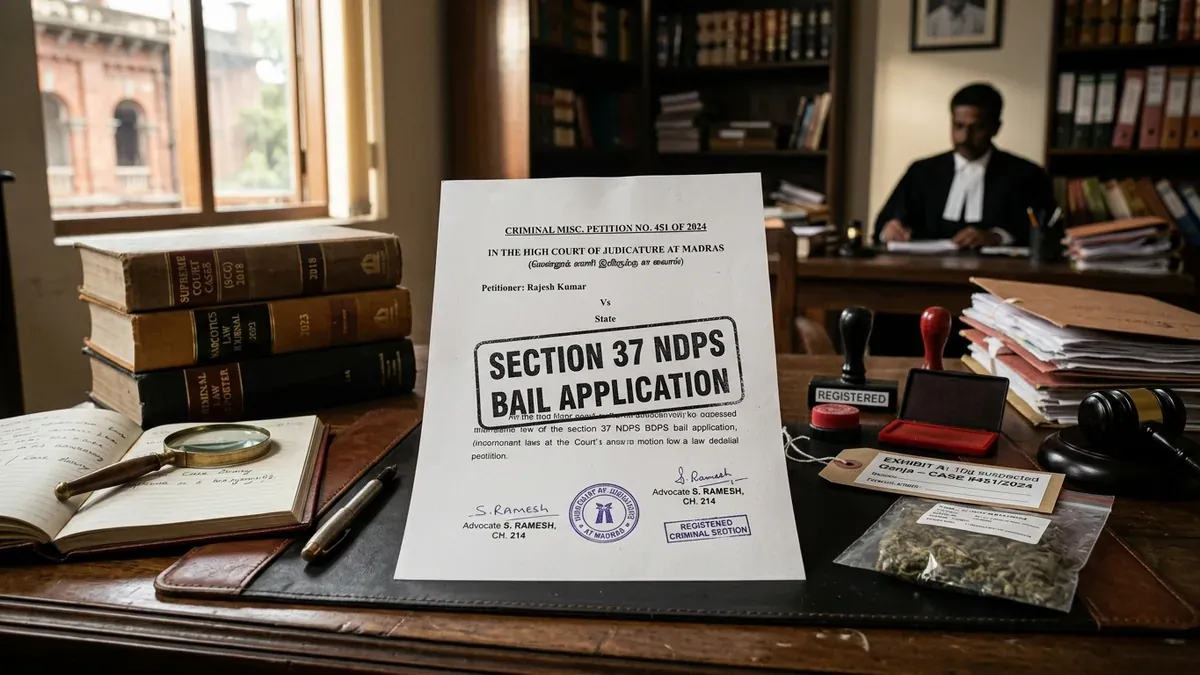
1. Statutory Architecture of Section 37 NDPS Act: The Draconian Bail Bar
The Narcotic Drugs and Psychotropic Substances Act, 1985 (NDPS Act) is one of the most stringent penal enactments in the Indian legal landscape. Designed to curb the societal scourge of illicit drug trafficking, the statute reverses traditional bail presumptions for offenses involving "Commercial Quantity". Under Section 37(1)(b) of the Act, every offense punishable under the statute is cognizable and non-bailable.
Section 37(1)(b) enacts a negative covenant that severely fetters judicial discretion in granting regular bail under Section 483 of the Bharatiya Nagarik Suraksha Sanhita, 2023 (BNSS) or Section 439 CrPC:
Section 37(1)(b)(ii), NDPS Act, 1985:
"No person accused of an offence punishable for offences under section 19 or section 24 or section 27A and also for offences involving commercial quantity shall be released on bail or on his own bond unless—
(i) the Public Prosecutor has been given an opportunity to oppose the application for such release, and
(ii) where the Public Prosecutor opposes the application, the court is satisfied that there are reasonable grounds for believing that he is not guilty of such offence and that he is not likely to commit any offence while on bail."
2. The Twin Conditions Explained: Shiv Shanker Kesari Jurisprudence
The interpretation of the phrase "reasonable grounds for believing that he is not guilty" has been the subject of extensive judicial scrutiny. In Union of India v. Shiv Shanker Kesari (2007) 7 SCC 798, the Supreme Court held:
Supreme Court in Shiv Shanker Kesari (2007):
"The expression 'reasonable grounds' means something more than prima facie grounds. It contemplates substantial probable causes for believing that the accused is not guilty of the alleged offence. The reasonable belief contemplated in the provision requires existence of such facts and circumstances as are sufficient in themselves to justify satisfaction that the accused is not guilty."
Consequently, to secure bail in a commercial quantity case, defence counsel cannot merely argue lack of motive; counsel must demonstrate incurable statutory violations, absence of conscious possession, or fatal sampling flaws that strike at the root of the prosecution's case.
3. Prolonged Incarceration as Constitutional Exception: Mohd. Muslim (2023)
For years, undertrials accused under commercial quantity provisions remained incarcerated for 4 to 8 years without trial commencement, as Sessions Courts felt powerless to bypass Section 37. In Mohd. Muslim @ Hussain v. State (NCT of Delhi) 2023 SCC OnLine SC 352, a two-judge bench of the Supreme Court delivered a monumental constitutional judgment liberating undertrials:
Supreme Court in Mohd. Muslim (2023):
"Grant of bail on ground of undue delay in trial cannot be fettered by statutory embargoes like Section 37 NDPS Act. Prolonged incarceration of an undertrial, in the absence of any fault on their part, directly infringes the fundamental right to personal liberty under Article 21. If a trial cannot proceed expeditiously, statutory restrictions on bail must yield to the higher constitutional command of liberty."
This doctrine was reaffirmed in Rabi Prakash v. State of Odisha (2023 SCC OnLine SC 1109), establishing that continuous detention exceeding 18 to 24 months with numerous prosecution witnesses remaining unexamined entitles the accused to regular bail regardless of drug weight.
4. Section 42 Search & Seizure Protocols: The Karnail Singh Doctrine
Section 42 of the NDPS Act governs the power of entry, search, seizure, and arrest without warrant. In Karnail Singh v. State of Haryana (2009) 8 SCC 539, a Constitution Bench laid down mandatory operational rules:
- Recording Information in Writing: An officer receiving secret intelligence regarding contraband in any building, conveyance, or enclosed place must immediately reduce that information into writing before proceeding to conduct the raid.
- Transmission to Senior Officers: The written record of information must be dispatched to the officer's immediate official superior within 72 hours.
- Total Non-Compliance is Fatal: While delayed transmission may be explained under exceptional circumstances, total failure to reduce secret information into writing or complete non-transmission to the superior officer vitiates the search and entitles the accused to immediate bail.
5. Mandatory Section 50 Personal Search Rights: Baldev Singh Mandate
Section 50 provides a vital constitutional safeguard to an individual about to undergo a personal body search. The officer must inform the suspect in clear terms that they have a statutory right to be taken to the nearest Gazetted Officer or Magistrate to be searched in their presence.
In the Constitution Bench ruling in State of Punjab v. Baldev Singh (1999) 6 SCC 172, the Supreme Court held that Section 50 is mandatory, not directory. The suspect must be made aware of this right, and their consent to be searched by the raiding officer cannot be presumed. If Section 50 is breached, the contraband recovered from the person is inadmissible, and the conviction stands vitiated.
6. Magisterial Sampling Flaws under Section 52A: Mohanlal Benchmark
The most powerful legal weapon for securing bail in NDPS commercial quantity cases is Section 52A. Under the historic Supreme Court ruling in Union of India v. Mohanlal (2016) 3 SCC 379 and subsequent rulings in Simarnjit Singh (2023) and Mangilal (2023):
| Mandatory Section 52A Requirement | Police Investigating Flaw | Legal Consequence at Bail Stage |
|---|---|---|
| Sampling Exclusively Before Magistrate | Investigating officer draws representative samples at the crime scene during seizure. | Fatal to Prosecution: Spot samples have zero legal standing; recovery is vitiated. |
| Prompt Magisterial Presentation | Contraband kept in police malkhana for weeks without filing Section 52A application. | Unexplained malkhana delay breaks chain of custody; entitles accused to bail. |
| Magistrate Inventory Certificate | Absence of Magistrate's seal and certificate on inventory list and photographs. | Substantive primary evidence non-existent under Section 52A(4); bail granted. |
7. Exclusion of Section 67 Statements: Tofan Singh Landmark Precedent
Investigating agencies like the Narcotics Control Bureau (NCB) and state anti-narcotics units routinely arrested individuals solely on the basis of disclosure statements of co-accused recorded under Section 67 of the NDPS Act. In Tofan Singh v. State of Tamil Nadu (2021) 4 SCC 1, a three-judge bench of the Supreme Court brought an end to this coercive practice:
Supreme Court in Tofan Singh (2021):
"Officers who are invested with powers under Section 53 of the NDPS Act are 'police officers' within the meaning of Section 25 of the Evidence Act. Any confessional statement made to them under Section 67 of the NDPS Act is inadmissible in evidence and cannot be used as substantive evidence against the maker or a co-accused."
Where an accused has been implicated purely on a co-accused's statement without independent physical recovery or call data records (CDR) establishing criminal conspiracy, Section 37 twin conditions stand displaced, and bail must be granted.
8. Specimen Draft: High Court NDPS Regular Bail Application
Below is an authoritative petition format for securing regular bail in commercial quantity cases:
IN THE HIGH COURT OF JUDICATURE AT [STATE / CITY]
CRIMINAL MISCELLANEOUS BAIL PETITION NO. _______ OF 202X
IN THE MATTER OF:
[Accused Full Name], currently lodged in Central Jail [Name] ... PETITIONER
VERSUS
State / Narcotics Control Bureau (NCB) ... RESPONDENT
APPLICATION UNDER SECTION 483 BHARATIYA NAGARIK SURAKSHA SANHITA, 2023 (OLD SECTION 439 CrPC) FOR GRANT OF REGULAR BAIL IN FIR / CRIME NO. [XX/202X] UNDER SECTIONS 8, 20, 22, 29 NDPS ACT
MOST RESPECTFULLY SHOWETH:
1. The Petitioner has been falsely implicated in the subject case and has been languishing in continuous judicial custody since [Date] (over [X] months).
2. Overcoming Section 37 Embargo via Prolonged Incarceration: The investigation is complete and chargesheet has been filed. Out of [35] cited prosecution witnesses, zero witnesses have been examined. The Petitioner is entitled to bail under Article 21 of the Constitution as held by the Supreme Court in Mohd. Muslim v. State (NCT of Delhi) 2023 and Rabi Prakash v. State of Odisha.
3. Fatal Non-Compliance with Section 52A: The seizing officer drew samples at the spot of recovery in direct violation of the Supreme Court's mandate in Union of India v. Mohanlal (2016), rendering the seizure invalid.
4. No Conscious Possession / Implicated Solely on Section 67 Statement: No contraband was recovered from the physical possession of the Petitioner. He has been named solely on the uncorroborated confessional statement of a co-accused, which is legally inadmissible under Tofan Singh v. State of Tamil Nadu (2021 SC).
PRAYER: It is respectfully prayed that this Hon'ble Court may be pleased to enlarge the Petitioner on regular bail on such terms and conditions as deemed fit.
PETITIONER THROUGH: COUNSEL
Date: [DD/MM/YYYY] Place: [City]
9. Drug Quantity Classification & Section 37 Applicability Matrix
| Substance / Narcotic Drug | Small Quantity (Sec 37 Does Not Apply) | Commercial Quantity (Sec 37 Bar Triggered) | Statutory Punishment for Commercial |
|---|---|---|---|
| Heroin / Diacetylmorphine | Up to 5 grams | 250 grams or more | 10 to 20 years RI + ₹1 to ₹2 Lakh fine |
| Cocaine | Up to 2 grams | 100 grams or more | 10 to 20 years RI + ₹1 to ₹2 Lakh fine |
| Charas / Hashish | Up to 100 grams | 1 kg or more | 10 to 20 years RI + ₹1 to ₹2 Lakh fine |
| Ganja / Cannabis | Up to 1 kg | 20 kg or more | 10 to 20 years RI + ₹1 to ₹2 Lakh fine |
| MDMA / Ecstasy | Up to 0.5 grams | 10 grams or more | 10 to 20 years RI + ₹1 to ₹2 Lakh fine |
| Methamphetamine | Up to 2 grams | 50 grams or more | 10 to 20 years RI + ₹1 to ₹2 Lakh fine |
Frequently Asked Questions on NDPS Section 37 Bail & Commercial Quantity Law
Comprehensive bail defense guide under NDPS Act, Section 52A sampling flaws, and Supreme Court Article 21 jurisprudence.
What are the mandatory 'Twin Conditions' for bail under Section 37 of the NDPS Act?
Under Section 37(1)(b)(ii) of the NDPS Act, 1985, when an accused is charged with offenses involving commercial quantity (e.g., Section 19, 24, 27A), bail cannot be granted unless two cumulative conditions are met: (1) The Public Prosecutor is given an opportunity to oppose the bail application; and (2) The Court is satisfied that there are reasonable grounds for believing that the accused is not guilty of such offense, and that he is not likely to commit any offense while on bail. The Supreme Court in Union of India v. Shiv Shanker Kesari held that 'reasonable grounds' means something more than a prima facie case—there must be substantial, probable causes for believing the accused is innocent.
Can prolonged incarceration override the stringent bar of Section 37 NDPS Act?
Yes. In Mohd. Muslim @ Hussain v. State (NCT of Delhi) 2023 SCC OnLine SC 352 and Rabi Prakash v. State of Odisha (2023), the Supreme Court ruled that statutory restrictions on bail like Section 37 NDPS must yield to the fundamental right to personal liberty and speedy trial under Article 21 of the Constitution. Where an accused has suffered prolonged incarceration (e.g., 2 to 4 years) with no prospect of the trial concluding expeditiously, Section 37 conditions are relaxed and regular bail must be granted.
What is the mandatory compliance required for personal search under Section 50 of the NDPS Act?
Under Section 50 of the NDPS Act and the Constitution Bench ruling in State of Punjab v. Baldev Singh (1999), before conducting a personal search of an individual, the authorized officer must mandatorily inform the suspect in writing of their statutory right to be searched before a Gazetted Officer or a Magistrate. Failure to communicate this right strictly or searching without such option vitiates the seizure and entitles the accused to bail and acquittal. However, Section 50 applies only to body searches, not bag or vehicle searches.
What is the consequence of non-compliance with Section 52A (Magisterial Sampling)?
Under Section 52A of the NDPS Act and the landmark Supreme Court ruling in Union of India v. Mohanlal (2016) 3 SCC 379, the investigating officer must immediately bring the seized contraband before a Judicial Magistrate to draw representative samples, certify the inventory, and take photographs under the Magistrate's supervision. Samples drawn at the spot of recovery by the police without magisterial supervision have zero evidentiary value; non-compliance with Section 52A invalidates the trial and mandates grant of bail.
Are confessional statements made to NCB / Police officers under Section 67 admissible in evidence?
No. In Tofan Singh v. State of Tamil Nadu (2021) 4 SCC 1, a three-judge bench of the Supreme Court held that officers invested with powers under Section 53 of the NDPS Act are 'police officers' within the meaning of Section 25 of the Evidence Act (now Section 23 BSA). Consequently, confessional statements recorded under Section 67 of the NDPS Act are completely inadmissible in evidence and cannot be used to convict an accused or deny bail in the absence of independent recovery.
What is the difference between small quantity, intermediate quantity, and commercial quantity?
Under Central Government Notification S.O. 1055(E): (1) Heroin: Small is up to 5 grams; Commercial is 250 grams or more; (2) Cocaine: Small is up to 2 grams; Commercial is 100 grams or more; (3) Ganja: Small is up to 1 kg; Commercial is 20 kg or more; (4) Charas/Hashish: Small is up to 100 grams; Commercial is 1 kg or more; (5) MDMA/Ecstasy: Small is up to 0.5 grams; Commercial is 10 grams or more. Intermediate quantities lie between small and commercial, where Section 37 does not apply and regular bail rules govern.
How does the 'Neutral Substance / Whole Mixture' rule apply to drug quantity calculation?
In Hira Singh v. Union of India (2020) 20 SCC 784, a three-judge bench of the Supreme Court held that when a narcotic substance is seized as a mixture along with neutral substances or cutting agents, the entire weight of the mixture or preparation must be taken into account for determining commercial quantity, and not merely the pure drug content, unless it involves specific exempted preparations.
What procedural flaws in search and seizure under Section 42 justify bail?
Under Section 42 of the NDPS Act and the Constitution Bench ruling in Karnail Singh v. State of Haryana (2009), an officer who receives secret information regarding contraband in a building or conveyance must record it in writing and transmit a copy to their immediate official superior within 72 hours. Total failure to record secret information or dispatch the report is an incurable illegality entitling the accused to bail.