Master Handbook: NRI Matrimonial Disputes, Cross-Border Custody & Mirror Orders
 Authored by: Advocate Kishan Kumar (Advocate & Legal Consultant)
Quick Summary & Strategic Takeaways
- Enforceability of Foreign Divorce Decrees (Section 13 CPC): Ex-parte divorce decrees granted by foreign courts without active submission to jurisdiction are null, void, and unenforceable in India under the landmark Y. Narasimha Rao doctrine.
- Inter-Country Child Custody & Mirror Orders: India is not a signatory to the 1980 Hague Abduction Convention. The Welfare of the Child remains paramount, and Indian courts examine repatriation through Mirror Orders and best interest tests.
- Look Out Circulars (LOC) & Passport Impounding: Remedies against arbitrary LOC issuance and passport impounding under Section 10(3)(h) of Passports Act for NRI husbands facing matrimonial FIRs.
- Video-Conferencing Trial & Power of Attorney (POA): Executing valid special powers of attorney and utilizing High Court VC rules for evidence recording without mandatory physical travel.
- Stridhan & Maintenance Enforcement Abroad: Securing maintenance orders under Section 144 BNSS and reciprocal enforcement of civil decrees under Section 44A CPC in reciprocating foreign territories.
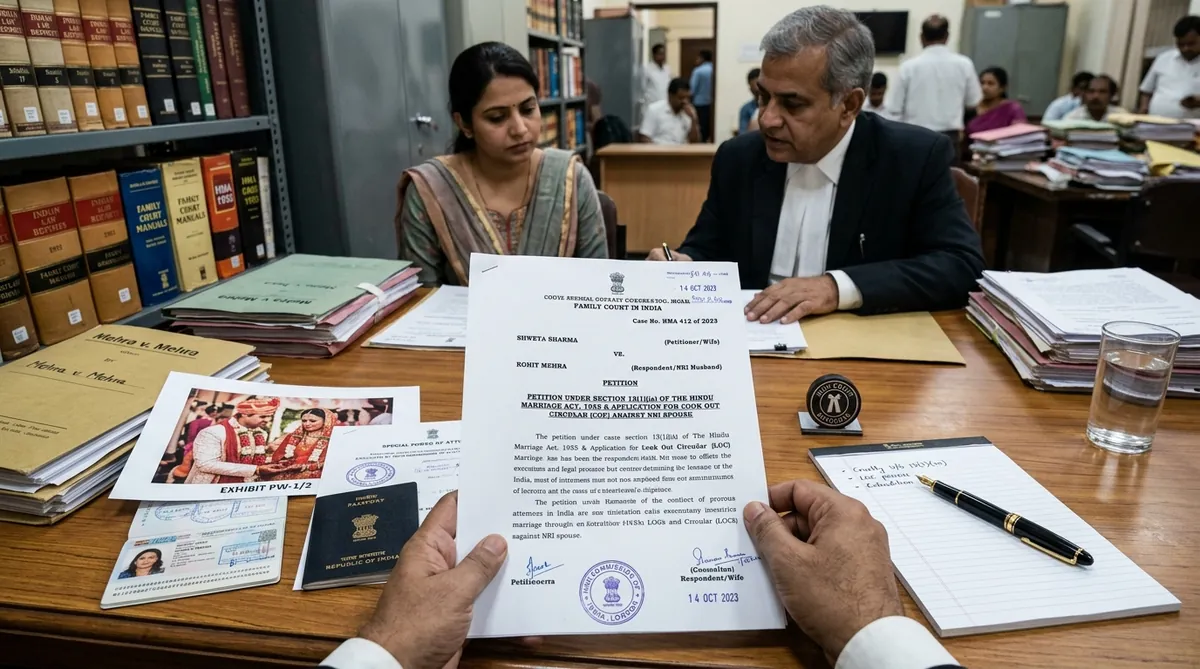
Cross-border matrimonial litigation involving Non-Resident Indians (NRIs), Overseas Citizens of India (OCI), and Indian expatriates residing in the USA, UK, Canada, Australia, Singapore, or the UAE presents intricate private international law, jurisdictional, and constitutional challenges. When marital relationships deteriorate across international borders, foreign court divorce decrees, inter-country child custody disputes, extradition threats, and Look Out Circulars (LOC) collide with Indian statutory frameworks under the Hindu Marriage Act, 1955, the Domestic Violence Act, 2005, and the Bharatiya Nagarik Suraksha Sanhita, 2023.
1. The Jurisdictional Architecture of NRI & Cross-Border Matrimonial Litigation
In an increasingly globalized world, matrimonial disputes involving Non-Resident Indians (NRIs), Overseas Citizens of India (OCI), Persons of Indian Origin (PIO), and Indian expatriates residing in the United States, United Kingdom, Canada, Australia, Singapore, Europe, and the Gulf Cooperation Council (GCC) countries represent one of the most intricate, high-stakes areas of private international law and family jurisprudence.
When marital discord erupts across international borders, the legal conflict rarely remains confined to a single courtroom. Instead, parties find themselves embroiled in parallel, multi-jurisdictional litigation where foreign divorce proceedings, inter-country child custody applications, spousal support claims, and anti-suit injunctions collide with Indian proceedings under the Hindu Marriage Act, 1955 (HMA), the Protection of Women from Domestic Violence Act, 2005 (PWDVA), the Guardians and Wards Act, 1890 (GWA), and criminal provisions under the Bharatiya Nagarik Suraksha Sanhita, 2023 (BNSS) and Bharatiya Nyaya Sanhita, 2023 (BNS).
Navigating this complex trans-national arena requires an authoritative mastery of Section 13 of the Code of Civil Procedure, 1908 (CPC), the comity of courts doctrine, the Non-Signatory status of India to the 1980 Hague Abduction Convention, the protective jurisprudence of Mirror Orders, and constitutional remedies under Article 226 against arbitrary Look Out Circulars (LOCs).
Authored by Advocate Kishan Kumar, this comprehensive master handbook serves as the definitive legal blueprint for NRI spouses, overseas families, and resident Indian spouses seeking to protect their marital status, parental custody rights, financial assets, and personal liberty.
2. Enforceability of Foreign Divorce Decrees: The Section 13 CPC Statutory Test
A fundamental tenet of Indian private international law is that a marriage solemnized in India under personal laws—such as the Hindu Marriage Act, 1955 or the Special Marriage Act, 1954—cannot be dissolved by a foreign court decree unless that decree strictly satisfies the six statutory conditions set forth in Section 13 of the Code of Civil Procedure, 1908 (CPC).
Under Section 13 CPC, a foreign judgment is conclusive as to any matter directly adjudicated upon between the same parties, EXCEPT in the following six exhaustive circumstances:
A. Lack of Competent Jurisdiction (Section 13(a)): The foreign court must possess competent jurisdiction under both private international law and the personal law of the parties. A husband who unilaterally relocates to a foreign jurisdiction cannot confer jurisdiction on a foreign family court over an Indian marriage if the wife has not voluntarily established domicile in that country.
B. Judgment Not on the Merits (Section 13(b)): A judgment given as a summary penalty for default of appearance, or granted ex-parte without evaluating substantive oral or documentary evidence, fails this test.
C. Refusal to Recognize Applicable Indian Law (Section 13(c)): Where the foreign court founded its decree on grounds not recognized by the personal law governing the parties (e.g. "no-fault divorce" or "irretrievable breakdown of marriage"—grounds not available under the Hindu Marriage Act).
D. Violation of Principles of Natural Justice (Section 13(d)): Where the respondent spouse was not served with proper legal summons in accordance with diplomatic/Hague Service Convention channels, was given inadequate time, or was deprived of a fair opportunity to contest.
E. Obtained by Fraud (Section 13(e)): Where false statements regarding the wife residence, abandonment of claims, or financial status were made to the foreign judge.
F. Sustaining a Claim Founded on Breach of Indian Law (Section 13(f)): Where the foreign order enforces a claim contrary to Indian public policy.
3. The Landmark Y. Narasimha Rao Doctrine & The Bigamy Consequence
The definitive constitutional interpretation of Section 13 CPC in matrimonial matters was established by the Supreme Court of India in the historic landmark judgment of Y. Narasimha Rao v. Y.Venkata Lakshmi (1991) 3 SCC 451.
The Three Cardinal Principles of Narasimha Rao: The Supreme Court held that the rules of private international law governing matrimonial causes must be interpreted strictly in conformity with Indian statutory laws. Foreign divorce decrees are recognized in India ONLY if:
1. The foreign court is one recognized by the personal law under which the parties were married;
2. The respondent spouse voluntarily submitted to the jurisdiction of the foreign court without protest; and
3. The ground on which the divorce was granted is a ground recognized under the Hindu Marriage Act, 1955 (such as cruelty, adultery, or desertion).
The Criminal Consequence of Void Foreign Decrees: If an NRI husband obtains an ex-parte foreign divorce decree in the United States, UK, or Canada in violation of the Narasimha Rao doctrine, the decree is a legal nullity in India. The marriage legally subsists under Indian law. If the husband subsequently remarries abroad or in India based on such an invalid foreign decree, he commits the criminal offence of Bigamy under Section 82 of the Bharatiya Nyaya Sanhita, 2023 (erstwhile Section 494 IPC), punishable with up to seven years imprisonment. Furthermore, the first wife can institute a Civil Suit for Declaration of Marital Status under Section 34 of the Specific Relief Act, 1963 to formally declare the foreign decree null and void.
4. Anti-Suit Injunctions: Restraining Oppressive Foreign Divorce Proceedings
When an NRI spouse initiates unilateral, vexatious divorce proceedings in an overseas court while proceedings between the parties are pending or maintainable in India, the resident spouse can approach the Indian Family Court or High Court for an Anti-Suit Injunction.
The Modi Entertainment Principles: In Modi Entertainment Network v. W.S.G. Cricket Pte. Ltd. (2003) 4 SCC 341 and Dinesh Singh Thakur v. Sonal Thakur (2018) 17 SCC 12, the Supreme Court laid down the strict tests for granting anti-suit injunctions in matrimonial matters: (1) The defendant must be amenable to the personal jurisdiction of the Indian court; (2) If the injunction is declined, the plaintiff will suffer grave injustice and the foreign proceedings would be oppressive or vexatious; and (3) The principle of international comity must be respected, and injunctions granted with extreme caution.
Obtaining an Ex-Parte Injunction: If the resident wife demonstrates that she lacks the financial means, visa status, or legal capacity to travel to the overseas jurisdiction to contest the foreign divorce, the Indian Family Court will grant an interim anti-suit injunction restraining the NRI husband from prosecuting the foreign suit. Disobedience of such an injunction constitutes contempt of court and renders any resulting foreign decree immediately void for fraud.
5. Cross-Border Child Custody & India Non-Signatory Status to 1980 Hague Convention
Inter-country parental child removal—where one parent relocates a minor child to India without the consent of the overseas parent or in violation of foreign court custody orders—is among the most complex areas of trans-national family litigation.
The Significance of Non-Signatory Status: India has deliberately refrained from signing or ratifying the 1980 Hague Convention on the Civil Aspects of International Child Abduction. Consequently, foreign summary return orders or foreign custody decrees do not automatically bind Indian courts. Indian law does not treat a parent who brings their child to their country of origin as an automatic criminal abductor.
The Statutory Supremacy of Child Welfare: In India, custody is governed by Section 13 of the Hindu Minority and Guardianship Act, 1956 (HMGA) and the Guardians and Wards Act, 1890 (GWA). Section 13 HMGA explicitly mandates that the "Welfare of the Minor shall be the paramount consideration". The Supreme Court has repeatedly held that the principle of comity of foreign courts must yield unconditionally to the holistic welfare, safety, education, and psychological stability of the child.
6. The Supreme Court Welfare of the Child Doctrine (Yashita Sahu & Lahari Sakhamuri)
When an overseas parent approaches an Indian High Court via a Writ of Habeas Corpus under Article 226 seeking the production and return of a minor child, the High Court does not conduct a superficial enforcement of the foreign order. Instead, it conducts a substantive summary or elaborate inquiry.
The Yashita Sahu Framework: In Yashita Sahu v. State of Rajasthan (2020) 3 SCC 67, Lahari Sakhamuri v. Sobhan Kodali (2019) 7 SCC 311, and Nithiin V. Shimre v. State of Karnataka (2020) 14 SCC 572, the Supreme Court established the definitive judicial parameters:
- Summary vs Elaborate Inquiry: If the child has been recently removed from their habitual foreign residence and has not yet developed deep social and educational roots in India, the court may order repatriation to the country of habitual residence to determine custody on merits.
- Rootedness in India: If the child has lived in India for a significant period, is enrolled in Indian schools, speaks the native language, is surrounded by extended family, and the mother expresses genuine fear of physical abuse or destitution abroad, the Indian court will refuse repatriation and assume full custody jurisdiction.
- Both Parents Love & Affection: The court ensures that the child is not deprived of the love and contact of either parent, mandating unrestricted daily video-conferencing access and structured visitation rights.
7. The Jurisprudential Architecture of Mirror Orders in Cross-Border Repatriation
When an Indian High Court or the Supreme Court decides that it is in the best interest of a minor child to return to their country of habitual residence (e.g. USA or UK), it never sends the mother and child back unprotected.
The Concept of a Mirror Order: A Mirror Order is an identical, ancillary protective order passed by the foreign court having jurisdiction in the country of habitual residence that mirrors the exact directions and safeguards formulated by the Indian court prior to the departure of the child from India.
Essential Safeguards Required in Mirror Orders:
1. Safe Separate Accommodation: The foreign husband must provide independent, fully furnished residential accommodation for the mother and child at his sole expense in the foreign city.
2. Monthly Maintenance & Medical Insurance: The husband must deposit advance living maintenance, child support, and comprehensive health insurance before travel.
3. Primary Caregiver Custody: The mother must retain primary physical custody of the child abroad pending final adjudication by the foreign family court.
4. Non-Prosecution Undertaking: The husband must formally withdraw all police complaints, red corner alerts, parental kidnapping warrants, or contempt applications filed in the foreign jurisdiction, ensuring the mother is not arrested at the airport upon arrival.
8. Look Out Circulars (LOC), Red Corner Notices & Passport Impounding Defence
In matrimonial disputes involving allegations under Section 85 BNS (498A), Section 316 BNS (Stridhan breach of trust), or the Domestic Violence Act, resident complainants frequently petition the police or Magistrate to request the Ministry of Home Affairs / Bureau of Immigration (BOI) to open a Look Out Circular (LOC) against the NRI husband and his parents.
The Sumer Singh Salkan Quashing Doctrine: Under the landmark Delhi High Court judgment in Sumer Singh Salkan v. Asst. Director (2010) SCC OnLine Del 2699 and subsequent Ministry of Home Affairs Office Memorandums, an LOC can be issued ONLY in cognizable offences where the accused is deliberately evading arrest, where non-bailable warrants are outstanding, or where national economic/security interests are threatened. LOCs cannot be issued routinely to harass NRIs or settle matrimonial scores.
Remedies against Airport Detention: An NRI stopped at an Indian airport or facing an active LOC can immediately approach the High Court under Article 226 of the Constitution to quash the LOC. High Courts routinely grant interim permission to travel abroad for employment upon the NRI furnishing: (a) an affidavit undertaking to appear via video-conferencing, (b) surety bonds, and (c) joining the investigation electronically.
Passport Impounding under Section 10(3)(h) Passports Act: The Regional Passport Office (RPO) cannot arbitrarily impound or revoke an NRI passport based on an FIR alone. Impounding is permissible only after criminal charges have been formally framed by a court under Section 10(3)(h) of the Passports Act, 1967, and requires prior show-cause notice and adherence to natural justice.
9. Remote Litigation Protocols: Embassies, Power of Attorney & Video Conferencing
NRI litigants are not required to abandon their overseas employment and travel physically to India for every court date. Indian procedural law provides robust frameworks for remote participation:
Special Power of Attorney (SPA) Attestation & Stamping: An NRI residing abroad can appoint a trusted relative or legal counsel as their attorney. The SPA must be executed before a Notary Public in the foreign country or attested by the Indian Embassy / Consulate. Upon arrival in India, the SPA must be submitted to the Divisional Commissioner / Collector of Stamps within three (3) months under Section 18 of the Indian Stamp Act, 1899 for formal adjudication and stamp duty payment.
Evidence Recording via Video Conferencing: Under the High Court Video Conferencing Rules, Family Courts and District Courts routinely permit the recording of examination-in-chief and cross-examination of NRI witnesses through secure consular links established at the Indian Embassy or authorized video centers.
Remote Mutual Consent Divorce under Section 13B HMA: Both first motion and second motion statements for Mutual Consent Divorce under Section 13B of the Hindu Marriage Act can be recorded via video conferencing without requiring physical presence in India.
10. Stridhan Recovery across Borders (Section 316 BNS & Pratibha Rani)
A Hindu woman Stridhan—including gold and diamond jewellery, silver articles, cash gifts, luxury items, and real estate given to her before, during, or after marriage—remains her absolute and exclusive separate property under Section 14 of the Hindu Succession Act, 1956.
The Pratibha Rani Landmark Rule: In Pratibha Rani v. Suraj Kumar (1985) 2 SCC 370, the Supreme Court declared that the husband and his family hold Stridhan articles merely as trustees. Dishonest retention, refusal to return upon demand, or unauthorized alienation of Stridhan constitutes the criminal offence of Criminal Breach of Trust under Section 316 of the Bharatiya Nyaya Sanhita, 2023 (erstwhile Section 406 IPC).
Section 12 PWDVA Recovery Orders: A wife can file an application under Section 12 and Section 19(8) of the Domestic Violence Act before the Magistrate in India seeking mandatory directions for the restoration of her Stridhan and personal belongings, even if the husband resides abroad.
11. Cross-Border Maintenance Enforcement & Reciprocating Territories (Section 44A CPC)
Securing Maintenance under Section 144 BNSS: A deserted wife residing in India can institute maintenance proceedings under Section 144 BNSS (replacing Section 125 CrPC) or Section 24 of the Hindu Marriage Act before the family court. The court will assess the husband global foreign income (converting USD/GBP/AED earnings taking into account purchasing power parity under Rajnesh v. Neha).
Trans-National Execution under Section 44A CPC: Under Section 44A of the CPC, money decrees and maintenance orders passed by Indian District Courts are directly executable in "Reciprocating Foreign Territories" (including the United Kingdom, Singapore, UAE, New Zealand, Malaysia) by filing a certified copy of the decree before the superior district court of that foreign country, enabling direct attachment of overseas salary and bank accounts.
12. Prenuptial Agreements, Marital Settlement Deeds & Finality under Indian Law
Status of Prenuptial Agreements: Under Indian matrimonial law, marriage is recognized as a sacred sacrament rather than a mere commercial contract. Consequently, prenuptial agreements (prenups) are not automatically enforceable in Indian family courts.
Evidentiary Weight of Prenups: However, courts consider prenuptial agreements as persuasive documentary evidence of the intention of the parties, separate asset disclosures, and financial status at the time of marriage under Section 11 of the Bharatiya Sakshya Adhiniyam, 2023.
Watertight Marital Settlement Deeds: To achieve complete, irreversible finality in cross-border disputes, parties must execute a comprehensive Marital Settlement Agreement (MSA) incorporating: (a) irrevocable mutual consent divorce under Section 13B HMA, (b) lump-sum permanent alimony in full and final satisfaction, (c) return of Stridhan, (d) joint custody / visitation schedule, and (e) quashing of all pending FIRs and criminal complaints under Section 528 BNSS before the High Court.
13. Extradition Treaties, Red Corner Notices (RCN) & Mutual Legal Assistance (MLAT)
In severe matrimonial disputes involving dowry death (Section 80 BNS / 304B IPC) or major financial fraud, investigating agencies sometimes attempt to invoke international criminal extradition or Interpol alerts:
A. Red Corner Notices (RCN) Limitations: Under Interpol Constitution and Rules on the Processing of Data (RPD), an RCN cannot be issued for private civil or matrimonial disputes. Where an RCN or Blue Corner notice is wrongfully requested by state police, NRI counsel can submit a formal application before the Commission for the Control of Interpol Files (CCF) in Lyon, France to delete the red notice.
B. Dual Criminality in Extradition Treaties: Extradition treaties between India and the USA, UK, Canada, or UAE require the principle of "Dual Criminality"—the alleged act must constitute a serious crime carrying at least one year imprisonment in both countries. Foreign courts routinely refuse extradition for matrimonial cruelty charges (Section 85 BNS / 498A) because foreign jurisdictions do not have an equivalent criminal statute for general marital domestic disputes.
14. Master NRI Matrimonial Defense & Protection 30-Point Strategic Checklist
To protect personal liberty, employment, overseas immigration status, and financial assets, an NRI spouse facing cross-border matrimonial litigation must execute a disciplined 30-point strategy:
Stage 1: Immediate Overseas Safeguards: (1) Secure certified copies of all overseas marriage certificates and local residence proof; (2) Safeguard foreign bank statements, tax returns, and employment contracts; (3) Do not initiate unilateral ex-parte divorce in foreign courts without legal advice; (4) Retain foreign counsel specialized in private international law.
Stage 2: Indian Defense Architecture: (5) Execute a Special Power of Attorney (SPA) attested by the Indian Consulate and stamped under Section 18 Stamp Act in India; (6) Engage High Court criminal defence counsel to monitor police complaints; (7) Move pre-emptive Anticipatory Bail under Section 482 BNSS for overseas husband and aging parents in India; (8) Submit formal Section 35 BNSS representation with proof of overseas employment.
Stage 3: Airport & LOC Protection: (9) Verify immigration status before traveling to India; (10) If stopped at airport, immediately instruct counsel to file an urgent Writ Petition under Article 226 before the High Court (Sumer Singh Salkan guidelines); (11) Seek interim travel permission on personal bond and video-conferencing undertaking.
Stage 4: Custody & Child Protection: (12) If child is brought to India, file Habeas Corpus under Article 226 with prayer for summary inquiry; (13) If child repatriation is ordered, obtain a formal Mirror Order from the foreign family court before departure; (14) Secure structured daily video-conferencing contact schedules under Yashita Sahu guidelines.
Stage 5: Final Settlement & Quashing: (15) Execute comprehensive Marital Settlement Agreement (MSA); (16) File joint petition for Mutual Consent Divorce under Section 13B HMA with video-conferencing statements; (17) File Section 528 BNSS petition before High Court for complete quashing of all pending FIRs, Domestic Violence cases, and maintenance petitions.
15. Government of India NRI Marriage Grievance Redressal & MADAD Portal
To address the widespread phenomenon of abandoned Indian brides and runaway NRI spouses, the Government of India has instituted specialized inter-ministerial institutional frameworks:
A. The MADAD & MEA Consular Redressal Portal: The Ministry of External Affairs (MEA) operates the MADAD consular grievance management system, enabling resident spouses to track overseas husbands, request consular welfare visits, and coordinate legal assistance through Indian diplomatic missions.
B. Compulsory Registration of NRI Marriages: Several states (including Punjab and Haryana) have enacted mandatory registration laws requiring marriages between Indian citizens and NRIs to be registered within thirty (30) days of solemnization. Failure to register creates statutory presumptions regarding service of process in subsequent matrimonial litigation.
C. Financial Assistance to Overseas Abandoned Women: The MEA provides financial and legal aid schemes (up to $4,000 per case in developed countries) through empaneled local foreign law firms and Indian community organizations to assist destitute Indian women contesting foreign court proceedings abroad.
16. Freezing Immovable Properties of Absconding NRI Spouses under Section 84 BNSS
When an NRI spouse flees abroad and fails to appear before Indian criminal courts despite summons and bailable warrants, the trial court possesses coercive statutory powers to attach their immovable and movable properties in India:
A. Proclamation for Person Absconding (Section 84 BNSS / Section 82 CrPC): If the court is satisfied that the accused has absconded or is concealing himself, the court publishes a written proclamation requiring him to appear at a specified place and time not less than thirty (30) days from publication.
B. Attachment of Property (Section 85 BNSS / Section 83 CrPC): Simultaneously with or subsequent to the proclamation, the court can issue warrants for the attachment of any agricultural land, residential plots, commercial properties, bank accounts, or ancestral Khewat shares belonging to the proclaimed offender in Haryana or Delhi NCR.
C. Restraining Third-Party Alienation: The victim wife can file an urgent civil application under Order 39 Rules 1 & 2 CPC or Section 18 PWDVA to restrain the absconding husband family from selling, mortgaging, or creating third-party rights on ancestral properties in India.
17. The Ten Most Critical Mistakes in Cross-Border NRI Matrimonial Litigation
Cross-border matrimonial litigation requires navigating jurisdictional landmines. The ten most common and damaging mistakes include:
1. Submitting to Foreign Jurisdiction without Protest: A resident wife who files an answer or participates in a foreign no-fault divorce without raising jurisdiction confers validity on the foreign decree under Section 13(a) CPC.
2. Unilateral Child Removal without Legal Strategy: Removing a minor child from their habitual foreign residence without securing evidence of domestic abuse triggers international Habeas Corpus petitions under Article 226.
3. Ignoring Look Out Circular (LOC) Triggers: Overseas husbands who ignore Section 35 BNSS notices face immediate detention at Indian immigration checkpoints upon landing.
4. Traveling to India while Facing Non-Bailable Warrants (NBW): Always secure Pre-Arrest Anticipatory Bail under Section 482 BNSS from the High Court before boarding a flight to India.
5. Failing to Execute a Registered Power of Attorney (SPA): A foreign POA is legally invalid in Indian courts unless attested by the Indian Consulate and stamped under Section 18 Stamp Act within 3 months in India.
6. Remarrying on an Ex-Parte Foreign Divorce Decree: Remarriage based on an invalid foreign decree constitutes criminal Bigamy under Section 82 BNS (punishable with 7 years imprisonment).
7. Neglecting Stridhan Documentation: Failing to maintain photographic and documentary proof of jewellery and gold makes Section 316 BNS recovery applications difficult to prove.
8. Concealing Foreign Income in Indian Maintenance Proceedings: Indian courts scrutinize overseas tax filings (W-2, Form 1040, P60) and impose adverse inferences and perjury charges for non-disclosure under Rajnesh v. Neha.
9. Settling Abroad without Quashing Indian FIRs: An overseas financial settlement does not automatically terminate criminal proceedings in India without a formal Section 528 BNSS quashing order from the High Court.
10. Delaying Anti-Suit Injunctions: Waiting until a foreign court enters a default divorce decree before approaching Indian courts creates complex jurisdictional conflicts.
Landmark Judicial Precedents
The Supreme Court ruled that a foreign divorce decree granted on grounds not recognized under the Hindu Marriage Act (such as irretrievable breakdown) or obtained ex-parte without voluntary submission of the wife is invalid in India.
Held that the welfare of the minor child overrides foreign custody orders, and while the child may be returned abroad to maintain connection with both parents, strict Mirror Orders must be secured.
Laid down authoritative guidelines for issuance of Look Out Circulars (LOC), holding that LOCs cannot be issued arbitrarily in matrimonial disputes where no cognizable economic flight risk exists.
Landmark ruling declaring that Stridhan is the absolute property of the woman, and the husband or in-laws hold it merely as trustees. Dishonest retention constitutes criminal breach of trust.
Laid down definitive principles for granting Anti-Suit Injunctions to restrain vexatious and oppressive litigation in foreign courts.
Landmark Supreme Court guidelines mandating comprehensive income and asset affidavits for maintenance determination, applicable to domestic and overseas earnings.
The Supreme Court ruled that in inter-country child custody disputes, comity of courts must yield to the best interest and psychological well-being of the minor child.
Reiterated that Indian courts will not order the summary return of a child to a foreign country if the child has developed deep cultural, educational, and familial roots in India.
An early landmark holding that a foreign divorce decree obtained by an Indian husband by falsely claiming domicile in Nevada, USA was obtained by fraud on nationality and domicile and thus void in India.
Settled that an Indian Family Court has full jurisdiction to entertain a custody application under the Guardians and Wards Act even if a foreign court has already granted ex-parte custody to the other parent.
Held that the mere fact that an order was passed by a foreign court is only one of the factors to be considered; the paramount consideration remains the holistic welfare of the child.
The Supreme Court held that an anti-suit injunction against foreign divorce proceedings should be granted only if the foreign proceedings are demonstrably oppressive, vexatious, and parallel proceedings in India are pending.
Cross-Border Matrimonial & NRI Legal Dispute Matrix
| Dispute Domain | Foreign Court Action | Indian Legal Status (Sec 13 CPC / BNSS) | Strategic Action & Judicial Remedy |
|---|---|---|---|
| Ex-Parte Foreign Divorce | Husband obtains default divorce in US/UK/Canada | Void and Unenforceable in India | File Suit for Declaration of Marital Status & Sec 144 BNSS maintenance. |
| Mutual Consent Abroad | Both parties sign joint settlement before foreign judge | Valid & Conclusive under Sec 13 CPC | Enforceable; recognized across jurisdictions. |
| Child Brought to India | Foreign court issues emergency return order | High Court examines child welfare independently | Oppose Habeas Corpus; seek Mirror Order if repatriation ordered. |
| Look Out Circular (LOC) | Police issue airport detention alert on arrival in India | Challengeable under Article 226 | Move High Court for quashing LOC & permission to travel abroad for work. |
| Stridhan Concealment | In-laws retain jewellery and gold abroad/India | Sec 316 BNS (Criminal Breach of Trust) | File application under Sec 12/19 PWDVA & Criminal Complaint for recovery. |
| Anti-Suit Injunction | Husband initiates foreign divorce during Indian suit | Indian Family Court restrains husband | Obtain ex-parte injunction to prevent foreign default judgment. |
| Maintenance Enforcement | Indian decree against NRI husband in UK/UAE | Sec 44A CPC Reciprocating Territory | Execute certified decree directly in foreign superior court. |
Section 13 CPC Foreign Judgment Enforceability Assessment Matrix
| Section 13 Clause | Statutory Ground for Invalidation | Common NRI Matrimonial Scenario | Legal Consequence under Indian Law |
|---|---|---|---|
| Section 13(a) CPC | Not pronounced by Court of Competent Jurisdiction | Husband files in state/country where wife never resided | Decree void ab initio; marriage subsists. |
| Section 13(b) CPC | Not given on the Merits of the Case | Summary default divorce without recording evidence | Inconclusive; cannot be recognized by Indian courts. |
| Section 13(c) CPC | Founded on Refusal to Recognize Indian Personal Law | Divorce granted on "no-fault / irretrievable breakdown" | Invalid under Hindu Marriage Act, 1955. |
| Section 13(d) CPC | Opposed to Principles of Natural Justice | Summons not served or inadequate time to contest | Null and void for breach of natural justice. |
| Section 13(e) CPC | Obtained by Fraud on Court / Jurisdiction | False affidavit of wife address or desertion | Decree set aside; criminal perjury liability. |
Cross-Border Child Custody: India (Child Welfare Test) vs Hague Convention
| Legal Parameter | Hague Convention 1980 Regimes (US/UK) | Indian Jurisprudence (Non-Signatory) | Pivotal Court Consideration |
|---|---|---|---|
| Primary Statutory Goal | Immediate summary return to country of habitual residence | Independent evaluation of Best Interests of the Child | Welfare of the Child is paramount under Sec 13 HMGA. |
| Treatment of Removing Parent | Presumed unlawful child abductor | Protective parent seeking familial refuge in country of origin | Court examines domestic abuse and maternal safety. |
| Foreign Custody Orders | Strict automatic cross-border enforcement | Persuasive factor; not binding on Indian High Courts | Substantive inquiry under Article 226 Habeas Corpus. |
| Repatriation Safeguard | Standard undertaking before home court | Mandatory Mirror Order formulated by Indian High Court | Ensures independent housing, maintenance & immunity from arrest. |
Actionable Next Steps & Critical Legal Strategy
If you are navigating an active legal dilemma regarding this subject matter, execute these immediate procedural steps:
- Preserve Primary Documentary Proof: Assemble certified copies of title deeds, notices, bank statements, and electronic records with Section 63 BSA compliance.
- Adhere to Statutory Limitation Windows: File urgent applications before jurisdictional civil courts or tribunals before rights are extinguished.
- Engage Specialized Trial Counsel: Secure customized litigation strategies from experienced High Court and Sessions Court advocates.
Statutory Authorities & Legal References
- Governing statutory codes under Bharatiya Nyaya Sanhita (BNS 2023), Bharatiya Nagarik Suraksha Sanhita (BNSS 2023), Bharatiya Sakshya Adhiniyam (BSA 2023), or Code of Civil Procedure (CPC 1908).
- Relevant state rules, court fee schedules, and registration notifications issued by the Government of Haryana and Delhi NCR authorities.
- Binding judicial precedents of the Supreme Court of India and the High Court of Punjab & Haryana.
- Official e-Courts portal and National Judicial Data Grid (NJDG) procedural guidelines.
Frequently Asked Questions
Key statutory answers and procedural guidance curated by Senior Advocates in Faridabad & Delhi NCR.
If my husband obtains an ex-parte divorce in the USA, is it valid in India?
No. Under Section 13 CPC and the Supreme Court landmark ruling in Y. Narasimha Rao, an ex-parte foreign divorce decree obtained without your active voluntary submission to the USA court is completely invalid and void in India. Your legal marriage continues under Indian law, and any remarriage by the husband constitutes criminal Bigamy under Section 82 BNS.
What is a Mirror Order in international child custody cases?
A Mirror Order is an identical protective order passed by the foreign court having jurisdiction in the country of habitual residence that mirrors the directions and safeguards formulated by the Indian High Court (such as providing separate accommodation, living expenses, and dropping criminal abduction charges) before the child is flown back.
Can an NRI file for mutual consent divorce without coming to India?
Yes. Through a registered Special Power of Attorney (SPA) and video-conferencing approved under High Court Video Conferencing Rules, both first and second motion statements for mutual divorce under Section 13B HMA can be recorded remotely.
What should an NRI do if an LOC (Look Out Circular) is issued against them at Indian airports?
Engage High Court counsel immediately to file a Writ Petition under Article 226 of the Constitution. Present proof of ongoing employment abroad, join investigation via video-conferencing, and seek interim orders suspending the LOC to prevent airport detention and permit unhindered international travel.
How is maintenance calculated when the husband earns abroad in foreign currency?
Under the Supreme Court guidelines in Rajnesh v. Neha, Indian courts require mandatory foreign income tax returns, pay slips, and asset disclosures. The court converts the foreign earnings taking into account the local cost of living and purchasing power parity (PPP) to award equitable maintenance under Section 144 BNSS or Section 24 HMA. Use our Interim Maintenance Calculator.
Can an Indian wife claim Stridhan from an NRI husband residing overseas?
Yes. Under Section 14 of the Hindu Succession Act and Pratibha Rani v. Suraj Kumar, Stridhan is the exclusive property of the wife. A wife can file a criminal complaint under Section 316 BNS (Criminal Breach of Trust) and an application under Section 12/19 PWDVA before the Magistrate in India, seeking mandatory recovery warrants.
How does an Anti-Suit Injunction protect a resident spouse from foreign divorce proceedings?
Under Modi Entertainment principles, an Indian Family Court can grant an ex-parte Anti-Suit Injunction restraining the overseas husband from prosecuting foreign divorce proceedings if the foreign suit is vexatious and the wife lacks resources or visa capacity to defend herself abroad.
Can an Indian maintenance decree be enforced against an NRI husband abroad?
Yes. Under Section 44A CPC, certified copies of money decrees and maintenance orders passed by Indian District Courts can be directly executed in reciprocating territories (such as the UK, UAE, Singapore, Malaysia) by filing execution before the superior foreign court to attach overseas bank accounts and salaries.
What is the role of the Ministry of External Affairs MADAD portal in NRI matrimonial disputes?
The MADAD portal operated by the MEA enables resident spouses to submit formal complaints against runaway or absconding NRI husbands. The MEA coordinates with Indian embassies abroad to serve legal summons, conduct consular welfare checks, and provide financial aid for local legal defense.
Can property of an absconding NRI husband in India be attached by court?
Yes. Under Section 84 and 85 BNSS (Sections 82/83 CrPC), if an accused NRI fails to appear before court, the Magistrate can declare him a Proclaimed Offender and attach his ancestral Khewat shares, residential plots, and bank accounts in India.