Master Handbook: Electronic Evidence Admissibility & Digital Forensics under BSA 2023
 Authored by: Advocate Kishan Kumar (Advocate & Legal Consultant)
Quick Summary & Strategic Takeaways
- Electronic Records as Primary Evidence (Section 62 BSA): Electronic records produced from original storage devices (cloud accounts, device RAM, multiple electronic copies) now qualify as Primary Evidence under Section 62.
- Mandatory Electronic Certificate (Section 63(4) BSA): Secondary electronic printouts and exports are inadmissible without a mandatory statutory certificate signed by the person in lawful control of the device and a qualified technical expert.
- Hash Value (SHA-256) & Chain of Custody Integrity: Forensic preservation requires documenting exact cryptographic hash values at the time of seizure to prevent tampering and ensure forensic admissibility.
- Trial Cross-Examination of Digital Exhibits: Strategic techniques to dismantle uncertified WhatsApp screenshots, truncated audio clips, unverified CDRs, and spoofed emails during criminal and civil trials.
- Mandatory Electronic Panchnama (Section 105 BNSS): Search and seizure procedures require mandatory audio-video electronic recording, creating powerful defence cross-examination opportunities.
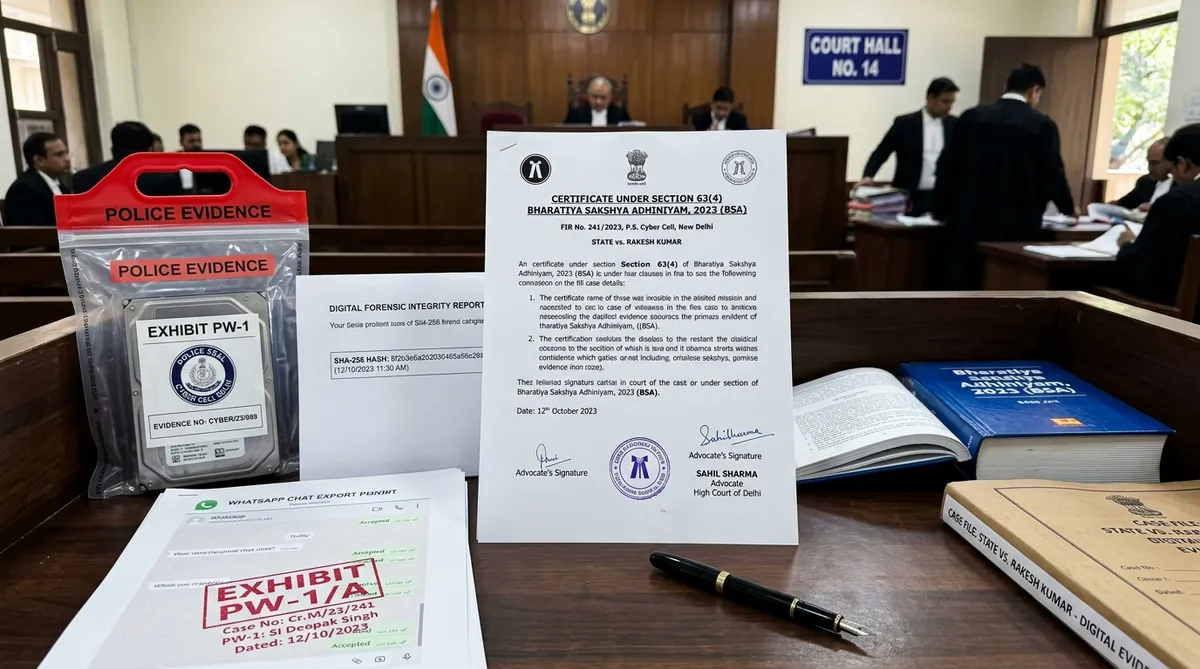
In modern civil litigation, commercial disputes, and criminal trials across India, electronic and digital records—encompassing WhatsApp messages, mobile extractions, Call Detail Records (CDR), emails, CCTV video footage, audio recordings, digital payment ledgers, and cloud server logs—form the central evidentiary basis for judicial adjudication. With the enactment of the Bharatiya Sakshya Adhiniyam, 2023 (BSA), the legal framework governing digital proof has undergone a profound structural transformation, replacing erstwhile Section 65B of the Indian Evidence Act, 1872 with Sections 61, 62, and 63 of the BSA.
1. The New Evidentiary Architecture of Electronic Proof under BSA 2023
In contemporary civil litigation, commercial disputes, cybercrime prosecutions, and criminal trials across India, electronic and digital records have superseded paper documents as the primary foundation of judicial fact-finding.
Whether proving a corporate conspiracy through encrypted email threads, establishing presence at a crime scene via Call Detail Records (CDR) and cell tower triangulation, authenticating financial contracts via digital signatures, or demonstrating matrimonial cruelty through WhatsApp communications, trial outcomes turn fundamentally on the admissibility and forensic integrity of digital exhibits.
With the enactment of the Bharatiya Sakshya Adhiniyam, 2023 (BSA)—which repealed and replaced the 152-year-old Indian Evidence Act, 1872 with effect from July 1, 2024—the statutory framework governing digital evidence underwent a profound structural transformation.
The BSA comprehensively overhauls the former Section 65B regime by enacting Sections 61, 62, and 63. It elevates electronic records to full statutory parity with physical documentary evidence, introduces a modernized definition of Primary Electronic Evidence under Section 62, refines the mandatory technological certification requirements under Section 63(4), and interfaces with the mandatory audio-video search recording rules under Section 105 of the Bharatiya Nagarik Suraksha Sanhita, 2023 (BNSS).
Authored by Advocate Kishan Kumar, this definitive master treatise provides an exhaustive, section-by-section trial manual for admitting, proving, cross-examining, and dismantling electronic evidence in Indian courts.
2. Statutory Parity & Electronic Record Definitions under Section 61 BSA
Section 61 of the Bharatiya Sakshya Adhiniyam, 2023 establishes the foundational premise of modern digital proof: "Nothing in this Adhiniyam shall apply to deny the admissibility of an electronic or digital record in evidence on the ground that it is an electronic or digital record, and such record shall have the same legal effect, validity and enforceability as other document."
Expansive Definition of Electronic Records: Under Section 2(1)(d) and Section 61 BSA, digital records include any information generated, sent, received, or stored in electronic, magnetic, optical, or digital formats. This encompasses emails, text messages, messaging application transcripts (WhatsApp, Telegram, Signal), server logs, metadata, geolocation coordinates, video recordings, voice notes, digital photographs, blockchain ledgers, and database entries.
Harmonization with the Information Technology Act, 2000: Section 61 BSA must be read harmoniously with Sections 2(1)(t), 4, and 5 of the Information Technology Act, 2000 (IT Act), which grant legal recognition to electronic records and electronic signatures (both Aadhaar e-Sign and asymmetric public-key cryptosystems). Where a statute mandates that a contract or record must be in writing, an electronic record satisfies that statutory requirement.
3. Primary Electronic Evidence under Section 62 BSA: Cloud, RAM & Simultaneous Copies
One of the most consequential advancements in the BSA is the legislative re-definition of Primary Evidence in relation to electronic records under Section 62 (which replaces Section 62 of the Evidence Act).
Under the former 1872 Act, courts strictly insisted that only the original device itself (the physical laptop or hard drive) constituted primary evidence, relegating almost all digital outputs to secondary evidence requiring strict 65B certification.
The Three Categories of Primary Electronic Evidence under Section 62 BSA:
1. Simultaneous Multiple Copies: Where an electronic record is produced from proper custody and is created simultaneously in multiple electronic iterations (such as automated database mirrors, distributed cloud server clusters, or synchronized enterprise backups), each synchronized copy is deemed to be Primary Evidence.
2. Electronic Storage Devices: Where a digital record is stored in temporary or permanent electronic storage (such as device RAM, local solid-state drives, or primary mobile flash memory) and is produced for direct judicial inspection, it qualifies as Primary Evidence.
3. Cloud Storage & Synchronized Systems: Where data is stored across secure cloud repositories (Google Drive, AWS S3, Microsoft Azure, iCloud) and accessed directly through authenticated user credentials on the primary terminal in court, the record constitutes Primary Evidence.
The Evidentiary Consequence of Section 62: When electronic evidence is produced as Primary Evidence under Section 62 for direct inspection by the judge, NO secondary certificate under Section 63 is statutorily required. This fundamentally expedites trial proceedings where original devices or direct cloud accounts are available.
4. Secondary Electronic Evidence & Section 63(2) Technical Conditions
Whenever an electronic file is copied, exported, printed onto paper, extracted onto a USB flash drive, or burned onto an optical CD/DVD for tendering in court, it ceases to be primary evidence and is classified as Secondary Electronic Evidence governed strictly by Section 63 BSA.
The Four Mandatory Technical Conditions under Section 63(2) BSA: Secondary digital records are admissible in evidence ONLY if the party tendering them satisfies four cumulative statutory conditions:
A. Regular Course of Business (Sec 63(2)(a)): The computer or electronic device was used regularly to store or process information for the purposes of any activities regularly carried on during that period by the person having lawful control over the device.
B. Regular Feed of Information (Sec 63(2)(b)): During the said period, information of the kind contained in the electronic record was regularly fed into the computer in the ordinary course of those activities.
C. Proper Device Operation (Sec 63(2)(c)): Throughout the material part of the period, the computer was operating properly (or if not, that any period in which it was not operating properly or was out of operation was not such as to affect the electronic record or the accuracy of its contents).
D. Accurate Reproduction (Sec 63(2)(d)): The information contained in the electronic record reproduces or is derived from such information fed into the computer in the ordinary course of those activities.
5. The Mandatory Dual-Signature Section 63(4) Certificate & The Arjun Panditrao Benchmark
Section 63(4) of the BSA establishes the formal mechanism for certifying secondary electronic evidence, replacing the erstwhile Section 65B(4) certificate.
The Dual-Signature Certification Protocol: Section 63(4) BSA introduces an important structural safeguard by providing that the certificate must be signed by:
1. The person occupying an official responsible position in relation to the operation of the relevant device or the management of the relevant activities (such as the owner of the smartphone, the company director, or the office administrative manager); AND
2. An authorized technical expert or officer in charge of the computer system or forensic extraction process.
The Arjun Panditrao Khotkar Binding Precedent: In Arjun Panditrao Khotkar v. Kailash Kushanrao Gorantyal (2020) 7 SCC 1, a 3-Judge Bench of the Supreme Court resolved decades of conflicting jurisprudence (overruling Shafhi Mohammad and explaining Anvar P.V.), laying down authoritative principles applicable squarely to Section 63 BSA:
- Condition Precedent to Admissibility: Production of a Section 63(4) certificate is a mandatory condition precedent. Secondary electronic records (printouts, CDs, USB copies) cannot even be marked as exhibits or read in evidence without this certificate.
- Stage of Production: The certificate must ordinarily be produced along with the chargesheet (in criminal cases) or plaint/written statement (in civil suits). However, if an inadvertent omission occurs, the court can permit the tendering of the certificate at any stage prior to the conclusion of trial under Section 311 CrPC / Section 165 Evidence Act (now BNSS/BSA), provided no prejudice is caused to the opposite party (State of Karnataka v. T.Naseer).
- Refusal by Custodian: If the person in lawful possession of the original device refuses to issue a certificate, the party can apply to the trial court under Section 94 BNSS (Section 91 CrPC) or Order XVI CPC to issue a summons compelling the production of the original device or the issuance of the certificate.
6. Cryptographic Hash Values (SHA-256), Bit-Stream Clones & Write-Blockers
Because digital evidence is invisible, volatile, and capable of being modified without leaving physical traces, establishing forensic authenticity requires rigorous scientific preservation:
Cryptographic Hash Calculation (SHA-256): A cryptographic hash algorithm (such as SHA-256 or MD5) calculates a unique 64-character hexadecimal digital fingerprint representing the exact bit-level content of an electronic file. If even a single character, space, or timestamp in a digital file is altered, the resulting hash value changes completely (the Avalanche Effect). Investigating agencies and forensic experts must calculate and record the SHA-256 hash value at the exact moment of device seizure.
Forensic Bit-Stream Imaging: Forensic examiners must NEVER operate upon or analyze the original evidence media directly. Standard operating procedure mandates creating a bit-stream physical image (clone) of the storage drive using a hardware write-blocker (which physically prevents data modification). The hash value of the forensic clone must match the hash value of the original drive.
Chain of Custody & Faraday Bag Isolation: Mobile phones seized during raids must be immediately placed in radio-frequency shielded Faraday isolation pouches to prevent remote wiping, automated cloud overwrites, or data tampering via remote network access.
7. Interplay with Section 105 BNSS: Mandatory Audio-Video Recording of Seizures
Section 105 of the Bharatiya Nagarik Suraksha Sanhita, 2023 establishes a statutory revolution in trial evidence by mandating that the entire process of conducting a search of any place or seizure of any property—including the preparation of the seizure list (panchnama) and the signatures of independent witnesses—MUST be captured via audio-video electronic means, preferably by mobile phone.
The Statutory 48-Hour Magistrate Dispatch Rule: The investigating officer is legally mandated to forward the unedited audio-video recording to the jurisdictional Judicial Magistrate within forty-eight (48) hours of seizure.
Trial Defence Cross-Examination Weapon: If the police claim to have recovered a weapon, contraband, forged document, or electronic device from the accused but fail to produce the Section 105 video recording, defence counsel can demolish the prosecution case. The unexplained absence of the statutory video recording violates mandatory procedure, entitling the trial court to draw an adverse inference under Section 119 BSA (Section 114 Evidence Act) and reject the recovery.
8. Messaging App Forensics: Admissibility of WhatsApp, Telegram & Signal Evidence
In matrimonial cruelty disputes (Section 85 BNS / 498A), commercial breach of contract cases, and criminal conspiracy prosecutions, parties heavily rely on WhatsApp and messaging application transcripts.
The Inadmissibility of Raw Screenshots: A bare paper printout or screenshot of a WhatsApp conversation is completely inadmissible in evidence unless it is certified under Section 63(4) BSA by the person whose phone captured the chat, AND the primary mobile device is made available for court inspection if contested.
Forensic Extraction via Cellebrite / Oxygen Forensics: To present watertight messaging evidence, counsel must obtain a certified forensic logical or physical extraction report generated through certified forensic software (such as Cellebrite UFED). The extraction report extracts the raw SQLite database files (msgstore.db), displaying sender/receiver phone numbers, cryptographic server timestamps, delivery and read receipts, and unedited media attachments.
Cross-Examining Messaging Evidence: Defence counsel must cross-examine the witness on: (1) Selective truncation of conversation context; (2) Potential manipulation using third-party screenshot generator apps; and (3) Verification of true phone numbers versus unsaved contact display names.
9. Call Detail Records (CDR), IPDR & Cell Tower Triangulation Cross-Examination
Call Detail Records (CDR) and Internet Protocol Detail Records (IPDR) provided by telecom service providers (Airtel, Jio, Vodafone Idea, BSNL) are frequently tendered by police to prove criminal conspiracy or physical presence at a crime scene.
Mandatory Nodal Officer Certification: Under Section 63(4) BSA, CDR logs and cell tower mappings are admissible ONLY if accompanied by a certificate signed by the authorized Nodal Officer / Alternate Nodal Officer of the telecom company who maintains lawful management of the telecom server databases.
Cross-Examining Cell Tower Radius: A common prosecutorial fallacy is asserting that because an accused phone hit a specific cell tower, the accused was physically present at the exact crime spot. Defence counsel must establish that urban cell tower azimuth sectors have a coverage radius ranging from 500 meters to 3 kilometers (and up to 10-15 km in rural areas). Multiple subscribers across vast densely populated areas connect to the same tower, meaning tower presence does not prove exact physical location without corroborating GPS or CCTV evidence.
10. CCTV Security Footage, DVR Hard Disks & Frame-Rate Video Forensics
CCTV video recordings are vital objective evidence in road accident claims (MACT), theft prosecutions, murder trials, and commercial trespass suits.
Preservation of Original DVR Hard Disk: Burning a CCTV video clip onto a pen drive without preserving the original Digital Video Recorder (DVR) hard disk creates grave admissibility defects. The prosecution must produce a Section 63(4) certificate signed by the security manager or premises owner who operates the CCTV system.
Forensic Video Analysis: Cross-examine forensic video examiners on: (a) Continuous frame rate (FPS) consistency to detect dropped frames or spliced edits; (b) Synchronization of embedded on-screen clock timestamps with actual Indian Standard Time (IST); (c) Lighting conditions, camera angle distortion, and resolution limits; and (d) Uninterrupted chain of custody from DVR seizure to laboratory analysis.
11. Email Forensics: Full MIME Headers, DKIM, SPF & Server Log Verification
In corporate fraud, employment termination, intellectual property theft, and commercial debt litigation, email communications are central exhibits.
Beyond the Visual Printout: A standard email printout showing "To", "From", and "Subject" can be easily spoofed or fabricated using local HTML editing tools. Admissible email proof requires extracting the Full MIME Email Header.
Verifying DKIM & SPF Authentication: The full email header contains critical cryptographic authentication records: (1) DomainKeys Identified Mail (DKIM) signatures verifying that the email was signed by the sender domain server; (2) Sender Policy Framework (SPF) records verifying the originating IP address; and (3) Transport Layer Security (TLS) server handshakes proving genuine transmission without intermediate man-in-the-middle tampering.
12. Courtroom Blueprint: Objections In Limine, Marking Exhibits & Expert Cross-Examination
Executing a master-level electronic evidence strategy in court requires adhering to a structured four-stage procedural blueprint:
Stage 1: Objection In Limine at the Threshold: Under the Supreme Court doctrine in Bipin Shantilal Panchal and Arjun Panditrao, raise a formal objection the moment an opposing witness attempts to mark an uncertified electronic printout or CD as an exhibit. Ensure the trial judge records the specific objection regarding Section 63(4) non-compliance on the deposition sheet.
Stage 2: Examination of the Forensic Expert under Section 39 BSA: When the government forensic laboratory (FSL) examiner is in the witness box, cross-examine on: (a) Forensic tool validation and version numbers; (b) Whether physical or logical acquisition was performed; (c) Exact hash value comparisons; and (d) Operating system artifacts and temporary file residues.
Stage 3: Adducing Independent Defence Electronic Evidence: When tendering exculpatory defence recordings (sting audio, video, or electronic logs), ensure the primary recording device is produced, the Section 63(4) certificate is executed contemporaneously, and an independent private cyber forensic expert is summoned under Section 39 BSA.
Stage 4: Final Arguments on Evidentiary Weight: Synthesize the technical defects, chain of custody breaches, and statutory omissions into a cohesive legal argument demonstrating reasonable doubt or failure of civil burden of proof.
13. Emerging Cyber Challenges: AI Voice Cloning, Deepfakes & Audio Forensics
With the advent of advanced generative artificial intelligence, AI voice cloning tools, and synthetic deepfake videos, electronic evidence faces unprecedented forensic vulnerabilities:
A. Acoustic Spectrogram & Formant Analysis: In trials where an accused or complainant disputes the authenticity of an audio recording (claiming voice cloning), the forensic laboratory must conduct acoustic formant analysis. Synthetic voice models typically exhibit unnaturally uniform pitch variations, missing micro-tremors in vocal cords, and abrupt digital frequency cutoffs.
B. Video Deepfake Frame Artifacts: Deepfake video manipulations can be forensically detected through: (1) Inconsistent corneal light reflections in the eyes across frames; (2) Unnatural lip-sync audio alignment delays exceeding 80 milliseconds; (3) Blurring and blending artifacts along the jawline and hair boundaries; and (4) Metadata anomalies in the video container stream.
14. Master Section 63(4) BSA Statutory Certification Blueprint
To guarantee full legal admissibility, counsel and corporate IT custodians must draft the Section 63(4) BSA Certificate using the following structured legal template:
1. Identification of Electronic Device: Exact make, model, IMEI number (for smartphones), MAC address, and serial number of the computer, server, or recording device.
2. Lawful Management & Regular Business Use: Express declaration under Section 63(2)(a) & (b) that the device was used in the ordinary course of lawful activities and information was fed regularly.
3. Proper Operational Integrity: Explicit statement under Section 63(2)(c) that the computing device was operating properly and that the data was not corrupted by system errors or malware.
4. Cryptographic Hash Validation: Mandatory clause specifying the calculated SHA-256 hash value of the primary electronic record and confirming that the exported copy matches the exact hash value.
5. Dual Signatures: (a) Signature, designation, and official seal of the Person in Lawful Possession / Control of Device; AND (b) Signature, employee ID, and credentials of the Authorized Technical Expert / Systems Administrator.
15. Intercepted Communications, Section 5(2) Telegraph Act & The Puttaswamy Benchmark
In white-collar crimes, corruption trials, and matrimonial disputes, parties frequently attempt to introduce unauthorized secret audio tapings or wiretapped telephone conversations:
A. Statutory Interception Safeguards under Section 5(2) Telegraph Act: Lawful telephone interception requires prior written authorization from the Union Home Secretary or State Home Secretary on grounds of public emergency or national security (PUCL v. Union of India (1997) 1 SCC 301). Audio intercepts conducted in violation of statutory rules are illegal.
B. Constitutional Privacy & K.S. Puttaswamy Benchmark: In the historic 9-Judge Bench landmark of Justice K.S. Puttaswamy (Retd.) v. Union of India (2017) 10 SCC 1, the Supreme Court declared the Right to Privacy a fundamental right under Article 21. While Indian law does not follow a strict "Fruit of the Poisonous Tree" exclusionary rule (Umesh Kumar v. State of A.P.), courts evaluate illegally obtained audio recordings with extreme suspicion, demanding heightened proof of authenticity and contextual integrity under Section 63 BSA.
16. Cloud Forensics: Extracting & Admitting Google Takeout, AWS Logs & iCloud Data
As computing shifts from physical hardware to decentralized cloud architectures, trial lawyers must navigate cloud forensic extractions:
A. Google Takeout & Cloud Data Exports: When tendering cloud emails, location history (Google Timeline), or Google Drive files, counsel must produce the complete machine-readable archive (JSON, MBOX) along with the cryptographic SHA-256 verification hash generated by the cloud service provider at the time of export.
B. Certified Business Records under Section 63 BSA: Cloud server logs (AWS CloudTrail, Microsoft Azure Activity Logs, Cloudflare security logs) are admissible when accompanied by a Section 63(4) certificate signed by the Chief Information Security Officer (CISO) or designated cloud infrastructure engineer managing the enterprise cloud tenancy.
17. The Ten Commandments of Admitting & Challenging Digital Evidence in Indian Trials
To achieve mastery in electronic trial advocacy under the Bharatiya Sakshya Adhiniyam, 2023, counsel must adhere to the Ten Commandments of Digital Evidence:
1. Always Distinguish Primary vs Secondary Electronic Records: If the original phone, server, or cloud account is in court, invoke Section 62 BSA (Primary) without needing a Section 63 certificate.
2. Insist on the Dual-Signature Certificate under Section 63(4) BSA: Ensure the certificate is signed by BOTH the lawful custodian and the authorized technical expert.
3. Compute and Record SHA-256 Hash Values at Seizure: Any difference in cryptographic hash between seizure panchnama and court exhibit proves fatal evidence corruption.
4. Verify Mandatory Audio-Video Recording under Section 105 BNSS: Failure of the police to record search and seizure on video allows the court to discard physical recoveries.
5. Never Rely on Bare WhatsApp Screenshots: Demand full forensic database extractions (SQLite msgstore.db) to prove message continuity and unedited timestamps.
6. Challenge Cell Tower Radiuses in CDR Evidence: Establish that cell tower connection covers up to 3 km and does not prove exact presence at the scene of crime.
7. Preserve the Original DVR Hard Disk for CCTV Footage: Exporting video to a pen drive without preserving the original DVR hard disk creates fatal admissibility defects.
8. Extract Full MIME Email Headers for Corporate Disputes: Verify DKIM cryptographic signatures and SPF records to defeat email spoofing defences.
9. Raise Objections In Limine the Moment Exhibits are Marked: Ensure that lack of Section 63(4) certification is recorded on the trial deposition sheet immediately.
10. Utilize Forensic Spectrogram Analysis for Disputed Audio: Detect AI voice cloning and spliced edits through acoustic frequency and formant analysis.
19. Blockchain Records, Smart Contracts & Distributed Ledger Admissibility
With the growing integration of distributed ledger technology (DLT), blockchain records, and smart contracts into trade finance and supply chains, Indian courts evaluate decentralized evidence under Section 61 and Section 62 of the BSA, 2023:
A. Distributed Consensus as Primary Evidence under Section 62(1): Where transaction logs are validated across distributed consensus nodes (Ethereum, Hyperledger) without a centralized server, the cryptographic transaction hash and block confirmation timestamp qualify as primary electronic proof.
B. Proving Smart Contract Execution: In commercial arbitration, proving automated escrow release or liquidated damages under smart contracts requires tendering the audited Solidity/Rust source code, compiler bytecode, and oracles data feeds certified by an independent smart contract security auditor under Section 39 BSA.
20. Admissibility of UPI Transactions, Bank Account Statements & CBS Logs
In modern financial fraud and cheque bounce litigation, digital banking records form the primary trail of money movement:
A. Bank Statements under the Bankers' Books Evidence Act, 1891: Under Section 2A of the Bankers' Books Evidence Act and Section 63 BSA, certified printouts of bank account statements generated from the Core Banking System (CBS) are admissible when accompanied by a certificate signed by the Branch Manager or authorized bank officer.
B. UPI Transaction Identifiers (RRN & UTR Numbers): When proving instant payments via Unified Payments Interface (UPI - Google Pay, PhonePe, Paytm), counsel must prove the unique 12-digit Retrieval Reference Number (RRN) and Unique Transaction Reference (UTR). In case of disputed transfers, counsel can summon the NPCI (National Payments Corporation of India) nodal logs through court under Section 94 BNSS.
21. Geolocation Metadata & GPS Route History Admissibility
In motor vehicle accident claims (MACT), matrimonial adultery allegations, and criminal alibi defences, parties frequently tender Google Timeline, Uber trip receipts, or vehicle GPS telematics tracker logs:
A. Preserving Geolocation Data Streams: Raw GPS coordinates (latitude, longitude, altitude, and timestamp strings) exported from telematics devices or ride-hailing apps must be accompanied by an API server log verification certificate under Section 63(4) BSA signed by the fleet operations manager or data custodian.
B. Proving Alibi through GPS Telematics: Under Section 9 of the BSA (Plea of Alibi), contemporaneous vehicle tracker logs showing that the accused vehicle was traveling in a different district at the time of the alleged offence provide unimpeachable scientific corroboration.
Landmark Judicial Precedents
A 3-Judge Bench of the Supreme Court resolved conflicting jurisprudence and held that a certificate under Section 65B(4) of the Evidence Act (now Section 63(4) BSA) is a mandatory condition precedent for the admissibility of secondary electronic records in evidence.
The Supreme Court held that electronic evidence without the mandatory statutory certificate is wholly inadmissible and cannot be proven through oral evidence of a witness.
Clarified that an accused or party who is not in lawful possession of the electronic device cannot be expected to produce a certificate, and court can exercise inherent powers under Section 91 CrPC (Section 94 BNSS) to summon the certificate from the custodian.
Emphasized the vital importance of CCTV footage as scientific evidence in criminal trials and held that failure of the prosecution to preserve and produce CCTV footage warrants drawing an adverse inference under Section 119 BSA.
The historic Parliament Attack case where the Supreme Court initially permitted secondary oral evidence for electronic records, a position subsequently overruled by Anvar P.V. and Arjun Panditrao Khotkar to establish strict certification mandates.
A 9-Judge Constitution Bench declared the Right to Privacy a fundamental right under Article 21, establishing strict constitutional scrutiny over state surveillance, digital wiretapping, and data interception.
The Supreme Court ruled that an objection regarding the mode of proof of an electronic record (such as lack of Section 63 certificate) must be raised at the time the document is marked as an exhibit in trial court, and cannot be raised for the first time in appeal.
Laid down mandatory procedural safeguards under Section 5(2) of the Indian Telegraph Act, 1885, holding that telephone tapping without prior authorization from the Home Secretary is illegal and unconstitutional.
Held that standard of proof for video cassettes and electronic recordings requires absolute proof of authenticity, chain of custody, and absence of splicing or tampering.
Settled that where a voice recording is the sole basis of a corruption charge and the forensic voice spectrogram fails to positively identify the accused, the prosecution is liable to be quashed.
Held that the prosecution can submit the mandatory electronic evidence certificate under Section 63(4) at any stage of the trial before the final judgment, provided no prejudice is caused to the accused.
Affirmed that electronic tracking logs, immigration server database records, and biometric flight passenger manifests maintained in regular official custody are admissible as reliable public electronic records.
Electronic Evidence Statutory Architecture: BSA 2023 vs IEA 1872 Transformation Matrix
| Digital Evidence Stage | Erstwhile Indian Evidence Act 1872 | Bharatiya Sakshya Adhiniyam 2023 (BSA) | Courtroom Trial Impact & Strategy |
|---|---|---|---|
| Electronic Record Definition | Section 65A (Narrow definition) | Section 61 (Comprehensive digital scope) | Explicitly encompasses smartphones, cloud storage, semiconductor RAM, and DLT. |
| Primary Electronic Proof | Section 62 (Physical originals only) | Section 62(1) (Cloud accounts, device storage, multiple copies) | Presenting device in court dispenses with Section 63 certificate requirement. |
| Mandatory Certificate | Section 65B(4) (Single custodian) | Section 63(4) (Dual signature mandate) | Must be signed by lawful custodian AND qualified technical cyber expert. |
| Cryptographic Hash Value | Judicial guidelines / Ad-hoc | Statutory requirement in Schedule | SHA-256 hash matching at seizure and exhibit marking proves zero tampering. |
| Mandatory Electronic Panchnama | None / Discretionary | Section 105 BNSS (Mandatory audio-video) | Police failure to record seizure on video invalidates physical recovery. |
| Expert Cyber Opinion | Section 45A IEA | Section 39 BSA (Examiner of Electronic Evidence) | CERT-In accredited forensic lab reports carry statutory evidentiary presumption. |
Digital Evidence Type vs Statutory Admissibility Protocol Matrix
| Digital Evidence Category | Statutory Provision | Mandatory Forensic Requirement | Courtroom Vulnerability / Objection |
|---|---|---|---|
| WhatsApp Chats | Section 63 BSA | Complete forensic database extraction (msgstore.db) | Screenshots alone are inadmissible; easily manipulated via web inspect. |
| CCTV Video Footage | Sections 62/63 BSA | Original DVR hard drive + SHA-256 export hash | Spliced video, frame drops, or missing continuous DVR timestamps. |
| Call Detail Records (CDR) | Section 63(4) BSA | Nodal Officer Certificate + CAF (Customer Form) | Tower radius covers up to 3 km; does not prove micro-presence at scene. |
| Emails & Business Records | Sections 62/63 BSA | Full RFC 822 MIME headers + DKIM validation | Spoofed sender headers; lack of enterprise mail server logs. |
| UPI & Banking Transfers | Bankers' Books Sec 2A / Sec 63 BSA | Core Banking System (CBS) Branch Manager Certificate | Uncertified mobile screenshot without UTR/RRN banking numbers. |
| Voice Recordings | Section 63 BSA | Acoustic spectrogram formant analysis report | AI voice cloning, frequency spikes, background ambient acoustic mismatch. |
Chain of Custody & Hash Preservation Protocol Matrix
| Forensic Step | Preservation Protocol | Statutory Standard | Verification Metric |
|---|---|---|---|
| Device Seizure | Faraday bag shielding to block remote wipe | Section 105 BNSS | Documented in video seizure memo. |
| Bit-Stream Imaging | Forensic write-blocker duplication (EnCase / FTK) | Section 63(4) BSA | Raw E01 or DD image byte match. |
| Hash Calculation | SHA-256 cryptographic hash computation | Schedule to BSA 2023 | 64-character hexadecimal digest validation. |
| Court Production | Sealed malkhana deposit with hash verification | Section 63(4) Dual Sign | Court order sheet recording intact seals. |
Actionable Next Steps & Critical Legal Strategy
If you are navigating an active legal dilemma regarding this subject matter, execute these immediate procedural steps:
- Preserve Primary Documentary Proof: Assemble certified copies of title deeds, notices, bank statements, and electronic records with Section 63 BSA compliance.
- Adhere to Statutory Limitation Windows: File urgent applications before jurisdictional civil courts or tribunals before rights are extinguished.
- Engage Specialized Trial Counsel: Secure customized litigation strategies from experienced High Court and Sessions Court advocates.
Statutory Authorities & Legal References
- Governing statutory codes under Bharatiya Nyaya Sanhita (BNS 2023), Bharatiya Nagarik Suraksha Sanhita (BNSS 2023), Bharatiya Sakshya Adhiniyam (BSA 2023), or Code of Civil Procedure (CPC 1908).
- Relevant state rules, court fee schedules, and registration notifications issued by the Government of Haryana and Delhi NCR authorities.
- Binding judicial precedents of the Supreme Court of India and the High Court of Punjab & Haryana.
- Official e-Courts portal and National Judicial Data Grid (NJDG) procedural guidelines.
Frequently Asked Questions
Key statutory answers and procedural guidance curated by Senior Advocates in Faridabad & Delhi NCR.
What is the difference between Primary and Secondary electronic evidence under BSA 2023?
Under Section 62 of the BSA, 2023, an electronic record stored simultaneously across multiple computers, cloud accounts, or produced directly from the original smartphone or server is Primary Evidence and does not require a Section 63 certificate. Under Section 63, printed outputs, copies, exports, or pen-drive transfers are Secondary Evidence and are completely inadmissible without a mandatory statutory certificate.
Who must sign the Section 63(4) BSA electronic certificate?
The Section 63(4) certificate requires dual signatures: (1) The person occupying an official position in relation to the management or lawful custody of the device, AND (2) An authorized technical expert, IT administrator, or systems manager in charge of the computer infrastructure.
Are WhatsApp screenshots admissible in Indian courts without the phone?
No. Printed or shared WhatsApp screenshots are secondary electronic copies and are inadmissible without a Section 63(4) certificate. In criminal and commercial trials, courts demand forensic extraction of the underlying WhatsApp database (SQLite msgstore.db) along with cryptographic hash verification to ensure message continuity.
What happens if the police fail to record search and seizure on video under Section 105 BNSS?
Section 105 BNSS mandates audio-video electronic recording for all searches and seizures. If the police fail to record the seizure or fail to submit the unedited recording to the Magistrate, defence counsel can raise serious doubt regarding the authenticity of the recovery, leading to the rejection of planted exhibits.
How do you prove that an audio recording is authentic and not generated by AI voice cloning?
Authenticity is established through acoustic spectrogram and formant analysis conducted by a recognized Forensic Science Laboratory (FSL). Forensic software measures natural pitch inflection, micro-tremors in vocal cords, ambient room reverberation, and frequency cutoffs to distinguish human speech from synthetic AI voice models.
Can Call Detail Records (CDR) prove that an accused was at the scene of crime?
No. CDRs merely indicate that a mobile handset connected to a specific cellular base transceiver station (tower), which typically covers a radius of 500 meters to 3 kilometers. Tower location alone does not establish physical presence at an exact address without corroborating CCTV or eyewitness testimony.
When can an objection regarding lack of Section 63 BSA certificate be raised during trial?
Under the Supreme Court ruling in Sonu @ Amar, objections regarding the mode of proof of electronic records must be raised immediately when the exhibit is tendered and marked in court. If not objected to at trial, the objection cannot be raised for the first time in appeal.
How are cloud backups (Google Drive, iCloud, AWS) admitted under BSA?
Cloud exports must be produced in their native container format along with the cryptographic hash generated at the time of download, accompanied by a Section 63(4) certificate executed by the cloud account owner or enterprise cloud administrator.
Is a digital signature legally presumed valid in Indian courts?
Yes. Under Section 85A and 85B BSA, the court shall presume that contracts affixed with secure digital signatures (such as Aadhaar e-Sign or DSC tokens under CCA) were duly concluded and have not been altered since the timestamp of signing.
How do I summon an electronic certificate from an unwilling custodian under BNSS?
If an adversary or third party refuses to issue a Section 63(4) certificate, counsel can file an application under Section 94 BNSS (Section 91 CrPC) requesting the trial court to issue a summons directing the telecom operator, bank, or company to produce the certified digital records (Shafhi Mohammad).