Master Handbook: Commercial Debt Recovery & Summary Suits (Order 37 CPC, Section 138 NI Act & IBC)
 Authored by: Advocate Kishan Kumar (Advocate & Legal Consultant)
Quick Summary & Strategic Takeaways
- Summary Suits under Order XXXVII CPC: Fast-track civil remedy where the defendant has no automatic right to defend and must apply for Leave to Defend on bona fide substantial triable issues.
- Cheque Bounce & Section 138/141 NI Act: Criminal quasi-commercial prosecution of corporate entities and individual directors for dishonoured negotiable instruments, carrying up to 2 years imprisonment and 20% interim compensation under Section 143A.
- Insolvency Petitions under Section 9 IBC: Insolvency resolution before NCLT for operational debts exceeding ₹1 Crore following mandatory statutory demand notices under Section 8 IBC.
- Commercial Courts Act 2015 & Section 12A Mediation: Mandatory Pre-Institution Mediation within 3 to 5 months before filing commercial suits, except where urgent interim injunctions are sought.
- Attachment Before Judgment (Order 38 Rule 5 CPC): Emergency pre-decree freezing of debtor bank accounts and immovable properties to prevent fraudulent asset siphoning.
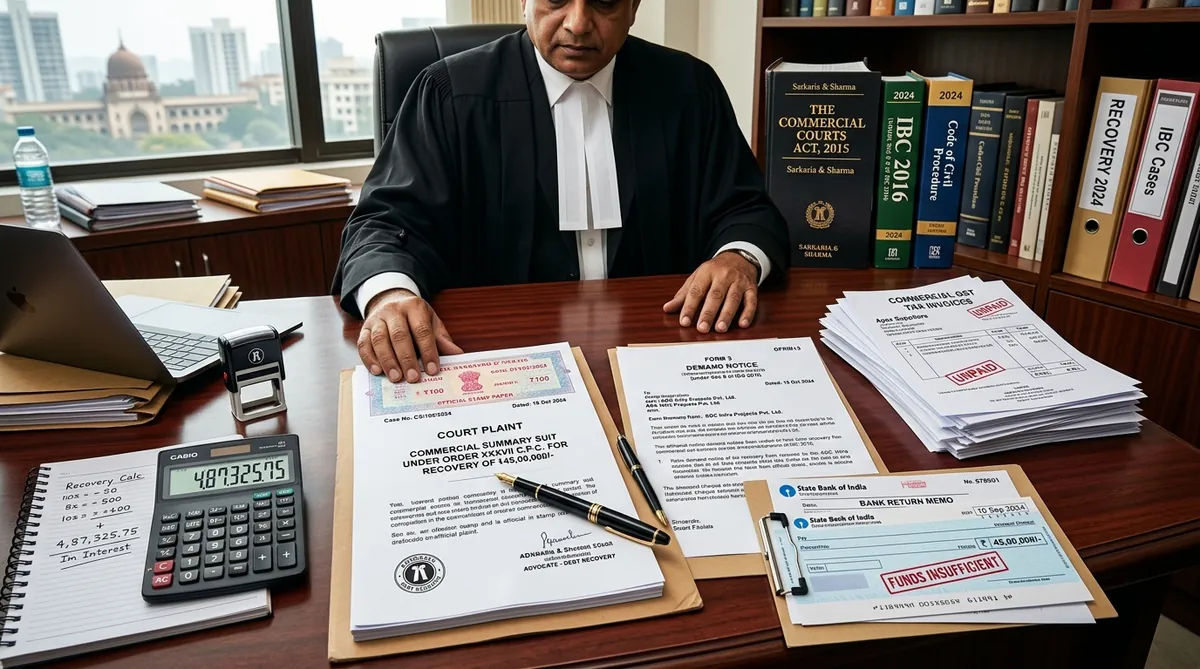
Recovering unpaid commercial debts, outstanding business invoices, dishonoured negotiable instruments, vendor dues, and corporate loan defaults in India requires an aggressive, multi-layered litigation strategy. Relying on slow-moving ordinary civil suits often leads to protracted procedural delays spanning several years. Modern commercial advocates must strategically synchronize fast-track Summary Suits under Order XXXVII CPC, parallel criminal prosecution under Section 138 of the Negotiable Instruments Act, pre-institution mediation under the Commercial Courts Act, 2015, and operational insolvency proceedings under the Insolvency and Bankruptcy Code (IBC).
1. The Strategic Architecture of Corporate & Commercial Debt Recovery in India
In the contemporary Indian economic and corporate landscape, recovering unpaid commercial debts, delinquent business receivables, defaulted supply invoices, dishonoured negotiable instruments, and unserviced corporate loans is one of the most critical operational challenges facing enterprises, MSMEs, contractors, and financial institutions.
Historically, commercial creditors in India were relegated to instituting standard civil suits for money recovery before ordinary civil courts—a litigation route notorious for procedural quagmires, frequent adjournments, protracted oral evidence stages, and delays extending across ten to fifteen years before achieving a preliminary decree.
In response to the economic imperative for rapid capital circulation, the Parliament of India and the judiciary have developed a sophisticated, multi-tiered legislative and procedural ecosystem for fast-track debt enforcement.
Modern commercial advocates must strategically synchronize fast-track Summary Suits under Order XXXVII of the Code of Civil Procedure, 1908 (CPC), quasi-criminal prosecutions under Section 138 and 141 of the Negotiable Instruments Act, 1881, pre-institution mediation and summary judgments under the Commercial Courts Act, 2015, emergency asset attachment before judgment under Order XXXVIII Rule 5 CPC, and operational insolvency proceedings before the National Company Law Tribunal (NCLT) under Section 9 of the Insolvency and Bankruptcy Code, 2016 (IBC).
This definitive master handbook authored by Advocate Kishan Kumar provides a comprehensive, practical, and jurisprudence-backed operational blueprint for recovering commercial dues across Delhi NCR, Haryana, and Indian appellate courts.
2. Summary Suits under Order XXXVII CPC: The Fast-Track Civil Decree Mechanism
Order XXXVII of the Code of Civil Procedure, 1908 establishes a specialized, expedited summary procedure designed to prevent unreasonable delays by debtors who have no genuine, bona fide defence against liquidated financial demands.
Unlike ordinary civil suits where a defendant is automatically entitled to file a written statement as a matter of right and drag the trial through prolonged framing of issues and witness examinations, Order XXXVII alters the baseline: the defendant has NO automatic right to defend the suit and MUST apply to the court for judicial permission (Leave to Defend) by disclosing substantial triable issues.
Statutory Scope and Classes of Suits Covered: Under Order XXXVII Rule 1(2) CPC, summary suits can be instituted exclusively for: (a) suits upon bills of exchange, hundis, and promissory notes, and (b) suits in which the plaintiff seeks only to recover a debt or liquidated demand in money payable by the defendant, with or without interest, arising on a written contract (including formal loan agreements, purchase orders, accepted commercial tax invoices, and lease contracts), or on an enactment where the sum sought to be recovered is a fixed sum or a debt, or on a guarantee where the claim against the principal is in respect of a debt or liquidated demand.
The Two-Stage Summons Protocol: The summary procedure operates through a rigorous two-stage notification protocol: (1) Upon institution of the plaint, the court issues a specialized Summons in Form No. 4 of Appendix B. The defendant must enter an appearance within exactly ten (10) days of service, providing an address for service. (2) If appearance is entered, the plaintiff serves a formal Summons for Judgment in Form No. 4A supported by an affidavit verifying the cause of action and asserting belief that there is no defence. (3) The defendant then has a non-extendable statutory window of ten (10) days from service of the Summons for Judgment to apply for Leave to Defend supported by a detailed affidavit disclosing facts that demonstrate a triable defence.
3. The IDBI Trusteeship Landmark Doctrine: Judicial Tests for Leave to Defend
For decades, courts struggled with discretionary inconsistencies in adjudicating Leave to Defend applications under Order XXXVII Rule 3(5) CPC. In the landmark judgment of IDBI Trusteeship Services Ltd. v. Hubtown Ltd. (2017) 1 SCC 568, the Supreme Court synthesized the historical principles laid down in Mechelec Engineers v. Basic Equipment Corporation into a definitive, binding three-tier judicial test:
Tier 1: Unconditional Leave to Defend: If the defendant satisfies the court that they have a substantial, bona fide defence that raises genuine triable issues of law or fact, the defendant is entitled to unconditional leave to defend, and the suit proceeds as a regular commercial suit.
Tier 2: Conditional Leave to Defend: If the defendant raises a defence that appears plausible but doubtful, or where the court suspects that the defence is not entirely in good faith, the court may grant conditional leave to defend upon the defendant depositing a specified portion of the claimed amount into court or furnishing suitable bank guarantee security.
Tier 3: Refusal of Leave & Immediate Decree: If the defendant raises a defence that is a sham, moonshine, frivolous, or illusory, the court MUST refuse leave to defend, and the plaintiff is entitled to an immediate money decree with interest and costs without any trial.
Admitted Debts and Part-Admissions: Crucially, where the defendant admits part of the debt (e.g. admitting the invoice amount but disputing interest), leave to defend cannot be granted unless the admitted amount is deposited into court forthwith under the mandatory proviso to Order XXXVII Rule 3(5) CPC.
4. Criminal Cheque Bounce Prosecution & Director Liability (Sections 138 & 141 NI Act)
Section 138 of the Negotiable Instruments Act, 1881 represents the most potent statutory mechanism in commercial recovery, infusing civil financial obligations with the coercive force of criminal penal sanctions.
The dishonour of a cheque for insufficiency of funds, or because it exceeds the amount arranged to be paid, or upon "stop payment" instructions (Modi Cements Ltd. v. Kuchil Kumar Nandi), constitutes a criminal offence punishable with imprisonment for a term which may extend to two (2) years, or with a fine which may extend to twice the cheque amount, or with both.
Mandatory Four-Stage Statutory Timeline: To maintain a valid Section 138 prosecution, strict adherence to statutory limitation deadlines is jurisdictional: (1) Cheque Presentation: The cheque must be presented to the drawee bank within three (3) months of its issue date; (2) Statutory Demand Notice: Within thirty (30) days of receiving the memo of dishonour from the bank, the payee must dispatch a formal written Legal Demand Notice demanding payment within 15 days; (3) 15-Day Cure Period: The drawer is given 15 days from receipt of the notice to pay; (4) Criminal Complaint Filing: If payment is not made within the 15-day cure window, a formal Criminal Complaint must be filed before the Judicial Magistrate / Metropolitan Magistrate within thirty (30) days from the date the cause of action accrued.
Corporate Vicarious Liability under Section 141 NI Act: When a cheque is issued by a company, LLP, or partnership firm, Section 141 extends criminal liability to every person who, at the time the offence was committed, was in charge of and responsible to the company for the conduct of its business, as well as the company itself. Drafting the complaint requires specific, factual averments demonstrating the active role of managing directors, authorized signatories, and operational directors under the Supreme Court benchmarks in S.M.S. Pharmaceuticals Ltd. v. Neeta Bhalla and Sunita Palita v. Panchami Stone Quarry.
Interim Compensation under Section 143A: Introduced by the 2018 amendment, Section 143A empowers the trial court to order the drawer to deposit up to 20% of the cheque amount as Interim Compensation within sixty (60) days of framing notice, providing vital liquidity to the complainant while trial proceeds.
5. Corporate Insolvency under Section 9 IBC: Thresholds, Demand Notices & Settlements
For operational creditors (suppliers of goods, service providers, contractors, distributors) holding undisputed corporate debt against a registered Private Limited or Public Limited company, the Insolvency and Bankruptcy Code, 2016 (IBC) provides an unparalleled pressure mechanism.
The ₹1 Crore Statutory Threshold: Following the Central Government notification under Section 4 IBC, the minimum threshold of default required to initiate Corporate Insolvency Resolution Process (CIRP) is ₹1 Crore (Rs. 10,000,000).
Mandatory Section 8 Demand Notice: Prior to approaching the NCLT, the operational creditor must serve a mandatory 10-day Demand Notice in Form 3 or Form 4 under Section 8 of the IBC, attaching copies of unpaid invoices, delivery challans, purchase contracts, and bank statements proving default.
The Pre-Existing Dispute Bar (The Mobilox Doctrine): Under Section 8(2) and Section 9(5) IBC, the corporate debtor can defeat the insolvency petition if it brings on record a "pre-existing dispute" raised prior to receipt of the Section 8 demand notice. In Mobilox Innovations Pvt. Ltd. v. Kirusa Software Pvt. Ltd. (2018) 1 SCC 353, the Supreme Court ruled that the NCLT must reject the insolvency petition if there is a real, plausible dispute regarding the existence of debt, quality of goods, or breach of representation that is not spurious, hypothetical, or illusory.
Strategic Settlement Dynamics: While the NCLT is strictly not a debt collection forum, the threat of CIRP admission—which immediately displaces the existing board of directors, freezes corporate assets, and hands over management to an Interim Resolution Professional (IRP)—creates massive commercial leverage, leading corporate debtors to settle genuine operational debts before the admission order.
6. Commercial Courts Act 2015 & Section 12A Mandatory Pre-Institution Mediation
The Commercial Courts Act, 2015 was enacted to accelerate the adjudication of commercial disputes of Specified Value (presently ₹3 Lakhs and above in District Courts, and varying thresholds in High Courts with original civil jurisdiction).
Mandatory Pre-Institution Mediation: Under Section 12A of the Act, a plaintiff cannot institute a commercial suit without first exhausting the remedy of Pre-Institution Mediation through the District Legal Services Authority (DLSA) within a 3-month statutory timeframe (extendable by 2 months with consent). In Patil Automation Pvt. Ltd. v. Rakheja Engineers Pvt. Ltd. (2022) 10 SCC 1, the Supreme Court declared that Section 12A is mandatory, and any suit filed in violation must be summarily rejected under Order VII Rule 11 CPC.
The Urgent Interim Relief Exception: Section 12A provides a single crucial exception: pre-institution mediation is not required where the suit contemplates urgent interim relief, such as an ex-parte temporary injunction under Order 39 Rules 1 & 2 CPC, an arrest before judgment under Order 38 Rule 1, or an order of attachment before judgment under Order 38 Rule 5 CPC to prevent the defendant from alienating properties or absconding with assets.
Summary Judgment under Order XIII-A CPC: The Commercial Courts Act introduces Order XIII-A CPC, allowing commercial courts to decide a claim without recording oral evidence if the plaintiff or defendant has no real prospect of succeeding and there is no other compelling reason why the claim should not be disposed of before trial.
7. Emergency Asset Attachment Before Judgment (Order XXXVIII Rule 5 CPC)
Securing a paper decree is meaningless if the debtor disposes of their bank balances, real estate, and movable assets during litigation. Proactive commercial advocates utilize emergency provisional remedies to secure the claim amount upfront:
Attachment Before Judgment (Order XXXVIII Rule 5 CPC): If the plaintiff demonstrates through documentary evidence that the defendant, with intent to obstruct or delay the execution of any decree, is about to dispose of the whole or part of their property or remove it from the court jurisdiction, the court will direct the defendant to furnish security or attach the specified property prior to judgment (Raman Tech. & Process Engg. Co. v. Solanki Traders).
Freezing Bank Accounts via Garnishee Orders: The court can direct banks where the debtor maintains operational accounts to freeze balances up to the suit valuation, ensuring immediate funds are available upon decree.
Appointment of Court Receivers (Order XL CPC): In commercial enterprises where stock-in-trade or machinery is at risk of being siphoned, the court can appoint a receiver to take physical custody and manage the business assets pending trial.
8. MSME Samadhaan & Fast-Track Statutory Recovery under the MSMED Act, 2006
For Micro, Small, and Medium Enterprises (MSMEs) registered under the Udyam portal, the Micro, Small and Medium Enterprises Development Act, 2006 (MSMED Act) provides an extraordinary statutory recovery mechanism with statutory priority over other civil laws.
Statutory 45-Day Payment Window (Section 15): The buyer of goods or services from an MSME is statutorily mandated to make payment within the agreed period, which CANNOT exceed forty-five (45) days from the date of acceptance or deemed acceptance of goods.
Compounded Monthly Penal Interest (Section 16): If the buyer fails to pay within 45 days, the buyer is legally liable to pay compound interest with monthly rests to the supplier at three times (3x) the Bank Rate notified by the Reserve Bank of India (RBI). Crucially, Section 23 of the MSMED Act stipulates that this penal interest cannot be claimed as a deductible business expense under the Income Tax Act, 1961.
MSEFC Arbitration & 75% Deposit Rule (Sections 18 & 19): In case of non-payment, the MSME files an online petition on the MSME Samadhaan portal before the Micro and Small Enterprises Facilitation Council (MSEFC). The Council conducts conciliation and, upon failure, automatically refers the dispute to statutory arbitration. If the buyer challenges the arbitral award before a civil court under Section 34 of the Arbitration and Conciliation Act, Section 19 MSMED Act mandates that the buyer MUST deposit seventy-five percent (75%) of the awarded amount upfront before the court can entertain the challenge.
9. Trial Strategy & Cross-Examination Blueprint in Commercial Money Suits
When a commercial debt recovery suit proceeds to full trial, the outcome hinges upon documentary forensics, ledger reconciliation, and strategic witness cross-examination:
Phase 1: Proof of Electronic Invoices & Delivery Challans under Section 63 BSA: Commercial tax invoices generated electronically and delivery challans signed by store managers or transport drivers must be authenticated. Under Section 63(4) of the Bharatiya Sakshya Adhiniyam, 2023, electronic ledger printouts and ERP accounting exports must be supported by a contemporaneous statutory certificate signed by the IT custodian.
Phase 2: Acknowledgment of Debt under Section 18 Limitation Act: Cross-examine the debtor witness on email confirmations of account balances, balance sheet entries acknowledging liability (Asset Reconstruction Co. v. Bishal Jaiswal), and TDS certificates (Form 26AS / Form 16A) showing tax deducted on invoice amounts.
Phase 3: Exposing Moonshine Quality Defences: Cross-examine the defendant on the timeline of alleged quality rejections. If the buyer retained goods without raising any written rejection notice within a reasonable time under Section 41 and 42 of the Sale of Goods Act, 1930, the defence of defective goods is legally deemed waived.
10. Execution of Money Decrees under Order XXI CPC & Garnishee Proceedings
A civil money decree becomes a tangible financial recovery through execution proceedings instituted before the executing court under Order XXI of the Code of Civil Procedure:
1. Garnishee Orders under Order XXI Rule 46: A Garnishee Order is an execution decree served upon a third party (such as a debtor bank, client, or tenant) who owes money to the judgment debtor. The court directs the garnishee bank or client to pay the owed funds directly into court to satisfy the decree.
2. Attachment and Public Auction of Immovable Properties (Order XXI Rule 54): The executing court issues warrants of attachment on commercial properties, plots, or factories owned by the judgment debtor, followed by proclamation and public court auction to recover the decretal amount.
3. Civil Imprisonment under Section 51 CPC: Where a judgment debtor has the financial means to satisfy the decree but contumaciously refuses to pay or dishonestly transfers assets to defeat execution, the executing court possesses the statutory power to order the arrest and detention of the debtor in civil prison for up to three months under Section 51 and Order XXI Rule 37 CPC.
11. Commercial Arbitration & Enforcement of Arbitral Awards (Section 36)
Where the underlying commercial contract contains a standard dispute resolution arbitration clause, recovery is pursued through arbitration under the Arbitration and Conciliation Act, 1996:
Fast-Track Sole Arbitrator Appointment (Section 11): If the debtor refuses to appoint an arbitrator upon invocation notice, the creditor approaches the High Court under Section 11(6) for the appointment of an independent sole arbitrator.
Interim Relief under Section 9: The creditor can approach the Commercial Court under Section 9 of the Arbitration Act before or during arbitral proceedings to obtain emergency freezing of bank accounts or attachment of debtor assets.
Execution of Arbitral Awards under Section 36: Once the arbitral award is passed, it is enforceable as a decree of the civil court under Section 36. Following the 2015 amendment, the mere filing of a Section 34 challenge does not operate as an automatic stay on award execution unless the court grants a specific stay upon deposit of security.
12. Preventive Commercial Drafting: Designing Default-Proof Business Contracts
The most effective debt recovery strategy begins before a dispute arises, through watertight commercial drafting:
- Clear Payment Terms & Interest Clauses: Incorporate express clauses stipulating payment within 30 days of invoice date, with commercial interest at 18% to 24% per annum on delayed payments.
- Retention of Title Clause (Romalpa Clause): Stipulate that legal ownership of supplied goods remains with the seller until full payment is realized.
- Personal Guarantee of Directors: Require company promoters and directors to execute separate continuing personal guarantee deeds, rendering their personal assets liable in case of corporate default.
- Exclusive Jurisdiction & Arbitration Clauses: Anchor dispute resolution to the exclusive jurisdiction of the Commercial Courts at Faridabad or Delhi NCR, with sole arbitration under the Delhi International Arbitration Centre (DIAC) rules.
13. Section 138 NI Act Cross-Examination Blueprints for Complainant & Accused
Cross-examination in Section 138 Negotiable Instruments trials requires precise statutory targeting:
A. Cross-Examining the Complainant (Defence Strategy):
- Financial Capacity & Income Tax Returns: Cross-examine the complainant on their financial capacity to lend substantial cash. Under the Supreme Court rulings in Tedhi Singh and Basalingappa, if the complainant cannot demonstrate legitimate financial resources or disclose the loan in their Income Tax Returns, the statutory presumption under Section 139 is rebutted.
- Absence of Legally Enforceable Debt: Prove that the cheque was issued as an advance security deposit for contracts never executed or goods never supplied (M.S. Narayana Menon v. State of Kerala).
- Material Alteration of Cheque (Section 87 NI Act): Question whether the handwriting, ink, or date on the cheque differs from the signature, establishing unauthorized filling of blank security cheques.
B. Cross-Examining the Accused (Complainant Strategy):
- Signature Admission & Section 139 Presumption: The moment the accused admits their signature on the cheque, confront them with Bir Singh v. Mukesh Kumar (2019) 4 SCC 197—which establishes that even a blank signed cheque carries a mandatory statutory presumption of legally enforceable debt.
- Failure to Demand Return of Security Cheque: Expose that the accused never issued a written stop-payment notice, never filed a police complaint for stolen cheques, and never issued a letter demanding the return of the alleged security cheque prior to receiving the statutory legal notice.
14. Master Drafting Blueprints: Plaint under Order 37 & Statutory 138 Notice
A. Essential Elements of an Order XXXVII CPC Plaint: (1) Specific title declaring the suit under Order XXXVII CPC; (2) Explicit averment that the suit is filed on written contract / negotiable instrument / commercial tax invoices; (3) Express averment that no relief not falling within the ambit of Order XXXVII has been claimed; (4) Verification of the exact liquidated principal debt and agreed contractual interest; (5) Prayer clause claiming decree with pendente lite and future interest.
B. Essential Elements of a Section 138 NI Act Statutory Demand Notice: (1) Precise narration of original transaction, contract, or invoices; (2) Description of cheque number, date, amount, and drawee bank; (3) Date of presentation and date of receipt of the bank return memo (with dishonour reason); (4) Clear, unambiguous demand directing the drawer to pay the exact cheque amount within fifteen (15) days of receipt of notice; (5) Dispatch via Registered Speed Post with tracking and Email.
15. Pre-Packaged Insolvency Resolution Process (PPIRP) for Corporate MSMEs
Introduced under Chapter III-A (Sections 54A to 54P) of the Insolvency and Bankruptcy Code, the Pre-Packaged Insolvency Resolution Process (PPIRP) provides an innovative, cost-effective restructuring mechanism for corporate Micro, Small, and Medium Enterprises (MSMEs) with defaults starting from ₹10 Lakhs up to ₹1 Crore.
Debtor-in-Possession Model: Unlike standard CIRP where the board of directors is immediately suspended, PPIRP operates on a "Debtor-in-Possession with Creditor-in-Control" framework. The existing management continues running day-to-day operations under the supervision of a Resolution Professional (RP), avoiding business disruption.
Strict 120-Day Timeline: The entire PPIRP process must be completed within 120 days from the commencement date, requiring 66% approval of financial creditors for the base resolution plan, providing an expedited avenue for viable commercial enterprises to resolve debts without corporate liquidation.
16. Corporate Fraud, Asset Siphoning & Section 447 Companies Act Prosecution
In aggressive commercial debt recovery where corporate directors have deliberately siphoned company funds into shell entities or family accounts to evade creditor claims, creditors can initiate criminal action under the Companies Act, 2013:
A. Section 447 Criminal Fraud: Any director, officer, or person found guilty of fraud (defined broadly as any act, omission, or concealment of fact with intent to deceive or injure the interests of the company or its creditors) is punishable with imprisonment for a term from six (6) months up to ten (10) years, and a fine which shall not be less than the amount involved in the fraud but which may extend to three times the amount.
B. Piercing the Corporate Veil: In cases of fraudulent asset diversion (Subhra Mukherjee v. Bharat Coking Coal Ltd.), civil and commercial courts possess the equitable authority to pierce the corporate veil and hold the personal properties of directors and promoters directly liable to satisfy company debts.
C. Serious Fraud Investigation Office (SFIO) Complaints: For large-scale corporate scams involving multiple entities, complaints can be submitted to the Ministry of Corporate Affairs (MCA) to trigger an SFIO forensic investigation under Section 212 of the Companies Act.
17. Strategic Pitfalls in Commercial Debt Litigation & How to Overcome Them
Recovering commercial debt requires avoiding common tactical errors that debtors exploit to delay or defeat claims:
1. Failing to Issue Statutory Demand Notice within 30 Days under Section 138 NI Act: The 30-day timeline from receipt of the bank return memo is non-extendable; missing it extinguishes criminal liability.
2. Conflating Ordinary Civil Suits with Summary Suits under Order XXXVII CPC: Filing an ordinary suit forfeits the massive summary advantage of forcing the defendant to apply for leave to defend.
3. Omitting the Mandatory Section 12A Commercial Mediation Step: Filing a commercial suit without pre-institution mediation (absent urgent interim injunctions) leads to mandatory rejection under Order VII Rule 11 CPC.
4. Failing to Secure Order XXXVIII Rule 5 Asset Attachment Early: Waiting for trial completion allows the debtor company to strip its assets, transfer properties to promoters, and leave an empty shell company.
5. Initiating Section 9 IBC Petitions in the Face of Documented Pre-Existing Disputes: If the debtor has email complaints regarding defect in goods prior to the Section 8 notice, NCLT will dismiss the petition with costs under Mobilox Innovations.
6. Omitting Section 63 BSA Electronic Certificates for Digital Invoices: Uncertified accounting ledger exports and email purchase orders are legally inadmissible under Arjun Panditrao Khotkar.
7. Neglecting Directors' Personal Guarantees: Always insist on personal guarantees of managing directors to pierce the corporate veil in debt recovery.
8. Delaying Past 3-Year Limitation: Ensure continuous acknowledgment of debt under Section 18 Limitation Act through email confirmations, balance confirmations, or part-payments.
Landmark Judicial Precedents
The Supreme Court restated the definitive principles governing Leave to Defend under Order 37 CPC, establishing that if the defence is sham or moonshine, the plaintiff is entitled to an immediate decree without trial.
Laid down the threshold for pre-existing disputes under Section 8 and 9 IBC, holding that NCLT must reject insolvency if there is a real, plausible dispute raised prior to the Section 8 notice.
Declared that Pre-Institution Mediation under Section 12A of the Commercial Courts Act is mandatory, and any commercial suit instituted without exhausting Section 12A (absent urgent interim relief) must be rejected under Order 7 Rule 11 CPC.
Held that parallel civil recovery proceedings (Summary Suit/Ordinary Suit) and criminal cheque bounce proceedings under Section 138 NI Act can proceed simultaneously for the same debt without legal bar.
Landmark ruling settling that an entry in the balance sheet of a corporate debtor acknowledging liability constitutes a valid acknowledgment of debt under Section 18 of the Limitation Act, extending limitation.
The Supreme Court held that once the signature on a cheque is admitted, the statutory presumption under Section 139 NI Act arises automatically that the cheque was issued for discharge of debt, even if the body was filled by another person.
Established that issuing "Stop Payment" instructions to a bank does not preclude criminal liability under Section 138 NI Act; dishonour upon stop payment is treated as dishonour for insufficiency of funds.
Laid down the foundational requirements for prosecuting company directors under Section 141 NI Act: the complaint must contain specific averments demonstrating that the director was in charge of and responsible for the company business.
The Supreme Court explained the fundamental scheme of the IBC: once a default of the statutory threshold is established and no pre-existing dispute exists, the adjudicating authority must admit the insolvency application.
Held that Order 38 Rule 5 CPC is an extraordinary power to prevent fraudulent asset disposal and cannot be exercised mechanically as a tool to coerce settlement without prima facie proof of intent to obstruct decree execution.
Upheld the constitutional validity of the Insolvency and Bankruptcy Code, affirming that IBC is a beneficial legislation aimed at corporate rehabilitation rather than mere debt recovery.
Settled that the burden of proof on the accused under Section 139 NI Act is not proof beyond reasonable doubt, but preponderance of probabilities; the accused can discharge this burden by cross-examining the complainant.
Commercial Debt Recovery Comparative Strategic Framework
| Litigation Route | Governing Statute | Forum | Limitation / Threshold | Key Strategic Strength & Leverage |
|---|---|---|---|---|
| Summary Suit | Order XXXVII CPC | District Commercial Court | 3 Years from Due Date (Art. 19/22 Limitation Act) | No automatic defence; rapid money decree upon moonshine defence. |
| Cheque Bounce | Section 138/141 NI Act | Judicial Magistrate (CJM/MM) | 30 days from notice expiry; 3 months validity | Personal criminal liability of directors + 20% interim compensation. |
| Insolvency Petition | Section 9 IBC 2016 | NCLT Bench | ₹1 Crore default threshold | Threat of corporate death & displacement of promoter management. |
| Commercial Suit | Commercial Courts Act 2015 | Commercial Court / High Court | Specified Value ≥ ₹3 Lakhs | Order XIII-A summary judgment & strict cost imposition. |
| Attachment Before Judgment | Order XXXVIII Rule 5 CPC | Civil / Commercial Court | Contemporaneous with Plaint | Freezes debtor bank accounts and real estate before decree. |
| MSME Samadhaan | MSMED Act 2006 | MSEFC Facilitation Council | 45 days statutory payment window | Compound monthly interest at 3x RBI bank rate + 75% mandatory pre-deposit. |
| Arbitration Enforcement | Arbitration Act 1996 | Commercial Executing Court | Section 36 Execution | Enforceable as a civil decree; no automatic stay on Section 34 challenge. |
Commercial Debt Statutory Limitation Periods & Triggers Matrix
| Nature of Claim | Governing Limitation Article | Limitation Window | Trigger Point / Accrual Date |
|---|---|---|---|
| Money Lent / Unpaid Invoice | Article 14 Limitation Act | Three (3) Years | Date of delivery of goods / expiration of credit period. |
| Dishonour of Bill / Cheque Civil Suit | Article 22 Limitation Act | Three (3) Years | Date of dishonour / bank return memo. |
| Section 138 NI Act Criminal Complaint | Section 142(1)(b) NI Act | Thirty (30) Days | From expiry of 15-day statutory demand notice. |
| Section 9 IBC Insolvency Application | Article 137 Limitation Act | Three (3) Years | From date of corporate debt default (Bishal Jaiswal). |
| Enforcement of Money Decree | Article 136 Limitation Act | Twelve (12) Years | From date when decree becomes enforceable. |
Summary Suits (Order 37) vs Commercial Suits (Order 13-A) vs Standard Suits
| Litigation Feature | Summary Suit (Order XXXVII CPC) | Commercial Suit (Order XIII-A CPC) | Ordinary Civil Suit |
|---|---|---|---|
| Right to Defend | No automatic right; must apply for Leave to Defend in 10 days | Automatic right to file Written Statement in 30–120 days | Automatic right to file Written Statement in 30–90 days |
| Evidence Stage | Dispensed with if Leave to Defend is refused (Immediate decree) | Summary Judgment without trial if no real prospect of success | Mandatory full trial with oral witness examination |
| Pre-Institution Mediation | Exempt if urgent interim relief sought under Sec 12A | Mandatory 3-month DLSA mediation under Section 12A | Not mandatory |
| Typical Disposal Time | 6 to 12 Months | 12 to 18 Months | 5 to 10+ Years |
Actionable Next Steps & Critical Legal Strategy
If you are navigating an active legal dilemma regarding this subject matter, execute these immediate procedural steps:
- Preserve Primary Documentary Proof: Assemble certified copies of title deeds, notices, bank statements, and electronic records with Section 63 BSA compliance.
- Adhere to Statutory Limitation Windows: File urgent applications before jurisdictional civil courts or tribunals before rights are extinguished.
- Engage Specialized Trial Counsel: Secure customized litigation strategies from experienced High Court and Sessions Court advocates.
Statutory Authorities & Legal References
- Governing statutory codes under Bharatiya Nyaya Sanhita (BNS 2023), Bharatiya Nagarik Suraksha Sanhita (BNSS 2023), Bharatiya Sakshya Adhiniyam (BSA 2023), or Code of Civil Procedure (CPC 1908).
- Relevant state rules, court fee schedules, and registration notifications issued by the Government of Haryana and Delhi NCR authorities.
- Binding judicial precedents of the Supreme Court of India and the High Court of Punjab & Haryana.
- Official e-Courts portal and National Judicial Data Grid (NJDG) procedural guidelines.
Frequently Asked Questions
Key statutory answers and procedural guidance curated by Senior Advocates in Faridabad & Delhi NCR.
What is the limitation period for filing a commercial money recovery suit in India?
Under Articles 14 to 22 of the Limitation Act, 1963, the limitation period for recovering commercial debts, unpaid invoices, or loan amounts is 3 years from the date of payment default, invoice due date, or last written acknowledgment of debt under Section 18 of the Limitation Act. Calculate deadlines using our Limitation Calculator.
Can I file a Section 138 cheque bounce case and a Summary Suit simultaneously?
Yes. The Supreme Court in D. Purushotama Reddy affirmed that criminal prosecution under Section 138 NI Act and civil recovery under Order 37 CPC are parallel, independent remedies and can be pursued concurrently for the same debt.
What constitutes a pre-existing dispute under IBC Section 9?
A pre-existing dispute under Mobilox Innovations includes quality complaints, warranty rejections, email disputes over delivery, or counter-claims raised before the issuance of the Section 8 demand notice.
How does an Order 38 Rule 5 CPC attachment protect the creditor?
Order 38 Rule 5 allows the court to attach the debtor immovable properties or freeze bank accounts before judgment is passed if there is evidence that the debtor is attempting to dispose of assets to frustrate decree execution.
Why is MSME Samadhaan more powerful than standard civil litigation?
Under the MSMED Act, buyers must pay within 45 days or face compound interest at 3x the RBI bank rate. Furthermore, under Section 19, a debtor cannot challenge an MSEFC arbitral award in court without depositing 75% of the awarded amount upfront.
How do I calculate court fees for a commercial recovery suit in Delhi NCR / Haryana?
Court fees are calculated ad-valorem based on the total suit valuation (principal plus interest claimed up to filing date) under the Court Fees Act, 1870 as amended by Haryana / Delhi state schedules. Use our interactive Court Fee Calculatorto determine exact stamps.
Can directors of a Private Limited Company be jailed for company debts?
Under civil law, directors have limited liability unless they executed personal guarantees or committed fraud under Section 447 of the Companies Act. However, under Section 141 of the Negotiable Instruments Act, directors in charge of company business face criminal imprisonment up to 2 years for cheque dishonour.
What happens if the defendant does not enter an appearance within 10 days in an Order 37 suit?
Under Order XXXVII Rule 2(3) CPC, if the defendant fails to enter an appearance within 10 days of service of summons, the allegations in the plaint are deemed admitted, and the plaintiff is entitled to an immediate decree for the sum claimed with interest.
Can electronic invoices and WhatsApp payment promises be used in Summary Suits?
Yes. Electronic tax invoices, purchase orders, and WhatsApp acknowledgments supported by a Section 63(4) BSA certificate constitute written contracts for liquidated demands under Order 37 Rule 1(2) CPC.
How does Garnishee Execution work under Order XXI Rule 46 CPC?
The executing court issues a direct warrant to third parties who owe money to the judgment debtor (such as banks holding debtor deposits or corporate clients with pending vendor invoices), ordering them to deposit funds into court to satisfy the decree.