Living Wills & Advance Medical Directives: Supreme Court Guidelines & Legal Execution in India
 Authored by: Advocate Kishan Kumar (Advocate & Legal Consultant)
Quick Summary & Strategic Key Takeaways
- Constitutional Right to Die with Dignity: In the landmark Common Cause (2018) judgment, a 5-Judge Constitution Bench ruled that the fundamental Right to Life under Article 21 encompasses the right to a dignified dying process, legalizing Advance Medical Directives (Living Wills).
- The 2023 Simplified Execution Protocol: In January 2023, the Supreme Court radically streamlined implementation barriers: Living Wills can now be attested before a Notary Public or Gazetted Officer, dispensing with cumbersome Magistrate physical countersignatures.
- Two-Tier Hospital Medical Boards: Execution requires concurrent 48-hour evaluations by a hospital Primary Medical Board and an independent Secondary Medical Board, followed by immediate judicial intimation to the JMIC.
- Doctor & Hospital Civil/Criminal Immunity: Healthcare professionals executing an advance directive in strict compliance with the Supreme Court protocol enjoy complete immunity from civil negligence claims and criminal culpable homicide charges.
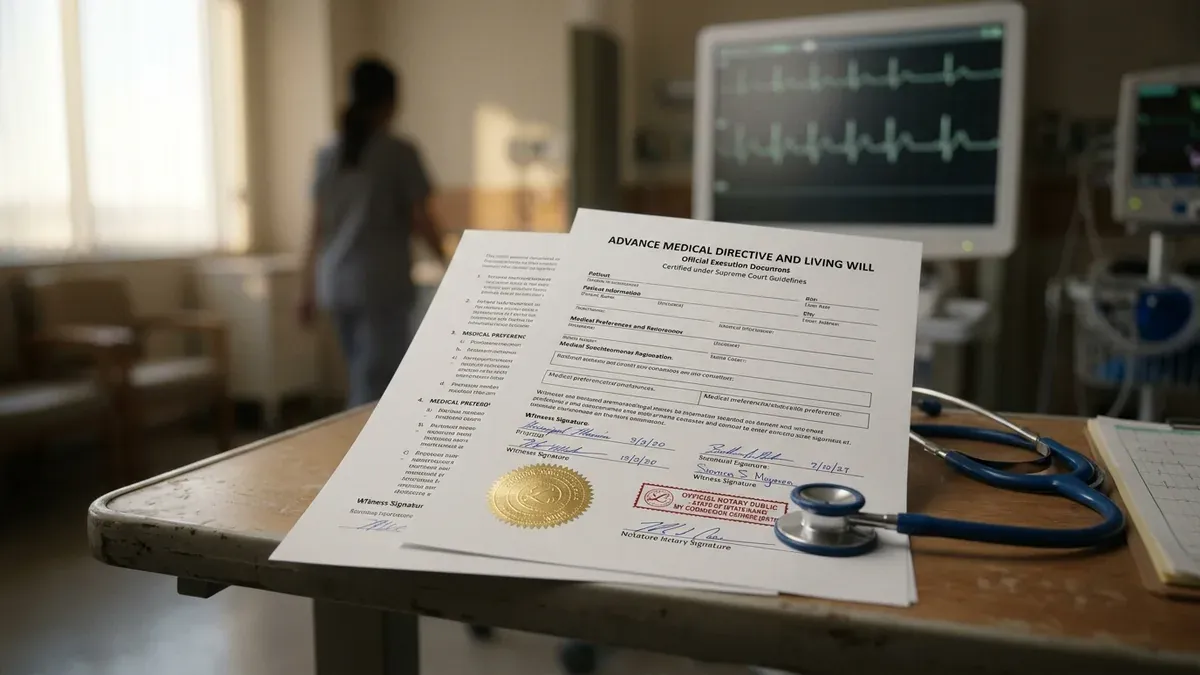
1. Constitutional Foundations: Article 21 & The Common Cause Landmark Jurisprudence
Advances in modern medical technology, intensive care pharmacology, and mechanical organ support systems have created profound bioethical dilemmas. While critical care medicine can sustain biological heartbeat and pulmonary respiration indefinitely, it often prolongs the agony of dying in patients afflicted with terminal metastatic cancers, brain death, or irreversible persistent vegetative states (PVS). Historically, Indian law lacked a statutory mechanism empowering citizens to refuse futile invasive medical interventions in advance.
This constitutional void was definitively addressed by a 5-Judge Constitution Bench of the Supreme Court of India in the monumental judgment of Common Cause (A Registered Society) v. Union of India (2018) 5 SCC 1. The Apex Court held that:
- The fundamental Right to Life under Article 21 of the Constitution encompasses the Right to Die with Dignity as an inseparable facet of personal liberty and bodily integrity.
- An adult of sound mind possesses an absolute constitutional right to refuse medical treatment, including life-sustaining treatment, and to execute an Advance Medical Directive (Living Will) specifying their wishes regarding future medical treatment.
- The court recognized the legality of Passive Euthanasia (withholding or withdrawing medical treatment), distinguishing it from unlawful active euthanasia.
2. Passive Euthanasia vs. Active Euthanasia: The Legal Boundary
Indian penal law draws a strict, non-negotiable boundary between passive and active euthanasia:
| Legal Parameter | Passive Euthanasia (Lawful) | Active Euthanasia (Criminal) |
|---|---|---|
| Nature of Act | Withholding or withdrawing artificial life support (ventilators, dialysis, feeding tubes) | Positive, lethal physical intervention (injecting lethal doses of toxic substances) |
| Cause of Death | Underlying natural disease progression or irreversible pathology | Lethal drug-induced cardiac arrest or respiratory paralysis |
| Legal Status in India | Lawfully recognized under Supreme Court Common Cause guidelines | Illegal; constitutes Culpable Homicide / Murder under Bharatiya Nyaya Sanhita (BNS) |
| Role of Advance Directive | Governed by the terms of a verified Living Will / Medical Board review | Unenforceable; consent of deceased is no legal defence for active killing |
3. The 2023 Simplified Supreme Court Guidelines: Removing Judicial Bottlenecks
While the 2018 judgment recognized Living Wills in principle, it enacted an excessively bureaucratic execution procedure requiring personal countersignatures by Judicial Magistrates of First Class (JMFC) and multi-layered District Collector approvals. Consequently, between 2018 and 2022, fewer than a hundred Living Wills were successfully registered across the entire country.
Recognizing that these cumbersome roadblocks defeated the constitutional purpose, a 5-Judge Constitution Bench headed by Justice K.M. Joseph issued a historic modification order on 24th January 2023 in Common Cause v. Union of India (2023), fundamentally streamlining the protocol:
- Notarized Execution: An Advance Medical Directive no longer requires physical appearance or countersignature before a Judicial Magistrate. It can now be lawfully executed and attested before a Notary Public or Gazetted Officer.
- Abolition of District Collector Board: The cumbersome secondary review board appointed by the District Collector was abolished and replaced by an internal hospital-based independent Secondary Medical Board.
- Strict 48-Hour Decision Timelines: Both the Primary Medical Board and the Secondary Medical Board are statutorily mandated to deliver their expert clinical opinions within forty-eight (48) hours each.
- Digital Repository Storage: The executor can upload their directive to the digital National Health Stack or submit a copy to the local municipal corporation or village panchayat.
4. Essential Contents & Drafting Clauses in an Advance Medical Directive
To be legally enforceable, an Advance Medical Directive must be drafted with clinical and legal precision:
- Voluntary Declaration of Sound Mind: Explicit affirmation that the executor is an adult of sound mental capacity, executing the document voluntarily without coercion, fraud, or undue influence.
- Specification of Terminal Medical Scenarios: Clear articulation that the instructions take effect ONLY if the executor suffers from an incurable, terminal illness, severe irreversible brain trauma, or persistent vegetative state (PVS) with no medical prospect of recovery.
- Specific Treatment Withholding Mandates: Unambiguous directions regarding:
- Refusal of cardiopulmonary resuscitation (Do Not Resuscitate — DNR);
- Withholding of invasive mechanical ventilation or tracheostomy;
- Refusal of artificial nutrition and hydration tubes where they merely prolong biological death;
- Mandatory provision of palliative palliative pain management and comfort care.
5. Appointment of Healthcare Custodians & Surrogate Decision-Makers
The Living Will must designate at least one primary and one alternate Healthcare Custodian (Surrogate Decision-Maker). The nominated custodian possesses the legal authority to:
- Present the original Advance Medical Directive to treating doctors and hospital authorities upon hospital admission;
- Participate in consultations with the hospital's Primary and Secondary Medical Boards;
- Provide informed consent on behalf of the unconscious patient to execute the withdrawal or withholding of life support in strict accordance with the written directive.
6. The Hospital Implementation Protocol: Primary & Secondary Medical Boards
When an individual who executed a Living Will is admitted in a critical state, the hospital executes the streamlined 2023 protocol:
- Tier 1 — Constitution of Primary Medical Board: The hospital constitutes a Primary Board comprising the treating physician and two subject specialists with a minimum of 5 years of experience. The Primary Board examines the patient and delivers its opinion on terminal prognosis within 48 hours.
- Tier 2 — Constitution of Secondary Medical Board: If the Primary Board recommends withdrawal, the hospital constitutes a Secondary Board comprising a Chief Medical Officer (CMO) nominee and two independent specialists not part of the primary treating team, who must examine the patient and concur within 48 hours.
- Judicial & Family Intimation: Upon concurrent findings, the hospital immediately intimates the decision to the Judicial Magistrate First Class (JMIC) and secures the written consent of the nominated surrogate before executing passive euthanasia.
7. Revocation, Amendment & Safe Digital Storage of Living Wills
An individual retains the absolute right to amend or revoke their Advance Medical Directive at any time during their life:
- Formal Revocation Deed: Execute a written Deed of Revocation attested before a Notary Public, distributing copies to healthcare custodians and hospitals.
- Verbal Overrule: An individual who regains consciousness can verbally instruct treating doctors to disregard the Living Will, which immediately supersedes the written directive.
- Safe Storage: Preserve copies with your designated surrogate, family physician, and in secure digital locker repositories (e.g., DigiLocker / ABHA National Health Account).
8. Comparative Matrix: Living Will vs. Testamentary Will vs. Power of Attorney
| Instrument Type | Operating Lifetime | Primary Legal Purpose | Governing Legal Authority |
|---|---|---|---|
| Advance Medical Directive (Living Will) | Operates during terminal unconsciousness before death | Directs refusal/withdrawal of futile life-support medical care | Article 21 Constitution & Supreme Court Common Cause Guidelines |
| Testamentary Will (Wasiyat/Will) | Takes effect strictly AFTER the death of testator | Distributes real estate, financial wealth, and personal assets | Indian Succession Act, 1925 / Muslim Personal Law |
| Power of Attorney (POA) | Operates during lifetime; automatically expires on death | Delegates commercial, banking, and real estate management | Powers of Attorney Act, 1882 |
9. Actionable Step-by-Step Living Will Execution Checklist
Living Will Execution & Registration Protocol
- Draft Comprehensive Advance Medical Directive: Retain medico-legal counsel to draft the directive specifying treatment refusals, palliative pain mandates, and surrogate powers.
- Nominate Primary & Alternate Healthcare Custodians: Name trusted family members or friends who understand your values and consent to act as surrogate decision-makers.
- Execute before Two Independent Witnesses: Sign the directive in the presence of two witnesses who are not direct beneficiaries under your testamentary Will.
- Attest before a Notary Public or Gazetted Officer: Under the 2023 Supreme Court guidelines, have the document verified and notarized before an authorized Notary Public.
- Distribute Official Copies to Surrogates & Doctors: Provide certified copies to your primary healthcare surrogate, family physician, and upload a copy to DigiLocker / ABHA.
Frequently Asked Questions on Living Wills & Advance Medical Directives
Key constitutional answers and medico-legal guidance curated by Bioethics & Healthcare Advocates in Delhi NCR.
What is a Living Will (Advance Medical Directive) under Indian law?
A Living Will, formally termed an Advance Medical Directive (AMD), is a legally recognized document executed by an adult of sound mental health in which they express their voluntary medical decisions in advance. It specifies whether life-sustaining treatments (such as mechanical ventilation, cardiopulmonary resuscitation, artificial feeding tubes, and dialysis) should be withheld or withdrawn in the event they suffer from a terminal illness, irreversible brain damage, or enter a persistent vegetative state (PVS) where there is no reasonable medical hope of recovery.
What did the Supreme Court decide in the landmark Common Cause (2018 & 2023) cases?
In Common Cause (A Registered Society) v. Union of India (2018) 5 SCC 1, a 5-Judge Constitution Bench ruled that Article 21's Right to Life includes the Right to Die with Dignity, legalizing passive euthanasia and advance medical directives. In January 2023, the 5-Judge Constitution Bench passed a historic modification order drastically simplifying the cumbersome execution guidelines: (1) An AMD can now be executed before a Notary Public or Gazetted Officer instead of a Judicial Magistrate; (2) The requirement of District Collector review was abolished; and (3) Hospital Primary and Secondary Medical Boards were mandated to deliver opinions within 48 hours.
What is the legal procedure for executing an Advance Medical Directive under the 2023 guidelines?
The execution protocol requires: (1) The directive must be executed voluntarily by an adult possessing sound mental capacity, in writing, clearly articulating instructions on withdrawal of life support; (2) Signed in the presence of two independent witnesses; (3) Attested and verified before a Notary Public or a Gazetted Officer; (4) The executor hands over a copy to their nominated healthcare custodian/surrogate decision-maker, family physician, and the relevant local municipal/panchayat digital repository.
How does a hospital implement a Living Will when a patient is in a persistent vegetative state?
When the treating physician forms an opinion that the patient is terminally ill with no recovery prospects, they verify the Living Will and constitute a Primary Medical Board comprising the treating physician and two subject specialists. If the Primary Board recommends withdrawal, the hospital constitutes a Secondary Medical Board comprising a Chief Medical Officer nominee and two independent specialists within 48 hours. Upon concurrence by both boards, the decision is conveyed to the Judicial Magistrate First Class (JMIC) and the family, followed by lawful, painless withdrawal of life support.
What is the difference between Active Euthanasia and Passive Euthanasia under Indian law?
Passive Euthanasia involves the withholding or withdrawal of medical life-support systems (such as switching off a mechanical ventilator, disconnecting dialysis, or withholding artificial nutrition) allowing the natural disease progression to terminate life peacefully. Passive euthanasia is lawful under the Supreme Court's Common Cause judgments. Active Euthanasia involves positive, lethal intervention (such as injecting lethal doses of sodium thiopental or potassium chloride to deliberately cause death). Active euthanasia remains strictly illegal and constitutes the criminal offence of culpable homicide under the Bharatiya Nyaya Sanhita, 2023.
Can a Living Will be revoked or amended after execution?
Yes. An individual retains the absolute, unconditional legal right to amend, alter, or revoke their Advance Medical Directive at any time during their life, provided they possess sound mental capacity. Revocation can be executed by destroying the original document, executing a formal written revocation deed attested before a Notary Public, or by explicitly expressing a contradictory verbal desire to the treating doctor prior to losing consciousness.
What protection is granted to doctors and hospitals executing an Advance Medical Directive?
Under the Supreme Court's 2018 and 2023 Common Cause rulings, medical practitioners, treating specialists, and hospitals adhering strictly to the court-mandated two-tier Medical Board protocol and acting upon a verified Living Will are fully insulated from civil negligence liability before Consumer Courts and criminal prosecution for culpable homicide under Indian penal laws.