Comparative Guide: Maintenance under Section 144 BNSS vs Section 24 Hindu Marriage Act vs PWDVA
 Authored by: Advocate Kishan Kumar (Advocate & Legal Consultant)
Quick Summary & Strategic Takeaways
- Section 144 BNSS (Sec 125 CrPC Overhaul): Summary, secular remedy available to wives, minor children, and aged parents to prevent vagrancy and destitution.
- Section 24 & 25 Hindu Marriage Act: Gender-neutral matrimonial remedy available to either spouse (husband or wife) during the pendency of divorce or restitution proceedings.
- Section 20 PWDVA Monetary Relief: Emergency financial maintenance granted to aggrieved women in shared households under domestic violence proceedings.
- Mandatory Asset Affidavit (Rajnesh v. Neha): Both parties must file detailed sworn affidavits of assets and liabilities along with 3-year ITRs and bank statements.
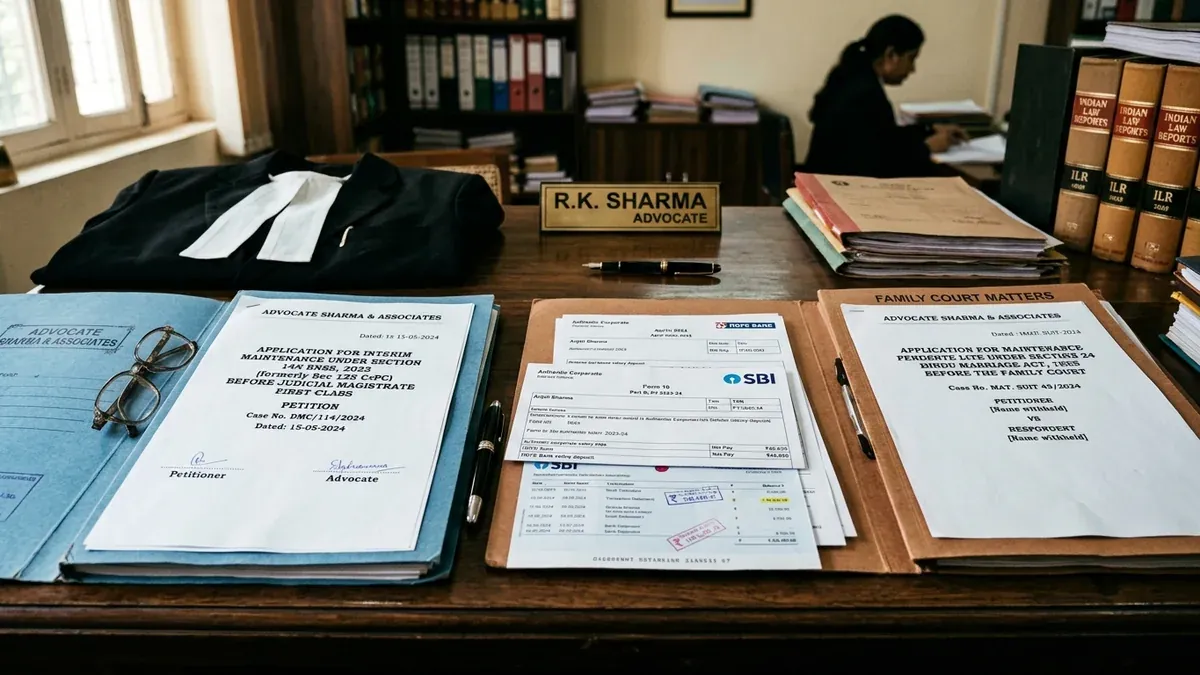
In matrimonial litigation in India, financial maintenance and alimony are frequently claimed under multiple overlapping statutes simultaneously. A wife can claim interim maintenance under Section 144 BNSS (replacing Section 125 CrPC), pendente lite maintenance under Section 24 of the Hindu Marriage Act, 1955, and monetary relief under Section 20 of the PWDVA, 2005 (PWDVA). Understanding statutory differences, overlapping adjustment principles, and mandatory income disclosure rules under Rajnesh v. Neha is vital for both claimants and respondents.
1. Comparative Framework of the Three Maintenance Statutes
1. Section 144 BNSS: A quasi-criminal, summary remedy aimed at preventing destitution. The applicant must prove that the respondent has sufficient means and neglects or refuses to maintain.
2. Section 24 HMA: A civil matrimonial provision providing interim maintenance and litigation expenses where the applicant spouse has no independent income sufficient for support.
3. Section 20 & 22 PWDVA: Civil monetary relief and compensation orders passed by the Magistrate in domestic violence proceedings to maintain the standard of living of the aggrieved person.
2. The Overlapping Maintenance Rule & Adjustment Principles
Prior to the Supreme Court ruling in Rajnesh v. Neha, spouses frequently obtained multiple conflicting maintenance orders across different courts for the same period without disclosure.
The Supreme Court established the mandatory rule of adjustment: (a) The applicant is statutorily bound to disclose all prior maintenance orders and pending claims in subsequent proceedings, and (b) The court adjudicating the subsequent claim must take into account and adjust amounts awarded in previous proceedings, ensuring the respondent is not subjected to double payment.
3. Judicial Computation Standards & Rajnesh v. Neha Format
While there is no rigid arithmetic formula, courts generally benchmark maintenance at 20% to 25% of the respondent net disposable monthly income after accounting for mandatory statutory deductions (income tax, GPF/EPF, and dependent liabilities).
Both parties must submit the comprehensive Affidavit of Disclosure of Assets and Liabilities mandated in Rajnesh v. Neha, covering: bank accounts, immovable assets, business shares, credit card spends, ITRs, and lifestyle expenses.
Landmark Judicial Precedents
The Supreme Court issued landmark guidelines standardizing maintenance adjudication across India, mandating uniform asset disclosure affidavits, overlapping adjustment, and dating maintenance from the date of application.
Reiterated that maintenance guidelines apply equally to proceedings under Section 125 CrPC / Section 144 BNSS, Section 24 HMA, and the Domestic Violence Act.
Held that 25% of the husband net salary is a just and proper benchmark for awarding maintenance to the wife.
Maintenance Statutes Comparison Matrix
| Parameter | Section 144 BNSS | Section 24 HMA | Section 20 PWDVA |
|---|---|---|---|
| Gender Eligibility | Wife / Children / Parents | Gender-neutral (Husband or Wife) | Aggrieved Woman Only |
| Forum | Judicial Magistrate (JMIC) | Family Court / District Judge | Judicial Magistrate / MM |
| Requirement of Main Case | Independent standalone petition | Must be during Divorce/HMA suit | Standalone DV petition |
| Enforcement Mechanism | Warrant & civil arrest (Sec 144(3)) | Execution under Order 21 CPC | Section 31 PWDVA / Contempt |
Comparative Guidelines & Computation Benchmarks under Rajnesh v. Neha
When claiming interim maintenance under Section 144 BNSS (Section 125 CrPC) or Section 24 HMA, family courts follow the binding Supreme Court guidelines in Rajnesh v. Neha:
1. Mandatory Affidavits of Assets and Liabilities: Both spouses must disclose all bank accounts, mutual funds, real estate holdings, credit card statements, and lifestyle expenses.
2. Standard Quantum Benchmark: Courts typically award 20% to 33% (one-fourth to one-third) of the husband net disposable income to maintain the wife and minor children. Estimate payments via our Interim Maintenance Calculator.
3. Date of Award: Maintenance is awarded from the date of filing the application, not the date of order, protecting the wife from protracted litigation delays.
Landmark Supreme Court ruling establishing standardized guidelines for maintenance in matrimonial cases, mandating comprehensive asset disclosure affidavits, and directing adjustment of overlapping maintenance orders.
Strategic Enforcement of Maintenance Orders under Section 144 BNSS
Obtaining an interim maintenance order is only half the battle; enforcing compliance against defaulting husbands requires prompt execution proceedings:
1. Attachment of Bank Accounts & Salaries: Under Section 144(3) BNSS, the Magistrate issues direct warrants to the husband employer or bank to attach and remit monthly maintenance.
2. Attachment of Immovable Property: Where arrears accumulate, the court issues recovery warrants under Section 461 BNSS (Section 421 CrPC) to auction the husband real estate or Khewat shares.
3. Sentence of Imprisonment for Default: For every breach of the maintenance order, the Magistrate can sentence the husband to civil imprisonment for up to one month or until payment is made (Kuldip Kaur v. Surinder Singh).
Actionable Next Steps & Critical Legal Strategy
If you are navigating an active legal dilemma regarding this subject matter, execute these immediate procedural steps:
- Preserve Primary Documentary Proof: Assemble certified copies of title deeds, notices, bank statements, and electronic records with Section 63 BSA compliance.
- Adhere to Statutory Limitation Windows: File urgent applications before jurisdictional civil courts or tribunals before rights are extinguished.
- Engage Specialized Trial Counsel: Secure customized litigation strategies from experienced High Court and Sessions Court advocates.
Statutory Authorities & Legal References
- Governing statutory codes under Bharatiya Nyaya Sanhita (BNS 2023), Bharatiya Nagarik Suraksha Sanhita (BNSS 2023), Bharatiya Sakshya Adhiniyam (BSA 2023), or Code of Civil Procedure (CPC 1908).
- Relevant state rules, court fee schedules, and registration notifications issued by the Government of Haryana and Delhi NCR authorities.
- Binding judicial precedents of the Supreme Court of India and the High Court of Punjab & Haryana.
- Official e-Courts portal and National Judicial Data Grid (NJDG) procedural guidelines.
Frequently Asked Questions
Key statutory answers and procedural guidance curated by Senior Advocates in Faridabad & Delhi NCR.
Can a wife claim maintenance under both Section 144 BNSS and Section 24 HMA?
Yes, a wife can initiate maintenance proceedings under both statutes simultaneously. However, under the Supreme Court rule of adjustment in Rajnesh v. Neha, payments made in one proceeding are adjusted against awards in another to avoid unjust double enrichment.
How does the court compute interim maintenance if the husband conceals income?
If the husband conceals business income or tax returns, the family court assesses maintenance based on lifestyle indicators: credit card spending, luxury vehicle ownership, foreign travel, and social status. Estimate payments with our Interim Maintenance Calculator.
Is an earning or professionally qualified wife entitled to interim maintenance?
Yes. In Sunita Kachwaha v. Anil Kachwaha, the Supreme Court held that the mere fact that the wife has earning capability or past employment does not disentitle her from maintenance if her current income is insufficient to maintain the standard of living of the matrimonial home.
From what date is interim maintenance payable?
Under Rajnesh v. Neha, interim maintenance is payable from the date of filing the application, not the date of judicial order, protecting the claimant from litigation delays.
What happens if the husband fails to pay interim maintenance?
Failure to pay invites coercive recovery warrants, attachment of salary, freezing of bank accounts, and civil imprisonment up to one month per default under Section 144(3) BNSS.
Can a working wife get maintenance in India?
If the wife independent income is insufficient to maintain the lifestyle and standard of living she enjoyed in the matrimonial home, the court can award top-up maintenance under Rajnesh v. Neha.
Can a husband claim maintenance from his wife?
Yes. Under Section 24 and Section 25 of the Hindu Marriage Act, a husband who has no independent income and is incapacitated from earning can claim maintenance from his earning wife.
From what date is maintenance awarded by courts?
Following Rajnesh v. Neha, maintenance is ordinarily awarded from the date of filing of the application, not the date of the final court order, preventing delay tactics.