Challenging Municipal Corporation Demolition Notices in Delhi NCR & Haryana: Stay Orders & Injunctions
 Authored by: Advocate Kishan Kumar (Advocate & Legal Consultant)
Quick Summary & Strategic Key Takeaways
- Statutory Show-Cause Mandate: Municipal Corporations (MCD, MCG, DTCP) cannot execute demolitions arbitrarily; Section 343 DMC Act and Section 261 Haryana MC Act mandate prior show-cause notices and personal hearings.
- Supreme Court 2024 Pan-India Demolition Code: The Supreme Court established a mandatory 15-day prior notice rule, compulsory personal hearing, reasoned speaking order, and a 15-day standstill window before any demolition can occur.
- Compounding & Regularization Remedies: Minor construction deviations within municipal building bye-law parameters are compoundable upon payment of compounding charges, extinguishing demolition threats.
- Judicial Stay Avenues: Aggrieved owners can secure immediate interim stay orders from the Appellate Tribunal (ATMCD), Civil Courts under Order 39 CPC, or High Courts under Article 226 writ jurisdiction.
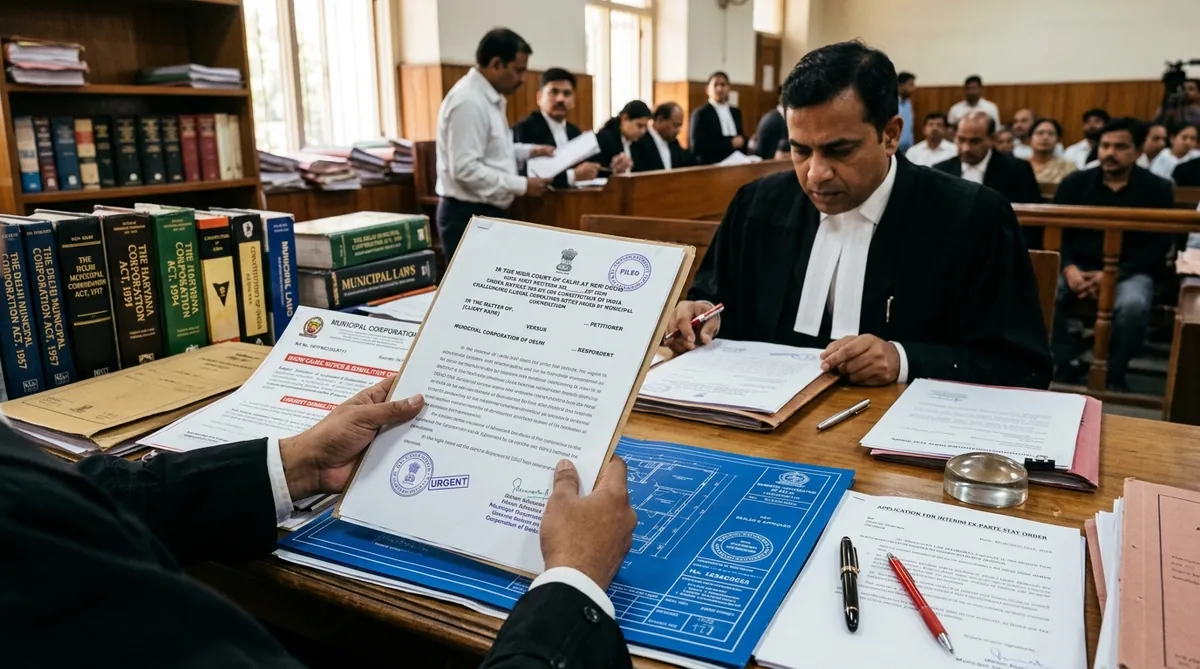
Receiving a demolition notice or sealing order from a Municipal Corporation—whether the Municipal Corporation of Faridabad (MCF), Municipal Corporation of Gurugram (MCG), or Municipal Corporation of Delhi (MCD)—is a traumatic crisis threatening millions of rupees in real estate investment and basic shelter. In recent years, aggressive municipal enforcement squads accompanied by earthmovers and police detachments have frequently bypassed statutory due process to execute rapid demolitions. However, Indian administrative and constitutional law severely restricts the arbitrary power of civic authorities. Property owners confronting illegal construction notices possess formidable procedural and statutory shields under state municipal codes, the Code of Civil Procedure, 1908 (CPC), and Article 226 of the Constitution of India.
1. Statutory Architecture of Municipal Demolition Laws
Urban planning and municipal enforcement across Haryana and Delhi NCR are governed by an intricate web of state enactments and municipal building bylaws:
| Statutory Code | Key Provisions | Subject Matter & Legal Scope |
|---|---|---|
| Haryana Municipal Corporation Act, 1994 | Sections 261, 263, 263A, 264 | Notice for demolition of unauthorized works, power to stop construction, sealing of premises, and appeal to Divisional Commissioner / District Judge. |
| Haryana Municipal Act, 1973 | Sections 12, 181, 208 | Applicable to smaller municipal councils; notice and demolition powers of executive officers. |
| Haryana Dev. & Reg. of Urban Areas Act, 1975 | Sections 8, 10, 10A | Enforcement by DTCP (Director Town and Country Planning) against unauthorized colonies and green belt violations. |
| Delhi Municipal Corporation Act, 1957 (DMC) | Sections 343, 344, 345A, 347B | Order of demolition, stoppage of building works, sealing of unauthorized constructions, and appeal to Appellate Tribunal MCD (ATMCD). |
| Haryana Building Code, 2017 (Amended) | Chapters 3, 4 & 7 | Permissible Ground Coverage, Floor Area Ratio (FAR), setback norms, and compounding fee schedules. |
2. Natural Justice Prerequisite: Show-Cause Notice & Hearing
The foundational bedrock governing municipal action is the doctrine of natural justice (audi alteram partem). A municipal authority cannot act as an arbitrary bulldozer squad without strictly adhering to statutory procedural conditions precedent:
The Supreme Court held that issuing a specific show-cause notice providing a reasonable time (at least 7 to 15 days) to the property owner to respond, affording an opportunity of personal hearing, and passing a well-reasoned speaking order are mandatory conditions precedent before embarking upon demolition. The Court held that demolitions carried out in violation of natural justice are void and render the civic body liable to pay substantial damages for unlawful property destruction.
The Supreme Court reiterated that while unauthorized commercial misuse and illegal structural deviations in residential zones must be checked, the authorities must provide adequate notice, inspect the site in the presence of the owner, and pass reasoned orders specifying whether deviations are compoundable.
Essential Requirements of a Valid Municipal Notice:
- Specific Measurement of Deviations: The notice cannot vaguely state "unauthorized construction." It must explicitly specify the exact square footage, floor, setbacks, or FAR violations compared against the sanctioned building plan.
- Reasonable Statutory Response Window: The owner must be given adequate statutory time (minimum 7 to 15 days under Section 261/343) to submit a formal written reply and architectural drawings.
- Reasoned Speaking Order: The Commissioner must pass a formal speaking order addressing the objections raised in the owner's reply. Failure to deal with the reply vitiates the subsequent demolition order.
3. Compounding, Purchasable FAR & Regularization Policies
Under modern urban bylaws in Haryana and Delhi, not all deviations warrant demolition. The law classifies deviations into two distinct categories:
- Non-Compoundable Deviations (Fatal Violations): Encroachment on municipal public roads, construction over storm-water drains, violating mandatory green buffers, exceeding absolute maximum height ceilings affecting flight paths, or construction in designated non-construction agricultural green zones. These cannot be regularized.
- Compoundable Deviations (Regularizable Violations): Minor internal layout changes, minor setback variations within permissible tolerance limits, ground coverage increases within allowable percentages, and additional Floor Area Ratio (FAR) purchasable from the municipal corporation upon payment of prescribed development charges.
Under the Haryana Building Code, 2017, property owners have the statutory right to submit an application for compounding through a licensed architect. The submission of a compounding application supported by structural safety certificates mandates that the municipal corporation must adjudicate upon regularizability before undertaking physical demolition.
4. Overcoming Statutory Civil Bar: The Dhulabhai Jurisprudence
Municipal enactments frequently insert exclusionary clauses (such as Section 263(3) of the Haryana Municipal Corporation Act or Section 347E of the DMC Act) declaring that "no civil court shall entertain any suit or grant any injunction in respect of any action taken by the Commissioner."
However, Indian civil jurisprudence has conclusively defeated this statutory shield through the landmark Constitution Bench ruling in Dhulabhai v. State of M.P. (AIR 1968 SC 787). The Supreme Court laid down that:
"Even where the jurisdiction of civil courts is expressly barred by a statute, the civil court's jurisdiction to examine cases where the provisions of the particular Act have not been complied with, or the statutory tribunal has not acted in conformity with the fundamental principles of judicial procedure or natural justice, is never excluded."
Therefore, whenever a municipal corporation issues a notice without specifying deviations, fails to grant a hearing, or issues a demolition order without disposing of a pending compounding application, the authority acts without jurisdiction (coram non judice), fully entitling the Civil Court to entertain an injunction suit under Section 9 CPC.
5. Urgent Civil Injunctions under Order 39 & Section 80(2) CPC
When municipal bulldozers are deployed on site, property owners cannot endure the traditional two-month statutory pre-suit notice mandated by Section 80(1) CPC. The procedural rescue mechanism is codified under Section 80(2) CPC:
The Urgent Civil Injunction Mechanism:
- Filing Plaint with Section 80(2) Application: File the suit for permanent injunction before the Senior Civil Judge accompanied by an urgent application under Section 80(2) CPC seeking leave to institute the suit without serving two months' prior notice, citing imminent threat of irreparable demolition.
- Order XXXIX Rules 1 & 2 Application for Interim Stay: Simultaneously move an application under Order 39 Rules 1 & 2 read with Section 151 CPC praying for an ad-interim ex-parte injunction restraining the municipal corporation from demolishing, sealing, or interfering with peaceful possession.
- Establishing the Triad of Injunction: Present the sanctioned building plan, compounding application receipts, and photographs proving existing construction to satisfy the court of prima facie case, balance of convenience, and irreparable injury.
6. Statutory Appeals before Appellate Tribunals (ATMCD / DTP)
In addition to civil suits, property owners possess specialized statutory appellate forums:
- Appellate Tribunal MCD (ATMCD) in Delhi: Under Section 347B of the DMC Act, any person aggrieved by an order of demolition (under Section 343) or sealing (under Section 345A) may appeal to the Appellate Tribunal within 30 days. The Tribunal possesses statutory power under Section 347C to grant interim stay on demolition during the pendency of the appeal.
- Appellate Jurisdiction in Haryana: Under Section 264 of the Haryana Municipal Corporation Act, an appeal against a demolition order lies to the Divisional Commissioner or the District Judge within 30 days, providing an effective administrative check against arbitrary executive action.
7. Article 226 Constitutional Writ Remedies against Bulldozer Action
Where municipal authorities act in blatant disregard of law, issuing arbitrary 24-hour demolition threats or deploying demolition squads over political vendettas, the ultimate constitutional shield is the High Court under Article 226 of the Constitution of India.
In landmark rulings addressing "bulldozer justice," the Supreme Court and High Courts have firmly ruled that executive demolitions carried out without due process violate the Right to Housing as an integral facet of the Right to Life under Article 21 of the Constitution (Olga Tellis v. Bombay Municipal Corporation). The High Court readily grants ex-parte stay orders, orders status quo, quashes invalid show-cause notices, and initiates contempt proceedings against municipal commissioners who execute demolitions during pending judicial proceedings.
8. Step-by-Step Emergency Demolition Defense Protocol
Executing a disciplined legal defense within the first 48 hours of receiving a demolition notice:
Verify whether the notice is issued by a competent officer. Check the statutory section invoked, whether specific deviation measurements are tabulated, and the exact response deadline.
Instruct an empanelled architect to prepare as-built drawings. Draft a detailed legal reply through counsel asserting compounding rights, attaching structural safety reports, and submitting under official municipal receipt stamp.
If the municipal corporation rejects the reply with a generic order, immediately institute a civil suit under Order 39 CPC with Section 80(2) leave or file an appeal before the Appellate Tribunal seeking urgent interim stay.
If local officials ignore stay applications and deploy demolition machinery, move an urgent morning mentioning before the High Court of Punjab & Haryana or Delhi High Court for an emergency protective stay order.
Practical Demolition Defense Checklist for Property Owners
- Preserve Sanctioned Plans & Receipts: Assemble original sanctioned building plans, completion certificates, property tax receipts, and water/power bills.
- Engage an Empanelled Architect: Commission accurate as-built drawings and structural stability certificates for compounding submissions.
- Submit Formal Reply under Official Receipt: Never hand over written replies casually; ensure the municipal receiving diary number and official seal are stamped on your copy.
- File Urgent Civil Suit with Section 80(2) CPC Leave: Obtain emergency judicial restraint against demolition before municipal bulldozers arrive on site.
- Video-Record Unlawful Administrative Action: If officials attempt demolition without following court orders or statutory notices, capture continuous video evidence under Section 63 BSA compliance for contempt action.
Statutory Authorities & Legal References
- Haryana Municipal Corporation Act, 1994: Sections 261, 263, 263A, and 264.
- Delhi Municipal Corporation Act, 1957: Sections 343, 344, 345A, 347B, and 347E.
- Code of Civil Procedure, 1908: Section 9 (Courts to try all civil suits unless barred), Section 80(2) (Notice exemption), and Order XXXIX Rules 1 & 2 (Temporary injunctions).
- Constitution of India: Article 21 (Protection of life and personal liberty / Right to shelter) and Article 226 (Power of High Courts to issue writs).
- Landmark Precedents: Dhulabhai v. State of M.P. (1968 SC), MCGM v. Sunbeam High Tech Developers (2019 SC), M.C. Mehta v. Union of India (2006 SC), and Olga Tellis (1985 SC).
Frequently Asked Questions
Authoritative municipal law and litigation guidance for property owners facing demolition notices in Haryana & Delhi NCR.
Can the Municipal Corporation demolish a building without prior notice?
No. Under Section 261 and Section 263 of the Haryana Municipal Corporation Act, 1994 (and Sections 343/344 of the Delhi Municipal Corporation Act, 1957), issuing a statutory Show-Cause Notice is a mandatory condition precedent before any demolition or sealing action can be undertaken. The Supreme Court in Municipal Corporation of Greater Mumbai v. Sunbeam High Tech Developers (2019) held that demolishing a structure without serving a specific show-cause notice providing at least 7 to 15 days to reply, or demolishing without passing a reasoned speaking order after hearing, is completely illegal and makes the municipal corporation liable for heavy compensatory damages.
Can a Civil Court grant a stay order against a Municipal Corporation demolition notice?
Yes. While municipal statutes often contain clauses purporting to bar civil court jurisdiction (such as Section 263(3) of Haryana Municipal Corporation Act or Section 347E of DMC Act), the Supreme Court's constitutional bench ruling in Dhulabhai v. State of M.P. (AIR 1968 SC 787) establishes that the civil court's plenary jurisdiction under Section 9 CPC is never barred where the statutory authority acts without jurisdiction, fails to follow mandatory statutory procedure, or violates fundamental principles of natural justice. Civil Courts grant urgent temporary injunctions under Order 39 Rules 1 & 2 CPC after dispensing with notice under Section 80(2) CPC.
What is the procedure for compounding and regularizing building deviations in Haryana?
Under the Haryana Building Code, 2017 (as amended in 2023–2026), non-structural deviations within permissible limits (such as minor ground coverage variations, non-compoundable setback margins, or excess FAR up to prescribed percentage thresholds) can be compounded. The property owner must submit an application through an empanelled architect accompanied by 'as-built' architectural drawings, structural safety certificates, and proof of payment of prescribed compounding fees and purchasable FAR charges to the Municipal Town Planner.
What emergency legal remedy is available if the MC issues an immediate 24-hour demolition notice?
If the Municipal Corporation issues a coercive 24-hour demolition notice, the property owner must: (1) Immediately file an urgent Civil Writ Petition under Article 226 of the Constitution before the High Court (High Court of Punjab & Haryana at Chandigarh or Delhi High Court), seeking a stay on demolition and quashing of the notice; (2) Alternatively, move an urgent stay application before the Municipal Appellate Tribunal (or Appellate Tribunal for MCD in Delhi) under Section 347B DMC Act / Section 264 Haryana MC Act; or (3) File an urgent civil injunction suit before the Senior Civil Judge with an application under Section 80(2) CPC seeking leave to institute the suit without the statutory two-month notice.
Can a tenant or lawful occupant challenge a demolition notice issued to the landlord?
Yes. A lawful tenant, lessee, or occupant in peaceful possession has an independent legal right to enjoy the premises without arbitrary administrative interference. Under Article 21 and Section 9 CPC, a tenant can challenge a demolition or sealing notice issued without hearing the actual occupants, especially where the landlord colluded with municipal officials to effect a constructive illegal eviction.
What constitutes a 'Speaking Order' under municipal demolition law?
A speaking order is a reasoned quasi-judicial determination passed by the Commissioner or Joint Commissioner of the Municipal Corporation. The order must explicitly record: (1) The specific architectural deviations mapped against the sanctioned building plan; (2) Detailed consideration and reasoned rejection of the property owner's written reply; (3) Discussion on whether the deviations are compoundable under the building bylaws; and (4) Clear statutory grounds justifying demolition instead of compounding or regularization.
How does Section 80(2) CPC enable urgent injunctions against Government authorities?
Normally, Section 80(1) CPC requires serving a two-month advance notice before suing the Government or municipal authorities. However, Section 80(2) CPC creates an express emergency exception: with the leave of the court, a suit to obtain an urgent or immediate relief against the Government or any public officer may be instituted without serving the two-month notice. Civil courts routinely grant Section 80(2) leave in imminent demolition and bulldozer action matters.
What rights exist regarding de-sealing of a property sealed by municipal authorities?
Under Section 263A of the Haryana Municipal Corporation Act (and Section 345A DMC Act), if a property is sealed for unauthorized construction or misuse, the owner can file a representation before the Commissioner or an appeal before the Appellate Tribunal demonstrating that unauthorized portions have been removed or compounded, or submitting an undertaking to rectify deviations within a stipulated period. The tribunal possesses powers to order temporary or permanent de-sealing.