HSVP & DDA Plot Allotment Cancellation: High Court Writ Petitions, Resumption Appeals & Restoration Rules
 Authored by: Advocate Kishan Kumar (Advocate & Legal Consultant)
Quick Summary & Strategic Key Takeaways
- Resumption as a Weapon of Last Resort: In the landmark ruling Teri Oat Estates v. U.T., Chandigarh (2004), the Supreme Court established that plot cancellation and resumption is a severe, ultimate penalty that must conform strictly to the constitutional Doctrine of Proportionality. Authorities cannot cancel plots when monetary defaults can be remedied via interest or extension fees.
- Statutory Framework under Section 17 HSVP Act: Section 17 of the Haryana Shehri Vikas Pradhikaran Act, 1977 governs resumption and forfeiture. It mandates personal show-cause notices, statutory hearings, and strictly limits monetary forfeitures.
- Mutual Obligations & Lack of Basic Infrastructure: Development authorities (HSVP and DDA) cannot penalize allottees for delayed construction or installment defaults when the authority itself has failed to develop essential trunk infrastructure like approach roads, water lines, and sewerage networks.
- Article 226 High Court Writ Remedies: When statutory authorities act arbitrarily, violate natural justice, or reject departmental appeals unfairly, aggrieved allottees can invoke the writ jurisdiction of the High Court of Punjab & Haryana (Chandigarh) or High Court of Delhi to quash resumption orders and compel plot restoration.
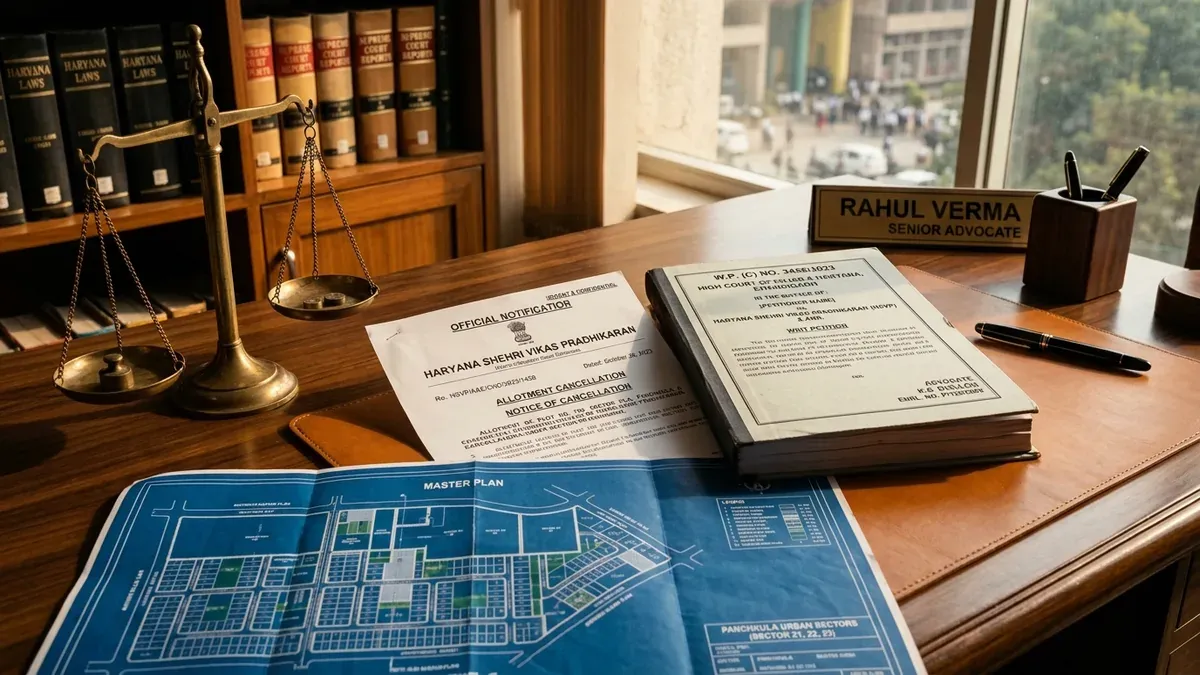
1. Common Grounds of Plot Allotment Cancellation by HSVP & DDA
In planned urban development zones across Delhi and Haryana, land parcels and residential, commercial, or institutional plots allotted by public authorities—primarily the Haryana Shehri Vikas Pradhikaran (HSVP) (formerly HUDA) and the Delhi Development Authority (DDA)—represent major financial assets. However, allottees routinely find their valuable allotments cancelled and properties "resumed" by bureaucratic authorities. Understanding the statutory grounds and procedural validity of such cancellations is essential for mounting an effective legal defense.
Public development authorities generally invoke resumption powers on four broad grounds:
- Default in Installment Payments: Failure of the allottee to deposit scheduled installment amounts along with interest within the prescribed timeframe stipulated in the formal Allotment Letter.
- Failure to Complete Construction Within Prescribed Time: Most public allotments contain a statutory covenant requiring the allottee to construct a building according to sanctioned building plans within a designated period (usually 2 to 3 years from the date of physical offer of possession). While authorities permit extensions upon payment of escalating "non-construction fees", failure to construct or pay compounding fees results in resumption notices.
- Unauthorized Pre-Conveyance Transfer or GPA Sale: Allottees who transfer rights through General Power of Attorney (GPA), Agreement to Sell, or unauthorized sub-division prior to executing a registered conveyance deed frequently face cancellation on grounds of violating transfer regulations.
- Alleged Misrepresentation or Document Deficiencies: Discrepancies in auction bidding forms, affirmative category eligibility certificates (e.g., defense personnel, EWS, oustee category quotas), or stamp duty deposits.
2. Statutory Resumption Procedure under Section 17 of the HSVP Act, 1977
Resumption by HSVP is governed strictly by Section 17 of the Haryana Shehri Vikas Pradhikaran Act, 1977 (Resumption and forfeiture for breach of conditions of transfer). The statute mandates a rigid, sequential procedure that the authority must follow without deviation:
| Statutory Sub-Section | Mandatory Legal Requirement | Procedural Safeguards for Allottees |
|---|---|---|
| Section 17(1) | Issuance of Notice to Show Cause | The Estate Officer must issue a formal notice giving the allottee not less than 30 days to rectify the breach or explain why a penalty should not be imposed. |
| Section 17(2) | Imposition of Financial Penalty | If default persists without reasonable cause, the Estate Officer may impose a financial penalty not exceeding 10% of the overdue installment amount. |
| Section 17(3) | Notice of Proposed Resumption | If the penalty and arrears remain unpaid, the Estate Officer must issue a second, specific show-cause notice proposing resumption of the land and forfeiture of deposits. |
| Section 17(4) | Order of Resumption & Forfeiture | The Estate Officer passes a speaking order resuming the land and forfeiting a proportion of money paid (strictly capped by constitutional limits). |
| Section 17(5) | Statutory First Appeal | The aggrieved allottee is entitled to file an appeal before the Administrator, HSVP within 30 days from the date of communication of the resumption order. |
| Section 17(8) | Statutory Revision Petition | The allottee can challenge the appellate order before the Principal Secretary to Government of Haryana, Town & Country Planning Department. |
Any failure by the Estate Officer to comply strictly with the statutory sequence—such as skipping the penalty stage under Section 17(2) and proceeding directly to resumption under Section 17(4), or failing to verify actual service of notices—renders the resumption order void ab initio.
3. Constitutional Doctrine of Proportionality: The Teri Oat Estates Precedent
The constitutional limits of a public authority's power to resume property were definitively articulated by the Supreme Court of India in the landmark decision of Teri Oat Estates (P) Ltd. v. U.T., Chandigarh & Ors. (2004 2 SCC 130).
The Core Facts and Supreme Court Ratio in Teri Oat Estates
In Teri Oat Estates, a commercial building site was cancelled and resumed by the Chandigarh Administration due to installment defaults. The Supreme Court reversed the resumption, laying down fundamental constitutional doctrines that govern all statutory authorities including HSVP and DDA:
- Resumption is a Weapon of Last Resort: The power of resumption is an extreme, drastic measure and should not be invoked lightly or mechanically. It must be utilized only when all other statutory methods of recovery (such as imposing interest, penalties, or extension fees) have completely failed.
- The Doctrine of Proportionality: Administrative action by the State must satisfy the test of proportionality under Article 14 of the Constitution of India. The punishment must match the gravity of the default. Cancelling a citizen's plot worth millions over a temporary financial delay that can be compensated with monetary interest is grossly disproportionate.
- The State Cannot Act Like a Private Shylock: A statutory development authority is a welfare entity created to promote urban housing and commercial infrastructure, not a commercial extortionist. It cannot act arbitrarily or ruthlessly like a private Shylock demanding its pound of flesh.
- Principles of Natural Justice: The requirement of audi alteram partem (hearing the other side) is not an empty formality. The authority must actively consider the allottee’s genuine financial difficulties, family tragedies, or project impediments before signing a resumption decree.
Kailash Nath Associates v. DDA (2015 4 SCC 136) & Forfeiture Limits
Authorities frequently attempt to forfeit 25%, 50%, or even 100% of the entire consideration paid by the allottee. In Kailash Nath Associates, the Supreme Court ruled that Section 74 of the Indian Contract Act, 1872 governs forfeitures by public authorities. Forfeiture of earnest money is permissible only where it represents a genuine pre-estimate of damages or a reasonable sum, which the courts have consistently capped at ten percent (10%) of the total sale value. Retaining any amount beyond 10% constitutes unjust enrichment and an illegal confiscation of private property in violation of Article 300A of the Constitution.
4. Departmental Appellate Hierarchy: Appeals, Revisions & Amnesty Schemes
Before rushing to court, an aggrieved allottee must thoroughly evaluate the departmental remedy matrix:
HSVP Departmental Hierarchy
- Statutory Appeal under Section 17(5): Filed before the jurisdictional Administrator, HSVP (e.g., Gurugram, Faridabad, Rohtak, Panchkula). The appeal must be accompanied by an application for stay of re-auction. The Administrator possesses equitable powers to restore the plot upon directing the allottee to clear outstanding principal balances with regular compound interest.
- Revision Petition under Section 17(8): If the Administrator dismisses the appeal, a revision petition lies before the Principal Secretary to the Government of Haryana, Department of Town and Country Planning. The Revisional Authority has broad statutory powers to examine the legality, propriety, and regularity of any proceeding.
DDA Departmental Remedies
Under the Delhi Development Act, 1957, cancellations are challenged via representations before the Disputes Resolution Committee (DRC), formal appeals before the Vice-Chairman, DDA, or statutory petitions before the Lieutenant Governor of Delhi. DDA routinely operates through departmental restoration policies where cancellations arising from late construction or non-submission of identity documents can be regularized upon payment of restoration charges.
Periodic Amnesty & Revival Schemes
Recognizing the massive volume of stalled litigation, both HSVP and DDA periodically formulate comprehensive Amnesty Schemes. Under these schemes, resumed residential and commercial plots where possession was not physically transferred to a third party through public e-auction can be restored unconditionally upon deposit of overdue installments, simple penal interest, and capped extension fees, fully reviving the allottee’s original title.
5. High Court Writ Strategy under Article 226: Overcoming Alternative Remedies
When departmental authorities rubber-stamp arbitrary cancellations or when plots are imminently threatened with public e-auction, filing a Writ Petition under Article 226 of the Constitution of India before the High Court of Punjab and Haryana at Chandigarh (for HSVP matters) or the High Court of Delhi at New Delhi (for DDA matters) is the most potent legal remedy.
| High Court Writ Ground | Legal & Evidentiary Foundation | Relief Granted by High Court |
|---|---|---|
| Violation of Natural Justice (Audi Alteram Partem) | Notices served at old/wrong address; no personal hearing granted before Estate Officer. | Quashing of resumption order; remand back for fresh hearing with interim protection. |
| Failure to Provide Basic Infrastructure | No approach roads, electricity lines, or water mains provided by authority at site. | Waiver of all non-construction extension fees; deferment of installments until amenities ready. |
| Disproportionate Penalty (Teri Oat Doctrine) | Authority resumed multi-crore plot over minor financial delay capable of being regularized. | Setting aside cancellation; directing restoration upon payment of balance with interest. |
| Imminent Threat of Third-Party E-Auction | Authority listed plot on public e-auction portal while appeal/revision pending. | Immediate ad-interim stay against e-auction and preservation of allottee status quo. |
Bypassing the Rule of Alternative Remedy
Government counsels routinely argue that a Writ Petition under Article 226 should be dismissed because the allottee has an alternative remedy via departmental appeal or civil suit. In landmark decisions including Whirlpool Corporation v. Registrar of Trade Marks (1998) and Harbanslal Sahnia v. Indian Oil Corp. (2003), the Supreme Court held that the existence of an alternative remedy does not operate as an absolute bar to writ jurisdiction where:
- The writ petition has been filed for the enforcement of a Fundamental Right (Articles 14, 19, or 21).
- There has been a complete violation of the principles of natural justice.
- The order or proceeding is wholly without jurisdiction or vires of an Act is challenged.
6. Specimen Representation for Restoration of Resumed Plot
Below is a specimen formal legal representation to the Estate Officer / Chief Administrator requesting restoration of a resumed plot prior to instituting High Court writ proceedings:
FORMAL REPRESENTATION FOR RESTORATION OF RESUMED PLOT & WAIVER OF PENAL EXTENSION FEES
Date: [Insert Date]
To:
The Chief Administrator / Estate Officer,
Haryana Shehri Vikas Pradhikaran (HSVP),
Urban Estate Office, [Sector / City, Haryana]
Subject: Formal Representation for setting aside ex-parte Resumption Order dated [Insert Date] and restoration of Allotment in respect of Residential Plot No. [Insert Plot No.], Sector [Insert Sector], Urban Estate [Insert City] in terms of the Supreme Court judgment in Teri Oat Estates v. U.T., Chandigarh.
Respected Sir / Madam,
The Applicant most respectfully submits as follows:
- That the Applicant is the original, bona fide allottee of Residential Plot No. [Insert Plot No.], measuring [Insert Area] sq. meters, situated in Sector [Insert Sector], Urban Estate, [Insert City], allotted vide Allotment Memo No. [Insert Memo No.] dated [Insert Date].
- That the Applicant has deposited a total sum of Rs. [Insert Amount Paid], representing over [Insert %] of the total tentative cost of the plot as per the schedule of payments.
- That the Estate Officer passed an ex-parte Resumption Order bearing Memo No. [Insert Order No.] dated [Insert Date] cancelling the allotment and ordering resumption of the plot on the alleged ground of non-payment of remaining installments and non-construction.
- That the aforementioned resumption order was passed in gross violation of the principles of natural justice, as the purported show-cause notices were never served upon the Applicant, who was temporarily residing at [Insert Address] due to [medical emergency / employment posting].
- That furthermore, the Authority has failed to this day to provide basic civic infrastructure—including motorable access roads, sewage connectivity, and water supply—in the immediate vicinity of Sector [Insert Sector], rendering physical construction practically impossible. Under settled law of the Punjab & Haryana High Court, the Authority cannot levy non-construction extension fees when basic developmental infrastructure is absent.
- That in Teri Oat Estates (P) Ltd. v. U.T., Chandigarh (2004 2 SCC 130), the Hon'ble Supreme Court held that resumption is an extreme weapon of last resort and that authorities must act proportionately. The Applicant is ready, willing, and undertakes to deposit the entire legitimate outstanding principal dues along with reasonable interest as determined by the Authority.
PRAYER: In light of the above facts, the Applicant humbly prays that your good office may be pleased to set aside the ex-parte Resumption Order dated [Insert Date], restore the allotment of Plot No. [Insert Plot No.], grant a reasonable period of two (2) years for construction from the date of providing basic civic trunk services, and refrain from placing the plot on the public e-auction portal.
Yours faithfully,
[Applicant Name]
Address: [Full Postal Address]
Phone: [Mobile Number] | Email: [Email Address]
7. Frequently Asked Questions (FAQs)
Frequently Asked Questions
Comprehensive legal answers on HSVP and DDA plot cancellation, resumption appeals, and High Court writs
Can HSVP or DDA cancel a plot allotment without serving a prior show-cause notice?
No. Under Section 17 of the HSVP Act, 1977 and corresponding DDA regulations, issuance of a detailed show-cause notice and providing a reasonable opportunity of personal hearing (audi alteram partem) are mandatory statutory prerequisites. Any resumption or cancellation order passed without serving a show-cause notice to the recorded allottee's verified address violates fundamental principles of natural justice and is liable to be quashed under Article 226 writ jurisdiction.
What is the landmark Supreme Court doctrine governing plot resumption in Teri Oat Estates?
In Teri Oat Estates (P) Ltd. v. U.T., Chandigarh (2004 2 SCC 130), the Supreme Court ruled that resumption of land by statutory authorities is a drastic weapon of last resort and must satisfy the constitutional Doctrine of Proportionality. The state cannot act like a private Shylock demanding its pound of flesh. Where an allottee's default involves financial non-payment or construction delays that can be compensated by penal interest or extension fees, cancellation and resumption of the plot are wholly disproportionate and illegal.
What is the maximum percentage of earnest money that HSVP or DDA can forfeit upon cancellation?
Under Section 17(3) of the HSVP Act and the Supreme Court landmark in Kailash Nath Associates v. DDA (2015 4 SCC 136), a statutory development authority is entitled to forfeit only a reasonable sum, which cannot exceed ten percent (10%) of the total earnest money consideration. Forfeiting entire paid-up installment sums or arbitrarily retaining 25% or 50% of the consideration constitutes unjust enrichment and violates Section 74 of the Indian Contract Act.
Can an allotment be cancelled if the authority failed to provide basic trunk infrastructure?
No. The Punjab and Haryana High Court and Delhi High Court have repeatedly ruled that public developmental authorities operate under mutual contractual and statutory obligations. If HSVP or DDA fails to provide basic infrastructure—such as motorable approach roads, water mains, sewerage lines, and electricity connections—it is legally estopped from demanding non-construction fees or penal installments, or cancelling the allotment.
What are the departmental appeal remedies before filing a High Court Writ Petition against HSVP?
Under the HSVP Act, 1977, an aggrieved allottee must generally exhaust two statutory departmental tiers: (1) First Appeal under Section 17(5) before the Administrator, HSVP within thirty (30) days of the resumption order; and (2) Revision Petition under Section 17(8) before the Principal Secretary to Government of Haryana, Town and Country Planning Department. However, if the resumption order was passed in gross violation of natural justice or without jurisdiction, a Writ Petition under Article 226 lies directly before the High Court.
Can a plot cancelled years ago be restored under current government amnesty or revival policies?
Yes. Both HSVP and DDA periodically notify comprehensive Relief Policies and Amnesty Schemes (e.g., HSVP Amnesty Policy for Resumed Plots) allowing original allottees or their legal heirs to seek restoration upon clearing outstanding dues, updated compounding extension fees, and reasonable penal interest, provided third-party rights have not been created by subsequent public re-auction.
What happens if HSVP or DDA puts my cancelled plot up for public re-auction?
If an allottee discovers that their cancelled plot is scheduled for public re-auction, they must immediately approach the High Court under Article 226 of the Constitution of India seeking an urgent interim stay against the e-auction. Once a third-party purchaser acquires the plot in good faith at a public auction and a conveyance deed is registered, restoring the original allotment becomes substantially more complex.
Are delayed construction extension fees charged by development authorities challengeable?
Yes. Where delayed construction was caused by governmental delays—such as pending litigation over underlying land acquisition, stay orders by the NGT, failure to demarcate plots, or high-tension electricity wires passing over the site—the High Court routinely quashes arbitrary extension fees and directs the authority to compute non-construction fees only from the date all impediments were formally removed.