How to File a Discharge Application under Section 250 BNSS: Groundless Charges & Case Law
 Authored by: Advocate Kishan Kumar (Advocate & Legal Consultant)
Quick Summary & Strategic Key Takeaways
- Vital Pre-Trial Threshold: Section 250 BNSS (Sessions) and Section 262 BNSS (Magistrate) empower the court to terminate malicious criminal proceedings before trial begins if no prima facie case exists.
- The Grave Suspicion Benchmark (Prafulla Samal): Mere suspicion does not justify framing of charges; the trial court is not a passive conduit for the prosecution and must discharge the accused where grave suspicion is absent.
- Sanjay Kumar Rai Mandate (2021): The Supreme Court held that discharge is a valuable statutory shield preventing citizens from enduring the prolonged trauma of unjustified criminal trials.
- Unimpeachable Defence Documents: Public records of sterling quality (MCA Form DIR-12, official passport entries) can be judicially considered to demolish baseless charges at the threshold.
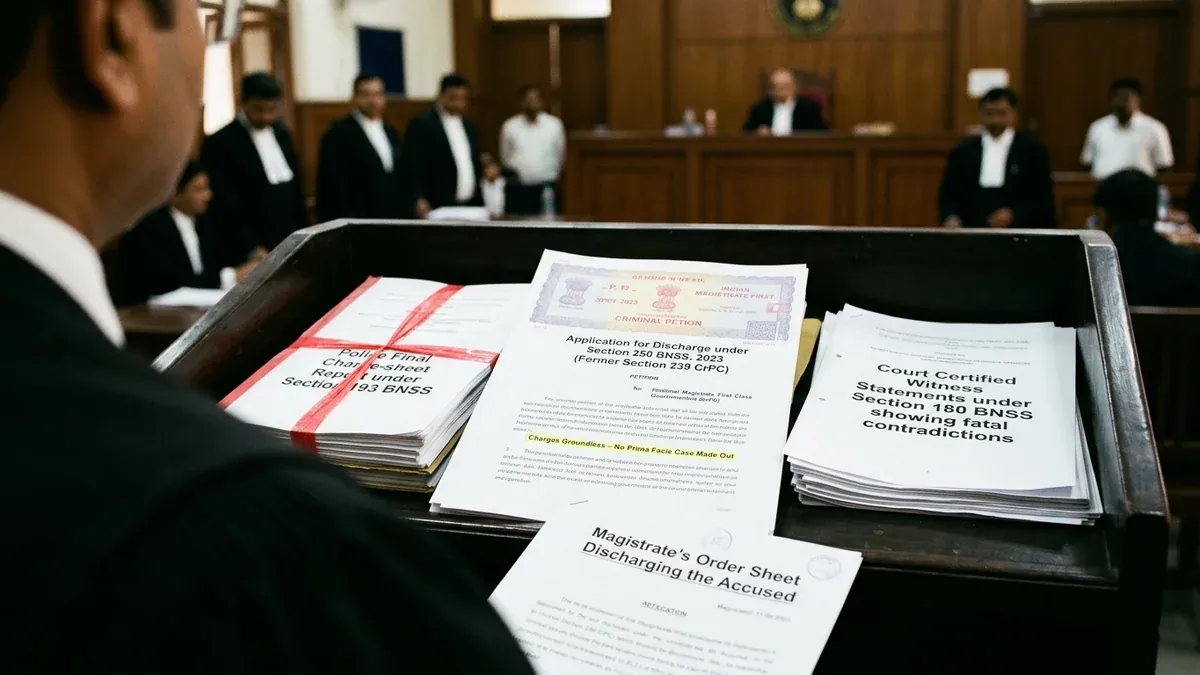
In Indian criminal litigation, the filing of a police charge-sheet (final report under Section 193 BNSS) does not mandate that the accused person must automatically undergo the psychological, financial, and reputational ordeal of a full-dress criminal trial. The criminal procedural law incorporates a decisive institutional filter prior to the framing of formal charges: the statutory remedy of Discharge. Under Section 250 of the Bharatiya Nagarik Suraksha Sanhita, 2023 (BNSS), the trial court is statutorily mandated to terminate proceedings and discharge the accused if the allegations, witness statements, and documents collected by the prosecution are found to be groundless. Mastering the law of discharge requires a deep command over statutory thresholds, judicial scrutiny standards, and binding Supreme Court precedents.
1. The Statutory Triad of Discharge: Sections 250, 262 & 268 BNSS
The Bharatiya Nagarik Suraksha Sanhita, 2023 structures the discharge mechanism across three distinct procedural tiers depending on the nature of the trial and forum:
| Statutory Provision | Trial Forum & Nature of Case | Old CrPC Equivalent | Statutory Test for Discharge |
|---|---|---|---|
| Section 250 BNSS | Warrant Cases instituted on a Police Report before a Magistrate | Section 239 CrPC | If the Magistrate considers the charge against the accused to be groundless. |
| Section 262 BNSS | Sessions Trial (Offences triable exclusively by Court of Session) | Section 227 CrPC | If the Judge considers that there is no sufficient ground for proceeding against the accused. |
| Section 268 BNSS | Warrant Cases instituted otherwise than on Police Report (Private Complaints) | Section 245 CrPC | If, upon taking evidence produced by complainant, no case has been made out which would warrant conviction. |
Under Section 250(1) BNSS:
"If, upon considering the police report and the documents sent with it under section 193 and making such examination, if any, of the accused as the Magistrate thinks necessary and after giving the prosecution and the accused an opportunity of being heard, the Magistrate considers the charge against the accused to be groundless, he shall discharge the accused, and record his reasons for so doing."
2. Legal Standards: 'Groundless' Charge vs 'Grave Suspicion'
One of the most profound judicial duties at the stage of framing charges is distinguishing between genuine prima facie evidence and mere speculative suspicion. The Supreme Court has repeatedly held that the trial judge is not a mere post office or rubber stamp of the police:
The Supreme Court formulated the foundational principles governing discharge: (1) The Judge has the undoubted power to sift and weigh the evidence for the limited purpose of finding out whether or not a prima facie case against the accused has been made out; (2) Where the materials disclose grave suspicion which has not been properly explained, the court will be fully justified in framing a charge; but (3) Where the materials disclose only mere suspicion, as distinguished from grave suspicion, the court will be fully within its rights to discharge the accused.
Reaffirmed that at the stage of framing of charge, the court is not required to marshal the evidence or appreciate its credibility as in a trial, but the court cannot blindly accept the prosecution version. If two views are possible and one of them gives rise to suspicion only, as distinguished from grave suspicion, the trial judge must discharge the accused.
Held that while roving inquiry or pros and cons analysis of evidence is impermissible at the stage of Section 227/239, the court must apply its judicial mind to determine whether the basic statutory ingredients of the penal offence alleged are disclosed in the record.
3. Admissibility of Defence Documents: The Sterling Quality Exception
A classic procedural debate centers on whether an accused person is entitled to produce their own documents at the discharge stage. While the landmark Constitution Bench verdict in State of Orissa v. Debendra Nath Padhi (2005) 1 SCC 568 ruled that the accused has no general statutory right to produce evidence before the framing of charges, subsequent Supreme Court jurisprudence carved out an authoritative exception:
The Doctrine of Sterling Quality Public Records:
- Rukmini Narvekar v. Vijaya Satardekar (2008) 14 SCC 1: The Supreme Court held that while the general rule in Debendra Nath Padhi applies, the court cannot shut its eyes to documents of sterling quality and unimpeachable authenticity produced by the defence which completely negate the foundation of the prosecution.
- Rajiv Thapar v. Madan Lal Kapoor (2013) 3 SCC 330: The Supreme Court laid down the four-step test allowing courts to rely on defence documents at the threshold stage:
- The material relied upon by the accused must be of sterling, unimpeachable quality (official government records, certified judicial orders, passport immigration stamps);
- The material must not have been controverted or disputed by the prosecution;
- The material must completely rule out the assertion of the complainant/prosecution; and
- Continuing the trial in the face of such evidence would constitute a travesty of justice and abuse of process.
4. Identifying Fatal Legal Defects (Sanction & Limitation)
In countless criminal prosecutions, the charge-sheet is infected with insurmountable threshold jurisdictional defects that render the charge legally groundless:
- Statutory Bar of Limitation (Section 513 BNSS / old Section 468 CrPC):
Under Section 513 BNSS, criminal courts are strictly barred from taking cognizance after the lapse of limitation periods:
- Six months for offences punishable with fine only.
- One year for offences punishable with imprisonment up to one year.
- Three years for offences punishable with imprisonment up to three years.
- Absence of Prior Government Sanction (Section 218 BNSS / old Section 197 CrPC): Where public servants, police officers, judges, or bureaucrats are prosecuted for acts performed in the purported discharge of official duties, obtaining prior sanction from the Central or State Government under Section 218 BNSS is mandatory. Taking cognizance or framing charges without sanction is void for want of jurisdiction (D. Devaraja v. Owais Sabeer Hussain 2020 SC).
- Absence of Indispensable Penal Ingredients: In cheating cases (Section 318 BNS / 420 IPC), demonstrating that the dispute is purely a commercial breach of contract without fraudulent intent at inception warrants discharge (Dalip Kaur v. Jagnar Singh 2009 SC). Similarly, in Section 85 BNS cases, general omnibus claims without dowry coercion warrant discharge.
5. Scrutiny of Section 230 BNSS Compliance (Supply of Documents)
Under Section 230 of the Bharatiya Nagarik Suraksha Sanhita, 2023 (corresponding to Section 207 CrPC), the Magistrate must furnish the accused person, free of cost, with certified copies of the police report, the first information report, witness statements recorded under Section 180 BNSS, confession statements under Section 183 BNSS, and seizure memos. The Supreme Court in P. Ponnusamy v. State of Tamil Nadu (2022) SCC OnLine SC 1543 held that the prosecution has a duty of fairness to supply all documents collected during investigation, including exculpatory material favorable to the accused.
Before arguing an application for discharge, defence counsel must file an application under Section 230 BNSS demanding the supply of omitted or withheld documents. Proceeding to hear arguments on charge without complete Section 230 compliance vitiates the proceedings.
6. Drafting an Unassailable Discharge Application
A successful discharge petition must be drafted with structural precision under Section 250 BNSS, avoiding generic rhetoric and focusing on statutory deficiencies:
Succinctly summarize the FIR allegations and date of occurrence. Emphasize delays in lodging the FIR, lack of independent eyewitnesses, and prior civil disputes between the parties.
Subject every prosecution witness statement to statutory analysis. Demonstrate that witnesses made only vague, hearsay, or contradictory statements, failing to establish specific overt acts attributable to the applicant.
Map the evidence against the essential ingredients of each charged BNS section. Show that mens rea, entrustment, inducement, or medical injury is entirely absent from the record.
Annex certified public records (passport departure stamps proving alibi, court decrees, registered deeds) compliant with the Rajiv Thapar four-pronged test to demonstrate that the charge is groundless.
7. Oral Arguments Strategy on Framing of Charges
During oral arguments on charge before the Judicial Magistrate or Sessions Judge, defence counsel must adopt an aggressive statutory posture:
- Emphasize the Prafulla Kumar Samal Distinctions: Remind the court that suspicion alone—even grave suspicion—cannot justify framing a charge if essential legal ingredients are not disclosed.
- Highlight Fatal Inconsistencies: Compare ocular testimony against medical jurisprudence (MLC reports), proving that alleged weapon strikes could not have produced the minor contusions recorded by the doctor.
- Demonstrate Malice & Ulterior Motives: Present documented civil suits, partition battles, or commercial rivalries demonstrating that the criminal process is being abused as an instrument of extortion.
8. Remedies Against Rejection: Criminal Revision under Section 438 BNSS
If the trial court rejects the discharge application and proceeds to frame charges, the accused is not without effective appellate recourse:
- Criminal Revision under Section 438 BNSS (old Section 397 CrPC): The accused can file a revision petition before the Sessions Court or the High Court. While Section 438(2) BNSS bars revision against purely interlocutory orders, the Supreme Court in Madhu Limaye v. State of Maharashtra (1977) 4 SCC 551 and Asian Resurfacing (2018 SC) held that an order rejecting discharge is an intermediate order, not purely interlocutory, because had the court accepted the application, proceedings would have terminated. Therefore, revision is maintainable.
- High Court Quashing under Section 528 BNSS (old Section 482 CrPC): Alternatively, the accused can invoke the High Court's inherent power to quash the order framing charges and the charge-sheet to prevent gross abuse of judicial process.
Strategic Discharge Checklist for Criminal Defence Counsel
- Audit Complete Section 230 BNSS Supply: Verify that all witness statements, seizure memos, and scientific reports have been supplied by the prosecution.
- Examine Statutory Limitation under Section 513 BNSS: Calculate the exact time elapsed between the alleged offence and the filing of the charge-sheet.
- Verify Sanction under Section 218 BNSS: If the client is a public servant, verify that valid government sanction was obtained before cognizance.
- Compile Rajiv Thapar Certified Documents: Gather passport entries, hospital admissions, or judicial orders of unimpeachable authenticity to demolish the charge.
- Draft Concise Points for Oral Arguments: Structure oral arguments around the absence of essential statutory ingredients and the Prafulla Kumar Samal guidelines.
Statutory Authorities & Legal References
- Bharatiya Nagarik Suraksha Sanhita, 2023: Section 230 (Supply of copies to accused), Section 250 (Discharge in warrant cases), Section 262 (Discharge in Sessions trial), Section 268 (Discharge in complaint cases), Section 438 (Calling for records in revision), and Section 513 (Bar to taking cognizance after lapse of period of limitation).
- Bharatiya Nyaya Sanhita, 2023: General principles of criminal liability, mens rea, and substantive penal provisions.
- Bharatiya Sakshya Adhiniyam, 2023: Section 63 (Admissibility of electronic records) and Section 104 (Burden of proof).
- Supreme Court Landmark Precedents: Union of India v. Prafulla Kumar Samal (1979), Sajjan Kumar v. CBI (2010), State of Orissa v. Debendra Nath Padhi (2005), Rajiv Thapar v. Madan Lal Kapoor (2013), and Sanjay Kumar Rai v. State of U.P. (2021).
Frequently Asked Questions
Strategic statutory guidance on discharge applications under Section 250 BNSS in Indian criminal courts.
What is the legal difference between Discharge and Acquittal under BNSS 2023?
Discharge occurs at the threshold stage of framing of charges under Section 250, 262, or 268 BNSS, before the trial commences. When an accused is discharged, the court holds that the allegations and police report are groundless, terminating proceedings without a full trial. An order of discharge does not amount to an acquittal; if fresh, tangible evidence emerges later, fresh proceedings are not barred by Section 337 BNSS (double jeopardy). Acquittal, by contrast, occurs after the complete trial process (evidence, cross-examination, final arguments) under Section 255 or 271 BNSS, permanently barring any retrial for the same offence.
Can the defence produce documents at the stage of Discharge under the Debendra Nath Padhi rule?
While the general rule established in State of Orissa v. Debendra Nath Padhi (2005) 1 SCC 568 states that the court must consider only the police report and prosecution documents at the stage of framing charges, the Supreme Court created an authoritative exception in Rukmini Narvekar v. Vijaya Satardekar (2008) 14 SCC 1 and Rajiv Thapar v. Madan Lal Kapoor (2013) 3 SCC 330: the defence may place on record documents of sterling quality, public records of unimpeachable authenticity (such as certified judicial orders, passport stamps, or government records), which completely demolish the prosecution case and demonstrate that the prosecution is an abuse of process.
What legal test distinguishes 'Groundless' from 'Grave Suspicion' during discharge arguments?
Under the foundational principles laid down in Union of India v. Prafulla Kumar Samal (1979) 3 SCC 4 and Sajjan Kumar v. CBI (2010) 9 SCC 368, the court at the stage of framing charges has the undoubted power to sift and weigh the evidence for the limited purpose of finding out whether or not a prima facie case against the accused has been made out. If the evidence gives rise to only suspicion, even if grave, but does not disclose a prima facie legal case disclosing the essential statutory ingredients of the offence, the Magistrate is legally bound to discharge the accused as the charge is 'groundless'.
What is the statutory triad of discharge provisions under BNSS 2023?
Under the Bharatiya Nagarik Suraksha Sanhita, 2023, discharge is governed by three distinct procedural tracks: (1) Section 250 BNSS for warrant cases instituted on a police report before a Magistrate (old Section 239 CrPC); (2) Section 262 BNSS for trials before a Court of Session (old Section 227 CrPC); and (3) Section 268 BNSS for warrant cases instituted otherwise than on a police report (private complaints) before a Magistrate (old Section 245 CrPC).
How does the statutory bar of limitation under Section 513 BNSS justify discharge?
Under Section 513 BNSS (corresponding to Section 468 CrPC), courts are barred from taking cognizance of offences after the expiry of statutory limitation periods: 6 months for offences punishable with fine only; 1 year for offences punishable with imprisonment up to 1 year; and 3 years for offences punishable with imprisonment up to 3 years. If the police filed the charge-sheet beyond this limitation period without obtaining a condonation order under Section 518 BNSS, the entire prosecution is legally barred, entitling the accused to immediate discharge.
Can absence of mandatory Government Sanction under Section 218 BNSS result in discharge?
Yes. Under Section 218 BNSS (old Section 197 CrPC), no court shall take cognizance of any offence alleged to have been committed by any public servant, judge, or magistrate while acting or purporting to act in the discharge of official duties without prior sanction of the appropriate Government. If the prosecution files a charge-sheet against a public servant without valid sanction, the trial court lacks jurisdiction to frame charges and must discharge the accused.
What is the legal remedy if the trial court dismisses a Discharge Application?
If the Magistrate or Sessions Court rejects the application and frames charges, the accused can: (1) File a Criminal Revision Petition under Section 438 read with Section 442 BNSS before the Sessions Court (if rejected by Magistrate) or before the High Court; or (2) Move a Petition under Section 528 BNSS (old Section 482 CrPC) before the High Court for quashing the charge-sheet and the order framing charges on grounds of manifest illegality and abuse of process.
What is the significance of Section 230 BNSS compliance before arguing discharge?
Section 230 BNSS (old Section 207 CrPC) mandates that the Magistrate must furnish the accused with free certified copies of the police report, FIR, statements of all witnesses recorded under Section 180 BNSS, and seizure memos without delay. If the prosecution has withheld crucial exculpatory witness statements or forensic reports, the defence must file an application demanding complete supply under Section 230 BNSS before opening arguments on discharge.