Fighting Health Insurance Claim Rejections for 'Pre-Existing Disease': IRDAI Rules & How to Force Payment
 Authored by: Advocate Kishan Kumar (Advocate & Legal Consultant)
Quick Summary & Strategic Key Takeaways
- New 5-Year Moratorium Rule (IRDAI 2024): Under the latest IRDAI regulations, once a health insurance policy is maintained for 60 continuous months (reduced from 8 years), insurers cannot reject claims on grounds of pre-existing diseases (PED) or non-disclosure, barring deliberate fraud.
- The Causal Nexus Doctrine (Sulbha Prakash Ruling): The Supreme Court has ruled that an undisclosed condition having no rational or medical nexus to the hospitalization illness cannot form the basis for claim repudiation.
- Section 45 Protection: Policies continuous for 3 years cannot be questioned for innocent non-disclosures or routine health oversights; the burden of proving intentional fraud rests entirely on the insurer.
- Zero-Cost Ombudsman Remedy: Policyholders can secure binding awards up to ₹50,00,000 via the Insurance Ombudsman without advocate fees or court charges within 30 to 90 days.
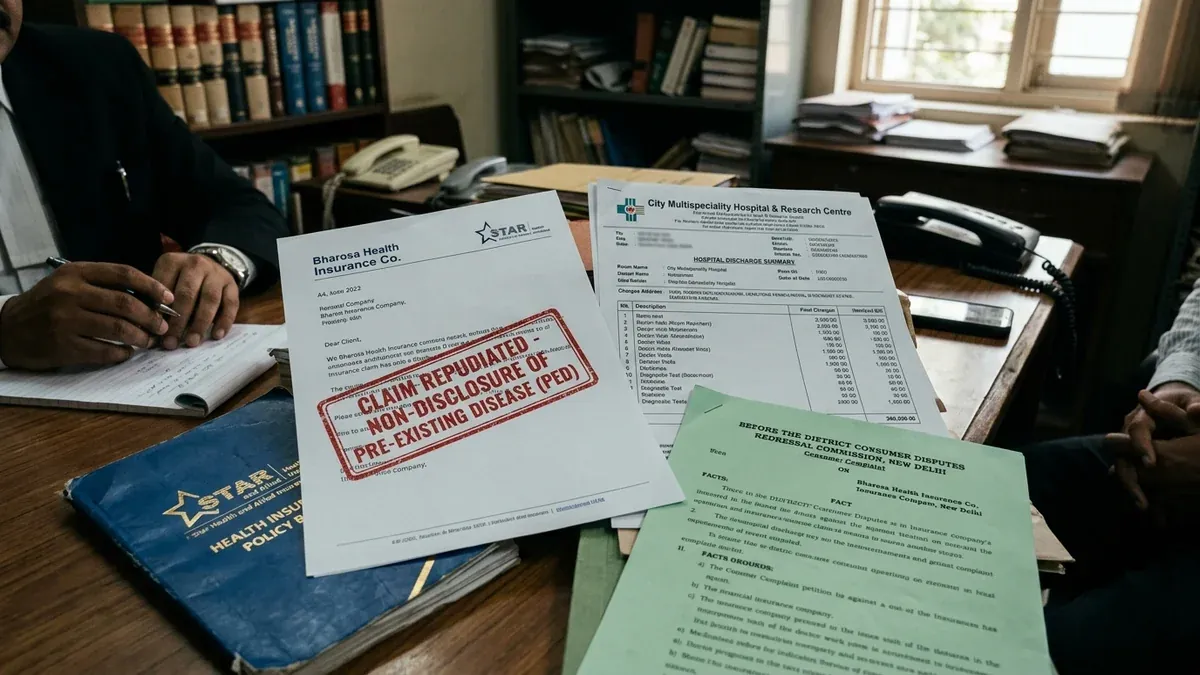
1. Statutory Definition of Pre-Existing Disease (PED) & IRDAI 2024 Reforms
Health insurance claim repudiation under the guise of "pre-existing disease non-disclosure" is the single largest category of consumer grievances in the Indian financial sector. Insurance companies and Third Party Administrators (TPAs) frequently search through historical hospital admission notes to uncover minor symptoms, such as elevated blood pressure, casual smoker history, or episodic back pain, using them as arbitrary grounds to reject life-saving medical reimbursements.
To curb this systematic abuse, the Insurance Regulatory and Development Authority of India (IRDAI) introduced strict standardized definitions under the IRDAI (Insurance Products) Regulations, 2024. Under statutory guidelines, a Pre-Existing Disease is defined strictly as:
Standardized PED Definition (IRDAI):
"Any condition, ailment, injury or disease that is diagnosed by a physician within 36 months (reduced from 48 months) prior to the effective date of the policy issued by the insurer; or for which medical advice or treatment was recommended by, or received from, a physician within 36 months prior to the effective date of the policy."
Consequently, routine lifestyle fluctuations, temporary fevers, or conditions diagnosed outside the 36-month look-back window cannot legally be categorized as pre-existing diseases.
2. The 60-Month Moratorium Rule & Section 45 Non-Challengeability
The 2024 IRDAI Master Circular introduced a major pro-consumer reform by shrinking the policy moratorium period:
| Legal Parameter | Prior Statutory Regime | Current IRDAI 2024 Regime | Practical Legal Consequence |
|---|---|---|---|
| PED Look-back Window | 48 Months prior to inception | 36 Months prior to inception | Insurers cannot investigate medical history beyond 3 years prior to policy commencement. |
| Moratorium Period | 8 continuous years (96 months) | 5 continuous years (60 months) | After 5 years of renewals, claim denial on grounds of non-disclosure is barred by law. |
| Maximum Waiting Period | Up to 4 years for named ailments | Maximum 3 years (36 months) | Waiting periods for hypertension, diabetes, and joint replacements capped at 3 years. |
| Section 45 Insurance Act | 3-Year absolute non-challengeability | 3-Year absolute non-challengeability | Burden of proving deliberate fraudulent intent rests strictly upon the insurer. |
Section 45 of the Insurance Act, 1938 acts as a shield for policyholders. Once three continuous policy years have elapsed, an insurance company cannot question the policy on grounds of innocent misstatement, inadvertent omission, or bona fide non-disclosure. To successfully repudiate under Section 45, the insurer must satisfy three cumulative legal tests: (1) the statement was on a material fact; (2) it was suppressed fraudulently; and (3) the policyholder knew at the time of making it that the statement was false.
3. The Causal Nexus Doctrine & Landmark Judicial Precedents
The Supreme Court of India has established the "Causal Nexus Doctrine", holding that an insurer cannot repudiate a claim based on an undisclosed ailment unless that undisclosed condition directly caused or medically accelerated the hospitalization event.
Sulbha Prakash Motegaonkar v. Life Insurance Corporation of India (Civil Appeal No. 224 of 2015)
The insured had suffered from lumbar spondylitis prior to taking the policy, which was not disclosed in the proposal form. The insured subsequently died of acute myocardial infarction. The Supreme Court held that lumbar spondylitis had no connection with death due to cardiac failure. The repudiation was set aside, and the Court laid down that non-disclosure of an ailment having no nexus with the cause of death or hospitalization cannot entitle the insurer to repudiate coverage.
Manmohan Nanda v. United India Insurance Co. Ltd. (2022) 4 SCC 582
In this landmark medical insurance ruling, the Supreme Court held that the duty of disclosure is governed by the principle of uberrimae fidei (utmost good faith). However, the Court clarified that an insured is only required to disclose material facts that a reasonable person would consider relevant. The Court ruled that once an insurer accepts a proposal without seeking diagnostic tests or medical board clearance, it cannot subsequently repudiate claims for known common conditions like hyperlipidemia or controlled diabetes when acute medical events occur.
Dharmendra Goel v. Oriental Insurance Co. Ltd. (2008) 8 SCC 279
The Supreme Court reprimanded insurance companies for adopting hyper-technical, mechanical, and predatory claim denial practices, emphasizing that consumer courts must adopt a purposive and benevolent interpretation of insurance contracts in favor of policyholders.
4. TPA Overreach vs Insurer Repudiation Authority
A frequent illegality committed in the Indian insurance ecosystem is the issuance of repudiation letters directly by Third Party Administrators (TPAs). Under the IRDAI (Third Party Administrators - Health Services) Regulations, 2016, TPAs are merely administrative service providers authorized to facilitate cashless hospital admissions, collect claims, and verify medical records.
Judicial Rule on TPA Authority:
The National Consumer Disputes Redressal Commission (NCDRC) has repeatedly ruled that a TPA has no legal authority to reject or repudiate an insurance claim. Any formal rejection letter issued solely under the letterhead of a TPA without the explicit, documented concurrence of the insurance company's authorized claims committee is void ab initio and constitutes an immediate deficiency in service.
5. Two-Tier Dispute Redressal: Insurance Ombudsman vs Consumer Commission
Policyholders faced with wrongful claim denials have two powerful statutory forums to secure reimbursement, interest, and damages:
Forum 1: The Insurance Ombudsman (Rule 13, Insurance Ombudsman Rules 2017)
- Cost: 100% Free of cost. No advocate required; no court fees payable.
- Jurisdiction: Handles disputes up to ₹50,00,000 (pecuniary limit).
- Timeline: Statutory disposal expected within 3 months of filing.
- Binding Nature: The Ombudsman award is legally binding on the insurance company (the insurer must implement it within 30 days or pay statutory penal interest). Crucially, the award is not binding on the consumer—if dissatisfied, the consumer remains free to file before Consumer Commissions.
Forum 2: Consumer Disputes Redressal Commission (Consumer Protection Act 2019)
- Pecuniary Limit: District Commission (up to ₹50 Lakhs); State Commission (₹50 Lakhs to ₹2 Crores); NCDRC (above ₹2 Crores).
- Territorial Comfort: Section 34 permits filing where the complainant resides or works, bypassing corporate jurisdictional clauses.
- Remedies: Full claim reimbursement, plus 9% - 12% annual interest from date of repudiation, heavy punitive damages for mental agony, and comprehensive litigation costs.
6. Step-by-Step Strategic Roadmap for Reversing Claim Denials
When an insurer serves a repudiation notice, executing the following tactical roadmap maximizes recovery prospects:
- Step 1: Obtain Complete Claim File & TPA Notes (Days 1 - 5): Request the insurer and hospital billing desk to provide the complete indoor case paper (ICP), discharge summary, doctor's initial admission notes, and the TPA internal scrutiny sheet.
- Step 2: Procure Treating Doctor's Nexus Certificate (Days 6 - 12): Request the hospital treating specialist / physician to issue an authenticated certificate clarifying that the hospitalization ailment was acute in onset and entirely independent of any historical health markers.
- Step 3: Formal Grievance Representation to GRO (Days 13 - 20): Draft a comprehensive representation to the Insurer's Grievance Redressal Officer (GRO) citing the IRDAI 2024 Moratorium rules, Section 45 Insurance Act, and the Sulbha Prakash precedent.
- Step 4: Escalate to IRDAI Bima Bharosa Portal (Day 25): If no positive reply is received within 14 days, register an online complaint on the IRDAI Bima Bharosa grievance portal (complaints.irdai.gov.in).
- Step 5: File Complaint Before Insurance Ombudsman (Day 31 - 45): If the GRO rejects the representation or fails to resolve it within 30 days, submit Form VI-A before the regional Insurance Ombudsman along with postal proofs and medical records.
- Step 6: Consumer Commission Filing (Post-Ombudsman or Parallel): For large claims exceeding ₹50 Lakhs or where bad-faith damages are sought, institute a formal consumer complaint through e-Daakhil before the District Commission.
7. Specimen Legal Representation to Insurer Grievance Redressal Officer
Below is an authoritative representation template for reversing wrongful repudiations:
FORMAL LEGAL REPRESENTATION AGAINST WRONGFUL CLAIM REPUDIATION
UNDER IRDAI REGULATIONS 2024 & SECTION 45 INSURANCE ACT, 1938
To:
The Chief Grievance Redressal Officer (GRO),
[Insurance Company Name], [Claims Department Address]
Policy No: [XXXXXXXXXXXX] | Claim No: [XXXXXXXXXXXX]
Insured Patient: [Patient Name] | Hospital: [Hospital Name]
Sub: Representation against wrongful repudiation letter dated [DD/MM/YYYY] for Claim No. [XXXXX] regarding hospitalization expenses of ₹[Amount].
Dear Sir / Madam,
1. The undersigned policyholder holds Health Insurance Policy No. [XXXXX], continuously renewed without any break in cover since [Inception Date: DD/MM/YYYY] (over [X] continuous years).
2. The insured was hospitalized on [Date] for emergency treatment of [Name of Ailment], incurring admissible medical expenses of ₹[Amount]. Vide letter dated [Date], your office arbitrarily repudiated the claim citing Clause [X] (Pre-Existing Disease Non-Disclosure of Hypertension/Diabetes).
3. Arbitrary Denial Without Causal Nexus: As confirmed by the attached medical certificate of Dr. [Name], Treating Specialist, the hospitalization condition was an acute event having zero causal or medical nexus with the alleged historical condition. In Sulbha Prakash Motegaonkar v. LIC, the Supreme Court held that non-disclosure of an unrelated condition cannot justify claim repudiation.
4. Protection Under 60-Month Moratorium & Section 45: The subject policy has been maintained for more than [3 / 5] continuous years. Under the IRDAI 2024 Regulations and Section 45 of the Insurance Act 1938, your company is statutorily barred from challenging the validity of cover or denying claims on grounds of non-disclosure.
5. Requisition: You are hereby called upon to recall the illegal repudiation letter dated [Date] and disburse the admitted claim amount of ₹[Amount] along with statutory interest within 15 days of receipt of this notice, failing which the undersigned shall escalate the dispute before the Insurance Ombudsman and the Consumer Disputes Redressal Commission for claim recovery, 12% interest, and ₹5,00,000 damages for deficiency in service and mental harassment.
Yours faithfully,
[Policyholder Name & Signature]
Address & Mobile No: [Contact Details]
8. Comparative Forum Matrix: Ombudsman vs Consumer Court vs Civil Court
| Comparison Factor | Insurance Ombudsman | Consumer Commission (CPA 2019) | Civil Court (CPC 1908) |
|---|---|---|---|
| Court Fees / Costs | ₹0 (Completely Free) | Nominal (₹100 to ₹5,000 via e-Daakhil) | Substantial ad-valorem court fees (up to 5-8% of claim) |
| Pecuniary Ceiling | Up to ₹50 Lakhs | No ceiling (District: 50L; State: 2Cr; NCDRC: 2Cr+) | Unlimited pecuniary jurisdiction |
| Disposal Timeline | 2 to 4 Months | 8 to 18 Months | 3 to 7 Years |
| Advocate Required? | No (Complainant appears directly) | Optional (Party-in-person or Advocate) | Mandatory for effective trial conduct |
| Enforceability | Binding on Insurer within 30 days | Enforceable as civil court decree / Section 71 recovery | Execution under Order XXI CPC |
Frequently Asked Questions on Health Insurance Claim Rejections & Pre-Existing Diseases
Comprehensive legal analysis of IRDAI moratorium rules, causal nexus doctrine, and Ombudsman dispute procedures.
What is the new IRDAI moratorium period rule regarding pre-existing diseases (PED)?
Under the landmark IRDAI (Insurance Products) Regulations, 2024, the moratorium period for health insurance policies has been reduced from 8 years (96 months) to 5 years (60 continuous months). Once a health insurance policy has been continuously renewed for 60 months without a break, the insurer cannot reject any claim or cancel the policy on grounds of non-disclosure or misrepresentation of pre-existing diseases, except in proven cases of established deliberate fraud.
Can an insurance company reject a claim if the illness is unrelated to the undisclosed condition?
No. The Supreme Court in Sulbha Prakash Motegaonkar v. LIC held that non-disclosure of a pre-existing condition that has no direct causal connection with the actual ailment or cause of hospitalization cannot justify claim repudiation. For example, non-disclosure of mild lumbar backache cannot be used to repudiate a hospitalization claim arising from acute appendicitis or coronary heart disease.
What does Section 45 of the Insurance Act 1938 say about challenging insurance policies?
Section 45 of the Insurance Act, 1938 establishes the 'Three-Year Non-Challengeability Rule'. No policy of insurance can be called in question by an insurer on any ground whatsoever (including misstatement or non-disclosure of material facts) after the expiry of three continuous years from the date of policy issuance, commencement of risk, or reinstatement, unless the insurer proves that the misstatement was fraudulent, material, and deliberately concealed with knowledge of its falsity.
What is the procedure for filing a complaint before the Insurance Ombudsman?
Under Rule 13 and Rule 14 of the Insurance Ombudsman Rules, 2017: (1) You must first submit a written representation to the insurer's Grievance Redressal Officer (GRO); (2) If the insurer rejects the representation or fails to respond within 30 days, you can file a complaint before the jurisdictional Insurance Ombudsman within 1 year; (3) The Ombudsman proceedings are completely free of court fees; (4) The Ombudsman can award compensation up to ₹50,00,000; (5) The Ombudsman's award is binding on the insurance company, but the policyholder retains the right to reject it and approach Consumer Commissions if dissatisfied.
What are the territorial and pecuniary jurisdictions of Consumer Commissions under CPA 2019?
Under the Consumer Protection Act, 2019: District Commission handles claims up to ₹50 Lakhs (Section 34); State Commission handles claims between ₹50 Lakhs and ₹2 Crores (Section 47); National Commission (NCDRC) handles claims exceeding ₹2 Crores (Section 58). Complaints can be filed where the consumer resides or works, making it highly accessible compared to prior law.
What documents are essential when contesting a health insurance repudiation letter?
Essential documents include: (1) Original Policy Schedule with terms, conditions, and proposal form; (2) Hospital admission notes, discharge summary, and treating doctor's detailed certificate confirming the acute onset of the condition; (3) Itemized hospital bills, pharmacy receipts, and diagnostic reports; (4) Repudiation letter issued by the TPA or Insurer stating the exact denial clause; (5) Written representation to the insurer's GRO with postal proof; and (6) Independent medical opinion demonstrating absence of prior nexus.
Can a consumer claim compensation for mental agony and medical loan interest against insurers?
Yes. Consumer Commissions and the Supreme Court routinely award the full reimbursed medical sum along with 9% to 12% annual interest from the date of repudiation, plus substantial damages (ranging from ₹50,000 to ₹5,00,000) for mental harassment, agony, and litigation costs caused by arbitrary or mala fide claim denials.
What is the legal difference between an Insurance TPA and an Insurance Company?
A Third Party Administrator (TPA) is merely a licensed service intermediary appointed to process hospital cashless desk claims and documentation. As held by the Supreme Court, a TPA has no statutory authority to issue a formal repudiation of an insurance claim; only the insurance company itself, through its authorized officers, can legally repudiate or deny coverage.