Electronic Evidence Certificate under Section 63 Bharatiya Sakshya Adhiniyam 2023: Mandatory Format & Rules
 Authored by: Advocate Kishan Kumar (Advocate & Legal Consultant)
Quick Summary & Strategic Key Takeaways
- Statutory Successor to Section 65B IEA: Section 63 of the Bharatiya Sakshya Adhiniyam, 2023 governs the admissibility of all electronic evidence, establishing that secondary electronic data is inadmissible without a statutory certificate.
- The Arjun Khotkar Three-Judge Bench Rule: Producing a certificate is an absolute condition precedent for secondary electronic media (CDs, pen drives, printouts); primary devices brought physically to court require no certificate.
- New Statutory Schedule Format (Part A & Part B): The BSA 2023 codifies a mandatory two-part certificate format in its Schedule: Part A for device custodians and Part B for IT/forensic experts, integrating cryptographic hash values.
- Judicial Power to Summon Custodians: Litigants unable to procure certificates from telecom service providers or hostile third parties can invoke Section 94 BNSS to compel certificate production by court summons.
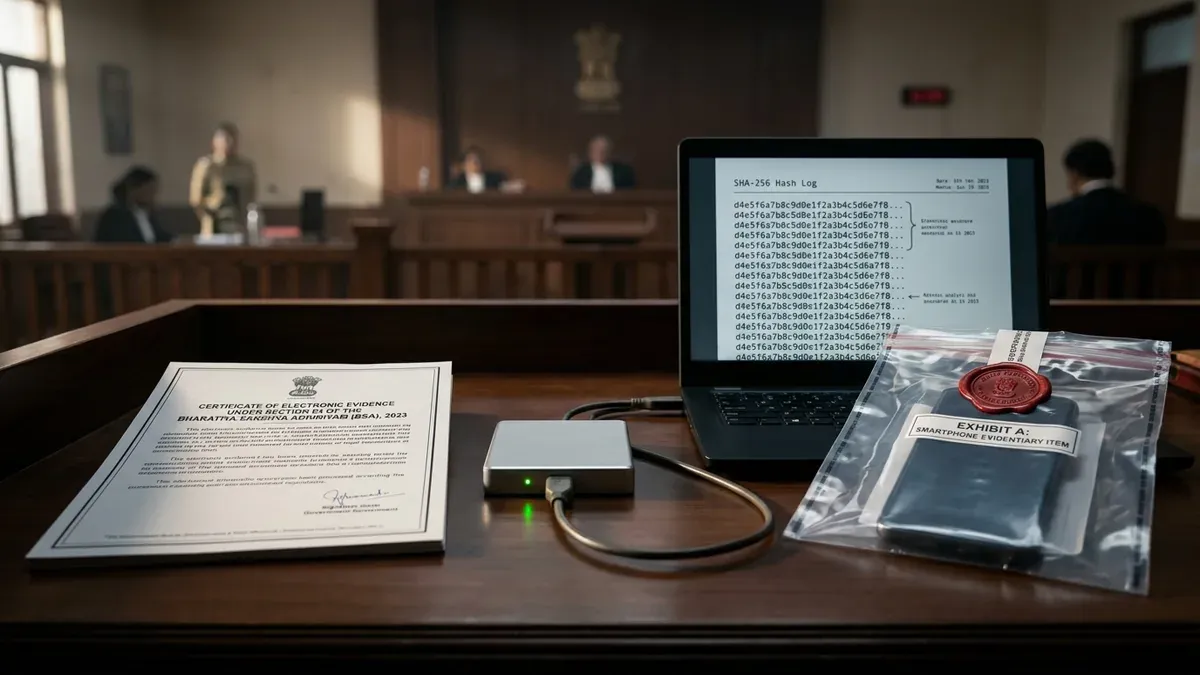
1. Statutory Transition: From Section 65B Evidence Act to Section 63 BSA 2023
The dawn of the digital age transformed how legal transactions, commercial contracts, and criminal conspiracies occur. Modern court disputes routinely depend upon computer printouts, WhatsApp chat backups, email threads, CCTV video footage, server logs, and GPS geolocation coordinates. To address the fragile and easily manipulable nature of digital data, Parliament enacted a specialized statutory gateway.
Section 63 of the Bharatiya Sakshya Adhiniyam, 2023 (BSA) statutorily replaces Section 65B of the repealed Indian Evidence Act, 1872. Section 63 establishes that any information contained in an electronic record which is printed on a paper, stored, recorded, or copied in optical, magnetic, or electronic media produced by a computer shall be deemed to be also a document, and shall be admissible in any proceedings, without further proof or production of the original, provided the statutory conditions are fulfilled.
2. The Arjun Panditrao Khotkar Landmark Jurisprudential Principles
For nearly two decades, conflicting Supreme Court judgments created confusion regarding whether electronic certificates were mandatory or merely directory (such as the conflicting lines in State (NCT of Delhi) v. Navjot Sandhu (2005), Anvar P.V. v. P.K. Basheer (2014), and Shafhi Mohammad v. State of H.P. (2018)).
This conflict was authoritatively resolved by a three-judge bench of the Supreme Court in Arjun Panditrao Khotkar v. Kailash Kushanrao Gorantyal (2020) 7 SCC 1. The Court laid down four immutable principles now embedded in Section 63 BSA:
Arjun Khotkar Landmark Principles:
1. Certificate is Mandatory: Producing a certificate under Section 65B(4) (now Section 63(4) BSA) is a condition precedent to the admissibility of evidence by way of a secondary electronic record.
2. Original Device Requires No Certificate: If the primary electronic record itself (e.g., the actual smartphone, laptop, or DVR hard drive) is brought to court and produced in the witness box, no statutory certificate is required under Section 62 BSA.
3. Court Discretion for Delayed Production: In criminal trials, while the prosecution must produce the certificate along with the chargesheet, the trial court possesses discretion to permit delayed production at any stage before the close of trial if no prejudice is caused to the accused.
4. Summoning Reluctant Custodians: If a third party (such as a telecom provider or hostile corporate entity) refuses to furnish a certificate, the party can apply under Section 91 CrPC (now Section 94 BNSS) to summon the custodian along with the certificate.
3. Primary vs Secondary Electronic Records: When is the Certificate Mandatory?
Understanding the distinction between primary electronic evidence under Section 62 BSA and secondary electronic evidence under Section 63 BSA is crucial for trial advocates:
| Evidentiary Category | Physical Manifestation in Court | Statutory Section | Certificate Requirement |
|---|---|---|---|
| Primary Electronic Evidence | The actual device on which data was originally created or stored (e.g., the mobile phone of the victim, the original DVR machine). | Section 62 BSA | No Certificate Required: Proved directly by calling the witness who operated the device. |
| Secondary Electronic Evidence (Physical Printout) | Paper printouts of emails, ledger sheets, WhatsApp chat transcripts, or bank account statements. | Section 63 BSA | Mandatory Section 63 Certificate: Inadmissible without contemporaneous certificate. |
| Secondary Electronic Evidence (Digital Extraction) | Audio/video files or CCTV footage copied onto a CD-ROM, DVD, USB Flash Drive, or external hard drive. | Section 63 BSA | Mandatory Section 63 Certificate: Inadmissible without Part A and Part B certificate. |
| Cloud / Server Stored Records | Data retrieved from remote AWS/Azure cloud servers, telecom call detail records (CDR), or email servers. | Section 63 BSA | Mandatory Section 63 Certificate: Must be signed by Nodal Officer or System Administrator. |
4. Deconstructing the Four Invariable Conditions under Section 63(2)
To render secondary electronic records admissible, Section 63(2) of the BSA prescribes four mandatory conditions that must be established:
- Regular Output: The computer output was produced by the computer during the period over which the computer was used regularly to store or process information for the purposes of any activities regularly carried on.
- Lawful Control & Regular Feed: During the said period, information of the kind contained in the electronic record was regularly fed into the computer in the ordinary course of the said activities.
- Proper Operational Functioning: Throughout the material part of the said period, the computer was operating properly or, if not, that any respect in which it was not operating properly or was out of operation was not such as to affect the electronic record or the accuracy of its contents.
- Accurate Reproduction: The information contained in the electronic record reproduces or is derived from such information fed into the computer in the ordinary course of the said activities.
5. Deconstructing the Statutory Schedule: Part A (Custodian) vs Part B (Expert)
A historic reform in the Bharatiya Sakshya Adhiniyam, 2023 is the inclusion of a standardized Schedule prescribing the precise statutory certificate format. Unlike old Section 65B where practitioners drafted haphazard certificates, the BSA Schedule establishes a structured two-part format:
- Part A (To be filled by the Party / Custodian): Executed by the person who owns, uses, or has lawful command and control over the device (e.g., the victim, complainant, or business manager). It identifies the device make, model, operating system, and certifies regular operational use.
- Part B (To be filled by the Forensic / System Expert): Executed by a cyber forensic expert, systems administrator, or technical officer who performed the digital extraction. Part B mandates documenting the exact extraction software used, hash value algorithms (SHA-256), and certifying bit-stream integrity.
6. Hash Algorithms (SHA-256) & ISO/IEC 27037 Digital Forensics Standards
The BSA statutory schedule formally incorporates digital forensics methodology into Indian evidence law by requiring Cryptographic Hash Values. A cryptographic hash function (such as SHA-256 or MD5) transforms an arbitrary block of digital data into a fixed 256-bit hexadecimal string.
Under international standard ISO/IEC 27037 (Guidelines for identification, collection, acquisition, and preservation of digital evidence):
- The certifying expert calculates the hash value of the original digital artifact on the source device.
- The evidence is extracted onto secondary media (such as a forensic USB drive).
- The hash value of the secondary copy is calculated.
- If both hash values match character-for-character, it scientifically guarantees that not a single byte, bit, or pixel of the electronic record was altered, deleted, or injected during extraction.
7. Trial Tactics: Raising Threshold Objections & Summoning Third-Party Custodians
In contested trials, counsel must master both defensive objections and offensive procurement tactics:
| Trial Litigation Scenario | Tactical Legal Step | Statutory Provision & Case Law |
|---|---|---|
| Opponent Tenders Printout Without Certificate | Raise immediate threshold objection at the time of marking the document as an exhibit. Insist that the objection be recorded in the deposition sheet. | Arjun Khotkar (2020); Document cannot be admitted or read in evidence. |
| Opponent Files Defective Post-Facto Certificate | Cross-examine certifying witness on technical competence: "Did you personally operate the server? What is the hash algorithm? Who had root admin access?" | Section 138 BSA; Dismantle certificate credibility and invalidate exhibit. |
| Airtel / Jio / Google Refuses Certificate to Citizen | File an application under Section 94 BNSS (old 91 CrPC) requesting the trial court to issue witness summons to the Nodal Officer with directions to produce the Section 63 certificate. | Paragraph 52 of Arjun Khotkar; Court is duty-bound to issue summons. |
8. Specimen Draft: Statutory Section 63 BSA Certificate (Full Schedule Format)
Below is the complete, standardized statutory format prescribed under the Schedule to the Bharatiya Sakshya Adhiniyam, 2023:
SCHEDULE
CERTIFICATE UNDER SECTION 63 OF THE BHARATIYA SAKSHYA ADHINIYAM, 2023
(PART A - TO BE PRODUCED BY THE PERSON IN CHARGE OF COMPUTER / DEVICE)
I, [Full Name], son/daughter/wife of [Parent's Name], aged [X] years, residing at [Address], occupying the official position of [Designation / Relation] at [Organization / Personal Capacity], do hereby solemnly affirm and state as follows:
1. I have been in lawful possession / command and control of the electronic device / computer system, namely: [Device Make, Model, IMEI / Serial Number, IP Address], running operating system [OS Version].
2. The electronic record, namely: [Description of File: e.g., WhatsApp Chat Export / CCTV Footage / Email Thread], was produced by the said computer / device during the period over which the device was regularly used to store and process information for lawful activities.
3. Throughout the material period, the device was operating properly, and there were no operational defects or system malfunctions affecting the production, contents, or reproduction of the electronic record.
4. The output produced herewith as Annexure [X] on Compact Disc / USB Flash Drive [Serial No: XXXXX] is an accurate reproduction of the original electronic record.
[Signature of Person in Charge]
Name: [Full Name] | Date: [DD/MM/YYYY] | Place: [City]
(PART B - TO BE PRODUCED BY THE SYSTEM / FORENSIC EXPERT)
I, [Expert Full Name], occupying the position of [Forensic Examiner / Systems Administrator / IT Head] at [Laboratory / Organization], do hereby certify:
1. I examined the computer system / electronic storage device described in Part A on [Date] at [Time] hours.
2. I executed the digital forensic extraction / reproduction of the questioned electronic record using validated extraction tool: [Tool Name, Version: e.g., Cellebrite UFED / EnCase / FTK Imager].
3. Cryptographic Hash Value Verification: The hash values of the extracted digital record are:
- Algorithm: SHA-256: [Insert 64-character SHA-256 Hash String]
- Algorithm: MD5: [Insert 32-character MD5 Hash String]
4. I certify that the electronic record has maintained unadulterated integrity and complies strictly with the requirements of Section 63 of the Bharatiya Sakshya Adhiniyam, 2023.
[Signature of Technical / Forensic Expert]
Name & Designation: [Details] | Date: [DD/MM/YYYY] | Official Seal: [Stamp]
9. Electronic Evidence Admissibility & Certification Comparative Matrix
| Electronic Evidence Type | Statutory Governing Rule | Certificate Mandatory? | Forensic Best Practice |
|---|---|---|---|
| WhatsApp Messages / SMS | Section 63 BSA | Yes (Part A & Part B) | Preserve device; extract chat with media; generate SHA-256 hash. |
| CCTV Footage / DVR Video | Section 63 BSA | Yes (Signed by DVR custodian & tech) | Seize original hard disk if possible; export raw AVI/MP4 without transcoding. |
| Emails & Headers | Section 63 BSA | Yes (Signed by recipient or IT admin) | Print full RFC 822 internet headers showing transmitting IP addresses. |
| Call Detail Records (CDR) | Section 63 BSA | Yes (Signed by Telecom Nodal Officer) | Procure cell tower location map and certified subscriber application form (CAF). |
| Original Laptop / Phone Produced | Section 62 BSA (Primary) | NO (No certificate required) | Produce device in court sealed in forensic anti-static Faraday bag. |
Frequently Asked Questions on Section 63 BSA 2023 Electronic Evidence Certification
Authoritative legal and forensic guide to electronic evidence admissibility, Section 63 statutory schedule format, and Arjun Khotkar jurisprudence.
What is Section 63 of the Bharatiya Sakshya Adhiniyam, 2023 (BSA)?
Section 63 of the Bharatiya Sakshya Adhiniyam, 2023 (BSA) replaces Section 65B of the Indian Evidence Act, 1872. It establishes the mandatory legal framework for the admissibility of electronic records (such as emails, WhatsApp chats, CCTV footage, server logs, hard drives, and mobile recordings) in Indian judicial proceedings. Any secondary electronic evidence is legally inadmissible unless accompanied by an authenticated certificate complying with the conditions set out in Section 63(2) and Section 63(4).
What are the structural changes between old Section 65B IEA and new Section 63 BSA?
While preserving the core operational conditions of old Section 65B(2), Section 63 of the BSA introduces three critical statutory advancements: (1) A standardized statutory certificate format codified directly in the Schedule to the BSA, divided into Part A (for the person in charge of the computer/device) and Part B (for an expert or systems administrator); (2) Explicit inclusion of modern digital forms like semiconductor memory, optical media, cloud storage, and communications devices; and (3) Alignment with modern digital forensics practices requiring cryptographic hash value documentation.
Who is legally authorized to sign a Section 63 BSA Certificate?
Under Section 63(4) of the BSA, the certificate must be signed by a person occupying a responsible official position in relation to the operation of the relevant device or the management of the relevant activities (such as the device owner, systems administrator, or nodal telecom officer), OR by a person who is an expert in the field of digital forensics or information technology. In corporate disputes, the IT Head or Information Security Officer typically executes the certificate.
Is a Section 63 Certificate required when the primary device (original phone/laptop) is produced?
No. The three-judge bench of the Supreme Court in Arjun Panditrao Khotkar v. Kailash Kushanrao Gorantyal (2020) 7 SCC 1 settled that if the original electronic device itself (e.g., the actual smartphone containing the WhatsApp chats or the actual DVR unit of the CCTV) is brought to court and produced in the witness box as primary evidence under Section 62 BSA, no Section 63 certificate is required. The certificate is mandatory only when secondary copies (printouts, USB drives, CDs, external hard drives) are tendered in evidence.
At what stage of trial must the Section 63 Certificate be produced?
Under the Arjun Khotkar ruling, in criminal cases, the prosecution must produce the Section 63 certificate along with the chargesheet under Section 193 BNSS (old Section 173 CrPC). However, if the certificate is inadvertently omitted, the trial court possesses discretion to permit the prosecution to produce the certificate at any stage prior to the conclusion of the trial, provided no prejudice is caused to the accused. In civil suits, it must be produced along with the list of documents under Order VII Rule 14 CPC.
Can a party be compelled to produce a Section 63 Certificate under court summons?
Yes. In Arjun Khotkar, the Supreme Court recognized that private litigants often cannot procure certificates from reluctant third parties (such as telecom companies, Google, or hostile employers). The Court held that an applicant can move an application under Section 94 BNSS (old Section 91 CrPC) or Order XVI CPC requesting the court to issue a witness summons directing the custodian of the electronic server or device to produce the requisite Section 63 certificate.
What is the consequence if electronic evidence is marked as an exhibit without a Section 63 Certificate?
In Anvar P.V. v. P.K. Basheer (2014) 10 SCC 473 and Arjun Khotkar (2020), the Supreme Court ruled that an electronic record cannot be looked into by a court if it lacks a valid statutory certificate. Mere marking of an electronic document as an exhibit by the trial court does not dispense with the mandatory statutory requirement of Section 63. Any conviction or decree based on uncertified secondary electronic evidence is liable to be set aside on appeal as an illegality.
What is the legal significance of Cryptographic Hash Values in the Schedule to BSA 2023?
Under the statutory Schedule to the BSA, the certificate requires documenting the cryptographic hash value (e.g., SHA-256 or MD5) of the electronic record. The hash value acts as an unalterable digital seal. If the secondary copy produced in court yields the exact same hash value as the source file on the server, it scientifically proves that the digital evidence has suffered zero tampering, bit rot, or manual alteration throughout the chain of custody.