Director DIN Disqualification: How to Reactivate Your DIN via High Court Article 226 Writs in India
 Authored by: Advocate Kishan Kumar (Advocate & Legal Consultant)
Quick Summary & Strategic Key Takeaways
- Statutory Disqualification Trigger: Section 164(2)(a) of the Companies Act, 2013 mandates a 5-year disqualification for directors of companies that fail to file financial statements or annual returns for three consecutive financial years.
- High Court Constitutional Remedy: Because the NCLT lacks jurisdiction to issue prerogative writs against MCA administrative actions, filing an Article 226 Writ Petition before the High Court is the sole established judicial mechanism to quash disqualification lists and reactivate deactivated DINs.
- Landmark Mukut Pathak Doctrine: The Delhi High Court and Madras High Court have established that the MCA has no statutory power under Rule 11 to automatically deactivate DINs without notice, and that disqualification in a defaulting entity does not vacate directorship in active, solvent companies under the amended Section 167(1)(a).
- Fast-Track Interim Relief: High Courts routinely grant urgent interim orders directing temporary de-tagging of DIN and reactivation of Digital Signature Certificates (DSC) to permit statutory filings and protect active commercial operations.
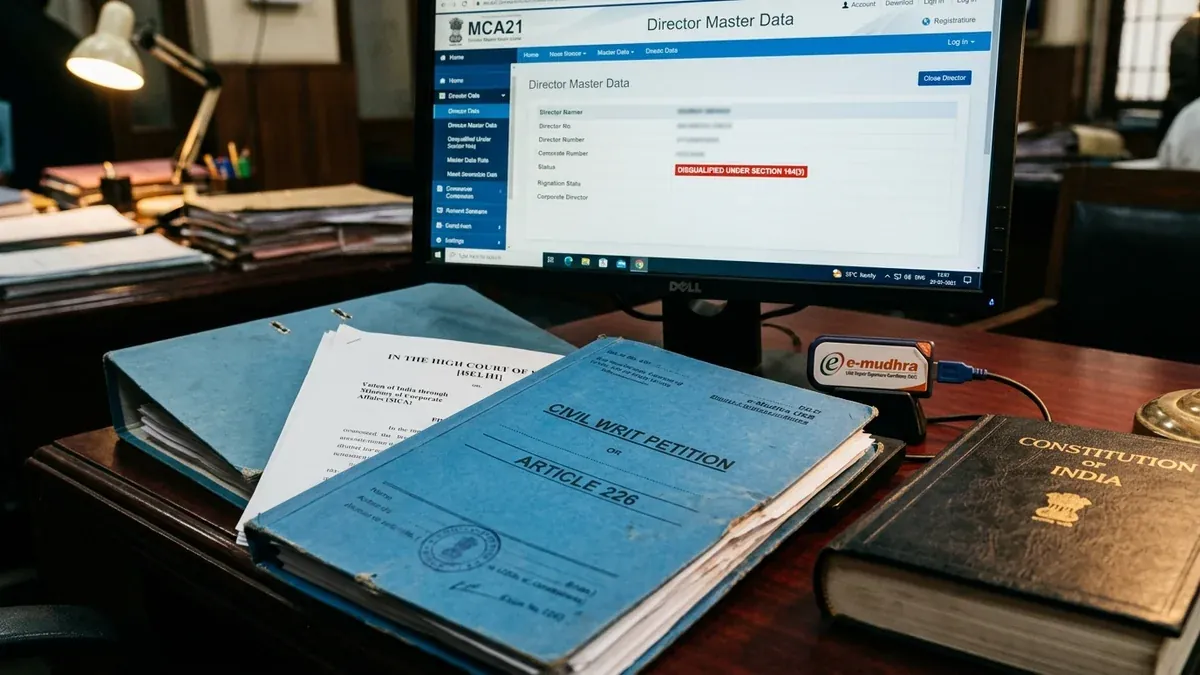
1. Statutory Trigger: Section 164(2) Companies Act 2013
Director Identification Number (DIN) disqualification represents one of the most disruptive regulatory enforcement measures in Indian corporate governance. Codified under Section 164(2) of the Companies Act, 2013, the provision was enacted to weed out 'shell companies', eradicate dummy directorships, and enforce statutory filing discipline across India's corporate registry.
Under Section 164(2), no person who is or has been a director of a company shall be eligible to be re-appointed as a director of that company or appointed in other companies for a period of five years from the date on which the company fails to:
- Section 164(2)(a): File financial statements (Form AOC-4) or annual returns (Form MGT-7) for any continuous period of three financial years; OR
- Section 164(2)(b): Repay deposits accepted by it or pay interest thereon, or redeem debentures on the due date, or pay any dividend declared, and such failure continues for one year or more.
When Section 164(2) is triggered, it operates automatically by statutory operation. However, the operational crisis arises from the aggressive enforcement mechanisms adopted by the Ministry of Corporate Affairs (MCA). Between 2017 and 2024, the Registrar of Companies (RoC) published sweeping lists of disqualified directors on the MCA portal and simultaneously marked their DINs as 'Deactivated due to Section 164(2)'. This arbitrary, automated administrative deactivation immediately paralyzed directors from signing statutory returns for other completely unrelated, solvent, and actively trading businesses.
2. Cascading Impact of DIN Deactivation on Active Businesses
The deactivation of a DIN is not merely a personal impediment; it produces an immediate existential threat to every corporate enterprise with which the director is associated:
- Freezing of Digital Signature Certificates (DSC): The MCA-21 portal mechanically locks the director's DSC, making it impossible to digitally upload mandatory secretarial filings, annual returns, balance sheets, or board change forms.
- Bank Account Freezes & Loan Recalls: Commercial banks and lending institutions conducting annual KYC audits flag the deactivated DIN. This routinely results in the freezing of corporate operating bank accounts, refusal to renew working capital credit lines, and immediate technical default notices under loan agreements.
- Disqualification from Government Tenders: Active companies are disqualified from bidding for municipal, state, and central government tenders under General Financial Rules (GFR) requiring clean director certifications.
- Statutory Defaults in Active Companies: Because the disqualified director cannot sign returns or resign, the active company itself defaults on MCA filing timelines, exposing other innocent co-directors to statutory fines under Section 450 and compounding liabilities under Section 441.
3. Landmark High Court Rulings: Mukut Pathak & Muralidharan Doctrines
Confronted with widespread administrative overreach, thousands of aggrieved directors approached Constitutional High Courts across India under Article 226. A formidable body of pro-director jurisprudence emerged that remains the governing law today:
A Division Bench of the Delhi High Court delivered a landmark judgment invalidating the retroactive application of Section 164(2). The Court held that:
- No Retrospective Effect: Section 164(2) came into force on 1st April 2014 and cannot be applied retrospectively to include defaults committed during financial years prior to 2014–2015.
- Rule 11 Ultra Vires: Rule 11 of the Companies (Appointment and Qualification of Directors) Rules, 2014 does not empower the MCA to deactivate a DIN for non-filing of returns. DIN deactivation without a specific statutory empowering clause in the primary Act is ultra vires.
- Section 167(1)(a) Amendment: A director vacates office only in the defaulting company and continues to lawfully hold directorships in active, compliant companies.
The Madras High Court struck down disqualification notifications published without prior individual notice, ruling that the fundamental principles of audi alteram partem (natural justice) cannot be discarded under the guise of automated corporate enforcement. Publication of names on a public portal without an individualized opportunity to show cause infringes Article 14 of the Constitution.
The Gujarat High Court reaffirmed that a DIN is a permanent identifier issued to an individual under Section 154, analogous to a PAN card. It cannot be extinguished or deactivated by an administrative fiat, as doing so destroys the individual's constitutional right to carry on trade and profession under Article 19(1)(g).
4. Step-by-Step Procedure to File Article 226 Writ Petition
Navigating a DIN reactivation writ before the High Court involves a precise procedural roadmap:
- Step 1 — Corporate Compliance Audit: Compile certified master data of both the defaulting company and all active companies. Distinguish between dormant companies struck off under Section 248 and active commercial entities requiring immediate filing relief.
- Step 2 — Drafting the Writ Petition: Draft the Writ Petition under Article 226 of the Constitution of India citing the Mukut Pathak doctrine. The primary prayers must include:
- Writ of Certiorari to quash the impugned disqualification list published by the RoC;
- Writ of Mandamus directing the Union of India / MCA to de-tag and reactivate the petitioner's DIN and DSC on the MCA-21 portal;
- Urgent Interim Relief permitting the petitioner to digitally sign and upload overdue financial statements for active companies without penalty.
- Step 3 — Filing & Advance Service: File the writ petition in the High Court having territorial jurisdiction over the registered office of the company or the petitioner's residence. Serve advance copies on the Central Government Standing Counsel (CGSC).
- Step 4 — Urgent Motion Hearing & Interim Order: Argue the admission motion before the Roster Bench. High Courts routinely grant immediate interim directions directing the MCA to reactivate the DIN within 7 to 10 days, subject to the final outcome of the petition.
- Step 5 — Serving Court Order on RoC: Submit a certified copy of the High Court order to the concerned Registrar of Companies along with a formal advocate covering letter, tracking compliance until the DIN status transitions from 'Deactivated' to 'Active'.
5. Substantive Constitutional Grounds of Challenge under Article 14 & 19(1)(g)
A watertight Article 226 writ petition must be anchored on four unimpeachable constitutional grounds:
- Violation of Natural Justice (Article 14): The RoC's administrative action in deactivating the DIN without issuing an antecedent show-cause notice under Section 424 of the Act violates procedural fairness and equal protection of laws.
- Infringement of Article 19(1)(g): Indiscriminate deactivation deprives the director of their fundamental right to practice their commercial profession and manage lawful enterprises entirely unassociated with the defaulting entity.
- Doctrine of Proportionality: The extreme sanction of deactivating a personal identifier (DIN) across all corporate entities is disproportionate to the statutory default of secretarial non-filing in a single dormant company.
- Amended Section 167(1)(a) Protection: Parliament's explicit amendment via the Companies (Amendment) Act, 2018 manifests the legislative intent that vacation of office must be restricted to the defaulting company, preventing collateral harm to innocent third-party companies and employees.
6. Clearing Corporate Defaults: Condonation of Delay & Section 248 Strike-Off
Reactivating the DIN via High Court writ is the first critical phase. Once the DIN is activated, the director must implement a permanent compliance strategy to eliminate future statutory risk:
- Option A — Fast-Track Strike-Off under Section 248(2): If the defaulting company has ceased commercial operations for at least 2 years and has no liabilities, file Form STK-2 to formally strike off the corporate shell, establishing an unencumbered regulatory exit.
- Option B — Filing Overdue Returns with Additional Fees: If the company intends to resume business, prepare and upload all overdue balance sheets (AOC-4) and annual returns (MGT-7) with statutory late filing fees under Section 403.
- Option C — Compounding under Section 441: Where defaults span several years, file an application in e-Form GNL-1 for compounding of the offence before the Regional Director (RD) or NCLT to achieve full immunity from criminal prosecution.
7. Comparative Assessment: High Court Writ vs. NCLT Restoration
| Evaluation Metric | High Court Writ Petition (Article 226) | NCLT Company Restoration (Section 252) |
|---|---|---|
| Primary Objective | Quash director disqualification & reactivate personal DIN | Revive a struck-off company name on the register |
| Constitutional Basis | Article 226 (Prerogative Writs of Certiorari & Mandamus) | Statutory petition under Section 252(3) Companies Act |
| Interim Relief Timeline | Fast-track: 7 to 15 days for interim DIN activation | Requires 3 to 6 months for RoC report & hearing |
| Impact on Other Companies | Immediately liberates all active companies | Limited solely to the specific revived company |
| Jurisdictional Competence | Exclusive High Court constitutional jurisdiction | NCLT National Company Law Tribunal bench |
8. Actionable Checklist for Disqualified Directors in Delhi NCR & Haryana
Practical DIN Reactivation Action Plan
- Download Certified MCA Disqualification Notification: Secure official portal screenshots and RoC notifications establishing the exact date and grounds of disqualification.
- Audit All Associated Directorships: Segregate active, functioning companies from defunct or struck-off companies to demonstrate prejudice to ongoing commercial trade.
- Engage High Court Writ Counsel: Draft and file the Article 226 petition promptly, citing Mukut Pathak and Muralidharan precedents before the High Court of Delhi or Punjab & Haryana.
- Secure Interim De-Tagging Order: Move an urgent application for interim DIN reactivation to enable the signing of pending tax returns, annual filings, and banking mandates.
- Serve Order with Speed Post & E-Mail: Serve certified orders directly on the Secretary (MCA) and concerned RoC, requesting compliance within the court-mandated deadline.
- Regularize or Strike Off the Defaulting Company: Within 60 days of DIN restoration, either file overdue returns or file Form STK-2 to formally eliminate future statutory disqualification exposure.
Frequently Asked Questions on DIN Disqualification & Reactivation
Key statutory answers and procedural guidance curated by High Court Writ Advocates in Delhi NCR.
Can the Ministry of Corporate Affairs (MCA) deactivate a director's DIN without prior notice under Indian law?
No. The Supreme Court and various High Courts, including the Delhi High Court in Mukut Pathak v. Union of India and Madras High Court in M.K. Muralidharan v. Union of India, have unequivocally ruled that the MCA has no statutory authority under Rule 11 of the Companies (Appointment and Qualification of Directors) Rules, 2014 to automatically deactivate a Director Identification Number (DIN) without issuing a prior show-cause notice and complying with the principles of natural justice. Deactivation without due process is ultra vires and unconstitutional.
What is the consequence of Section 164(2) disqualification on other active, compliant companies where I am a director?
Following the Companies (Amendment) Act, 2018, a crucial proviso was inserted into Section 167(1)(a) of the Companies Act, 2013. Under this settled doctrine, if a director is disqualified due to non-filing of returns in a defaulting company, they vacate office only in that defaulting company. They do NOT vacate office in other active, solvent, and compliant companies where they serve as a director, ensuring that operational businesses are not paralyzed by defaults in dormant entities.
How do I reactivate a deactivated DIN through the High Court?
The primary legal remedy is filing a Writ Petition under Article 226 of the Constitution of India before the jurisdictional High Court (such as Delhi High Court or Punjab & Haryana High Court). The petition seeks a Writ of Certiorari to quash the RoC disqualification notification and a Writ of Mandamus directing the MCA to de-tag and reactivate the petitioner's DIN and Digital Signature Certificate (DSC) on the MCA-21 portal, enabling them to make statutory filings for active companies.
What is the statutory limitation period for challenging a DIN disqualification list under Article 226?
While Article 226 of the Constitution does not prescribe a rigid limitation period under the Limitation Act 1963, writ petitions are governed by the doctrine of laches and delay. Litigants should approach the High Court promptly upon learning of the DIN deactivation or publication of the disqualification list. Petitions filed within a reasonable time (typically within months of prejudice to an active business) are routinely entertained, especially where fundamental rights under Article 19(1)(g) are infringed.
Can a disqualified director be reappointed as a director in a new company during the 5-year disqualification period?
Under Section 164(2), a person disqualified is statutorily ineligible to be appointed as a director of any other company for a period of five years from the date of default, unless the disqualification is set aside, stayed, or quashed by a competent High Court through a writ order. Once the High Court grants an interim order or final judgment directing DIN reactivation, the director can be lawfully appointed.
Can an aggrieved director seek relief from the NCLT instead of the High Court for DIN reactivation?
No. The National Company Law Tribunal (NCLT) is a creature of statute and lacks the constitutional jurisdiction to issue prerogative writs under Article 226 of the Constitution. Because DIN disqualification notifications and automatic deactivation flow from administrative actions of the Ministry of Corporate Affairs, only the High Court has the constitutional power to quash the disqualification list and issue a writ of mandamus for DIN de-tagging.
What documents are required to draft and file a DIN reactivation writ petition before the High Court?
Essential documents include: (1) Copy of the impugned RoC Disqualification List showing the petitioner's name and DIN; (2) Master Data of the defaulting company and all active companies; (3) Appointment forms (Form 32 / DIR-12) proving directorship; (4) Certificate of Incorporation and audited balance sheets of active companies demonstrating ongoing commercial operations and employee payroll; and (5) An affidavit of non-involvement in money laundering, shell company operations, or siphoning of public funds.