Defending False Section 85 BNS (498A) Allegations: Supreme Court Precedents & Bail Strategy
 Authored by: Advocate Kishan Kumar (Advocate & Legal Consultant)
Quick Summary & Strategic Key Takeaways
- Section 85 & 86 BNS 2023 Architecture: Bharatiya Nyaya Sanhita consolidates marital cruelty under Sections 85 and 86, preserving the core ingredients of old Section 498A IPC.
- Arnesh Kumar Arrest Protections (Sec 35(3) BNSS): Automatic arrest is barred; police must issue a mandatory Section 35(3) BNSS Notice of Appearance, and Magistrates must scrutinize police remand applications strictly.
- Quashing In-Laws' Names (Kahkashan Kausar Doctrine): Supreme Court established that vague, omnibus allegations against distant relatives, married sisters, and elderly in-laws must be quashed under Section 528 BNSS.
- Anticipatory Bail & Mediation Shield: Pre-arrest bail under Section 482 BNSS coupled with CAW Cell conciliation and Section 13B HMA settlements ensures complete protection against custodial harassment.
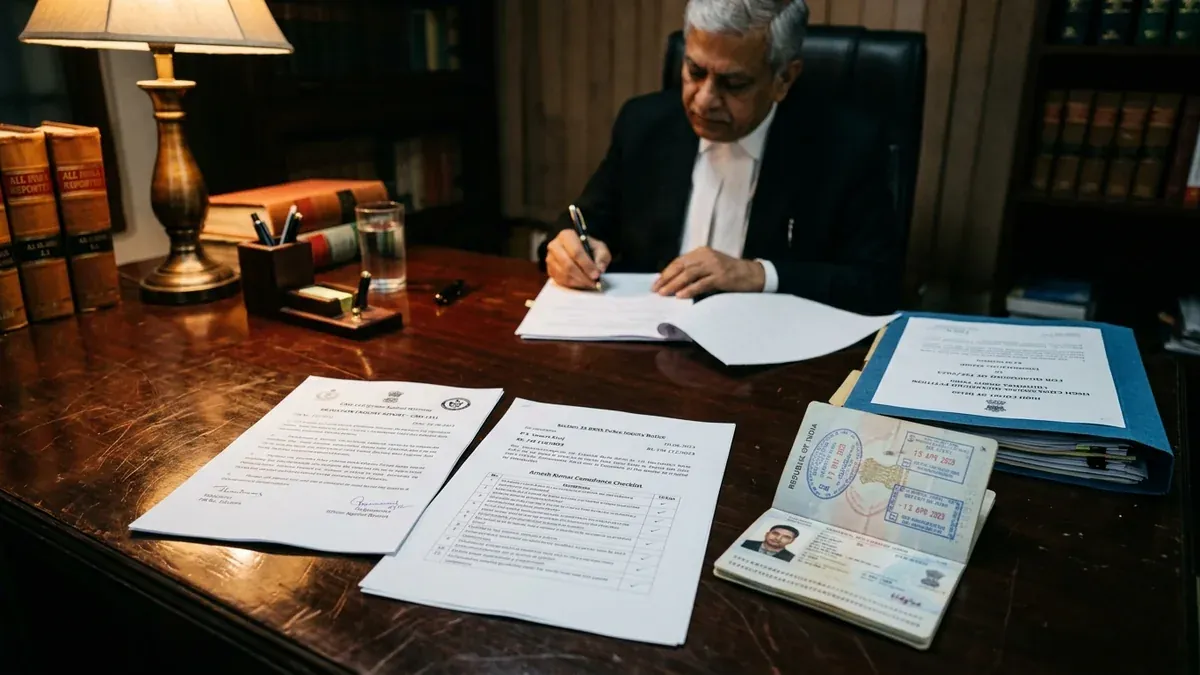
The criminalization of matrimonial cruelty was originally introduced into Indian penal law as a vital legislative shield to protect married women from dowry harassment and domestic violence. However, over decades of litigation across Delhi NCR, Haryana, and Punjab, the misuse of matrimonial cruelty provisions as an instrument of extortion, harassment of elderly in-laws, and matrimonial vendetta has been repeatedly acknowledged by the Supreme Court of India. With the enforcement of India's new criminal codes, the erstwhile Section 498A of the Indian Penal Code has been replaced by Section 85 of the Bharatiya Nyaya Sanhita, 2023 (BNS), while the substantive definition of cruelty is codified under Section 86 BNS. Successfully defending against false allegations demands a rigorous, multi-tiered criminal defence strategy anchored in statutory procedural safeguards and binding constitutional jurisprudence.
1. Statutory Architecture: Section 85 & Section 86 BNS 2023
Under the new penal architecture of the Bharatiya Nyaya Sanhita, 2023, the legislature bifurcated the offence into two distinct statutory provisions:
Statutory Dissection of Sections 85 & 86 BNS:
- Section 85 BNS (The Penal Provision): Provides that whoever, being the husband or the relative of the husband of a woman, subjects such woman to cruelty shall be punished with imprisonment for a term which may extend to three years and shall also be liable to fine.
- Section 86 BNS (The Substantive Definition of Cruelty): To convict an accused, the prosecution must establish that the alleged conduct falls strictly within one of two statutory explanations:
- Explanation (a) - Severe Physical or Mental Danger: Any wilful conduct which is of such a nature as is likely to drive the woman to commit suicide or to cause grave injury or danger to life, limb or health (whether mental or physical) of the woman.
- Explanation (b) - Dowry Coercion & Harassment: Harassment of the woman where such harassment is with a view to coercing her or any person related to her to meet any unlawful demand for any property or valuable security or is on account of failure by her or any person related to her to meet such demand.
As consistently held by the Supreme Court in Manju Ram Kalita v. State of Assam (2009) 13 SCC 330, petty domestic quarrels, ordinary wear and tear of married life, emotional incompatibility, or differences in lifestyle do not satisfy the rigorous threshold of "cruelty" under the statute. The conduct must be persistent, grave, and directly linked to unlawful property demands or life-threatening peril.
2. Pre-Arrest Safeguards: Section 35 BNSS & Arnesh Kumar
The foremost dread confronting innocent families upon the lodging of a matrimonial complaint is the threat of midnight arrests. Under the Bharatiya Nagarik Suraksha Sanhita, 2023 (BNSS), this vulnerability is curtailed by Section 35 BNSS, which formally codifies the landmark guidelines laid down in Arnesh Kumar v. State of Bihar (2014) 8 SCC 273:
| Procedural Parameter | Statutory Requirement under Section 35 BNSS | Consequence of Police Violation |
|---|---|---|
| Notice of Appearance | Mandatory service of written notice under Section 35(3) BNSS for offences punishable up to 7 years. | Arrest made without serving notice or recording reasons is void ab initio. |
| Arrest Checklist & Justification | Police officer must record written satisfaction that arrest is necessary to prevent fleeing, tampering, or crime repetition (Section 35(1)(b)). | Magistrate must decline police custody; officer liable to disciplinary action. |
| Judicial Scrutiny by Magistrate | Magistrate must independently perusal the arrest checklist before authorizing detention under Section 187 BNSS. | Remand without reasoned judicial order constitutes contempt of Supreme Court. |
| Appearance by Accused | If the accused complies with the Section 35 notice and cooperates, they cannot be arrested unless reasons are recorded. | Protects innocent working husbands and elderly parents from mechanical incarceration. |
3. Judicial Shield for Parents, In-Laws & Distant Relatives
A persistent pattern in fabricated matrimonial disputes is the roping in of the entire extended family—aged father-in-law, bedridden mother-in-law, married sisters-in-law living in distant cities, and unmarried brothers. The Supreme Court has repeatedly intervened to halt this abuse through binding precedents:
The Supreme Court reviewed its entire jurisprudence on 498A roping and ruled that in the absence of specific, distinct, and clear allegations against in-laws indicating overt physical acts, general and omnibus allegations of harassment must be quashed. Roping in distant relatives on vague statements without concrete dates and instances is a manifest abuse of law.
The Court observed that a significant percentage of matrimonial complaints are filed in the heat of the moment over trivial differences, roping in married sisters and brothers who reside separately. The Court directed criminal courts to exercise utmost caution and scrutiny before issuing process against distant family members.
Held that mere casual reference to family members in the matrimonial home without any specific allegation of active participation in physical violence or unlawful dowry demands cannot justify putting relatives through an agonizing criminal trial.
4. Documentary Exoneration Toolkit & Digital BSA Proof
Defeating false allegations under Section 85 BNS requires building an unassailable paper trail before the police or the trial court. The defence must assemble a comprehensive documentary exoneration docket:
- Conclusive Proof of Separate Residence:
- Registered lease deeds, sale deeds, or allotment letters establishing that in-laws reside at a completely distinct property.
- Utility bills (electricity, water, piped natural gas) in the names of family members at their respective residential addresses.
- Employer residence declarations, Aadhaar cards, voter IDs, and passport address endorsements.
- Financial Transparency & Rebuttal of Dowry Demands:
- Certified bank statements of the husband and parents proving that all marriage expenses, holiday trips, and household appliances were self-funded.
- Proof of voluntary financial transfers made to the wife or her family, disproving allegations of deprivation.
- Income tax returns establishing legitimate financial status and the financial incapacity of the complainant's family to provide alleged exorbitant dowry.
- Digital Evidence under Section 63 BSA 2023:
- WhatsApp messages, emails, audio call recordings, and video clips demonstrating harmonious relations, extortion threats, or voluntary abandonment.
- Under Section 63 BSA 2023, all electronic records must be accompanied by an Electronic Evidence Certificate signed by the custodian, verifying device hash values and extraction integrity.
- Alibi Records on Alleged Incident Dates:
- Biometric office attendance logs, flight tickets, toll plaza Fastag transactions, and hotel bookings proving physical absence from the alleged place of cruelty on specific dates claimed in the complaint.
5. Multi-Tiered Defence Litigation Protocol
A strategic defence against false matrimonial litigation requires deploying a synchronized, multi-tiered procedural roadmap across administrative, magisterial, and High Court forums:
Attend all conciliation sessions with counsel. Submit a formal point-by-point rebuttal accompanied by certified separate residence documents. Avoid signing any coercive financial settlement, and record attendance in official registers.
Upon receipt of a Section 35(3) BNSS notice from the IO, appear promptly with written compliance. Submit defence documents under receiving. Lawful compliance legally immunizes the accused from custodial arrest.
If the police act in bad faith or threaten coercive custody, immediately file for Anticipatory Bail before the Sessions Court or High Court under Section 482 BNSS, annexing proof of Section 35 compliance and false implications.
Move a petition under Section 528 BNSS (old Section 482 CrPC) before the High Court for quashing the FIR against distant in-laws, married sisters, and parents on the strength of Kahkashan Kausar and Preeti Gupta ratios.
If the case proceeds to trial and the police file a charge-sheet, file a substantive application for discharge under Section 250 BNSS at the stage of framing of charges, demonstrating that allegations are groundless.
6. Discharge Application under Section 250 BNSS
If the High Court relegates the parties to the trial court, the accused is not condemned to face a full-length criminal trial. Under Section 250 of the Bharatiya Nagarik Suraksha Sanhita, 2023 (corresponding to Section 239 CrPC):
"If, upon considering the police report and the documents sent with it under section 193 and making such examination, if any, of the accused as the Magistrate thinks necessary and after giving the prosecution and the accused an opportunity of being heard, the Magistrate considers the charge against the accused to be groundless, he shall discharge the accused, and record his reasons for so doing."
As held by the Supreme Court in Sanjay Kumar Rai v. State of Uttar Pradesh (2021) SCC OnLine SC 367, the trial court cannot act as a mere mouthpiece or rubber stamp of the prosecution. If the statements recorded under Section 180 BNSS reveal only omnibus accusations without specific dates, times, or medical records, the Magistrate is under a statutory obligation to discharge the husband and relatives.
7. High Court Quashing under Section 528 BNSS
The inherent powers of the High Court under Section 528 BNSS (old Section 482 CrPC) exist specifically to prevent the abuse of the process of any court and to secure the ends of justice. Under the foundational principles laid down in State of Haryana v. Bhajan Lal (1992 Supp (1) SCC 335):
- Where the allegations made in the FIR or the complaint, even if taken at their face value and accepted in their entirety, do not prima facie constitute any offence or make out a case against the accused.
- Where the criminal proceeding is manifestly attended with mala fide and/or where the proceeding is maliciously instituted with an ulterior motive for wreaking vengeance on the accused.
High Courts across Punjab & Haryana and Delhi routinely quash proceedings against in-laws where the marriage lasted only a few weeks, where the wife left the matrimonial home voluntarily, or where allegations lack specific dowry harassment ingredients.
8. Interplay with DV Act, Section 144 BNSS & Restitution
A false Section 85 BNS complaint rarely stands in isolation. Complainants routinely launch a coordinated barrage of parallel civil and quasi-criminal actions:
- Section 12 of the Protection of Women from Domestic Violence Act, 2005 (PWDVA): Seeking interim maintenance, right of residence in the shared household (Section 19), and protection orders (Section 18). Defence counsel must establish that the premises belong exclusively to the elderly in-laws as self-acquired property, meaning it does not constitute a "shared household" under S.R. Batra v. Taruna Batra (2007) 3 SCC 169 as explained in Satish Chander Ahuja v. Sneha Ahuja (2020) 10 SCC 788.
- Maintenance under Section 144 BNSS (old Section 125 CrPC): The husband must file a detailed Assets & Liabilities Affidavit compliant with the Supreme Court's mandate in Rajnesh v. Neha (2021) 2 SCC 324, demonstrating actual living expenses, dependent parents, and loan liabilities.
- Restitution of Conjugal Rights (Section 9 HMA) vs Divorce (Section 13 HMA): Demonstrating that the husband made bona fide efforts to reconcile, while false criminal complaints and defamatory notices constitute mental cruelty justifying dissolution of marriage under K. Srinivas Rao v. D.A. Deepa (2013) 5 SCC 226.
Practical Defence Checklist for Husbands & In-Laws
- Preserve Admissible Electronic Proof: Generate backup copies of call records, WhatsApp chats, and CCTV footage with Section 63 BSA certificates.
- Document Proof of In-Laws' Separate Living: Compile electricity bills, rent agreements, and voter ID cards demonstrating independent residence.
- Strict Compliance with Section 35 BNSS Notices: Never evade appearance notices from the police; submit written replies under official stamp and signature.
- File Comprehensive Rajnesh v. Neha Disclosures: In maintenance proceedings, declare all genuine debt liabilities, EMIs, and elderly parental medical expenses.
- Engage High Court Counsel for Quashing: Challenge omnibus allegations against married sisters and elderly parents at the earliest opportunity under Section 528 BNSS.
Statutory Authorities & Legal References
- Bharatiya Nyaya Sanhita, 2023: Section 85 (Husband or relative of husband subjecting woman to cruelty) and Section 86 (Definition of cruelty).
- Bharatiya Nagarik Suraksha Sanhita, 2023: Section 35 (Notice of appearance & arrest safeguards), Section 144 (Order for maintenance), Section 187 (Procedure when investigation cannot be completed in 24 hours), Section 250 (Discharge in warrant cases), Section 482 (Anticipatory bail), and Section 528 (Inherent powers of High Court).
- Bharatiya Sakshya Adhiniyam, 2023: Section 63 (Admissibility of electronic records) and Section 104 (Burden of proof).
- Supreme Court Landmark Jurisprudence: Arnesh Kumar v. State of Bihar (2014), Kahkashan Kausar @ Sonam v. State of Bihar (2022), Preeti Gupta v. State of Jharkhand (2010), Geeta Mehrotra v. State of U.P. (2012), Rajnesh v. Neha (2021), and Bhajan Lal (1992).
Frequently Asked Questions
Authoritative criminal defence guidance for husbands and families facing Section 85 BNS / 498A allegations.
Can the police arrest my elderly parents or relatives immediately upon a Section 85 BNS FIR?
No. Under Section 35(1) and Section 35(3) of the Bharatiya Nagarik Suraksha Sanhita, 2023 (BNSS)—which statutorily codifies the Supreme Court's binding mandate in Arnesh Kumar v. State of Bihar (2014)—for offences punishable with imprisonment of seven years or less (such as Section 85 BNS), arrest is not mandatory. The police officer is legally required to serve a formal Notice of Appearance under Section 35(3) BNSS. Arrest cannot be executed unless the officer records objective reasons in writing showing necessity (e.g. flight risk or evidence tampering), and any arbitrary arrest renders the police officer liable to departmental disciplinary action and contempt of court.
What is the Supreme Court's ruling on roping in distant relatives and in-laws under Section 85 BNS?
In a consistent line of landmark verdicts including Preeti Gupta v. State of Jharkhand (2010), Geeta Mehrotra v. State of U.P. (2012), and Kahkashan Kausar @ Sonam v. State of Bihar (2022) 6 SCC 599, the Supreme Court ruled that general, vague, and omnibus allegations made against the husband's parents, married sisters, and distant relatives without attributing specific overt acts, exact dates, and tangible roles constitute a gross abuse of the judicial process. High Courts are empowered to quash such proceedings under Section 528 BNSS at the threshold.
What documentary proof is most effective to establish separate residence for in-laws?
To establish separate residence conclusively, provide: (1) Registered lease agreements, title deeds, or property tax receipts showing a distinct address; (2) Government utility bills (electricity, water, piped gas) in the parents' or married sisters' names at the separate address; (3) Bank statements, Aadhaar cards, voter IDs, and employer records reflecting residence in a different city or locality; and (4) Society resident association (RWA) certificates confirming non-cohabitation.
How does Section 86 BNS legally define 'Cruelty'?
Under Section 86 of Bharatiya Nyaya Sanhita, 2023, cruelty is strictly defined under two limbs: Explanation (a) Any wilful conduct which is of such a nature as is likely to drive the woman to commit suicide or to cause grave injury or danger to life, limb or health (mental or physical); or Explanation (b) Harassment of the woman with a view to coercing her or any person related to her to meet any unlawful demand for any property or valuable security or is on account of failure by her or any person related to her to meet such demand. Ordinary marital wear and tear or domestic discord does not amount to cruelty.
What is the legal strategy during Women Cell / CAW Cell mediation proceedings?
When summoned by the Crime Against Women (CAW) Cell or Mahila Thana prior to FIR registration, attend every session with counsel. Submit a formal written point-by-point rebuttal with attached documentary proof disproving dowry demands, separate residence bills, and travel records. Never sign any settlement agreement admitting guilt or agreeing to unilateral financial demands under pressure, and ensure every appearance is noted in the official police attendance register.
When should an accused husband file for Anticipatory Bail vs High Court Quashing?
If an FIR has been registered and the police threaten imminent arrest in violation of Section 35 BNSS, immediately file for Anticipatory Bail under Section 482 BNSS before the Sessions Court or High Court to secure interim protection. Concurrently, if the FIR contains patently absurd, omnibus, or fabricated allegations, file a quashing petition under Section 528 BNSS before the High Court seeking to quash the criminal proceedings, especially for distant relatives.
Can WhatsApp chats and audio recordings be used to defend against false 498A / Section 85 BNS charges?
Yes. Digital communications demonstrating amicable relations, extortion threats, or voluntary departure from the matrimonial home are admissible defence evidence under Section 63 of the Bharatiya Sakshya Adhiniyam, 2023 (BSA). The accused must submit an electronic certificate under Section 63 BSA signed by the person in lawful control of the device, detailing the hash value, extraction procedure, and integrity of the digital files.
What is the interplay between Section 85 BNS, the DV Act, and Section 144 BNSS maintenance?
Complainants routinely institute parallel proceedings under Section 85 BNS (criminal cruelty), Section 12 of the Protection of Women from Domestic Violence Act (PWDVA - residence and monetary relief), and Section 144 BNSS (old 125 CrPC maintenance). Under the Supreme Court ruling in Rajnesh v. Neha (2021) 2 SCC 324, overlapping maintenance claims must be disclosed in a mandatory Assets & Liabilities Affidavit, and courts must adjust interim maintenance orders across forums to prevent double recovery.