Cross-FIR Strategy in Mutual Affrays: Protecting the Right of Private Defence in Police Investigation
 Authored by: Advocate Kishan Kumar (Advocate & Legal Consultant)
Quick Summary & Strategic Key Takeaways
- The Nathi Lal Dual Trial Mandate: Cross-cases arising from the same violent incident must be conducted by the same trial judge, heard concurrently, and decided on the same day with separate judgments.
- Lakshmi Singh Doctrine: Total failure of the prosecution to explain severe, contemporaneous injuries on the accused in the MLC severely shatters the prosecution's narrative and establishes private defence.
- Free Fight vs Right of Private Defence: Premeditated mutual brawls extinguish private defence under Sections 34-44 BNS, whereas resisting an unprovoked sudden assault preserves lawful defence rights.
- Magisterial Counter-FIR Recourse: When police register a one-sided FIR, victims must invoke Section 175(3) BNSS or Section 223 BNSS before the Magistrate to place the counter-version on record.
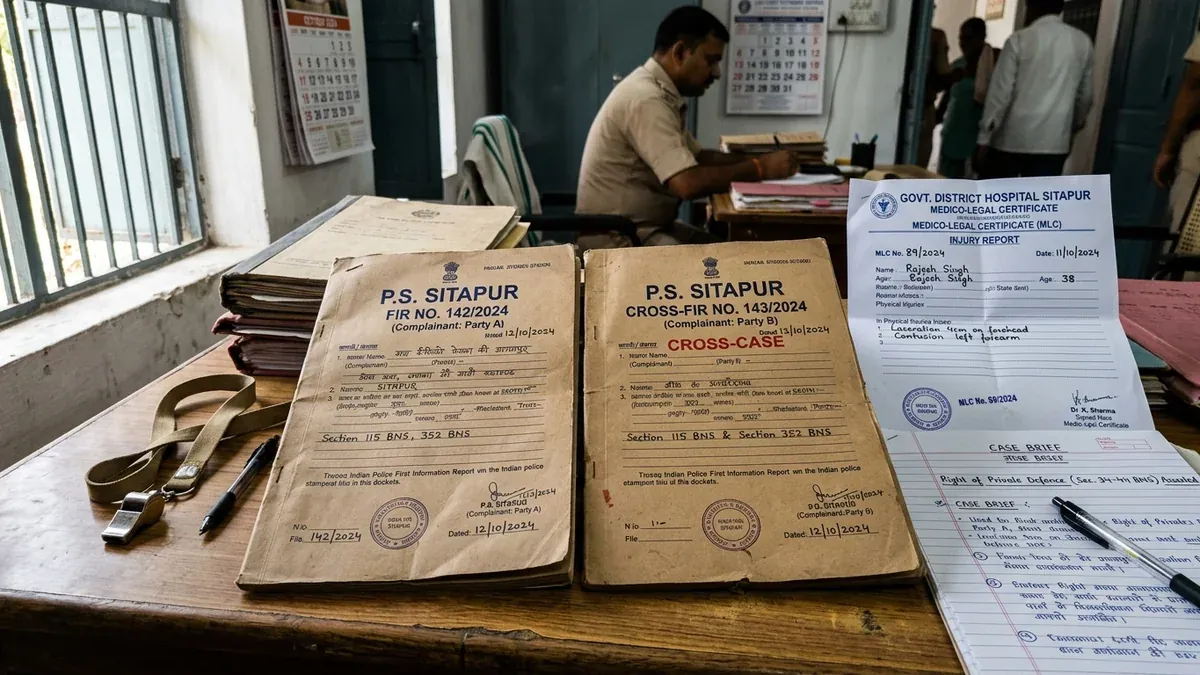
Mutual physical altercations, group clashes arising out of property boundary disputes, road rage incidents, and village factional feuds across Haryana, Delhi NCR, and Punjab frequently culminate in the registration of cross-FIRs (counter-cases). When both factions sustain physical injuries and rush to police stations to lodge competing complaints, the criminal justice system is confronted with two conflicting versions of the exact same violent occurrence. Navigating a cross-FIR demands an intricate understanding of the substantive law of private defence under the Bharatiya Nyaya Sanhita, 2023 (BNS), the procedural trial framework under the Bharatiya Nagarik Suraksha Sanhita, 2023 (BNSS), and binding constitutional precedents of the Supreme Court of India.
1. Anatomy of Cross-FIRs in Violent & Mutual Fights
A cross-case arises when two adversarial factions involved in the same physical clash or criminal transaction lodge independent complaints against each other, asserting contradictory narratives regarding:
- The First Aggressor: Each faction claims the other initiated the unprovoked assault, armed themselves with lethal weapons, and trespassed upon private premises.
- The Right of Self-Defence: Both parties assert that any physical violence, weapon usage, or vehicular collision caused by them was an emergency act executed purely in exercise of lawful private defence to save human life or protect property.
- Severity & Provenance of Injuries: While Party A claims that Party B inflicted grievous hurt using sharp-edged or blunt weapons, Party B counters with Medico-Legal Examination Reports (MLCs) proving that Party A inflicted fractured bones, incised wounds, or blunt trauma.
The substantive penal charges routinely invoked in cross-FIRs under the Bharatiya Nyaya Sanhita, 2023 include:
| Offence Description | BNS 2023 Section | Old IPC Section | Nature & Punishment |
|---|---|---|---|
| Causing Simple Hurt | Section 115(2) BNS | Section 323 IPC | Cognizable, Bailable (Up to 1 year imprisonment or fine) |
| Voluntarily Causing Grievous Hurt | Section 117(2) BNS | Section 325 IPC | Cognizable, Bailable (Up to 7 years imprisonment and fine) |
| Grievous Hurt by Dangerous Weapons | Section 118(1)/(2) BNS | Section 324/326 IPC | Cognizable, Non-Bailable (Up to 10 years / Life imprisonment) |
| Attempt to Murder | Section 109 BNS | Section 307 IPC | Cognizable, Non-Bailable (Up to 10 years / Life imprisonment) |
| Affray & Disturbance of Peace | Section 189 BNS | Section 159/160 IPC | Cognizable, Bailable (Up to 1 month imprisonment) |
| Rioting & Unlawful Assembly | Section 191(2)/(3) BNS | Section 147/148 IPC | Cognizable, Non-Bailable if armed with deadly weapon (Up to 3-5 years) |
| Criminal Trespass & House-Trespass | Section 329 / 331 BNS | Section 447/452 IPC | Cognizable, Non-Bailable if prepared for hurt (Up to 7 years) |
2. Private Defence Framework: Sections 34–44 BNS 2023
The cornerstone of defending a cross-FIR lies in establishing that the accused was exercising the statutory right of private defence codified under Sections 34 to 44 of the Bharatiya Nyaya Sanhita, 2023 (corresponding to Sections 96 to 106 of the old Indian Penal Code).
Under Section 34 BNS, nothing is an offence which is done in the exercise of the right of private defence. Every citizen has a legal right to defend their own body and the body of any other person against any offence affecting the human body (Section 35 BNS), as well as to defend movable or immovable property against theft, robbery, mischief, or criminal trespass.
Crucial Parameters of Lawful Private Defence:
- Proportionality & No More Harm than Necessary (Section 37 BNS): The right of private defence in no case extends to the inflicting of more harm than it is necessary to inflict for the purpose of defence. The force used must be reasonably commensurate with the imminent peril faced.
- Commencement & Continuance (Section 39 & 42 BNS): The right commences as soon as a reasonable apprehension of danger to the body or property arises from an attempt or threat to commit the offence, even if the offence has not yet been committed; and it continues only so long as such apprehension of danger persists. Once the aggressor retreats or drops their weapon, the right immediately ceases.
- When the Right Extends to Causing Death (Section 38 BNS): The right of private defence of the body extends to voluntarily causing death only when the assault reasonably creates apprehension of:
- Death;
- Grievous hurt;
- Rape;
- Unnatural lust;
- Kidnapping or abduction;
- Wrongful confinement under circumstances where public assistance cannot be obtained.
- Recourse to Public Authorities (Section 37 BNS): There is no right of private defence in cases where there is sufficient time to have recourse to the protection of the public authorities.
3. The Free Fight Doctrine & Individual Criminal Liability
A pivotal distinction drawn by Indian criminal jurisprudence is between legitimate private defence and a mutual free fight. In numerous group clashes, both sides actively prepare for combat, arm themselves, and assemble at a common spot to settle scores.
As authoritatively enunciated by the Supreme Court in Gajanand v. State of U.P. (AIR 1954 SC 695) and reaffirmed in Dharman v. State of Punjab (AIR 1957 SC 324) and Munir Khan v. State of M.P. (2003) 11 SCC 110:
- Exclusion of Private Defence: In a mutual free fight, where both factions engage in armed combat by mutual agreement or pre-arranged understanding, the plea of private defence is completely unavailable to either side. Neither party can claim to be an innocent victim resisting an unprovoked attack.
- No Constructive Liability (Absence of Common Object): In a true free fight, the doctrine of vicarious liability under Section 190 BNS (old Section 149 IPC - unlawful assembly) or Section 3(5) BNS (old Section 34 IPC - common intention) does not automatically apply to rope in every member for the fatal acts of one participant. Each individual combatant is held criminally responsible solely for the specific overt injuries inflicted by their own hand.
4. The Supreme Court's Golden Rule for Simultaneous Trial
Trying cross-cases requires an extraordinary procedural safeguard to prevent conflicting judicial findings and premature disclosure of defence arguments. In a trilogy of authoritative verdicts—Nathi Lal v. State of U.P. (1990 Supp SCC 145), Sudhir v. State of M.P. (2001) 2 SCC 688, and State of M.P. v. Mishrilal (2003) 9 SCC 426—the Supreme Court established the mandatory Golden Rule governing the trial of cross-cases:
The Five Mandatory Commandments of the Golden Rule:
- Same Court & Same Judge: Both cross-cases arising out of the same occurrence must be committed to the very same Sessions Court or tried concurrently before the very same Judicial Magistrate.
- Strictly Separate Trials & Records: The trials must be conducted separately. Separate dockets, charge-sheets, exhibits, and witness statements must be maintained. Under no circumstances can evidence recorded in Case A be read into, cross-referenced, or evaluated in Case B.
- Consecutive Arguments: After the evidence in both cases is fully concluded, the presiding judge must hear final arguments in both trials one after the other without delivering judgment in either.
- Independent Evaluation: The judge must evaluate each case strictly on the strength of its own evidence, without allowing admissions or omissions from the cross-case to prejudice the accused.
- Simultaneous Pronouncement: The judge must write two separate, independent judgments and pronounce them on the very same day, eliminating any risk of contradictory findings or miscarriage of justice.
5. Statutory Duties of Police Investigation under BNSS 2023
Under the Bharatiya Nagarik Suraksha Sanhita, 2023, an Investigating Officer (IO) confronted with cross-complaints cannot arbitrarily elect which faction to favor. The statutory scheme imposes strict duties upon the police:
- Registration of Counter-FIR (Section 173 BNSS): When a counter-version disclosing a cognizable offence is presented, the police officer is bound under Section 173(1) BNSS to register the cross-FIR. The police cannot decline registration on the pretext that an FIR for the same incident has already been lodged.
- Independent Investigation & Distinct Case Diaries (Section 192 BNSS): The IO must maintain separate Case Diaries for each FIR under Section 192 BNSS. Statements under Section 180 BNSS (old 161 CrPC) and site inspection plans must be compiled independently.
- Forensic Scene of Crime Preservation (Section 176 BNSS): Under Section 176(3) BNSS, for offences punishable with imprisonment of seven years or more, the visit of a forensic expert to the crime scene and videographic recording of the collection of evidence is mandatory. This includes seizing weapons used by both sides, collecting blood-stained earth, and inspecting ballistic trajectories.
- Prohibition on Acting as Judge: As held by the Punjab & Haryana High Court in Babu Ram v. State of Haryana, the police cannot act as an adjudicatory court to decide who was the aggressor during the investigation phase; their sole statutory duty is to collect evidence impartially and place all material before the competent Magistrate under Section 193 BNSS.
6. Non-Explanation of Injuries on the Accused: The Lakshmi Singh Rule
One of the most potent weapons available to criminal defence counsel in mutual combat cases is the presence of un-explained injuries on the accused person. In the locus classicus judgment of Lakshmi Singh v. State of Bihar (1976) 4 SCC 394, the Supreme Court laid down that:
"Where the prosecution witnesses fail to explain serious, un-superficial injuries sustained by the accused in the course of the same occurrence, the omission is a very important circumstance from which the court can draw the following three inferences: (1) that the prosecution has suppressed the true genesis and origin of the occurrence; (2) that the witnesses who have denied presence of injuries on the accused are lying on a most material point; and (3) that the defence version that the accused acted in exercise of the right of private defence is rendered highly probable."
This principle has been consistently reaffirmed by the Supreme Court in State of Rajasthan v. Madho (1991 Supp (2) SCC 396) and Nand Lal v. State of Chhattisgarh (2023 10 SCC 470). If Party A's witnesses completely conceal that Party B also suffered fractured ribs or skull trauma, their credibility is shattered, entitling the accused to an acquittal.
7. Procedural Remedies if Police Refuse Counter-FIR
Local police stations frequently succumb to local political influence or race to favor the party that reached the Thana first, refusing to register the cross-FIR of the injured counter-claimants. When confronted with such refusal, the aggrieved faction must execute these sequential remedies under BNSS 2023:
- Representation to SP / DCP under Section 175(3) BNSS: Send a written complaint setting forth the complete cross-version accompanied by certified MLC copies by registered post or verified email to the Superintendent of Police or Deputy Commissioner of Police under Section 175(3) BNSS.
- Magisterial Application under Section 175(4) read with Section 223 BNSS: If the senior police officer fails to direct registration of the FIR, file an application before the Chief Judicial Magistrate (CJM) / Metropolitan Magistrate under Section 175(4) BNSS seeking court directions for registration of the counter-FIR or initiating a private complaint proceeding under Section 223 BNSS.
- Writ Petition for Mandamus under Article 226: Approach the High Court of Punjab & Haryana or Delhi High Court by filing a Criminal Writ Petition under Article 226 of the Constitution seeking a writ of mandamus directing the registration of the cross-FIR and transfer of the investigation to an independent agency (Crime Branch / State CID) under the guidelines of Lalita Kumari v. Govt. of U.P. (2014) 2 SCC 1.
8. Evidentiary Preservation & Electronic Records under BSA 2023
Modern mutual clashes almost invariably generate digital footprints: CCTV footage from nearby residential societies or market complexes, dashboard cameras, and mobile phone video recordings captured by bystanders. Under the Bharatiya Sakshya Adhiniyam, 2023 (BSA), preserving this electronic evidence is crucial:
- Section 63 BSA 2023 Certificate: Any digital video, audio recording, or CDR (Call Detail Record) submitted as defence proof must be accompanied by a valid Section 63 BSA electronic certificate executed by the person in lawful control of the recording device.
- Section 94 BNSS Production Notice: Serve an immediate written application under Section 94 BNSS upon the Investigating Officer requesting the immediate seizure and preservation of CCTV DVRs from surrounding shops or residential complexes before the footage is overwritten in 15 to 30 days.
- Forensic Voice & Video Authentication: Moving the court under Section 39 BSA to dispatch original mobile phone recordings to the Forensic Science Laboratory (FSL) to establish that the complainant faction arrived armed at the scene as the initial aggressors.
9. Strategic Defence Roadmap for Criminal Trial Advocates
A disciplined litigation strategy must be deployed from the day of the incident to protect clients facing cross-prosecutions:
Ensure all injured family members are examined at a Government Civil Hospital immediately under Section 176 BNSS. Photograph all injuries, bruises, and lacerations with contemporaneous date stamps.
Because the opposite side will push for immediate arrests under Sections 118, 109, or 191 BNS, urgently move the Sessions Court or High Court for anticipatory bail under Section 482 BNSS, annexing the cross-MLCs to prove mutual clash.
If the police chargesheet both cases or if one case is committed to Sessions while the other lingers in the Magistrate court, file a transfer and clubbing application under Section 447 BNSS to bring both files before the same judge pursuant to the Nathi Lal rule.
Cross-examine prosecution eyewitnesses on their failure to disclose who initiated the fight, why they carried weapons, and why their own faction inflicted injuries on the accused, leveraging the Lakshmi Singh ratio.
Cross-FIR Strategic Checklist for Defence Litigators
- Secure Certified MLC Copies Immediately: Obtain certified copies of the Medico-Legal Injury Sheets from the civil hospital to establish contemporaneous trauma.
- Serve Preservation Notice for Digital Proof: Issue formal notices under Section 94 BNSS to preserve nearby private CCTV footage and police control room (PCR) calls.
- Ensure Strict Compliance with Nathi Lal Rule: Object immediately if cross-trials are scheduled before different courts or if judgments are listed on different dates.
- Never Import Cross-Case Evidence: Ensure that admissions made in the counter-case are never directly tendered into your client's defence file without independent proof.
- Document Pre-Existing Enmity & Land Disputes: Compile revenue records, pending civil suits, or prior police complaints demonstrating long-standing animosity between factions.
Statutory Authorities & Legal References
- Bharatiya Nyaya Sanhita, 2023: Sections 34–44 (General Exceptions: Right of private defence of body and property), Sections 115, 117, 118 (Hurt and grievous hurt), Section 109 (Attempt to murder), Sections 189, 191 (Affray and rioting), and Section 3(5) (Common intention).
- Bharatiya Nagarik Suraksha Sanhita, 2023: Section 173 (Information in cognizable cases), Section 175 (Investigation powers), Section 176 (Procedure for investigation & mandatory forensics), Section 180 (Examination of witnesses), Section 192 (Diary of proceedings), Section 193 (Report of police officer on completion), and Section 482 (Direction for grant of bail).
- Bharatiya Sakshya Adhiniyam, 2023: Section 39 (Opinions of experts), Section 63 (Admissibility of electronic records), and Section 108 (Burden of proving that case of accused comes within exceptions).
- Supreme Court Binding Precedents: Nathi Lal v. State of U.P. (1990), State of M.P. v. Mishrilal (2003), Sudhir v. State of M.P. (2001), Lakshmi Singh v. State of Bihar (1976), and Gajanand v. State of U.P. (1954).
Frequently Asked Questions
Strategic statutory guidance on cross-FIRs, mutual combat, and criminal defence in Delhi NCR & Haryana.
What is the Supreme Court's Golden Rule on the trial of cross-cases?
In the landmark precedents of Nathi Lal v. State of U.P. (1990 Supp SCC 145) and State of M.P. v. Mishrilal (2003) 9 SCC 426, the Supreme Court formulated the mandatory Golden Rule: (1) Both cross-cases arising from the same occurrence must be committed to the same Sessions Court and tried by the same Judge simultaneously; (2) The trials must be conducted separately with strictly distinct case records; (3) Evidence recorded in one case cannot be read into or relied upon in the cross-case; (4) Arguments in both cases must be heard consecutively; and (5) Separate judgments must be authored and pronounced on the very same day to prevent pre-judgment.
How does the 'Free Fight Doctrine' eliminate the plea of private defence?
As held by the Supreme Court in Gajanand v. State of U.P. and Dharman v. State of Punjab, where two armed factions assemble by mutual consent or pre-arrangement to engage in a violent clash, the concept of private defence is completely excluded. In a mutual free fight, neither faction can claim the right of private defence under Sections 34–44 of Bharatiya Nyaya Sanhita, 2023 (BNS), and each participant is held individually criminally liable for their specific overt acts.
What is the legal consequence if the police fail to explain injuries on the accused?
Under the seminal Supreme Court ruling in Lakshmi Singh v. State of Bihar (1976) 4 SCC 394, the non-explanation by the prosecution of serious, un-superficial injuries sustained by the accused in the course of the same occurrence leads to three critical legal inferences: (1) The prosecution has suppressed the true genesis and origin of the clash; (2) The prosecution witnesses are lying on material points; and (3) The defence version that the accused acted in self-defence becomes highly probable.
Can the police file a cancellation report against one FIR while chargesheeting the cross-FIR?
Yes, but such an investigation is subject to intense judicial scrutiny under Section 193 of the Bharatiya Nagarik Suraksha Sanhita, 2023 (BNSS). The Investigating Officer cannot act as a trial judge to decide who is guilty. If the police file a cancellation or untraced report against the counter-FIR, the aggrieved complainant has the statutory right to file a Protest Petition under Section 210/223 BNSS, which the Magistrate can treat as a private criminal complaint and take cognizance.
Can the same Investigating Officer investigate both cross-FIRs?
While the police department often assigns cross-cases to the same investigating officer or a joint Special Investigation Team (SIT) to ensure a holistic appreciation of the incident, the officer must maintain completely separate Case Diaries (under Section 192 BNSS). Evidence, statements recorded under Section 180 BNSS, and seizure memos from one docket cannot be copied into the other.
What legal remedy exists if the local police refuse to register a counter-FIR?
If the SHO refuses to lodge a cross-FIR under Section 173(1) BNSS: (1) Submit a written representation by speed post or email to the Superintendent of Police / DCP under Section 175(3) BNSS; (2) If no FIR is ordered, file an application under Section 175(4) read with Section 223 BNSS before the jurisdictional Judicial Magistrate seeking directions for investigation or taking cognizance; (3) Concurrently move a Criminal Writ under Article 226 before the High Court for a writ of mandamus.
When does the right of private defence extend to causing death under BNS 2023?
Under Section 38 of the Bharatiya Nyaya Sanhita, 2023 (BNS), the right of private defence of the body extends to causing death only if the assault causes a reasonable apprehension of death, grievous hurt, rape, unnatural lust, kidnapping, or wrongful confinement where release cannot be obtained from public authorities. Under Section 41 BNS, private defence of property extends to death in cases of robbery, house-breaking by night, mischief by fire, or house-trespass causing death/grievous hurt apprehension.
How crucial is prompt Medico-Legal Examination (MLC) in mutual clash cases?
Prompt MLC conducted at a Government Civil Hospital under Section 176 BNSS is paramount. It establishes the contemporaneous nature, dimension, depth, and age of injuries inflicted on both parties, rules out self-inflicted superficial abrasions, and proves who was hospitalized first, which serves as foundational corroborative evidence during trial.