
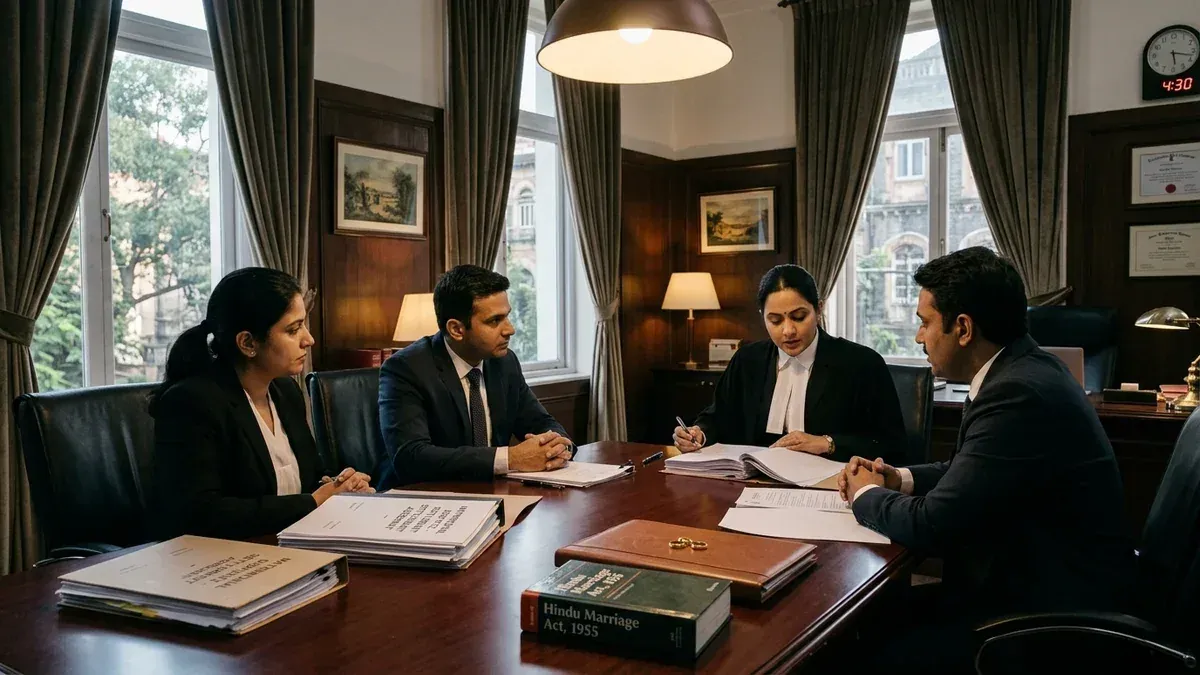
In acrimonious divorce trials and maintenance disputes under Section 125 CrPC (now Section 144 BNSS, 2023) across Family Courts in Delhi NCR and Haryana, husbands routinely levy allegations of adultery against their wives and move applications demanding a forensic DNA paternity test of the minor child. Litigants assume that because modern DNA technology is scientifically foolproof (99.99% accuracy), courts will automatically order blood or buccal swab tests upon request.
That assumption fundamentally contradicts Indian family law. In India, public policy and child welfare vigorously guard against the social stigma of bastardizing an innocent child. The definitive judicial framework governing when a trial court can compel a DNA test was settled by the Supreme Court of India in Bhabani Prasad Jena v. Convenor Secretary, Orissa State Commission for Women (2010) 8 SCC 633.
Courts cannot order DNA tests as a matter of routine or on roving inquiries merely because one spouse makes a bald allegation of infidelity. A DNA test directly impinges on an individual's right to privacy and bodily autonomy. It can only be directed when an eminent need is demonstrated and when the applicant first establishes a strong prima facie case of non-access under Section 112 Evidence Act (now Section 114 of Bharatiya Sakshya Adhiniyam, 2023).
1. The Statutory Presumption of Legitimacy: Section 114 BSA vs. Section 112 IEA
The foundation of Indian paternity law rests upon an unshakeable statutory presumption:
- Conclusive Proof of Legitimacy: Any child born during the continuance of a valid marriage, or within 280 days after its dissolution (the mother remaining unmarried), is conclusively presumed to be the legitimate child of the husband.
- The Sole Rebuttal Ground: Non-Access: The husband cannot rebut this presumption by showing suspicion, physical dissimilarities, or general infidelity. The only way to rebut Section 114 BSA is by proving that the husband had no access to the wife at any time when the child could have been conceived.
- Meaning of "Non-Access": Non-access means physical impossibility of sexual cohabitation (e.g., husband was deployed abroad in military service, imprisoned, or residing in another continent without physical proximity).
2. The Balancing Test: Scientific Truth vs. Privacy & Child Welfare
In Bhabani Prasad Jena, Justice R.M. Lodha articulated the judicial dilemma between discovering scientific truth and protecting human rights:
| Competing Interest | Legal Consideration | Judicial Weight |
|---|---|---|
| Right to Privacy & Bodily Autonomy | Article 21 protects individuals against coercive medical extraction without consent (K.S. Puttaswamy (2017)). | Very High. Compulsion violates fundamental dignity unless strictly justified by law. |
| Welfare of the Child | A judicial declaration of illegitimacy causes catastrophic psychological, social, and inheritance injuries to an innocent minor. | Paramount. Courts will not allow a child to be weaponized as a pawn in marital warfare. |
| Search for Scientific Truth | DNA profiling provides accurate biological parentage determination. | Secondary to public policy, unless an eminent prima facie case of non-access is established. |
3. Procedural Checklist for Opposing a DNA Test Application
If you represent a wife defending against a coercive DNA test application in a Family Court (such as Saket, Tis Hazari, Gurugram, or Faridabad), raise these four substantive objections:
- Absence of Pleaded Non-Access: Point out that the husband shared a common roof, cohabited, or lived in the same city during the 9-month conception window. If access was physically possible, Section 114 BSA bars the test.
- Roving & Fishing Inquiry: Cite Aparna Bhat v. State of M.P. (2021) and Inayatullah (2021) to show that DNA applications cannot be used to fish for evidence of adultery when the husband has no independent proof.
- Best Interests of the Child: Emphasize that the minor child is not a party to the matrimonial cruelty or divorce petition, and their constitutional rights under Article 21 cannot be compromised.
4. Consequences of Refusal & Adverse Inference
What if the court orders a DNA test and the wife or child refuses to provide blood or tissue samples?
- Under the Constitution Bench ruling in Selvi v. State of Karnataka (2010), no civil court can physically restrain or forcibly extract biological samples from a citizen.
- However, under Section 114(g) of the Evidence Act / Section 119 of the Bharatiya Sakshya Adhiniyam, 2023, the trial court can draw a rebuttable adverse inference against the party who disobeys a lawful judicial direction without just cause.
Ready Court Draft: Reply Opposing Husband's DNA Test Application
IN THE COURT OF THE LEARNED PRINCIPAL JUDGE, FAMILY COURT, FARIDABAD / DELHI

HMA PETITION NO. ________ OF 2026

IN THE MATTER OF:
[Petitioner Husband]                         ...PETITIONER
                             VERSUS
[Respondent Wife]                            ...RESPONDENT

REPLY ON BEHALF OF THE RESPONDENT WIFE OPPOSING PETITIONER'S APPLICATION FOR DNA PATERNITY TEST OF MINOR CHILD

MOST RESPECTFULLY SHOWETH:

1. That the Petitioner's application seeking a DNA paternity test of the minor child [Child Name], aged [Age] years, is a gross abuse of judicial process, malicious, and wholly unmaintainable.
2. That the minor child was born on [Date of Birth] during the subsistence of a lawful, valid marriage between the parties. In terms of Section 114 of the Bharatiya Sakshya Adhiniyam, 2023 (Section 112 Evidence Act), birth during marriage is conclusive proof of legitimacy.
3. That the Petitioner has completely failed to plead or establish the essential statutory prerequisite of "non-access" during the conception window; the parties were indisputably cohabiting together at the matrimonial home in [Location] during the entire period.
4. That in terms of the binding Supreme Court judgment in Bhabani Prasad Jena v. Convenor Secretary, Orissa State Commission for Women (2010) 8 SCC 633, DNA tests cannot be directed routinely on roving inquiries, and courts must not subject innocent children to the trauma of bastardization.
5. That the application is a vindictive ploy to evade payment of interim maintenance and harass the Respondent.

PRAYER:
It is therefore respectfully prayed that this Hon'ble Court may be pleased to dismiss the Petitioner's application for DNA testing with exemplary costs.

RESPONDENT
THROUGH COUNSEL
Official Landmark Case Brief
Read our certified case analysis: Bhabani Prasad Jena (2010) Case Brief & Ratio. Our family litigation advocates represent spouses in contested divorce, child custody, and maintenance trials across Delhi NCR.

Advocate Kishan Kumar
Criminal, Civil & Debt Recovery Advocate • Bar Council of Delhi