
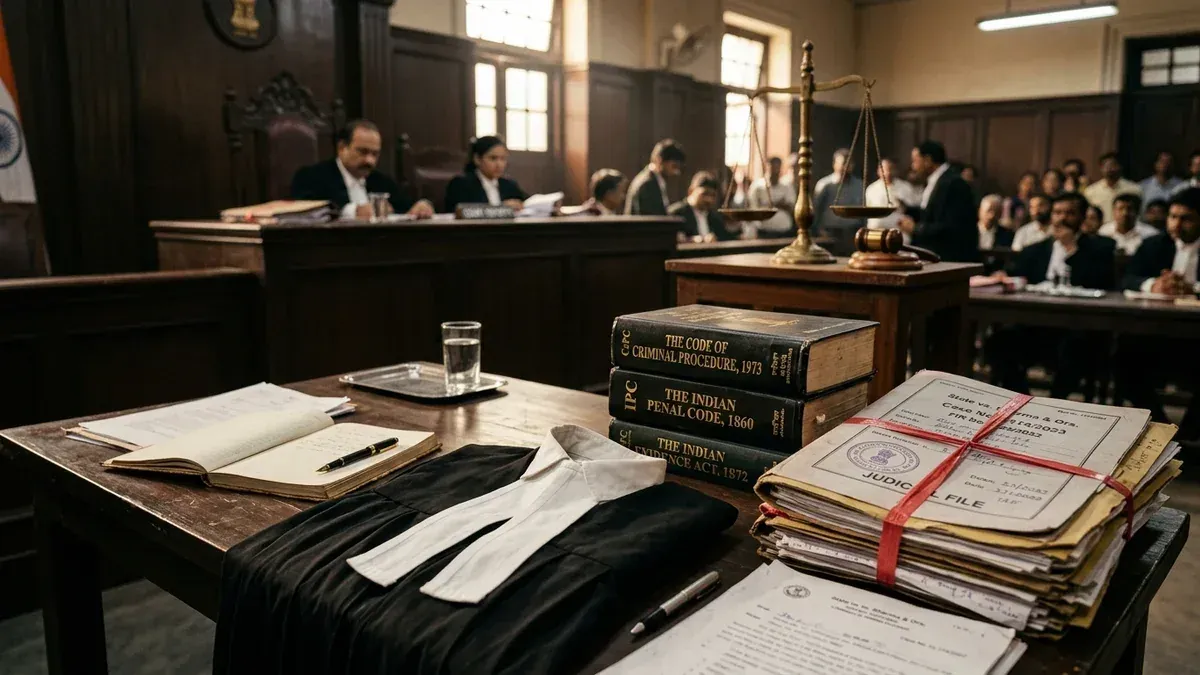
In the vast majority of homicide, poison, and premeditated conspiracy prosecutions, there are no eyewitnesses. Crimes conceived in secrecy are executed behind closed doors. In such cases, the state relies entirely on circumstantial evidence — pieces of forensic and conduct evidence woven together like strands of a rope to prove the defendant's guilt.
However, circumstantial evidence is perilous. If courts convict on mere conjecture or cumulative suspicions, innocent lives are destroyed. To protect citizens against judicial intuition, the Supreme Court of India in Sharad Birdhichand Sarda v. State of Maharashtra (1984) 4 SCC 116, relying on the classic foundation of Hanumant Govind Nargundkar v. State of M.P. (1952) and Bodhraj alias Bodha v. State of J&K (2002), laid down the definitive Panchsheel — the five golden principles that must be fulfilled before a conviction on circumstantial evidence can be sustained.
- The circumstances from which the conclusion of guilt is to be drawn should be fully established.
- The facts so established should be consistent only with the hypothesis of the guilt of the accused, that is to say, they should not be explainable on any other reasonable hypothesis.
- The circumstances should be of a conclusive nature and tendency.
- They should exclude every possible hypothesis except the one to be proved.
- There must be a chain of evidence so complete as not to leave any reasonable ground for the conclusion consistent with the innocence of the accused and must show that in all human probability the act must have been done by the accused.
1. The Mental Distance Between "May Be True" and "Must Be True"
One of the most frequently quoted judicial dictums across Indian trial courts stems from Hanumant (1952), reiterated verbatim in Sharad Sarda:
"There is a long distance between 'may be true' and 'must be true', and this distance must be traversed by the prosecution by producing clear, cogent, and unimpeachable evidence."
Even if the circumstantial matrix creates grave suspicion against the accused, suspicion cannot take the place of legal proof. If the prosecution evidence merely suggests that the accused might have committed the murder, an acquittal must follow as a matter of law.
2. Deconstructing the Typical Circumstantial Chain
In murder and conspiracy trials, the prosecution typically attempts to construct its chain using the following links:
| Evidentiary Link | Prosecution Objective | Vulnerable Defense Flaws to Expose in Cross-Examination |
|---|---|---|
| 1. Motive | Establish animosity, financial greed, or marital discord. | Motive is a double-edged sword; existence of motive without proof of act is meaningless. Complete absence of motive weakens the prosecution case. |
| 2. Last Seen Theory | Deceased and accused seen together shortly before death. | Long time gap between "last seen" and time of death breaks the presumption. Third parties had access to the crime scene during the intervening interval. |
| 3. Weapon / Recovery | Section 23 BSA (formerly Section 27 IEA) weapon recovery. | Stock police panch witnesses, failure to seal weapons, delayed FSL dispatch, lack of blood group match on weapon. |
| 4. Call Detail Records (CDR) | Tower location proximity and call exchanges. | Non-compliance with Section 63 BSA certificate; cellular tower covers a 2-5 km radius, proving presence in a neighborhood, not the crime scene. |
| 5. Medical / Post-Mortem | Forensic cause of death aligning with weapon. | Rigor mortis and stomach contents contradicting prosecution's alleged time of occurrence. |
3. The Statutory Transition: IEA to BSA
With the Bharatiya Sakshya Adhiniyam, 2023 (BSA) replacing the Indian Evidence Act, 1872 (IEA), defense advocates must cite the modernized statutory references:
| Legal Evidentiary Principle | Indian Evidence Act, 1872 | Bharatiya Sakshya Adhiniyam, 2023 |
|---|---|---|
| Fact "Proved" & Standard of Proof | Section 3 (Proved) | Section 2(1)(m) BSA |
| Motive, Preparation & Subsequent Conduct | Section 8 | Section 6 BSA |
| Discovery of Fact Based on Disclosure Statement | Section 27 | Section 23 BSA |
| Admissibility of Electronic Evidence (CDR, CCTV) | Section 65B | Section 63 BSA |
| Burden of Proof in Criminal Trial | Section 101 | Section 104 BSA |
| Burden of Proving Fact Especially Within Knowledge | Section 106 | Section 109 BSA |
4. Section 109 BSA (106 IEA) Does Not Relieve Prosecution of Its Primary Burden
Prosecutors frequently rely on Section 106 IEA (Section 109 BSA) to argue that if a murder occurs inside a matrimonial bedroom, the husband must explain how the death occurred. In Sharad Sarda, the Supreme Court demolished this shortcut:
- Section 106 does not relieve the prosecution of its primary duty to establish an unbroken chain of circumstantial evidence beyond reasonable doubt.
- Section 106 comes into play only after the prosecution has independently established foundational facts pointing directly to the accused's culpability. It cannot be used to bridge missing links in an incomplete prosecution narrative.
Ready Final Arguments Drafting Checklist: Circumstantial Evidence Defense
BEFORE THE LEARNED SESSIONS JUDGE, PATIALA HOUSE COURTS, NEW DELHI

SESSIONS CASE NO. ________ OF 2026
FIR NO.: ________ / 2024
POLICE STATION: [Name]
UNDER SECTION: 103 BNS (302 IPC)

STATE                                                 ...PROSECUTION
                               VERSUS
[Accused Name]                                        ...ACCUSED

WRITTEN SYNOPSIS OF FINAL DEFENSE ARGUMENTS: BROKEN CHAIN OF CIRCUMSTANTIAL EVIDENCE
(IN TERMS OF SHARAD BIRDHICHAND SARDA (1984) 4 SCC 116)

1. NO EYEWITNESS TO THE OCCURRENCE: The entire prosecution case rests upon circumstantial evidence, requiring strict compliance with the Five Golden Principles (Panchsheel).

2. BROKEN "LAST SEEN" LINK:
   a) PW-2 claims seeing accused at 8:00 PM; post-mortem report (Ex. PW-7/A) places death between 2:00 AM and 4:00 AM (an unexplained 6-hour gap).
   b) Crime scene was an open courtyard accessible to neighborhood third parties.

3. DISCREDITED DISCLOSURE & RECOVERY UNDER SECTION 23 BSA:
   a) Recovery panch witnesses (PW-3 & PW-4) are stock police witnesses who admitted signing blank papers in the police station.
   b) The recovered knife was sent to FSL after an unexplained delay of 28 days without parcel seal verification.
   c) FSL report (Ex. PW-12/C) found blood on the knife to be "disintegrated", yielding no DNA or human group match with the deceased.

4. INSUFFICIENT CDR & SECTION 63 BSA INFIRMITY:
   No certificate under Section 63 BSA was filed with the chargesheet; CDR tower location merely proves cellular coverage of a 3-kilometer radius.

5. CONCLUSION: The prosecution has failed to establish an unbroken chain. Suspicion, howsoever strong, cannot take the place of proof. Accused is entitled to an honorable acquittal.

DEFENSE COUNSEL
NEW DELHI | DATED: [Date]
Official Landmark Case Briefs
Read our comprehensive criminal trial briefs: Sharad Birdhichand Sarda v. State of Maharashtra, Hanumant Govind Nargundkar v. State of M.P., and Bodhraj alias Bodha v. State of J&K. Our criminal trial team defends serious homicide, conspiracy, and forensic trials before Sessions Courts across Delhi NCR.

Advocate Kishan Kumar
Criminal, Civil & Debt Recovery Advocate • Bar Council of Delhi