Challenging a Registered Will on Suspicious Circumstances: Burden of Proof & Evidence in Indian Courts
 Authored by: Advocate Kishan Kumar (Advocate & Legal Consultant)
Quick Summary & Strategic Key Takeaways
- Registration Does Not Prove Validity: The Supreme Court in Kavita Kanwar (2020) and Rani Purnima Debi established that registration before a Sub-Registrar does not wipe away suspicious circumstances or establish a sound disposing mind.
- The H. Venkatachala Iyengar Doctrine: The propounder of a Will carries the initial legal burden to prove execution under Section 63 Indian Succession Act and satisfy the court's conscience by removing all suspicious surrounding circumstances.
- Attestation Proof (Section 68 BSA 2023): At least one attesting witness must be examined in court to prove that the testator executed the Will in their physical presence and in the presence of another witness.
- Cognitive Capacity & Medical Records: Proving lack of testamentary capacity under Section 59 requires subpoenaing indoor hospital records, psychiatric evaluations, and treating physicians to demonstrate cognitive deficits.
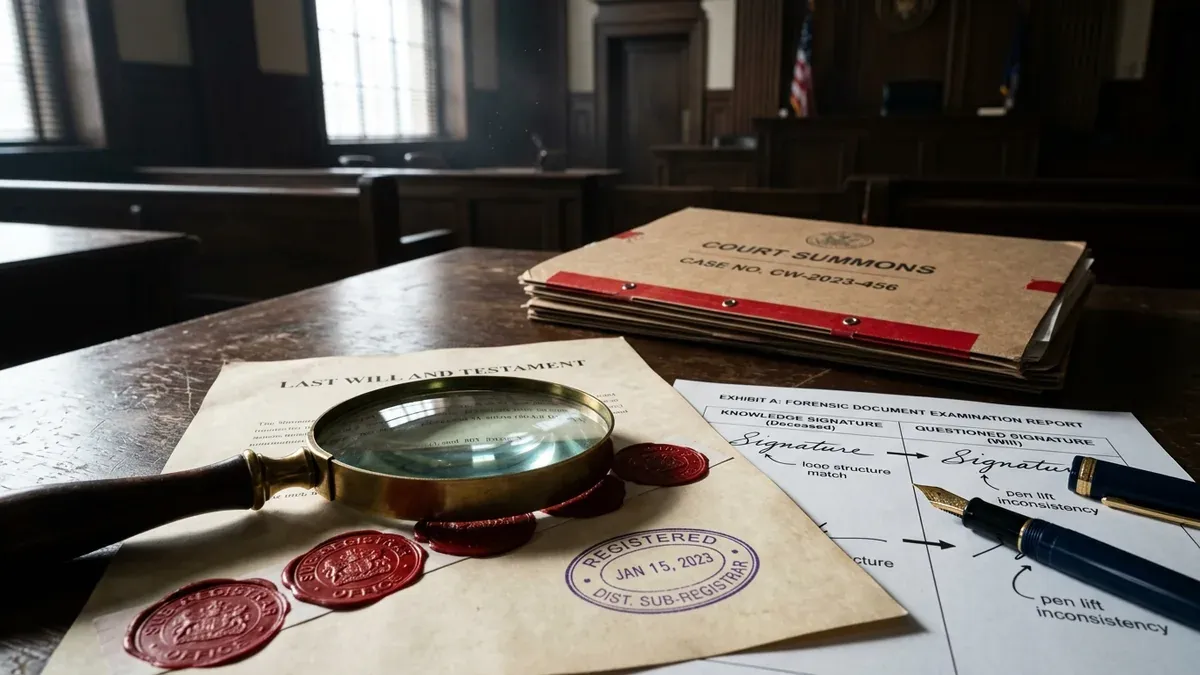
1. Statutory Framework: Indian Succession Act 1925 & BSA 2023
A Will is one of the most solemn legal instruments known to law. Unlike contracts, deeds of conveyance, or leases where both contracting parties are alive to confirm their intentions, a Will speaks from the death of the testator. Consequently, the testator is no longer present to affirm whether the instrument truly reflects their final wishes or whether it was procured through fraud, undue influence, or outright forgery.
The substantive and procedural law governing Wills in India is codified under:
- Section 59, Indian Succession Act, 1925: Defines testamentary capacity, mandating that every person of sound mind may dispose of property by Will.
- Section 61, Indian Succession Act, 1925: Declares that a Will or any part of a Will, the making of which has been caused by fraud or coercion, or by such importunity as takes away the free agency of the testator, is void.
- Section 63, Indian Succession Act, 1925: Mandates the execution formalities: the testator must sign or affix their mark, and the Will must be attested by two or more witnesses, each of whom must have seen the testator sign and must sign in the testator's presence.
- Sections 67 & 68, Bharatiya Sakshya Adhiniyam, 2023 (BSA): Mandates that a document required by law to be attested shall not be used as evidence until at least one attesting witness has been called to prove its execution.
2. Deconstructing the Registration Myth: Rani Purnima Debi to Kavita Kanwar
A pervasive misconception among lay citizens and even junior practitioners is that registering a Will before the Sub-Registrar under the Registration Act, 1908 makes it bulletproof and immune to legal challenge. The Supreme Court of India has repeatedly shattered this myth.
Rani Purnima Debi v. Kumar Khagendra Narayan Deb (1962) 3 SCR 195
A Constitution Bench of the Supreme Court held that the mere fact that a Will is registered does not per se wash away the suspicious circumstances attending its execution. The Court noted that registration is often carried out routinely by ministerial officers without any rigorous inquiry into the mental capacity of the testator or the voluntariness of the disposition.
Kavita Kanwar v. Pamela Mehta (2020) 14 SCC 235
In this authoritative modern ruling, a two-judge bench of the Supreme Court examined a registered Will where the major beneficiary had actively participated in drafting and registration, while other natural heirs were excluded without explanation. The Supreme Court set aside the probate of the registered Will, holding:
Supreme Court in Kavita Kanwar (2020):
"Registration of a Will by itself does not dispel all suspicion... The thick clouds of suspicious circumstances are not cleared merely by showing that the Will was registered. The propounder must show by satisfactory evidence that the Will was signed by the testator with a sound disposing mind and that they fully understood what they were signing."
3. Anatomy of Suspicious Circumstances: Landmark Judicial Precedents
The foundational jurisprudence on suspicious circumstances was laid down by the Constitution Bench in H. Venkatachala Iyengar v. B.N. Thimmajamma (1959) Supp (1) SCR 426. The Court established that where suspicious circumstances exist, the court will not grant probate or enforce the Will unless the propounder removes all such suspicions to the court's conscience.
Supreme Court jurisprudence categorizes the following recurring suspicious circumstances:
| Suspicious Circumstance Category | Factual Manifestation in Litigation | Leading Judicial Rulings |
|---|---|---|
| 1. Unnatural / Unexplained Disposition | Complete disinheritance of loving sons, daughters, or spouse in favor of a distant relative or stranger without assigning any plausible reasons. | Murthy v. C. Saradambal (2022 SC); Jaswant Kaur v. Amrit Kaur (1977 SC) |
| 2. Active Participation by Propounder | The sole beneficiary engaged the advocate, procured the stamp paper, was present during drafting, took the testator to the Sub-Registrar, and retained custody of the Will. | Kavita Kanwar v. Pamela Mehta (2020 SC); Guro v. Atma Singh (1992 SC) |
| 3. Cognitive Decline & ICU Hospitalization | Will purportedly executed while the testator was admitted in an ICU, under heavy sedation, suffering from end-stage dementia or delirium. | Niranjan Umeshchandra Joshi v. Mrudula Jyoti Rao (2006 SC) |
| 4. Disputed Shaky Signatures / Thumb Marks | An educated testator accustomed to signing elegant English signatures suddenly executing a crude thumb impression on the disputed Will. | Babu Singh v. Ram Sahai (2008 SC) |
| 5. Suspicious Attesting Witnesses | Attesting witnesses are total strangers, interested employees, or close personal associates of the propounder rather than trusted family doctors or friends. | Janki Narayan Bhoir v. Narayan Namdeo Kadam (2003 SC) |
4. Testamentary Capacity under Section 59: Proving Dementia, Fraud & Coercion
Under Section 59 of the Indian Succession Act, mere physical presence or the ability to mumble does not constitute testamentary capacity. The law demands a Sound Disposing Mind (the classic Banks v. Goodfellow doctrine). The testator must possess sufficient active memory to:
- Understand the nature of the act and its effects;
- Understand the extent of the property of which they are disposing; and
- Comprehend and appreciate the claims to which they ought to give effect.
To successfully challenge a Will on grounds of medical incapacity, counsel must immediately subpoena:
- Hospital Indoor Case Papers (ICP): Daily clinical progress sheets, Glasgow Coma Scale (GCS) scores, nursing medication charts showing narcotic/sedative administration.
- Neurological & Psychiatric Assessments: Mini-Mental State Examination (MMSE) scores proving moderate-to-severe cognitive impairment.
- Treating Doctor Testimony: Summoning the treating physician under Section 138 BSA to testify whether the patient was lucid, coherent, and capable of executing legal documents on the date of execution.
5. Mandatory Attestation Proof under Section 68 BSA (Old Section 68 IEA)
Section 63(c) of the Indian Succession Act requires that a Will must be attested by two or more witnesses. Section 68 of the BSA, 2023 mandates that at least one attesting witness must be examined in court to prove execution. In Janki Narayan Bhoir v. Narayan Namdeo Kadam (2003) 2 SCC 91, the Supreme Court held that the witness must not merely state that they signed the Will; they must specifically depose that the testator signed in their presence and that the second attesting witness also signed in their joint presence.
If an attesting witness admits in cross-examination that they signed at a different time, in a different room, or after the testator had already departed, the mandatory statutory requirement of Section 63(c) is shattered, rendering the Will null and void.
6. Procedural Litigative Pathways: Probate Caveat vs Civil Declaration Suit
An aggrieved legal heir has two primary procedural mechanisms to invalidate a fraudulent Will:
Pathway A: Filing a Caveat in Testamentary / Probate Court (Section 284)
In presidency towns (Mumbai, Kolkata, Chennai) or where probate is mandatory, when the propounder files a Probate Petition under Section 276, the legal heir must immediately lodge a Caveat under Section 284 accompanied by an Affidavit of Objections under Section 285. Once the caveat is entered, the probate petition is converted into a contested testamentary suit, and trial commences under CPC rules.
Pathway B: Civil Suit for Declaration & Partition (Section 34 Specific Relief Act)
In regions where probate is not mandatory (such as North India, Delhi, Haryana, Punjab, UP), the aggrieved heir must institute a regular civil suit before the Civil Judge / District Judge praying for: (1) A decree of declaration that the Will dated [Date] is forged, fabricated, null, and void; (2) Cancellation of the Will under Section 31 Specific Relief Act; and (3) Preliminary decree for partition under Order XX Rule 18 CPC, coupled with an interim injunction under Order 39 Rules 1 & 2 CPC restraining property alienation.
7. Forensic Cross-Examination Blueprint for Discrediting Propounder & Attestors
Trial counsel challenging a Will must deploy targeted cross-examination questions to dismantle the propounder's testimony:
| Witness Under Cross-Examination | Strategic Questions to Put | Forensic Objective |
|---|---|---|
| The Propounder / Beneficiary | "Who typed this Will? Who purchased the stamp papers? Where were you seated when the testator signed? Why did the testator not mention his married daughters?" | Extract admission of active participation, triggering the Kavita Kanwar doctrine of suspicious participation. |
| The Attesting Witness | "Did the testator read the Will aloud? What glasses was he wearing? Did you see the other witness sign? Did you receive any money or favor from the propounder?" | Expose failure of simultaneous attestation under Section 63(c) and demonstrate bias. |
| The Sub-Registrar / Clerk | "Did you personally inquire into the testator's medical condition? Did you read the contents over to the testator? Is there any medical certificate attached to the registry volume?" | Neutralize the registration presumption under Rani Purnima Debi. |
8. Specimen Draft: Caveat & Written Statement Challenging Fraudulent Will
Below is a standardized objection format for challenging a Will in probate or civil court:
IN THE COURT OF THE PRINCIPAL DISTRICT JUDGE / CIVIL JUDGE (SENIOR DIVISION)
AT [CITY, E.G., GURUGRAM / NEW DELHI]
CIVIL SUIT / TESTAMENTARY CASE NO. _______ OF 202X
IN THE MATTER OF:
[Plaintiff / Aggrieved Legal Heir] ... PLAINTIFF / OBJECTOR
VERSUS
[Propounder / Sole Beneficiary] ... DEFENDANT / PROPOUNDER
PRELIMINARY OBJECTIONS REGARDING SUSPICIOUS CIRCUMSTANCES & LACK OF TESTAMENTARY CAPACITY:
1. That the purported Will dated [DD/MM/YYYY] set up by the Defendant is a forged, fabricated, and fraudulent document procured under suspicious circumstances, having zero legal validity.
2. Lack of Sound Disposing Mind (Section 59): On the purported date of execution, the deceased testator was aged [85] years and was hospitalized in [Hospital Name] under intensive medical care for advanced vascular dementia and chronic renal failure, completely devoid of cognitive testamentary capacity.
3. Unnatural Exclusion of Natural Heirs: The alleged Will unnatural disinherits the Plaintiff, who was the loving and dutiful daughter of the deceased, without assigning any earthly reason, bestowing the entire estate upon the Defendant.
4. Active Participation by Defendant: The Defendant himself drafted the instrument, engaged his personal associates as attesting witnesses, and procured registration behind the back of the family, squarely falling within the suspicious circumstances doctrine in Kavita Kanwar v. Pamela Mehta (2020 SC).
5. Non-Compliance with Section 63: The mandatory statutory attestation requirements under Section 63(c) of the Indian Succession Act were never fulfilled.
PRAYER: It is respectfully prayed that this Hon'ble Court may be pleased to reject the purported Will dated [Date] as null, void, and fraudulent, and decree partition of the suit properties in equal shares.
OBJECTOR / PLAINTIFF THROUGH: ADVOCATE
Date: [DD/MM/YYYY] Place: [City]
9. Genuine vs Suspicious Will Evidentiary Comparison Matrix
| Evidentiary Factor | Indicative of a Genuine Will | Indicative of a Suspicious / Void Will |
|---|---|---|
| Testator's Health | Vigorous or stable health; accompanied by contemporaneous doctor's fitness certificate. | Admitted in ICU; bedridden; severe cognitive dementia; heavy psychoactive medications. |
| Disinheritance Rationale | Clear, cogent, affectionate reasons recorded explaining why specific heirs are provided for otherwise. | Total silence; abrupt and unnatural exclusion of natural heirs without explanation. |
| Propounder's Role | Passive role; Will prepared independently by testator's long-standing family solicitor. | Active role; propounder engaged scribe, bought stamp papers, and managed entire execution. |
| Attesting Witnesses | Independent family doctors, long-standing neighbors, or respected community elders. | Total strangers, domestic employees, or direct commercial associates of the propounder. |
| Signatures | Consistent with historical admitted signatures of testator on bank records. | Tremulous, hesitating, unnatural signatures or sudden thumb mark by an educated testator. |
Frequently Asked Questions on Challenging Registered Wills & Suspicious Circumstances
Comprehensive legal treatise on proving Will invalidity under Indian Succession Act, Kavita Kanwar doctrine, and Section 68 BSA attestation rules.
Does the mere fact that a Will is registered before the Sub-Registrar prove its validity?
No. The Supreme Court in Rani Purnima Debi v. Kumar Khagendra Narayan Deb and reiterated in Kavita Kanwar v. Pamela Mehta (2020) settled that mere registration of a Will does not per se attach a presumption of genuine testamentary capacity or wash away suspicious circumstances. Registration merely proves that a document was presented for registration. The propounder must independently satisfy the conscience of the court by proving execution under Section 63 of the Indian Succession Act, 1925 and removing all suspicious circumstances surrounding the Will.
What legally constitutes 'suspicious circumstances' surrounding a Will?
Suspicious circumstances recognized by the Supreme Court in H. Venkatachala Iyengar v. B.N. Thimmajamma (1959) and Murthy v. C. Saradambal (2022) include: (1) An unnatural, improbable, or unfair disposition of property, such as disinheriting natural heirs without cogent reasons; (2) Active and prominent participation of the propounder/sole beneficiary in drafting, procuring, or executing the Will; (3) Shaky, unnatural, or disputed signatures/thumb impressions of the testator; (4) Feeble physical health, severe cognitive decline, or ICU hospitalization of the testator at the time of execution; and (5) The attesting witnesses being strangers or close associates of the propounder rather than trusted family friends.
How must attestation of a Will be proved under Section 68 of Bharatiya Sakshya Adhiniyam, 2023?
Under Section 68 of BSA, 2023 (formerly Section 68 Indian Evidence Act) read with Section 63(c) of the Indian Succession Act, 1925, a Will cannot be received in evidence unless at least one attesting witness is examined to prove its execution. The attesting witness must testify: (1) That they saw the testator sign or affix their mark; (2) That the testator signed in the presence of both witnesses; and (3) That each witness signed the Will in the presence of the testator. If both witnesses turn hostile or deny execution, Section 69 BSA permits proving the handwriting of at least one witness and the testator.
What is testamentary capacity under Section 59 of the Indian Succession Act, 1925?
Under Section 59, every person of sound mind not being a minor may dispose of their property by Will. Testamentary capacity requires a 'sound disposing mind', meaning the testator must understand: (1) The nature and effect of the act of making a Will; (2) The extent and character of the property being disposed of; and (3) The claims of the natural heirs whom they are including or excluding. A doctor's fitness certificate issued contemporaneously with execution is strong, but not conclusive, evidence of testamentary capacity.
What is the limitation period for challenging a registered Will in civil court?
Under Article 58 of the Limitation Act, 1963, a suit for declaration that a registered Will is null, void, and inoperative must be filed within 3 years from the date when the right to sue first accrues—typically when the propounder sets up the Will or when the aggrieved heir first gains knowledge of the fraudulent instrument. In partition suits (Article 65), limitation is 12 years based on title.
Can a Will be challenged if the testator was suffering from Alzheimer's or dementia?
Yes. A Will executed by a person suffering from severe cognitive impairment, advanced Alzheimer's disease, or vascular dementia is void ab initio for lack of sound disposing mind under Section 59. Litigants must subpoena hospital medical records, neuro-psychiatric evaluations, and treating physicians to prove that the testator lacked mental capacity to comprehend the testamentary disposition on the date of execution.
What is the difference between Probate and Letters of Administration?
A Probate (granted under Section 276 of the Indian Succession Act) is an official court decree certifying that the Will was validly executed, issued exclusively to an executor named in the Will. Letters of Administration with Will Annexed (granted under Section 278) are issued to a beneficiary, legatee, or legal heir when no executor is appointed by the Will, or when the named executor dies or renounces probate.
What interim injunctions can be obtained pending a Will challenge suit?
Under Order 39 Rules 1 & 2 read with Section 151 CPC, an aggrieved legal heir can secure an interim temporary injunction restraining the propounder or third parties from alienating, selling, mortgaging, or creating third-party rights in the suit properties. Additionally, under Section 52 of the Transfer of Property Act, 1882 (Lis Pendens), any sale made during the pendency of the suit remains subject to the final court decree.