How to Cancel a Fraudulent or Forged Sale Deed in Civil Court: Section 31 Specific Relief Act
 Authored by: Advocate Kishan Kumar (Advocate & Legal Consultant)
Quick Summary & Strategic Key Takeaways
- Section 31 Specific Relief Act: The primary civil remedy to annul a fraudulent, forged, or sham conveyance is a suit for cancellation of instrument under Section 31 SRA, accompanied by an Order 39 temporary injunction.
- Sub-Registrar Incompetence (Satya Pal Anand): The Sub-Registrar cannot administratively cancel a registered deed; civil court intervention is the sole legal mechanism to extinguish registered title deeds.
- Suhrid Singh Court Fee Doctrine: Non-executants in possession seeking a declaration that a forged deed is void pay fixed nominal court fees; executants seeking cancellation of their own deed pay ad-valorem fees on sale value.
- Forensic Examination under BSA 2023: Forgery and impersonation must be established by summoning original registry records and securing expert forensic comparison under Section 39 of the Bharatiya Sakshya Adhiniyam.
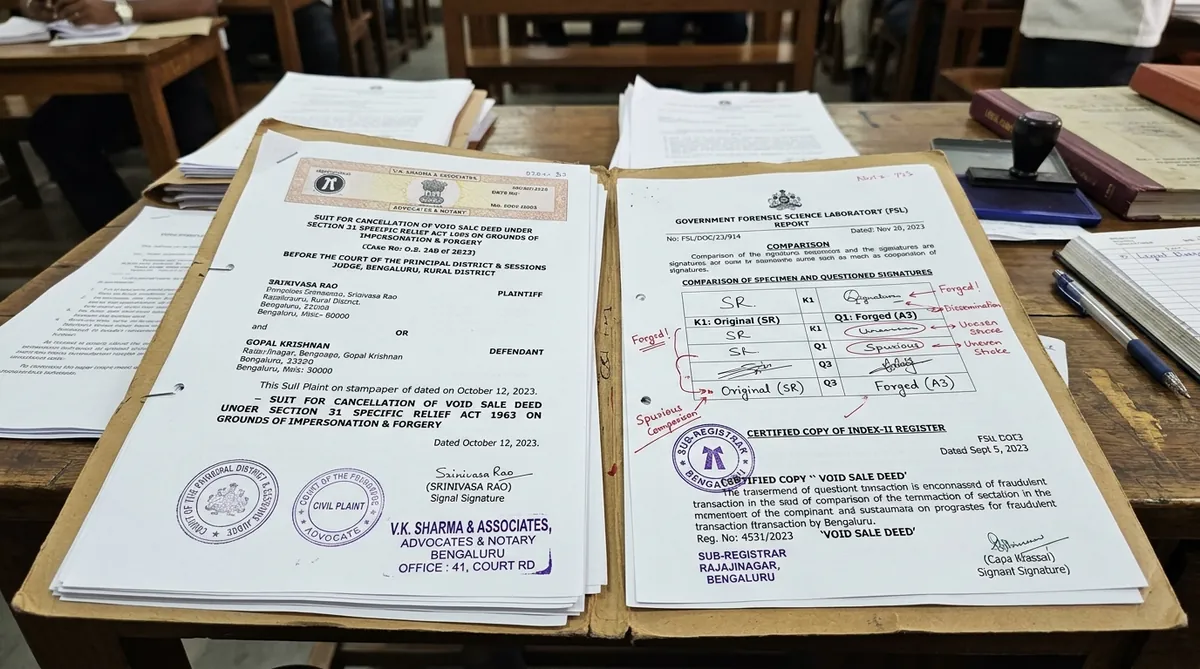
Property fraud, forged power of attorney deeds, impersonation at the Sub-Registrar office, and sham conveyances executed without payment of sale consideration represent some of the most aggressive threats to real estate ownership across Haryana and Delhi NCR. Because a registered sale deed carries a formidable statutory presumption of authenticity under Section 35 of the Registration Act, 1908 and Section 114 of the Bharatiya Sakshya Adhiniyam, 2023, an aggrieved property owner cannot simply lodge an administrative complaint with the revenue authorities to erase the transaction. Instead, the injured party must initiate a substantive civil suit for cancellation of the written instrument under Section 31 of the Specific Relief Act, 1963.
1. Statutory Architecture of Section 31 Specific Relief Act
The substantive power of civil courts to adjudicate upon tainted property documents is codified under Chapter V of the Specific Relief Act, 1963. Under Section 31(1) of the Specific Relief Act, any person against whom a written instrument is void or voidable, and who has reasonable apprehension that such instrument, if left outstanding, may cause him serious injury, may sue to have it adjudged void or voidable; and the court may, in its discretion, so adjudge it and order it to be delivered up and cancelled.
Three indispensable jurisdictional ingredients must coalesce before a civil court exercises its equitable jurisdiction under Section 31:
- Existence of a Void or Voidable Written Instrument: The impugned sale deed, conveyance, gift deed, or relinquishment deed must either be null in law from inception (void ab initio) or subject to avoidance at the option of the defrauded owner.
- Reasonable Apprehension of Serious Injury: The plaintiff must demonstrate that if the deed remains on the public record, it creates a cloud over proprietary title, jeopardizes peaceful possession, or exposes the owner to imminent dispossession, alienation, or mortgage encumbrances by fraudulent third parties.
- Equitable Judicial Discretion: The relief of cancellation is an equitable remedy governed by judicial conscience, requiring clean hands, lack of collusion, and prompt institutional approach.
Furthermore, under Section 31(2) of the Specific Relief Act, where the instrument has been registered under the Indian Registration Act, 1908, the Civil Court is legally mandated to send an official certified copy of its cancellation decree to the Sub-Registrar officer in whose office the instrument was originally entered. The registering officer must immediately note the fact of cancellation in his official registration books (Book No. 1 and related registers), formally extinguishing the document's legal existence on the public record.
Complementing Section 31 are two pivotal auxiliary provisions:
- Partial Cancellation (Section 32 SRA): Where an instrument conveys distinct rights or obligations regarding separate parcels of land, the court may, in appropriate cases, cancel the deed in part and allow the residue to stand.
- Restitution of Benefits (Section 33 SRA): The court possesses statutory authority to require the party to whom relief of cancellation is granted to restore any benefits received or make financial compensation to the other party to prevent unjust enrichment.
2. Substantive Grounds for Cancellation of Registered Deeds
Civil courts in Haryana (Faridabad, Gurugram, Rohtak) and Delhi recognize distinct factual and legal grounds that render a registered sale deed void or voidable:
- Total Impersonation & Forgery: Where the true owner never appeared before the Sub-Registrar and an impostor executed the deed using forged identity cards (Aadhaar/PAN). Under the fundamental doctrine nemo dat quod non habet (no one can give what they do not have), a forged conveyance transfers zero title and is void ab initio.
- Forged, Expired, or Revoked Power of Attorney: A conveyance executed on the basis of a General Power of Attorney (GPA) or Special Power of Attorney (SPA) that was forged, revoked prior to the date of execution, or terminated by operation of law upon the principal's demise under Section 201 of the Indian Contract Act, 1872.
- Suppression of Legal Heirs & Forged Death Certificates: Fraudsters presenting fabricated genealogical trees or falsified death certificates to execute sales of ancestral or co-parcenary land without the consent of lawful co-sharers.
- Execution by Minor or Mentally Incompetent Person: Contracts executed by a minor or a person of unsound mind are absolute nullities under Section 11 of the Indian Contract Act, 1872 (Mohori Bibee v. Dharmodas Ghose).
- Vitiated Consent (Fraud, Coercion, Undue Influence): Where elderly, uneducated, or vulnerable landowners are induced to sign conveyance deeds under the false representation that they are executing lease deeds, loan agreements, or maintenance documents.
- Total Failure of Consideration with Fraudulent Intent: While simple delayed payment does not invalidate an outright sale, where post-dated cheques or fictitious RTGS references were presented solely as an artifice of deceit with no intention of payment, civil courts adjudge the transaction a fraudulent sham.
3. Limitation Framework: Articles 56, 58 & 59 Limitation Act
The statutory clock governing cancellation suits represents one of the most rigorously litigated frontiers in Indian property law. The primary governing provision is Article 59 of the Schedule to the Limitation Act, 1963, which establishes a strict 3-year limitation window:
| Relief Claimed | Governing Article | Limitation Period | Commencement of Statutory Clock |
|---|---|---|---|
| To cancel or set aside an instrument or decree | Article 59 | 3 Years | When the facts entitling the plaintiff to have the instrument cancelled first become known to him. |
| To obtain any other declaration (e.g. deed is void) | Article 58 | 3 Years | When the right to sue first accrues. |
| To declare the forgery of an instrument issued or registered | Article 56 | 3 Years | When the issue or registration becomes known to the plaintiff. |
| Possession based on title (where deed is void ab initio) | Article 65 | 12 Years | When the possession of the defendant becomes adverse to the plaintiff. |
A crucial legal dichotomy exists between void and voidable instruments:
As clarified by the Supreme Court in Abdul Rahim v. Abdul Zabar (2009) 6 SCC 160 and Prem Singh v. Birbal (2006) 5 SCC 353, when an instrument is void ab initio (such as a forged sale deed executed through total impersonation), the true owner is not strictly bound to seek formal cancellation under Section 31. The owner may simply file a comprehensive suit for declaration of title and recovery of possession under Article 65 of the Limitation Act within 12 years, treating the forged deed as a complete legal nullity. However, where the owner was an executant whose consent was obtained through misrepresentation or undue influence (making the deed voidable), the 3-year limitation clock under Article 59 is strictly enforced from the date of discovery.
4. Court Fee Valuation & The Suhrid Singh Jurisprudence
Court fee calculation in sale deed cancellation suits often determines whether litigation is economically viable. In the landmark judgment of Suhrid Singh @ Sardool Singh v. Randhir Singh (2010) 12 SCC 112, the Supreme Court authoritatively resolved the conflict between Section 7(iv)(c) and Section 7(iv)(a) of the Court Fees Act, 1870:
The Two-Pronged Suhrid Singh Rule:
- When Plaintiff is an Executant: If the plaintiff was a party/signatory to the sale deed and seeks its cancellation, he must pay ad-valorem court fees on the consideration value stated in the instrument under Section 7(iv)(c) of the Court Fees Act.
- When Plaintiff is a Non-Executant: If the plaintiff was not an executant of the deed (e.g., a defrauded co-parcener, real owner impersonated by a stranger, or legal heir), he does not need to claim cancellation; he merely needs to seek a declaratory decree under Section 34 of the SRA that the deed is void, non-est, and ineffective against his rights. For such declaratory relief, only a fixed nominal court fee is payable under Article 17(iii) of Schedule II of the Court Fees Act.
5. Landmark Judicial Precedents of the Supreme Court
A constitutional bench of the Supreme Court held that the Sub-Registrar has no statutory authority under the Registration Act, 1908 to administratively recall, cancel, or set aside an already registered sale deed or extinguish deed, even if fraud or forgery is alleged. The plenary jurisdiction to adjudicate upon the validity of registered instruments vests solely in the Civil Court under Section 31 of the Specific Relief Act.
Held that mere non-payment of a portion or full sale consideration does not automatically render a registered sale deed void or voidable under Section 31, if the deed clearly expressed an intention to pass title immediately upon registration. The vendor's remedy in pure unpaid consideration cases is to sue for recovery of the unpaid price with statutory charge under Section 55(4)(b) of the Transfer of Property Act, unless contemporaneous fraud or misrepresentation at execution is established.
The Supreme Court held that where a party seeks cancellation of an instrument, Section 31 of the Specific Relief Act empowers the civil court to grant cancellation even if the plaintiff is not a party to the deed, provided he has reasonable apprehension of serious injury to his pre-existing proprietary rights.
Reaffirmed that when an order, transaction, or deed is void ab initio, it does not require a formal declaration or cancellation under Section 31. The aggrieved true owner can ignore the void instrument and directly institute a suit for recovery of possession within the 12-year window under Article 65.
6. Void vs Voidable Instruments: Comparative Legal Matrix
| Parameter | Void Ab Initio (Forgery / Impersonation) | Voidable (Coercion / Undue Influence) |
|---|---|---|
| Legal Status | Nullity from inception; transfers zero title in law | Valid and legally binding until set aside by civil court decree |
| Executant Status | Owner never signed; absolute imposture or forged GPA | Owner signed, but consent was vitiated by deceit, misrepresentation, or coercion |
| Remedy Required | Suit for Declaration that deed is void & nullity | Suit for Cancellation under Section 31 Specific Relief Act |
| Limitation Period | Article 65 (12 years for possession); Article 58 (3 years for declaration) | Article 59 (Strict 3 years from date of knowledge of fraud) |
| Court Fees | Fixed declaratory fee if non-executant (Suhrid Singh) | Ad-valorem on consideration if plaintiff signed the deed |
| Subsequent Transferee | Nemo dat quod non habet: third parties acquire zero title | Bona fide purchaser for value before cancellation may claim protection |
7. Interim Injunctions (Order 39 CPC) & Lis Pendens Protection
When a fraudulent deed has been registered, the fraudster's primary objective is to swiftly flip the land to third-party purchasers or execute construction to alter the property's physical topography. Defeating this stratagem requires an aggressive two-tier interlocutory defense:
- Temporary Injunction under Order XXXIX Rules 1 and 2 CPC:
The plaintiff must file an application for temporary injunction supported by an affidavit under Order 39 Rules 1 and 2 read with Section 151 CPC concurrently with the plaint. The court must be satisfied of three vital parameters:
- Prima Facie Case: Demonstrating clear registered title preceding the forged conveyance.
- Balance of Convenience: Proving that greater hardship will befall the rightful owner if the property is mutated or alienated than will befall the defendant by maintaining the status quo.
- Irreparable Injury: Establishing that creation of multi-layered third-party interests or demolition of structures cannot be adequately compensated in monetary damages.
- Doctrine of Lis Pendens under Section 52 Transfer of Property Act, 1882: Section 52 mandates that during the active pendency in any court of competent jurisdiction of any suit in which any right to immovable property is directly and specifically in question, the property cannot be transferred or otherwise dealt with by any party to the suit or proceeding so as to affect the rights of any other party thereto under any decree or order which may be made therein. Any subsequent purchaser during litigation is legally bound by the ultimate judgment under constructive notice.
8. Forensic Evidence & Expert Examination under Bharatiya Sakshya Adhiniyam, 2023
Proving forgery in a civil suit for cancellation of a registered sale deed requires concrete, admissible scientific evidence. When an impostor executes a conveyance or signatures are forged, the statutory burden rests squarely upon the plaintiff under Section 104 of BSA 2023 (old Section 101 Indian Evidence Act). To discharge this burden, civil courts rely on forensic document analysis under Section 39 and Section 72 of BSA 2023 (old Sections 45 and 73 Indian Evidence Act).
The plaintiff must move an application under Order XI and Order XVI of the Code of Civil Procedure (CPC) to summon original registration volumes (Bahi No. 1), Thumb Impression Registers, and electronic biometric logs from the Sub-Registrar’s Office (Tehsil). The Civil Court dispatches these questioned instruments alongside admitted, contemporaneous specimen signatures to the State Forensic Science Laboratory (FSL Madhuban in Haryana or CFSL Delhi). Forensic analysis inspects tremor of fraud, pen lifts, line quality, microscopic ink degradation, and ridge characteristics of papillary patterns, establishing conclusive proof of impersonation.
9. Revenue Mutation (Intiqal) Rectification in Haryana
A frequent dilemma confronting defrauded landowners in Haryana (Faridabad, Gurugram, Palwal, Sonipat) is that fraudsters quickly get the land mutated in revenue records following registration of a sham deed. Under Section 34 of the Punjab Land Revenue Act, 1887 (as applicable to Haryana), a mutation entry (Intiqal) is sanctioned purely for fiscal and land revenue assessment purposes. As repeatedly held by the Supreme Court in Bhimabai Mahadeo Kambekar v. Arthur Import & Export Co. (2019) and Prahlad Pradhan v. Sonu Kumhar (2019), revenue mutation entries do not confer, extinguish, or create proprietary title.
Upon instituting a civil suit under Section 31 of the Specific Relief Act, the plaintiff must immediately serve a formal notice of the pending litigation alongside an interim stay order to the Halqa Patwari and Tehsildar/Revenue Assistant. The revenue officer is legally required under Paragraph 7.25 of the Punjab Land Records Manual to record a Red Ink Entry (Roznamcha Waqiati) denoting the lis pendens challenge, thereby arresting any subsequent issuance of misleading Jamabandi or Fard records to prospective innocent buyers.
10. Step-by-Step Civil Litigation Protocol to Cancel Fraudulent Deeds
Executing a flawless civil action to nullify a forged or fraudulent conveyance requires a coordinated statutory protocol under the Specific Relief Act, CPC, and BSA 2023:
Apply immediately for certified copies of the impugned sale deed, GPA, index inspection, and registration photographs from the Sub-Registrar Office under Section 57 of the Registration Act. Obtain current Jamabandi, Inteqal, and Aks Shajra records from the Tehsil.
Under Order VI Rule 4 of the Code of Civil Procedure, general allegations of fraud are fatal. The plaint must state exact dates, specific acts of forgery, particulars of impersonation, failure of consideration, and the precise date on which the plaintiff acquired knowledge of the deed.
File the suit before the Civil Judge (Senior Division) having territorial and pecuniary jurisdiction. Move an urgent application under Order XXXIX Rules 1 & 2 read with Section 151 CPC for an immediate ex-parte injunction restraining any alienation, alteration, or revenue mutation.
Serve certified copies of the plaint and stay order upon the Tehsildar and Patwari to endorse red-ink lis pendens entries in the Roznamcha Waqiati. Register formal notice under Section 52 Transfer of Property Act with the Sub-Registrar.
Under Order XVI CPC, summon the original Sub-Registrar register and biometric logs. Apply to the court under Section 39 & 72 BSA 2023 to dispatch questioned signatures and thumb impressions to the State FSL for scientific forensic comparison.
Upon decreeing the suit, obtain certified copies of the judgment and decree. Move the court to transmit a certified copy to the Sub-Registrar under Section 31(2) Specific Relief Act for mandatory cancellation endorsement in registration records, followed by revenue mutation sanction restoring the plaintiff's ownership.
Actionable Litigation Checklist for Aggrieved Property Owners
- Immediate Certified Copy Retrieval: Apply under Section 57 of the Registration Act, 1908 for certified copies of the fraudulent conveyance and all underlying powers of attorney from the Sub-Registrar's Office.
- Urgent Order 39 Injunction Filing: Ensure the civil plaint is accompanied by an urgent application under Order XXXIX Rules 1 & 2 CPC for temporary restraining orders against alienation and construction.
- Registration of Lis Pendens Notice: Submit an application under Section 52 Transfer of Property Act to the Sub-Registrar and Revenue Assistant to record pending litigation in the revenue registers.
- Concurrently File Criminal Complaint under BNS 2023: Lodge a criminal complaint under Sections 318(4) (Cheating), 336(3) (Forgery), and 340(2) (Forged document used as genuine) of the Bharatiya Nyaya Sanhita, 2023.
- Preserve Admitted Contemporaneous Specimen Signatures: Assemble registered deeds, bank KYC cards, and passport documents bearing specimen signatures executed during the same time period for comparative FSL examination.
Statutory Authorities & Legal References
- Specific Relief Act, 1963: Sections 31 (Cancellation of instruments), 32 (Partial cancellation), 33 (Restitution of benefits), and 34 (Discretion of court as to declaration of status or right).
- Code of Civil Procedure, 1908: Order VI Rule 4 (Particulars of fraud), Order VII Rule 11 (Rejection of plaint), Order XI (Discovery and inspection), Order XVI (Summoning witnesses), and Order XXXIX Rules 1 & 2 (Temporary injunctions).
- Indian Registration Act, 1908: Sections 17 (Compulsory registration), 47 (Time from which registered document operates), and 57 (Inspection and certified copies).
- Bharatiya Sakshya Adhiniyam, 2023: Section 39 (Opinions of experts), Section 72 (Comparison of signature, writing or seal), Section 104 (Burden of proof), and Section 114 (Presumption as to certain documents).
- Court Fees Act, 1870 (Haryana & Delhi Amendments): Section 7(iv)(c) (Suits for declaratory decree with consequential relief) and Schedule II Article 17(iii).
- Punjab Land Revenue Act, 1887: Section 34 (Report of acquisition of rights) and Paragraph 7.25 Punjab Land Records Manual.
Frequently Asked Questions
Authoritative statutory guidance on property deed cancellation in Haryana & Delhi NCR civil courts.
Can the Sub-Registrar cancel a registered Sale Deed administratively?
No. As definitively settled by the Supreme Court of India in Satya Pal Anand v. State of M.P. (2016) 10 SCC 767, once a sale deed is registered, the Sub-Registrar is functus officio and possesses zero statutory power under the Registration Act, 1908 to cancel or rescind the conveyance. Only a competent Civil Court has exclusive plenary jurisdiction under Section 31 of the Specific Relief Act, 1963 to cancel or declare void a registered document.
When does the 3-year limitation clock start for forged property deeds?
Under Article 59 of the Schedule to the Limitation Act, 1963, the 3-year limitation period begins from the date when the facts entitling the plaintiff to have the instrument cancelled or set aside first become known to him, not from the date of fraudulent execution or registration. Furthermore, where a deed is void ab initio due to total impersonation, the Supreme Court held in Abdul Rahim v. Abdul Zabar (2009) that the true owner may seek a declaration of title under Article 65 within 12 years.
How does Section 52 of the Transfer of Property Act (Lis Pendens) protect a plaintiff?
Section 52 of the Transfer of Property Act, 1882 establishes the doctrine of lis pendens: during the active pendency of a contentious civil suit involving immovable property, the property cannot be transferred or alienated by any party so as to affect the rights of any other party under the decree. Any subsequent purchaser during litigation is bound by the court's ultimate decree under the rule of constructive notice, precluding them from claiming bona fide purchaser status.
What is the rule for court fees in sale deed cancellation suits under Suhrid Singh?
Under the Supreme Court's landmark ruling in Suhrid Singh @ Sardool Singh v. Randhir Singh (2010) 12 SCC 112: (1) If the plaintiff is an executant of the deed seeking cancellation, ad-valorem court fees under Section 7(iv)(c) of the Court Fees Act on the consideration mentioned in the sale deed must be paid; (2) If the plaintiff is a non-executant not bound by the deed seeking a declaration that the deed is void and ineffective against him, only a fixed declaratory court fee is payable.
Can a bona fide purchaser for value claim title if their seller bought via a forged deed?
No. Under the fundamental common law maxim nemo dat quod non habet (no one can confer a better title than he himself possesses), a forged or impersonated conveyance is void ab initio—an absolute legal nonentity. Because the fraudster acquired zero legal title, no title could pass to subsequent buyers, regardless of their good faith or payment of full market consideration (State of Maharashtra v. Pravin Jethalal Kamdar).
What forensic evidence is required under BSA 2023 to prove forgery in court?
Under Section 39 and Section 72 of Bharatiya Sakshya Adhiniyam, 2023 (BSA), the plaintiff must move an application under Order XI and Order XVI CPC to summon original registration volumes (Bahi No. 1) and biometric Thumb Impression Registers from the Sub-Registrar's Office. These questioned signatures and thumb impressions are dispatched to the State Forensic Science Laboratory (such as FSL Madhuban in Haryana or CFSL Delhi) for comparative ridge and handwriting analysis alongside admitted contemporaneous documents.
How can a plaintiff prevent subsequent sales or construction while the suit is pending?
The plaintiff must file an application under Order XXXIX Rules 1 and 2 read with Section 151 CPC for a temporary injunction on the very day of filing the suit. Upon establishing a prima facie case, balance of convenience, and irreparable injury, the Civil Court grants an ad-interim injunction restraining the defendant from alienating, encumbering, creating third-party interests, or raising construction on the suit property.
How does a civil court cancellation decree affect the official registration records?
Under Section 31(2) of the Specific Relief Act, 1963, the Civil Court is legally mandated to send a certified copy of its cancellation decree to the Sub-Registrar officer in whose office the instrument was registered. The registering officer must then make an official entry of cancellation in the registration books (Book 1 index), extinguishing the deed from official public record.