Delayed Flat Possession: Filing in Consumer Court (NCDRC/State Commission) vs. RERA (Supreme Court Rules)
 Authored by: Advocate Kishan Kumar (Advocate & Legal Consultant)
Quick Summary & Strategic Key Takeaways
- Supreme Court Doctrine of Concurrent Jurisdiction: In Imperia Structures Ltd. v. Anil Patni (2020), the Supreme Court ruled that RERA does not bar Consumer Courts. Aggrieved homebuyers have an absolute statutory choice to seek relief under the Consumer Protection Act 2019 or the RERA Act 2016.
- Right to Full Refund under Section 18 RERA: If a developer fails to deliver possession according to the Builder-Buyer Agreement (BBA), the homebuyer has an unconditional right to withdraw from the project and claim a full refund of all amounts paid, along with statutory interest at SBI MCLR + 2%.
- One-Sided Clauses Declared Void: Under Pioneer Urban v. Govindan Raghavan (2019), one-sided agreement clauses that impose 18% penal interest on buyers for late payment but offer a paltry Rs. 5 per sq. ft. for builder delays constitute unfair trade practices and are legally void.
- Enforcement Comparison: While RERA enforces orders via Section 40 Recovery Certificates to the District Collector (arrears of land revenue), Consumer Commissions possess direct criminal contempt and attachment powers under Section 71 and 72 of the Consumer Protection Act 2019, including imprisonment up to 3 years.
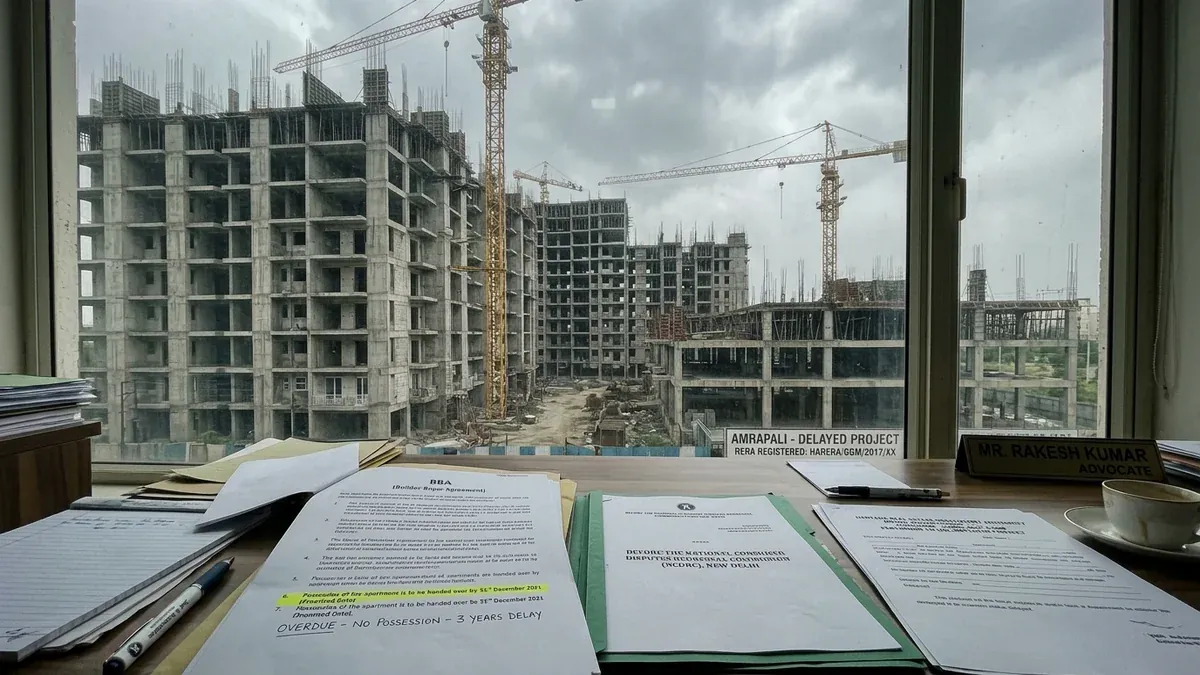
1. The Concurrent Jurisdiction Doctrine: Imperia Structures & Pioneer Urban
For millions of urban property buyers across the National Capital Region (Gurgaon, Noida, Greater Noida, Faridabad) and metropolitan India, builder possession delays represent devastating financial trauma. Buyers find themselves servicing crushing bank home loan EMIs while simultaneously paying commercial house rent. When projects languish years past promised completion dates, the most critical legal decision is selecting the right forum: the Real Estate Regulatory Authority (RERA) or the Consumer Disputes Redressal Commission.
Following the enactment of the Real Estate (Regulation and Development) Act, 2016 (RERA), real estate promoters routinely raised preliminary objections before Consumer Commissions, arguing that Section 79 of RERA ousted the jurisdiction of all consumer forums. This jurisdictional dispute was permanently laid to rest by a sequence of landmark Supreme Court judgments.
A. Imperia Structures Ltd. v. Anil Patni (2020 10 SCC 783)
In this watershed judgment, a two-judge bench of the Supreme Court analyzed Section 79, Section 88, and Section 89 of RERA alongside the Consumer Protection Act. The Apex Court held:
- Section 79 of RERA bars the jurisdiction of ordinary Civil Courts, but Consumer Commissions established under the Consumer Protection Act are specialized judicial/quasi-judicial tribunals and not civil courts within the meaning of the Code of Civil Procedure, 1908.
- Section 88 of RERA explicitly declares that the provisions of RERA are in addition to, and not in derogation of, the provisions of any other law for the time being in force.
- Therefore, the remedies available to allottees under the Consumer Protection Act are concurrent and alternative. An aggrieved homebuyer possesses the unfettered legal prerogative to elect whether to initiate proceedings before RERA or before the Consumer Commission.
B. Pioneer Urban Land & Infrastructure Ltd. v. Govindan Raghavan (2019 5 SCC 725)
In Pioneer Urban, the Supreme Court struck a decisive blow against standard one-sided builder-buyer agreements. The developer’s contract stipulated that if an allottee delayed installment payments, they were liable to pay compound interest at 18% per annum, whereas if the developer delayed possession, the developer was liable to pay a nominal delay compensation of only Rs. 5 per square foot per month (amounting to barely 1.5% per annum). The Supreme Court ruled:
- Such contractual terms are entirely one-sided, oppressive, and constitute an Unfair Trade Practice under the Consumer Protection Act.
- A developer cannot compel an allottee to accept possession after an unreasonable delay. An allottee who has waited beyond the contractual delivery date is fully justified in terminating the contract and claiming a 100% refund of the consideration along with substantial compensatory interest.
C. Experion Developers Pvt. Ltd. v. Sushma Ashok Shiroor (2022 SC)
Reaffirming Imperia Structures, the Supreme Court confirmed that Consumer Commissions have the statutory authority to direct full restitution, refund, and compensatory interest calculated from the date of each installment deposit up to the date of actual payment.
2. Detailed Comparative Matrix: RERA vs. Consumer Commission vs. NCLT
Homebuyers must carefully evaluate the jurisdictional, pecuniary, and operational parameters of each judicial forum before filing their claims.
| Operational Parameter | Consumer Commission (CPA 2019) | Real Estate Regulatory Authority (RERA) | Insolvency Tribunal (NCLT / IBC) |
|---|---|---|---|
| Governing Statute | Consumer Protection Act, 2019 | RERA Act, 2016 | Insolvency & Bankruptcy Code, 2016 |
| Pecuniary Tier Thresholds | District: ≤ ₹50L State: ₹50L – ₹2 Cr NCDRC: > ₹2 Cr (Consideration Paid) |
No pecuniary ceiling. Handles projects regardless of valuation. | Minimum default threshold of ₹1 Crore against the corporate debtor. |
| Filing Threshold | Individual allottee can file independently. | Individual allottee can file independently. | Mandatory minimum 100 buyers or 10% of total allottees in project. |
| Primary Relief Focus | Full refund, high interest, mental agony damages, unfair trade practices. | Handover of possession, project monitoring, statutory delay interest (MCLR+2%). | Resolution of corporate debtor; liquidation or takeover by new promoter. |
| Interim Protections | Power to stay cancellation and restrain demand notices. | Power to restrain promoter from alienating project inventory (Sec 36). | Moratorium under Section 14 halts all other ongoing proceedings. |
| Enforcement Teeth | Civil imprisonment up to 3 years, bailable/non-bailable warrants (Sec 71/72). | Recovery Certificate to District Collector as arrears of land revenue (Sec 40). | Control of company transferred to Resolution Professional (RP). |
3. Strategic Election: When to Choose the Consumer Commission (NCDRC)
While RERA is an excellent regulatory mechanism, the Consumer Court is distinctly superior under specific litigation scenarios:
- When the Primary Objective is a Full Cash Refund: If a buyer has lost complete trust in the builder and cannot afford to wait for speculative project completion, Consumer Commissions have an unblemished record of directing complete refunds of principal consideration with compensatory interest ranging from 9% to 12% per annum.
- High-Value Properties (Consideration Paid > Rs. 2 Crores): If an allottee has paid more than Rs. 2 Crores in total deposits, the complaint can be instituted directly before the National Consumer Disputes Redressal Commission (NCDRC) in New Delhi. This bypasses lower state tribunals and provides direct access to a national bench whose final orders are appealable exclusively to the Supreme Court of India under Section 67 of the CPA 2019.
- Oppressive Agreement Terms & Unfair Contracts: Section 2(46) of the Consumer Protection Act, 2019 explicitly codifies the doctrine of "Unfair Contract". Only Consumer Commissions possess the explicit statutory power to declare unilateral forfeiture clauses, disproportionate interest penalties, and unfair escalation clauses null and void.
- Robust Criminal Execution Powers: Under Section 72 of the CPA 2019, if a builder fails to comply with a consumer decree, the commission sits as a Judicial Magistrate of the First Class and can issue non-bailable warrants (NBWs) and commit directors of the real estate company to civil prison for terms up to three years. This threat of immediate incarceration provides unprecedented leverage in securing compliance.
4. Strategic Election: When to Choose RERA for Project Completion & Possession
Conversely, initiating a statutory complaint before RERA (e.g., HARERA Gurugram/Panchkula, UP RERA, or Delhi RERA) is the strategically superior path under the following circumstances:
- When the Buyer Prioritizes Physical Possession Over Refund: If the project is 80% to 90% physically completed and the buyer genuinely wants the flat (e.g., due to massive capital appreciation in the locality), RERA has comprehensive statutory machinery to monitor site progress, inspect construction milestones under Section 35, and ensure timely completion.
- Claiming Continuous Monthly Delay Interest: Under Section 18(1) second proviso of RERA, an allottee who chooses to remain in the project is entitled to monthly interest at the statutory rate (SBI MCLR + 2%) for every single month of delay until possession is formally handed over with an Occupancy Certificate. RERA authorities routinely order builders to pay this interest every month or adjust it against final demand letters.
- Faster Adjudication on Preliminary Non-Compliance: RERA benches operate on streamlined summary procedures with specialized technical members who understand construction milestones and floor-area calculations intimately.
- Revocation of Promoter Registration: Under Section 7 and 8 of RERA, if a developer abandons a project or indulges in persistent defaults, RERA can revoke the project's registration, freeze the promoter's designated 70% escrow bank account, and consult with the association of allottees (RWA) to take over and complete construction.
5. Debunking Force Majeure, Grace Periods & Illegal Holding Charges
When faced with possession delay claims, real estate promoters universally raise boilerplate defense mechanisms that have been consistently dismantled by the judiciary:
A. The Myth of Seasonal Force Majeure
Builders routinely plead that winter construction bans imposed by the National Green Tribunal (NGT) or Commission for Air Quality Management (CAQM) in NCR constitute Force Majeure events justifying 6 to 12 months of delay. The Supreme Court in Pioneer Urban and NCDRC in numerous judgments held that annual winter air quality dips and temporary construction pauses are foreseeable seasonal realities in North India, not unexpected catastrophes. A commercial developer is expected to price and factor foreseeable seasonal pauses into their construction roadmap.
B. Unilateral Grace Periods
Most BBAs stipulate a completion period of 36 months plus an automatic "6-month grace period". Courts have clarified that a grace period cannot be invoked automatically as a matter of contractual right. The developer must affirmatively establish with documentary proof that unforeseen circumstances occurred during the original term that necessitated invoking the grace window.
C. Illegal Holding Charges Without Occupancy Certificate (OC)
Developers frequently issue "intimations of possession" or "offer of fit-out possession" when a tower is barely structurally complete, demanding final installment balances, escalated super area charges, and threatening "holding charges" of Rs. 5 to Rs. 10 per sq. ft. per month if the buyer fails to take possession. The law on this point is unequivocal: An offer of possession without a valid, legally issued Occupancy Certificate (OC) is an absolute nullity (Wg. Cdr. Arifur Rahman Khan v. DLF Southern Homes). A homebuyer is under zero legal obligation to accept fit-out possession, and no holding charges can ever be levied prior to the receipt of an authentic OC.
6. Execution Warfare: Section 40 RERA Warrants vs. Section 72 CPA Contempt
Obtaining a favorable judgment is only half the battle; the real legal challenge lies in debt realization. The two forums employ fundamentally different execution mechanisms:
Execution Under RERA (Section 40)
When a builder fails to satisfy a monetary order, RERA issues a Recovery Certificate (RC) under Section 40, forwarding it to the District Magistrate / Collector of the relevant district (e.g., Gurugram, Gautam Buddha Nagar). The Collector initiates recovery under the Punjab Land Revenue Act, 1887 or UP Revenue Code, 2006 as arrears of land revenue. While powerful on paper, this process is frequently bottlenecked by administrative inertia at the local Tehsildar level, requiring aggressive writ petitions under Article 226 before the High Court to compel the Collector to execute the RC.
Execution Under Consumer Protection Act (Section 71 & 72)
Under Section 71 of the CPA 2019, a consumer order is executed directly as a civil court decree under Order XXI CPC (attachment of bank accounts, appointment of court receivers). More importantly, under Section 72, non-compliance is treated as a criminal offense punishable with imprisonment up to 3 years and fines. Because the Consumer Commission issues non-bailable arrest warrants directly to the Commissioner of Police, real estate directors face immediate detention, leading to rapid out-of-court settlements and bank transfers.
7. Frequently Asked Questions (FAQs)
Frequently Asked Questions
Strategic legal guidance on choosing between Consumer Courts and RERA for delayed flat possession
Can a homebuyer file cases in both RERA and the Consumer Forum simultaneously?
No. While the Supreme Court in Imperia Structures Ltd. v. Anil Patni (2020) affirmed that homebuyers have concurrent remedies and can choose either RERA or the Consumer Forum, you cannot maintain two parallel proceedings for the exact same relief against the same builder. Once you elect a forum and pursue it to adjudication, parallel litigation on the identical cause of action is barred by the doctrine of election and risk of conflicting decrees. However, you can withdraw a pending complaint from one forum and move to another if allowed by the court.
What is the statutory interest rate awarded for delayed possession under RERA?
Under Rule 15 of the Haryana Real Estate (Regulation and Development) Rules, 2017 (and corresponding rules in Delhi, UP, and Maharashtra), the statutory interest payable by a promoter for delayed possession under Section 18 of RERA is pegged to the State Bank of India (SBI) highest Marginal Cost of Funds Based Lending Rate (MCLR) plus two percent (+2%). This currently translates to approximately 10.75% to 11.15% per annum, calculated from the promised date of possession until actual handover.
What is the difference in pecuniary jurisdiction between District, State, and National Consumer Commissions?
Under the Consumer Protection (Pecuniary Jurisdiction) Rules, 2021 framed under the Consumer Protection Act, 2019, pecuniary jurisdiction is determined strictly by the total 'consideration paid' rather than the overall property value or damages claimed: (1) District Consumer Commission: up to Rs. 50 Lakhs; (2) State Consumer Commission: above Rs. 50 Lakhs up to Rs. 2 Crores; (3) National Consumer Disputes Redressal Commission (NCDRC): exceeding Rs. 2 Crores.
Can a builder justify possession delays by citing 'Force Majeure' like NGT bans or labor strikes?
No. The Supreme Court in Pioneer Urban Land and Experion Developers has categorically ruled that standard commercial eventualities—such as routine seasonal winter construction bans by the National Green Tribunal (NGT), demonetization, local labor shortages, or contractor disputes—do not qualify as Force Majeure events. Force Majeure is strictly confined to unexpected, insurmountable acts of God (vis major) or government-mandated project lockdowns that make performance physically impossible.
Can a builder force a buyer to pay holding charges or maintenance before obtaining an Occupancy Certificate?
Absolutely not. In landmark rulings such as Wg. Cdr. Arifur Rahman Khan v. DLF Southern Homes (2020), the Supreme Court ruled that an offer of possession made without a valid Occupancy Certificate (OC) or Completion Certificate (CC) issued by the competent municipal planning authority is legally invalid. A builder cannot demand holding charges, advance maintenance, or final consideration until a legal offer of possession is accompanied by an authenticated OC.
Which forum is better if a homebuyer wants a 100% refund with interest rather than the flat?
The Consumer Court (NCDRC or State Commission) is traditionally preferred for complete refunds and heavy compensatory damages for mental harassment, as consumer commissions have broad equitable jurisdiction to restore the consumer to their original financial status. While RERA also provides for refunds under Section 18, execution of RERA refund orders through District Revenue Collectors can sometimes face bureaucratic delays.
How are RERA Recovery Certificates executed against defaulting real estate promoters?
Under Section 40 of RERA read with the relevant state rules, when a promoter fails to pay the refund or compensation awarded, the Authority issues a Recovery Certificate (RC) to the District Collector. The Collector is legally empowered to recover the amount as arrears of land revenue by attaching the promoter's corporate bank accounts, auctioning unsold inventory, or attaching the developer's personal real estate assets.
What is the threshold for homebuyers to initiate insolvency proceedings under the IBC?
Under Section 7 of the Insolvency and Bankruptcy Code, 2016 (amended by the 2020 Amendment Act), individual homebuyers cannot file for corporate insolvency resolution alone. A joint application must be filed by either at least one hundred (100) allottees or not less than ten percent (10%) of the total allottees under the same real estate project, whichever is less. Because of this high threshold, Consumer Commissions and RERA remain the primary individual remedies.