Blank Signed Cheques & Section 20 NI Act: Implied Authority, Limits, and Rebutting Section 139

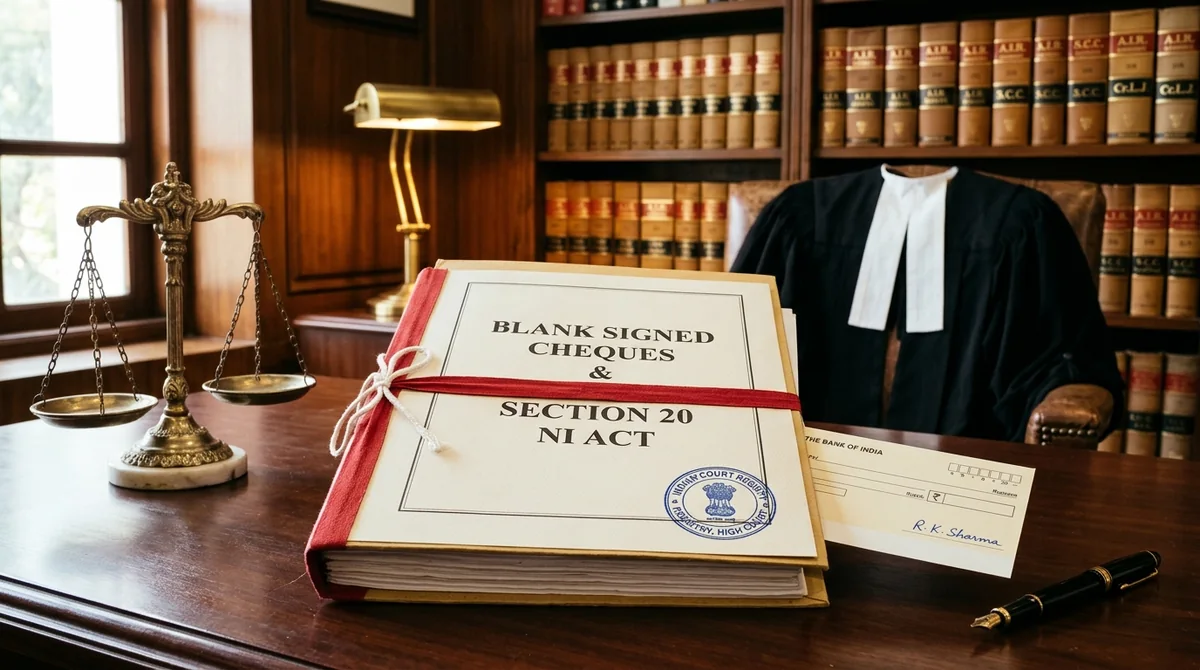
Executive Legal Brief
- Under Section 20 of the Negotiable Instruments Act, 1881, handing over an inchoate (incomplete) signed instrument grants prima facie implied authority to the holder to complete the instrument.
- In Bir Singh v. Mukesh Kumar (2019), the Supreme Court ruled that a cheque signed by the drawer and delivered voluntarily attracts the Section 139 presumption even if filled in by another person or in different ink.
- However, implied authority is legally circumscribed: the holder can fill in only the amount representing the actual, existing, legally enforceable debt, not an arbitrary or extortionate sum.
- Filling an amount exceeding actual liability or presenting a security cheque when no debt subsists constitutes unauthorized material alteration under Section 87 NI Act, rendering the instrument void.
Key Statutory Provisions & Regulatory Framework
| Statutory Provision / Doctrine | Legal Operation & Judicial Impact |
|---|---|
| Section 20 NI Act | Inchoate stamped instruments: Drawer gives implied prima facie authority to the holder to fill particulars. |
| Section 87 NI Act | Material alteration: Any unauthorized material alteration renders a negotiable instrument void against non-consenting parties. |
| Section 139 NI Act | Statutory presumption that the cheque was received for the discharge of a legally enforceable debt or liability. |
| Bir Singh (2019) 4 SCC 197 | Supreme Court: Person signing blank cheque is liable; filling particulars by payee does not invalidate instrument. |
| Kalamani Tex (2021) 5 SCC 283 | Supreme Court: Admission of signature triggers Section 139 presumption; drawer must raise a probable defense. |
1. The Concept of Inchoate Instruments: Section 20 of the NI Act
In commercial transactions, banking facilities, and property leases, borrowers and tenants frequently hand over blank signed cheques as security or convenience instruments. When relations sour, payees often fill in exorbitant figures, present the cheques, and initiate criminal proceedings under Section 138 of the Negotiable Instruments Act upon dishonour.
To understand the legal parameters governing blank cheques, one must examine Section 20 of the Negotiable Instruments Act, 1881, which codifies the law on Inchoate Stamped Instruments:
'Where one person signs and delivers to another a paper stamped in accordance with the law relating for the time being in force in India, and either wholly blank or having written thereon an incomplete negotiable instrument, he thereby gives prima facie authority to the holder thereof to make or complete upon it a negotiable instrument, for any amount specified therein and not exceeding the amount covered by the stamp.'
By delivering a signed cheque leaf without filling the payee name, date, or amount, the drawer legally confers an implied authority upon the payee to complete the negotiable instrument and make it operative.
2. The Landmark Bir Singh v. Mukesh Kumar Doctrine
For decades, accused drawers sought to avoid liability by arguing: 'The signature is mine, but the handwriting in the body of the cheque and the ink are completely different; therefore, the cheque was fabricated!' In the definitive ruling Bir Singh v. Mukesh Kumar (2019) 4 SCC 197, a 2-judge bench of the Supreme Court firmly closed this avenue of defense:
- If a person signs a cheque and voluntarily delivers it to a payee, they cannot escape liability under Section 138 merely because the particulars were filled up by the payee or any other person.
- It is immaterial whether the ink, handwriting, or font in the body of the cheque differs from the signature, provided the drawer voluntarily signed the instrument.
- Under Section 139 of the NI Act, the moment the drawer admits their signature on the cheque, a statutory presumption of law arises that the cheque was issued in discharge of a legally enforceable debt.
This principle was reaffirmed by a 3-judge bench in Kalamani Tex v. P. Balasubramanian (2021) 5 SCC 283 and K.S. Ranganatha v. Vittal Shetty (2021).
3. The Statutory Boundary of Implied Authority: Section 87 Material Alteration
While Bir Singh protects payees from technical handwriting defenses, it does NOT grant an unlimited license to commit commercial extortion. The implied authority conferred under Section 20 is strictly coterminous with the actual, subsisting, legally enforceable debt.
Under Section 87 of the Negotiable Instruments Act, any material alteration of a negotiable instrument renders the instrument void as against anyone who did not consent to the alteration:
- Filling an Excessive Sum: If a borrower owed ₹2,00,000, and the creditor filled ₹20,00,000 into the blank cheque leaf, the creditor exceeded their implied authority. Such unauthorized completion constitutes a fraudulent material alteration under Section 87, voiding the instrument entirely.
- Filling Cheque After Debt Extinction: If the underlying debt was already repaid via bank transfer or cash receipts before presentation, filling the blank cheque leaf and presenting it is unauthorized and unlawful.
- Unilateral Date Insertion After Stale Period: Inserting a date years after the transaction to artificially revive a time-barred debt exceeds the mandate of implied authority.
4. The Security Cheque Dilemma: When No Debt Existed at Handover
A critical battleground in Section 138 trials is whether a blank cheque handed over as 'security' can be prosecuted upon dishonour. The Supreme Court harmonized this area across several landmark rulings:
- Sampelly Satyanarayana Rao (2016) 10 SCC 458 & Sunil Todi (2021): If a cheque is handed over as security for a loan that has already been disbursed or a committed installment obligation, the cheque matures into an enforceable instrument the moment the installment defaults. Dishonour attracts Section 138.
- Indus Airways Pvt. Ltd. v. Magnum Aviation (2014) 12 SCC 539: If a cheque is handed over as advance payment for purchase of goods or services, and the contract is cancelled or goods are never supplied before presentation, NO legally enforceable debt ever arose. Presenting the security cheque in such circumstances does NOT constitute an offence under Section 138.
5. Courtroom Defense Strategy: How to Rebut Section 139 in Blank Cheque Cases
To successfully rebut the Section 139 presumption in a blank signed cheque prosecution, the accused must establish a probable defense on a preponderance of probabilities:
- Demonstrate Accounting Disparity: Produce audited books of accounts, tax ledgers, and bank statements showing that the actual commercial balance between the parties was either nil or vastly smaller than the figure filled into the cheque.
- Prove Vintage of the Cheque Leaf: File an application under Section 94 BNSS (Sec 91 CrPC) summoning the drawer bank's records to prove that the specific cheque leaf series was issued by the bank 5 or 8 years prior to the alleged transaction date, corroborating the defense that it was an old stale security instrument.
- Establish Prior Stop-Payment & Police Complaints: Tender certified copies of written letters sent to the payee demanding return of the unused blank security cheques, formal stop-payment instructions to the bank, and police complaints lodged prior to cheque presentation.
- Dismantle Financial Capacity (Basalingappa Doctrine): Force the complainant to prove their financial capacity to lend the massive sum filled into the cheque. If the complainant has no bank withdrawal slips or ITR disclosures, the case collapses.
Disclaimer: This article is published strictly for academic and educational purposes under the Advocates Act, 1961. It does not constitute formal legal advice, solicitation, or advertisement under Rule 36 of the Bar Council of India Rules, nor does it create an advocate-client relationship. For case-specific legal counsel, readers should consult an independent advocate.
Frequently Asked Questions
If I admit my signature on a blank cheque, am I automatically convicted under Section 138?
No. While admission of signature triggers the legal presumption under Section 139, the presumption is rebuttable. You can secure acquittal by demonstrating on a preponderance of probabilities that no debt existed or that the amount filled exceeded actual liability.
Can a case be dismissed because the body of the cheque was written in different handwriting?
No. The Supreme Court in Bir Singh v. Mukesh Kumar held that different handwriting, different ink, or typing in the body of the cheque does not invalidate the instrument if the signature was voluntarily appended.
What happens if a creditor fills ₹10 Lakh on a blank cheque given for a ₹1 Lakh loan?
This exceeds implied authority and constitutes unauthorized material alteration under Section 87 NI Act. If the accused proves the actual liability was ₹1 Lakh through bank records or receipts, the entire instrument becomes void.
Can an accused stop payment of a blank security cheque?
Yes, provided the stop-payment instruction is backed by valid legal grounds (such as loan repayment, cancellation of contract, or demand for return of security) and supported by adequate bank balance or documented notice to the payee.

Advocate Kishan Kumar
Criminal, Civil & Recovery Advocate • Bar Council of Delhi