Annual POSH Compliance Filing: Mandatory Report to District Officer under Section 21 POSH Act 2013
 Authored by: Advocate Kishan Kumar (Advocate & Legal Consultant)
Quick Summary & Strategic Key Takeaways
- Statutory Mandate (Section 21 & Rule 14): Every establishment employing 10 or more individuals must constitute an Internal Committee (IC) and submit an authenticated Annual Report to the District Officer by or before January 31st each year.
- Dual Reporting Architecture: In addition to the District Officer filing under Section 21, companies must include an explicit disclosure in the Director's Board Report under Rule 8(5)(x) of the Companies (Accounts) Rules, 2014.
- Penal Sanctions (Section 26): Initial non-compliance attracts a statutory fine of up to ₹50,000; repeat violations trigger double penalties and risk revocation or cancellation of business licenses and shop/factory registrations.
- Supreme Court Mandate (Aureliano Fernandes 2023): The Supreme Court issued binding pan-India directions requiring strict audit of IC constitution, external member appointments, and regular submission of annual reports to eradicate institutional lapses.
1. Statutory Architecture: Sections 21 & 22 of POSH Act 2013
The Sexual Harassment of Women at Workplace (Prevention, Prohibition and Redressal) Act, 2013 (the POSH Act) was enacted to guarantee women their fundamental constitutional rights to gender equality under Article 14, non-discrimination under Article 15, and the right to practice any profession with dignity in a safe workplace under Article 19(1)(g) and Article 21. Central to the enforcement mechanism of the POSH Act is an institutional oversight model that obligates private and public employers to document, audit, and disclose their compliance records annually.
Section 21(1) of the Act sets out the direct reporting obligation of the Internal Committee:
Section 21(1), POSH Act, 2013:
"The Internal Committee or the Local Committee, as the case may be, shall in each calendar year prepare, in such form and at such time as may be prescribed, an annual report and submit the same to the employer and the District Officer."
Under Rule 14 of the Sexual Harassment of Women at Workplace (Prevention, Prohibition and Redressal) Rules, 2013, the annual report must be prepared for each calendar year ending December 31st and submitted to both the employer and the designated District Officer. Concurrently, Section 22 of the Act imposes an independent statutory duty upon the employer to monitor this reporting:
Section 22, POSH Act, 2013:
"The employer shall include in its report the number of cases filed, if any, and their disposal under this Act in the annual report of his organization or where no such report is required to be prepared, intimate such number of cases, if any, to the District Officer."
2. Mandatory Contents & Metric Disclosures of the Annual Report
The Annual Report is not a vague administrative memo; it is an evidence-backed statutory audit document. Under Rule 14 of the POSH Rules, the Internal Committee's annual report must contain the following core metric heads:
| Statutory Disclosure Head | Legal Description & Requirements | Audit Verification Check |
|---|---|---|
| Complaints Received | Total number of written formal complaints received by the IC under Section 9 within the calendar year. | Cross-reference with IC formal complaint register and acknowledgment receipts. |
| Complaints Disposed Of | Total number of inquiries completed with formal final reports submitted under Section 13(1) or conciliation settlements under Section 10. | Copy of final inquiry reports and conciliation terms signed by both parties. |
| Inquiries Pending > 90 Days | Number of active complaints pending resolution exceeding the statutory 90-day inquiry window under Section 11(4), with specific legal reasons for extension. | Interim orders detailing medical leaves, document discovery delays, or witness unavailability. |
| Workshops & Sensitization | Total number of employee orientation, gender-sensitization, and POSH awareness training programs conducted during the year. | Attendance logs, presentation materials, and employee feedback forms. |
| IC Capacity-Building | Dedicated skill training and legal orientation sessions organized specifically for IC members and Presiding Officers. | Certificates of participation and training agenda logs. |
| Employer Actions Taken | Disciplinary sanctions enforced by the employer under Section 13(3) (written apologies, salary deductions, termination, or compensation payout). | HR implementation letters, payroll debit vouchers, or termination orders. |
3. District Officer Jurisdiction & Jurisdictional Portals (Gurugram, Delhi, Mumbai, Bengaluru)
Under Section 5 of the POSH Act, the appropriate State Government notifies the District Magistrate, Additional District Magistrate, Collector, or Deputy Collector as the "District Officer" for each administrative district. The District Officer exercises supervisory jurisdiction over all employers within the district, reviews annual reports, and coordinates with Local Committees (LCs).
In major commercial hubs, municipal administrations have established specific submission procedures:
- Gurugram / Haryana: The District Officer (Deputy Commissioner, Gurugram) issues annual public notices designating the Additional Deputy Commissioner (ADC) or the Women and Child Development Department (WCD) as the nodal authority. Physical submissions with stamped acknowledgment receipts or submissions via designated state labor portals are strictly audited.
- NCT of Delhi: The Directorate of Women and Child Development (DWCD), GNCTD requires annual filings across all 11 Delhi revenue districts. Employers submit reports to the District Magistrate / DM Office of the respective district (e.g., South Delhi, New Delhi, Central).
- Bengaluru / Karnataka: The Department of Women and Child Development coordinates submissions through district nodal officers. Large IT/ITeS campuses across Whitefield and Electronic City must maintain campus-wise branch filings.
- Mumbai / Maharashtra: The Collector & District Magistrate (Mumbai City and Mumbai Suburban) mandates annual report filings through the WCD cell, with increasing enforcement via digital upload circulars.
4. Interplay with Companies Act 2013 & MCA Board Disclosures
Compliance under the POSH Act does not exist in isolation from corporate law. The Ministry of Corporate Affairs (MCA), vide Notification dated July 31, 2018, amended Rule 8(5)(x) of the Companies (Accounts) Rules, 2014, creating an express link between POSH compliance and corporate governance.
Under this statutory rule, the Board of Directors of every company (whether public or private limited) must incorporate a dedicated statement in their Board's Report declaring:
- Whether the company has complied with provisions relating to the constitution of the Internal Committee under the POSH Act, 2013;
- The number of cases filed during the financial year;
- The number of cases disposed of during the financial year; and
- The number of cases pending at the end of the financial year.
Any deliberate misstatement, false declaration, or omission in the Director's Report attracts severe personal liabilities for directors under Section 134(8) of the Companies Act, 2013, punishable with fines ranging from ₹50,000 to ₹5,00,000 for the company, and fines from ₹50,000 to ₹5,00,000 or imprisonment for every officer in default.
5. Section 26 Penalties: Fines, Repeat Offences & License Revocation
Section 26 of the POSH Act establishes a rigorous two-tier penal framework for non-compliant employers:
Section 26, POSH Act, 2013:
"(1) If the employer fails to— (a) constitute an Internal Committee under sub-section (1) of section 4; (b) take action under sections 13, 14 and 22; and (c) contravene or attempt to contravene or abet contravention of other provisions of this Act or any rules made thereunder, he shall be punishable with fine which may extend to fifty thousand rupees.
(2) If any employer, after having been previously convicted of an offence punishable under this Act subsequently commits and is convicted of the same offence, he shall be liable to— (i) twice the punishment, which might have been imposed on a first conviction... (ii) cancellation, of his licence or withdrawal, or non-renewal, or approval, or cancellation of the registration, by the Government or local authority required for carrying on his business or activity."
A second conviction under Section 26(2) operates as a corporate death sentence: municipal corporations and licensing departments are statutorily empowered to revoke shop and establishment licenses, factory licenses, environmental consents to operate, and municipal trade registrations.
6. Landmark Precedents: Aureliano Fernandes & Institutional Accountability
The Supreme Court of India has transformed POSH compliance from a checklist into an actively monitored constitutional guarantee:
Aureliano Fernandes v. State of Goa (2023) 14 SCC 344
In this watershed judgment, a two-judge bench of the Supreme Court delivered sweeping directions across the country after discovering severe structural flaws in the implementation of the POSH Act. The Court observed that despite a decade having passed since the enactment of the law, serious lacunae remained in the constitution of Internal Committees, the training of members, and the enforcement of reporting obligations.
The Supreme Court issued mandatory directions ordering:
- All Union Ministries, State Governments, statutory authorities, professional bodies, and private sector establishments to conduct immediate audits of IC constitution across all offices and branches;
- Mandatory publishing of IC member details, contact credentials, and email IDs on official websites and physical office notice boards;
- Strict compliance with Section 21 annual report submissions to District Officers, with supervisory monitoring by High Courts and State Legal Services Authorities.
Medha Kotwal Lele v. Union of India (2013) 1 SCC 297
The Supreme Court held that the Vishaka guidelines and subsequent statutory mandates under the POSH Act must be implemented in letter and spirit. Failure to provide institutional redressal mechanisms constitutes an immediate actionable breach of the employer's constitutional duty of care toward female personnel.
7. Step-by-Step Filing Procedure & Documentation Checklist
To achieve ironclad statutory compliance, corporate legal and HR departments must execute the following structured protocol:
- Step 1: Annual IC Review & Register Closure (December 15 - 31): Convene an extraordinary meeting of the Internal Committee. Review all entries in the POSH complaint register, audit the stage of pending inquiries, and reconcile complaint numbers with HR grievance channels.
- Step 2: Drafting the Metric Report (January 1 - 10): Compile exact statistics on complaints received, disposed of within 90 days, conciliations effected, and ongoing proceedings. Document all employee sensitization sessions, dates, and attendee counts.
- Step 3: Verification & Sign-Off (January 11 - 18): Ensure the Presiding Officer and the independent External Member jointly sign and seal the draft report, accompanied by all internal committee members.
- Step 4: Formal Submission to Employer (January 19 - 22): Deliver an authenticated copy of the report to the Board of Directors / Managing Director with a formal receipt.
- Step 5: Submission to the District Officer (January 23 - 31): Submit the report to the notified District Officer (Collector / ADC / WCD Cell) of each district where the establishment maintains an office employing 10+ staff. Obtain a physical receiving stamp or digital acknowledgment receipt.
- Step 6: Digital Archiving & Board Disclosure (February - AGM): Archive the stamped acknowledgment in corporate legal records for at least 8 years and transmit the verified figures to company secretaries for inclusion in the Director's Board Report under Rule 8(5)(x).
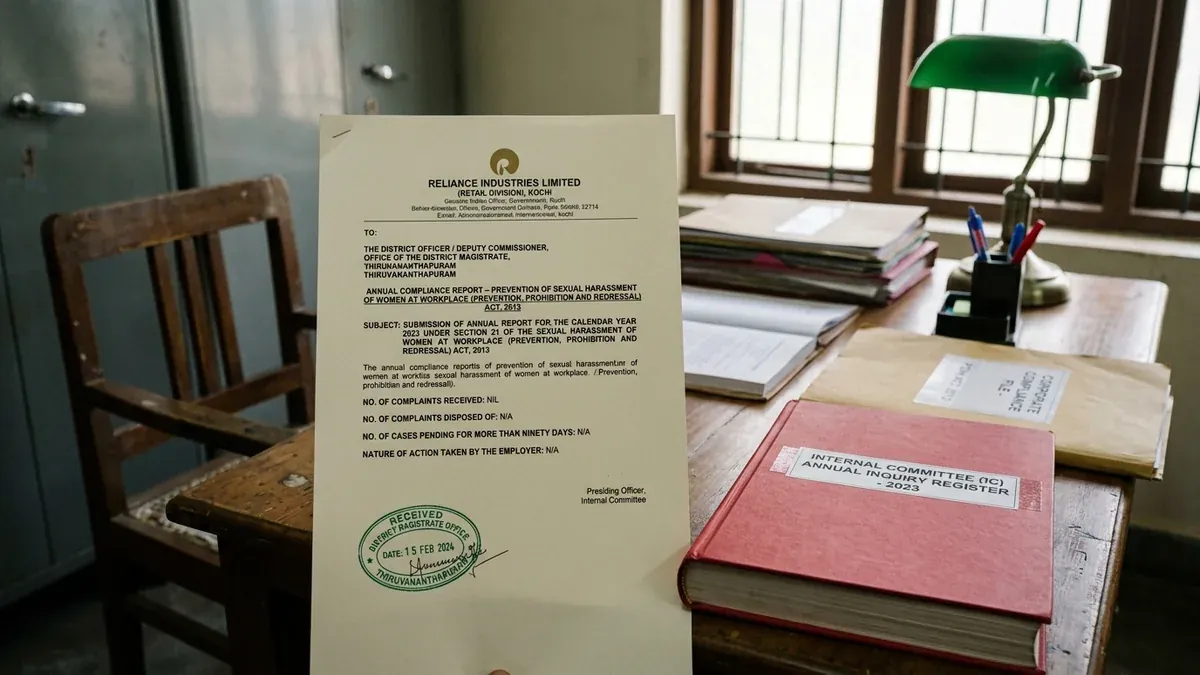
8. Specimen Draft: POSH Annual Compliance Report Format
Below is a standardized statutory format for drafting the Section 21 Annual Report:
ANNUAL REPORT UNDER SECTION 21 OF THE SEXUAL HARASSMENT OF WOMEN AT WORKPLACE (PREVENTION, PROHIBITION AND REDRESSAL) ACT, 2013
FOR THE CALENDAR YEAR ENDED DECEMBER 31, 202X
To:
The District Officer / Deputy Commissioner,
[District Name, e.g., Gurugram / New Delhi / Bengaluru Urban],
[Department of Women & Child Development / Revenue Complex]
From:
The Internal Committee (IC),
[Company / Establishment Name], [Registered Office Address]
1. Constitution of Internal Committee (Section 4):
- Presiding Officer: [Name, Designation, Contact Email]
- Employee Members: [Name 1], [Name 2]
- External Independent Member: [Name, Representing NGO/Legal Expert, Contact]
2. Summary of Complaints & Inquiries (Rule 14):
(a) Total complaints received during calendar year: [Number / Nil]
(b) Complaints disposed of within 90 days: [Number / Nil]
(c) Complaints pending for more than 90 days: [Number / Nil, with reasons]
(d) Conciliation settlements effected under Section 10: [Number / Nil]
(e) Disciplinary actions executed by Employer under Section 13(3): [Details / Nil]
3. Training & Sensitization Programs (Section 19):
- Total employee orientation workshops conducted: [Number]
- Total personnel sensitized: [Number]
- IC member legal training sessions: [Number]
Verification:
We hereby verify that the contents stated above are true, complete, and accurately extracted from the official records maintained by the Internal Committee.
[Signature & Seal]
Presiding Officer External Member
Date: [DD/MM/YYYY] Place: [City]
9. POSH Annual Compliance Comparative Deadlines & Penalty Matrix
The table below summarizes the statutory deadlines, recipients, and legal liabilities governing annual POSH compliances across Indian enterprises:
| Compliance Mechanism | Governing Statute & Rule | Statutory Recipient | Filing Deadline | Consequence of Breach |
|---|---|---|---|---|
| IC Annual Report | Section 21, POSH Act & Rule 14, POSH Rules | District Officer (Deputy Commissioner / Collector) | January 31st (Every Year) | Fine up to ₹50,000; repeat default leads to trade license cancellation. |
| Employer Intimation | Section 22, POSH Act | District Officer / Local Authority | January 31st (Where no annual report is prepared) | Section 26 monetary fine and prosecution of management. |
| Board's Report Disclosure | Rule 8(5)(x), Companies (Accounts) Rules, 2014 | Registrar of Companies (MCA) & Shareholders | Annual Filing (Form AOC-4 post-AGM) | Penalty on Company up to ₹5,00,000; Officer in Default fines up to ₹5,00,000. |
| Internal Committee Constitution | Section 4(1), POSH Act | Workplace Display & Official Website | Immediate upon reaching 10 employees | Invalidity of internal proceedings; writ mandamus by High Court. |
Frequently Asked Questions on POSH Annual Compliance & Section 21 Filings
Comprehensive legal guide to District Officer annual report submissions, Internal Committee metrics, and MCA disclosures.
What is the mandatory statutory deadline for submitting the POSH Annual Report under Section 21?
Under Section 21 of the Sexual Harassment of Women at Workplace (Prevention, Prohibition and Redressal) Act, 2013 read with Rule 14 of the POSH Rules, 2013, the Internal Committee (IC) must prepare and submit its Annual Report to the Employer and the District Officer by or before January 31st of each calendar year for the preceding calendar year (January 1 to December 31). In states like Haryana (Gurugram), Maharashtra (Mumbai), Karnataka (Bengaluru), and the NCT of Delhi, specific district notifications mandate submission via designated online portals or physical receipt before the Women and Child Development (WCD) nodal officer.
What must be included in the POSH Annual Report submitted to the District Officer?
As mandated by Section 21(1) and Rule 14, the annual report must explicitly detail: (1) Total number of sexual harassment complaints received during the year; (2) Total number of complaints disposed of; (3) Number of cases pending resolution for more than 90 days along with explicit reasons for delay; (4) Number of employee awareness workshops and gender-sensitization programs conducted; (5) Number of IC capacity-building orientation sessions held; (6) Nature of disciplinary actions taken by the employer against proven respondents; and (7) Number of complaints declared frivolous or malicious under Section 14.
What are the legal consequences and penalties under Section 26 for non-compliance with POSH filings?
Under Section 26(1) of the POSH Act, failure to constitute an Internal Committee, failure to file the annual report under Section 21, or contravention of statutory rules attracts a monetary fine of up to ₹50,000 upon the employer. Under Section 26(2), a repeat conviction leads to twice the punishment or fine, as well as cancellation, suspension, or non-renewal of the establishment's trade license, factory license, or incorporation registration by the competent government authority.
Does a company with fewer than 10 employees need to file an annual POSH report?
Establishments with fewer than 10 employees are exempt from constituting an Internal Committee under Section 4; complaints from such workplaces are directly handled by the Local Committee (LC) constituted by the District Officer under Section 6. However, under Section 22, every employer—regardless of size—must ensure a safe working environment and cooperate with the District Officer when requested for inquiries or audit inspections.
Is 'Nil Filing' mandatory if no sexual harassment complaints were received during the year?
Yes. The Supreme Court in Aureliano Fernandes v. State of Goa (2023) reiterated that statutory POSH reporting is mandatory regardless of complaint numbers. A 'Nil Report' explicitly declaring zero complaints received, while documenting the constitution of the IC, details of presiding officers and external members, and records of mandatory employee sensitization workshops, must be filed with the District Officer.
What is the role of the External Member in the Internal Committee and report preparation?
Section 4(2)(c) mandates that at least one IC member must be from a non-governmental organization or association committed to the cause of women, or a person familiar with issues relating to sexual harassment. The external member ensures procedural impartiality, prevents institutional bias, and must countersign the inquiry findings and the Section 21 Annual Report.
How does the Board of Directors Report under the Companies Act 2013 incorporate POSH compliance?
Under Rule 8(5)(x) of the Companies (Accounts) Rules, 2014, every company (including private limited entities) must include a mandatory statement in its Board's Report confirming that the company has complied with provisions relating to the constitution of the Internal Committee under the POSH Act, alongside the number of complaints filed, disposed of, and pending at year-end.
What judicial remedies exist if a District Officer issues a show-cause notice for delayed filing?
Upon receipt of a Section 26 show-cause notice, an employer must immediately submit a comprehensive compliance affidavit enclosing retrospective proof of IC constitution, minutes of sensitization workshops, and the verified Annual Report. If arbitrary penal action or license cancellation is threatened without affording natural justice, the employer may approach the jurisdictional High Court under Article 226 for writ intervention.