Agent Signing a Cheque Without Disclosing Agency: Personal Liability Under Section 28 of the NI Act

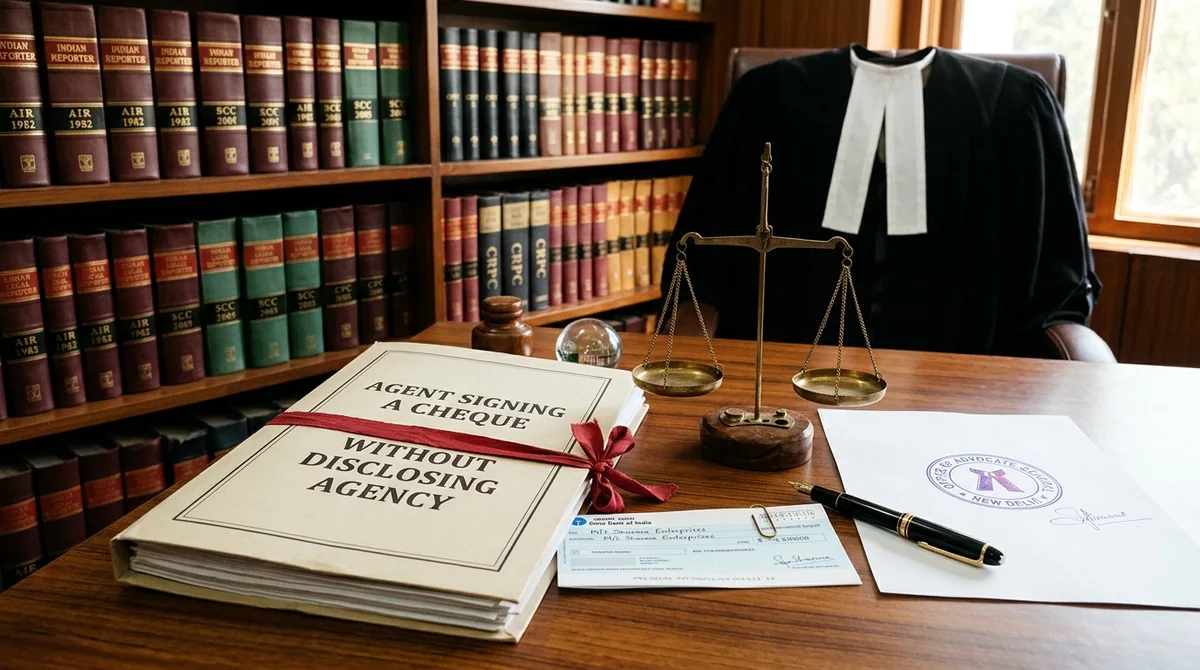
Executive Legal Brief
- Section 28 of the Negotiable Instruments Act, 1881 fastens strict personal liability on any agent, broker, or manager who signs a cheque, bill of exchange, or promissory note without indicating on the instrument itself that they sign as an agent or exclude personal responsibility.
- Describing one's internal authority in a covering letter or pleading an underlying agency contract cannot cure a bare signature on the instrument; extrinsic parol evidence is generally excluded except to prove the narrow statutory inducement exception.
- Section 28 civil liability on an undisclosed agent must be sharply distinguished from corporate vicarious criminal liability under Section 141 NI Act, where the company is the primary drawer maintaining the bank account.
- When an agent or director draws a cheque from their personal bank account for a principal's or company's liability, they become personally liable as the primary drawer under Section 138 without needing to arraign the principal.
Key Statutory Provisions & Regulatory Framework
| Statutory Provision / Doctrine | Legal Operation & Judicial Impact |
|---|---|
| Section 28, NI Act, 1881 | Renders an agent signing a cheque, bill, or pro-note personally liable unless agency capacity or exclusion of personal liability appears on the face of the instrument, subject only to the inducement proviso. |
| Section 27, NI Act, 1881 | Establishes that a principal is bound only by a duly authorized agent acting in the principal's name; general business authority does not automatically confer bill-endorsing power. |
| Section 138 & 141, NI Act, 1881 | Criminal dishonour liability attaches strictly to the drawer maintaining the bank account; corporate signatories face vicarious liability under Section 141 only when the company itself is arraigned as principal accused. |
| Aneeta Hada v. Godfather Travels (2012) 5 SCC 661 & Mainuddin v. Vijay Salvi (2015) 9 SCC 622 | Mandates arraignment of the company for corporate cheques under Section 141, whereas an individual signing a personal cheque for corporate debt is personally liable as drawer under Section 138. |
1. Statutory Text and Commercial Rationale of Section 28 NI Act
Commercial paper circulates as a substitute for currency because subsequent transferees must be able to ascertain the liable parties solely by inspecting the four corners of the instrument. Section 28 of the Negotiable Instruments Act, 1881 codifies this strict doctrine of apparent liability in uncompromising terms:
"An agent who signs his name to a promissory note, bill of exchange or cheque without indicating thereon that he signs as agent, or that he does not intend thereby to incur personal responsibility, is liable personally on the instrument, except to those who induced him to sign upon the belief that the principal only would be held liable."
In everyday Indian commerce, branch managers, commission brokers, procurement agents, power-of-attorney holders, and managing partners frequently sign promissory notes, hundis, or cheques to close urgent supplier settlements. Where the agent simply signs their bare name—or writes a mere descriptive title such as "Manager" or "Broker" without binding the named principal—Section 28 triggers automatic personal liability. Under the rule against varying written instruments by oral testimony (formerly Sections 91 and 92 of the Indian Evidence Act, 1872, now Sections 94 and 95 of the Bharatiya Sakshya Adhiniyam, 2023), a signatory cannot later testify that both parties privately understood the debt belonged solely to an undisclosed principal.
To escape Section 28 personal liability, the face of the instrument must unambiguously disclose representative execution using established commercial formulations:
- Express Agency Attribution: Signing explicitly as "For and on behalf of [Principal Name], Authorised Agent" or using the standard banking notation "Per Procurationem (p.p.) [Principal Name]".
- Express Non-Liability Clause: Adding qualifying words immediately beside or above the signature such as "As agent only, without personal liability".
- Principal's Printed Mandate: Executing a cheque bearing the printed account title and rubber stamp of the principal entity where the signature is visibly affixed strictly in the designated capacity of authorized signatory.
2. The Inducement Exception and Civil Recovery Under Order XXXVII CPC
Section 28 contains one critical statutory safety valve: an agent who forgets to note their representative status on the instrument is still exempt from personal liability "to those who induced him to sign upon the belief that the principal only would be held liable."
In civil summary suits instituted under Order XXXVII of the Code of Civil Procedure, 1908 (CPC) on promissory notes, bills of exchange, or dishonoured cheques, plaintiffs routinely rely on Section 28 to oppose an agent's application for leave to defend. Under the Supreme Court's principles governing leave to defend in IDBI Trusteeship Services Ltd. v. Hubtown Ltd., (2017) 1 SCC 568, a bare denial of personal liability by a signatory whose agency does not appear on the promissory note ordinarily fails as a moonshine defense. However, if the agent produces contemporaneous emails, WhatsApp confirmations, board authorizations, or prior correspondence showing that the creditor actively induced them to sign on an assurance that only the principal would be sued, the defense raises a triable issue under the Section 28 proviso.
Critically, this inducement exception protects the agent only against the inducing party (and transferees taking with notice or after maturity under Section 59). If the promissory note or bill is negotiated before maturity for value to an innocent Holder in Due Course (Section 9), the inducement defense collapses completely under Section 36 and Section 120 of the NI Act, leaving the signing agent personally liable to pay the holder in full.
3. Distinguishing Section 28 Agency Liability From Corporate Section 141 Signing
Litigants frequently conflate civil liability under Section 28 with criminal vicarious liability under Sections 138 and 141 of the NI Act. The statutory architecture treats these two regimes very differently depending on whose bank account the cheque is drawn upon:
- Cheque Drawn on the Company's Account: Under Section 138, the offence is committed only by the person who draws a cheque "on an account maintained by him with a banker." When an authorized signatory or director signs a corporate cheque over the company's stamp, the company is the sole "drawer" (Aparna A. Shah v. Sheth Developers Pvt. Ltd., (2013) 8 SCC 71). The signatory is not personally the drawer under Section 28; instead, criminal liability can attach only vicariously under Section 141. Consequently, as settled by a three-Judge Bench in Aneeta Hada v. Godfather Travels & Tours Pvt. Ltd., (2012) 5 SCC 661, a Section 138 complaint against a signing director or manager is legally non-maintainable unless the company itself is arraigned as an accused.
- Pleading Burden for Vicarious Officers: Under S.M.S. Pharmaceuticals Ltd. v. Neeta Bhalla, (2005) 8 SCC 89 and K.K. Ahuja v. V.K. Vora, (2009) 10 SCC 48, an authorized signatory who signs a corporate cheque is generally presumed to fall within Section 141(2) if consent, connivance, or neglect is pleaded, whereas non-signing directors require specific averments establishing that they were in charge of and responsible for the conduct of the company's business at the time of the offence (Susela Padmavathy Amma v. M/s Bharti Airtel Ltd., 2024 SCC OnLine SC 311).
- Cheque Drawn on Agent's Personal Account for Principal's Debt: Conversely, if a director, broker, or branch manager signs a cheque drawn on their own personal bank account to discharge a debt owed by their company or client, Section 141 does not apply at all. In Mainuddin Abdul Sattar Shaikh v. Vijay D. Salvi, (2015) 9 SCC 622, the Supreme Court held that an individual who draws a cheque on his personal account to satisfy a company's liability is personally liable as the drawer under Section 138—even if the company is never arrayed as an accused—because Section 138 encompasses "any debt or other liability" (ICDS Ltd. v. Beena Shabeer, (2002) 6 SCC 426).
4. Litigation Strategy: Challenging or Enforcing Agent Signatures in Court
Whether prosecuting a recovery action or defending an employee or broker ensnared in cheque bounce litigation, counsel must separate criminal maintainability from civil instrument liability at the threshold:
- Inspect the Account Mandate and Stamp: In criminal Section 138 complaints, obtain the dishonour memo and account opening form/banker's witness record under Section 146 NI Act. If the account stands in the principal's or firm's name and the complaint omits the principal entity, file for quashing under Section 482 CrPC / Section 528 BNSS citing Aneeta Hada and Himanshu v. B. Shivamurthy, (2019) 3 SCC 797.
- Verify Section 27 Authority in Civil Suits: Section 27 warns that a general authority to transact business and receive debts does not by itself confer authority on an agent to accept or indorse bills of exchange so as to bind the principal. A creditor suing a principal on an agent-signed note must prove express power of attorney or board authorization (A.C. Narayanan v. State of Maharashtra, (2014) 11 SCC 790), whereas if the agent lacked authority, the creditor can immediately pivot to Section 28 to hold the agent personally liable.
- Preserve Inducement Evidence Before Trial: Any agent asked to sign a personal promissory note or undated guarantee cheque as a comfort instrument for an employer or client must retain written confirmation (emails, board minutes, or covering letters) acknowledging that only the principal is liable, preserving the Section 28 inducement exception for civil recovery proceedings.
Disclaimer: This article is published strictly for academic and educational purposes under the Advocates Act, 1961. It does not constitute formal legal advice, solicitation, or advertisement under Rule 36 of the Bar Council of India Rules, nor does it create an advocate-client relationship. For case-specific legal counsel, readers should consult an independent advocate.
Frequently Asked Questions
Does writing my designation like "Branch Manager" next to my signature protect me under Section 28 NI Act?
No. Mere words of description (descriptio personae) such as "Manager", "Director", or "Broker" placed after a signature on a promissory note or cheque do not suffice to exclude personal liability under Section 28. You must expressly state on the instrument that you are signing for and on behalf of the named principal or without personal liability.
Can an authorized signatory who signed a company cheque be prosecuted personally under Section 138 without making the company an accused?
No. If the cheque was drawn on the company's bank account, the company is the drawer. Under Aneeta Hada v. Godfather Travels (2012) 5 SCC 661, prosecuting the signatory alone without arraigning the company is impermissible, unless legal impossibility such as company dissolution intervened before trial.
What happens if a director or agent issues a cheque from their personal bank account to settle the company's dues?
They incur direct personal liability under both Section 28 and Section 138 NI Act. As ruled in Mainuddin Abdul Sattar Shaikh v. Vijay D. Salvi (2015) 9 SCC 622, the statutory expression "any debt or other liability" covers a company's debt discharged via an individual's personal cheque, without requiring arraignment of the company.
When can an agent use the inducement exception under Section 28?
An agent can defeat personal liability against the immediate payee in a civil suit if they establish through clear documentary or circumstantial proof that the payee expressly induced them to sign the note or cheque on the representation that only the principal would be pursued. However, this exception does not avail against a subsequent Holder in Due Course.

Advocate Kishan Kumar
Criminal, Civil & Recovery Advocate • Bar Council of Delhi